Survey of Definition and Determination • 2

In the early 1990s, “in the middle of life’s journey” as the saying goes, I returned to grad school in a systems engineering program with the idea of taking a more systems-theoretic approach to my development of Peircean themes, from signs and scientific inquiry to logic and information theory.

Two of the first questions calling for fresh examination were the closely related concepts of definition and determination, not only as Peirce used them in his logic and semiotics but as researchers in areas as diverse as computer science, cybernetics, physics, and systems science would find themselves forced to reconsider the concepts in later years.  That led me to collect a sample of texts where Peirce and a few other writers discuss the issues of definition and determination.  There are copies of those selections at the following sites.

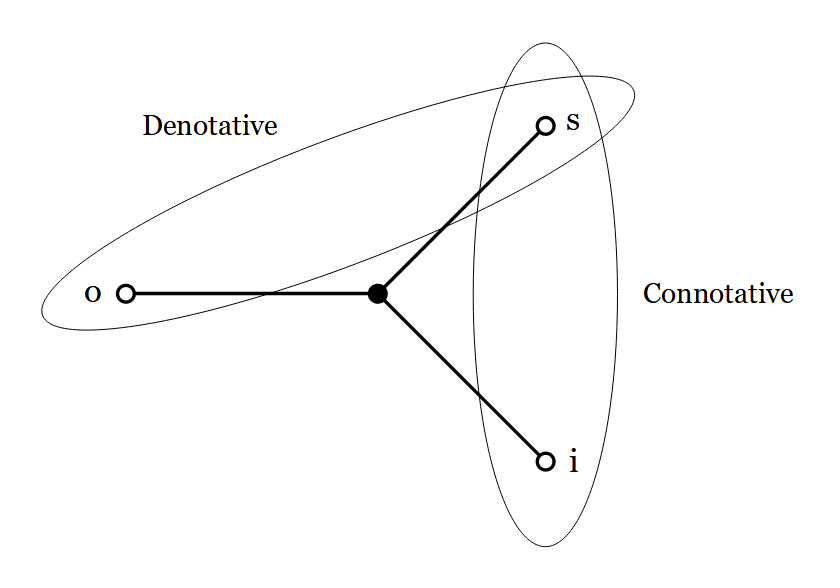
What follows is a Survey of blog and wiki posts on Definition and Determination, with a focus on the part they play in Peirce’s interlinked theories of signs, information, and inquiry.  In classical logical traditions the concepts of definition and determination are closely related and their bond acquires all the more force when we view the overarching concept of constraint from an information-theoretic point of view, as Peirce did beginning in the 1860s.

Blog Dialogs

cc: FB | Inquiry Driven SystemsLaws of FormMathstodonOntologAcademia.edu
cc: Conceptual GraphsCyberneticsStructural ModelingSystems Science
cc: W3 | RDF Surfaces

Posted in C.S. Peirce, Comprehension, Constraint, Definition, Determination, Extension, Form, Indication, Information = Comprehension × Extension, Inquiry, Intension, Logic, Logic of Science, Mathematics, Peirce, Semiotics, Structure | Tagged , , , , , , , , , , , , , , , , | Leave a comment

Survey of Semiotics, Semiosis, Sign Relations • 4

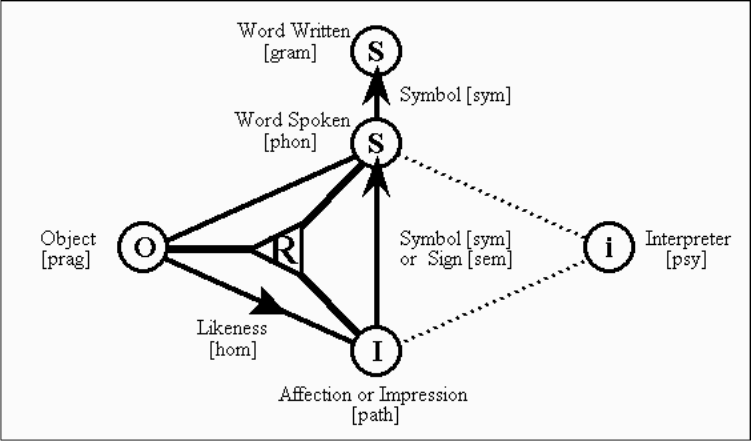
C.S. Peirce defines logic as “formal semiotic”, using formal to highlight the place of logic as a normative science, over and above the descriptive study of signs and their role in wider fields of play.  Understanding logic as Peirce understands it thus requires a companion study of semiotics, semiosis, and sign relations.

What follows is a Survey of blog and wiki resources on the theory of signs, variously known as semeiotic or semiotics, and the actions referred to as semiosis which transform signs among themselves in relation to their objects, all as based on C.S. Peirce’s concept of triadic sign relations.

Elements

Sources

Blog Series

  • Semiositis • (1)
  • Signspiel • (1)
  • C.S. Peirce • Algebra of Logic ∫ Philosophy of Notation • (1)(2)

Blog Dialogs

References

  • Awbrey, S.M., and Awbrey, J.L. (2001), “Conceptual Barriers to Creating Integrative Universities”, Organization : The Interdisciplinary Journal of Organization, Theory, and Society 8(2), Sage Publications, London, UK, 269–284.  AbstractOnline.
  • Awbrey, S.M., and Awbrey, J.L. (September 1999), “Organizations of Learning or Learning Organizations : The Challenge of Creating Integrative Universities for the Next Century”, Second International Conference of the Journal ‘Organization’, Re‑Organizing Knowledge, Trans‑Forming Institutions : Knowing, Knowledge, and the University in the 21st Century, University of Massachusetts, Amherst, MA.  Online.
  • Awbrey, J.L., and Awbrey, S.M. (1995), “Interpretation as Action : The Risk of Inquiry”, Inquiry : Critical Thinking Across the Disciplines 15(1), 40–52.  ArchiveJournal.  Online (doc) (pdf).
  • Awbrey, J.L., and Awbrey, S.M. (1992), “Interpretation as Action : The Risk of Inquiry”, The Eleventh International Human Science Research Conference, Oakland University, Rochester, Michigan.

cc: FB | SemeioticsLaws of FormMathstodonOntologAcademia.edu
cc: Conceptual GraphsCyberneticsStructural ModelingSystems Science
cc: W3 | RDF Surfaces

Posted in C.S. Peirce, Inquiry, Logic, Mathematics, Relation Theory, Semiosis, Semiotics, Sign Relations, Triadicity | Tagged , , , , , , , , | 1 Comment

Survey of Pragmatic Semiotic Information • 6

This is a Survey of blog and wiki posts on a theory of information which grows out of pragmatic semiotic ideas.  All my projects are exploratory in character but this line of inquiry is more open‑ended than most.  The question is —

What is information and how does it impact the spectrum of activities answering to the name of inquiry?

Setting out on what would become his lifelong quest to explore and explain the “Logic of Science”, C.S. Peirce pierced the veil of historical confusions obscuring the issue and fixed on what he called the “laws of information” as the key to solving the puzzle.

The first hints of the Information Revolution in our understanding of scientific inquiry may be traced to Peirce’s lectures of 1865–1866 at Harvard University and the Lowell Institute.  There Peirce took up “the puzzle of the validity of scientific inference” and claimed it was “entirely removed by a consideration of the laws of information”.

Fast forward to the present and I see the Big Question as follows.  Having gone through the exercise of comparing and contrasting Peirce’s theory of information, however much it yet remains in a rough‑hewn state, with Shannon’s paradigm so pervasively informing the ongoing revolution in our understanding and use of information, I have reason to believe Peirce’s idea is root and branch more general and has the potential, with due development, to resolve many mysteries still bedeviling our grasp of inference, information, and inquiry.

Inference, Information, Inquiry

Pragmatic Semiotic Information

Semiotics, Semiosis, Sign Relations

Sign Relations, Triadic Relations, Relation Theory

  • Blog Series • (1)
    • Discusssions • (1)(2)

Excursions

Blog Dialogs

References

  • Peirce, C.S. (1867), “Upon Logical Comprehension and Extension”.  Online.
  • Awbrey, J.L., and Awbrey, S.M. (1992), “Interpretation as Action : The Risk of Inquiry”, The Eleventh International Human Science Research Conference, Oakland University, Rochester, Michigan.
  • Awbrey, J.L., and Awbrey, S.M. (1995), “Interpretation as Action : The Risk of Inquiry”, Inquiry : Critical Thinking Across the Disciplines 15(1), pp. 40–52.  ArchiveJournalOnline.

cc: FB | SemeioticsLaws of FormMathstodonOntologAcademia.edu
cc: Conceptual GraphsCyberneticsStructural ModelingSystems Science

Posted in Abduction, C.S. Peirce, Communication, Control, Cybernetics, Deduction, Determination, Discovery, Doubt, Epistemology, Fixation of Belief, Induction, Information, Information = Comprehension × Extension, Information Theory, Inquiry, Inquiry Driven Systems, Inquiry Into Inquiry, Interpretation, Invention, Knowledge, Learning Theory, Logic, Logic of Relatives, Logic of Science, Mathematics, Peirce, Philosophy, Philosophy of Science, Pragmatic Information, Probable Reasoning, Process Thinking, Relation Theory, Scientific Inquiry, Scientific Method, Semeiosis, Semiosis, Semiotic Information, Semiotics, Sign Relational Manifolds, Sign Relations, Surveys, Triadic Relations, Uncertainty | Tagged , , , , , , , , , , , , , , , , , , , , , , , , , , , , , , , , , , , , , , , , , , , | 4 Comments

Survey of Precursors Of Category Theory • 3

A few years ago I began a sketch on the “Precursors of Category Theory”, tracing the continuities of the category concept from Aristotle, to Kant and Peirce, through Hilbert and Ackermann, to contemporary mathematical practice.  A Survey of resources on the topic is given below, still very rough and incomplete, but perhaps a few will find it of use.

Background

Blog Series

  • Notes On Categories • (1)
  • Precursors Of Category Theory • (1)(2)(3)

Categories à la Peirce

cc: FB | Peirce MattersLaws of FormMathstodonOntologAcademia.edu
cc: Conceptual GraphsCyberneticsStructural ModelingSystems Science

Posted in Abstraction, Ackermann, Analogy, Aristotle, C.S. Peirce, Carnap, Category Theory, Diagrams, Foundations of Mathematics, Functional Logic, Hilbert, History of Mathematics, Hypostatic Abstraction, Kant, Logic, Mathematics, Peirce, Propositions As Types Analogy, Relation Theory, Saunders Mac Lane, Semiotics, Type Theory, Universals | Tagged , , , , , , , , , , , , , , , , , , , , , , | Leave a comment

Survey of Abduction, Deduction, Induction, Analogy, Inquiry • 3

This is a Survey of blog and wiki posts on three elementary forms of inference, as recognized by a logical tradition extending from Aristotle through Charles S. Peirce.  Particular attention is paid to the way these inferential rudiments combine to form the more complex patterns of analogy and inquiry.

Blog Dialogs

Blog Series

Blog Surveys

OEIS Wiki

Ontolog Forum

cc: FB | Inquiry Driven SystemsLaws of FormMathstodonOntologAcademia.edu
cc: Conceptual GraphsCyberneticsStructural ModelingSystems Science

Posted in Abduction, Aristotle, C.S. Peirce, Deduction, Dewey, Discovery, Doubt, Fixation of Belief, Functional Logic, Icon Index Symbol, Induction, Inference, Information, Inquiry, Invention, Logic, Logic of Science, Mathematics, Morphism, Paradigmata, Paradigms, Pattern Recognition, Peirce, Philosophy, Pragmatic Maxim, Pragmatism, Scientific Inquiry, Scientific Method, Semiotics, Sign Relations, Surveys, Syllogism, Triadic Relations, Visualization | Tagged , , , , , , , , , , , , , , , , , , , , , , , , , , , , , , , , , | 4 Comments

Survey of Relation Theory • 6

In this Survey of blog and wiki posts on Relation Theory, relations are viewed from the perspective of combinatorics, in other words, as a topic in discrete mathematics, with special attention to finite structures and concrete set‑theoretic constructions, many of which arise quite naturally in applications.  This approach to relation theory is distinct from, though closely related to, its study from the perspectives of abstract algebra on the one hand and formal logic on the other.

Elements

Relational Concepts

Relation Construction Relation Composition Relation Reduction
Relative Term Sign Relation Triadic Relation
Logic of Relatives Hypostatic Abstraction Continuous Predicate

Illustrations

Information‑Theoretic Perspective

  • Mathematical Demonstration and the Doctrine of Individuals • (1)(2)

Blog Series

Peirce’s 1870 “Logic of Relatives”

Peirce’s 1880 “Algebra of Logic” Chapter 3

Resources

cc: FB | Relation TheoryLaws of FormMathstodonOntologAcademia.edu
cc: Conceptual GraphsCyberneticsStructural ModelingSystems Science
cc: W3 | RDF Surfaces

Posted in Algebra, Algebra of Logic, C.S. Peirce, Category Theory, Combinatorics, Discrete Mathematics, Duality, Dyadic Relations, Foundations of Mathematics, Graph Theory, Logic, Logic of Relatives, Mathematics, Peirce, Relation Theory, Semiotics, Set Theory, Sign Relational Manifolds, Sign Relations, Surveys, Triadic Relations, Triadicity, Type Theory | Tagged , , , , , , , , , , , , , , , , , , , , , , | 2 Comments

Survey of Theme One Program • 5

This is a Survey of blog and wiki posts relating to the Theme One Program I worked on all through the 1980s.  The aim was to develop fundamental algorithms and data structures for integrating empirical learning with logical reasoning.  I had earlier developed separate programs for basic components of those tasks, namely, 2-level formal language learning and propositional constraint satisfaction, the latter using an extension of C.S. Peirce’s logical graphs as a syntax for propositional logic.  Thus arose the question of how well it might be possible to get “empiricist” and “rationalist” modes of operation to cooperate.  The long-term vision is the design and implementation of an Automated Research Tool able to double as a platform for Inquiry Driven Education.

Wiki Hub

Documentation

Blog Series

Blog Dialogs

Applications

References

  • Awbrey, S.M., and Awbrey, J.L. (May 1991), “An Architecture for Inquiry • Building Computer Platforms for Discovery”, Proceedings of the Eighth International Conference on Technology and Education, Toronto, Canada, pp. 874–875.  Online.
  • Awbrey, J.L., and Awbrey, S.M. (January 1991), “Exploring Research Data Interactively • Developing a Computer Architecture for Inquiry”, Poster presented at the Annual Sigma Xi Research Forum, University of Texas Medical Branch, Galveston, TX.
  • Awbrey, J.L., and Awbrey, S.M. (August 1990), “Exploring Research Data Interactively • Theme One : A Program of Inquiry”, Proceedings of the Sixth Annual Conference on Applications of Artificial Intelligence and CD-ROM in Education and Training, Society for Applied Learning Technology, Washington, DC, pp. 9–15.  Online.

cc: FB | Theme One ProgramLaws of FormMathstodonOntologAcademia.edu
cc: Conceptual GraphsCyberneticsStructural ModelingSystems Science
cc: W3 | RDF Surfaces

Posted in Algorithms, Animata, Artificial Intelligence, Boolean Functions, C.S. Peirce, Cactus Graphs, Cognition, Computation, Constraint Satisfaction Problems, Data Structures, Differential Logic, Equational Inference, Formal Languages, Graph Theory, Inquiry Driven Systems, Laws of Form, Learning Theory, Logic, Logical Graphs, Mathematics, Minimal Negation Operators, Painted Cacti, Peirce, Propositional Calculus, Semiotics, Spencer Brown, Visualization | Tagged , , , , , , , , , , , , , , , , , , , , , , , , , , | 5 Comments

Survey of Animated Logical Graphs • 5

This is a Survey of blog and wiki posts on Logical Graphs, encompassing several families of graph-theoretic structures originally developed by Charles S. Peirce as graphical formal languages or visual styles of syntax amenable to interpretation for logical applications.

Beginnings

Elements

Examples

Excursions

Applications

Blog Series

  • Logical Graphs, Iconicity, Interpretation • (1)(2)
  • Genus, Species, Pie Charts, Radio Buttons • (1)

Anamnesis

cc: FB | Logical GraphsLaws of FormMathstodonOntologAcademia.edu
cc: Conceptual GraphsCyberneticsStructural ModelingSystems Science
cc: W3 | RDF Surfaces

Posted in Amphecks, Animata, Boolean Algebra, Boolean Functions, C.S. Peirce, Cactus Graphs, Computational Complexity, Constraint Satisfaction Problems, Differential Logic, Equational Inference, Graph Theory, Laws of Form, Logic, Logical Graphs, Mathematics, Minimal Negation Operators, Model Theory, Painted Cacti, Peirce, Proof Theory, Propositional Calculus, Propositional Equation Reasoning Systems, Spencer Brown, Theorem Proving, Visualization | Tagged , , , , , , , , , , , , , , , , , , , , , , , , | Leave a comment

Differential Logic and Dynamic Systems • Overview

In modeling intelligent systems, whether we are trying to understand a natural system or engineer an artificial system, there has long been a tension or trade‑off between dynamic paradigms and symbolic paradigms.  Dynamic models take their cue from physics, using quantitative measures and differential equations to model the evolution of a system’s state through time.  Symbolic models use logical methods to describe systems and their agents in qualitative terms, deriving logical consequences of a system’s description or an agent’s state of information.  Logic‑based systems have tended to be static in character, largely because we have lacked a proper logical analogue of differential calculus.  The work laid out in this report is intended to address that lack.

This article develops a differential extension of propositional calculus and applies it to the analysis of dynamic systems whose states are described in qualitative logical terms.  The work pursued here is coordinated with a parallel application focusing on neural network systems but the dependencies are arranged to make the present article the main and the more self‑contained work, to serve as a conceptual frame and a technical background for the network project.

Part 1

Review and Transition

A Functional Conception of Propositional Calculus

Qualitative Logic and Quantitative Analogy

Philosophy of Notation : Formal Terms and Flexible Types

Special Classes of Propositions

Basis Relativity and Type Ambiguity

The Analogy Between Real and Boolean Types

Theory of Control and Control of Theory

Propositions as Types and Higher Order Types

Reality at the Threshold of Logic

Tables of Propositional Forms

A Differential Extension of Propositional Calculus

Differential Propositions : Qualitative Analogues of Differential Equations

An Interlude on the Path

The Extended Universe of Discourse

Intentional Propositions

Life on Easy Street

Part 2

Back to the Beginning : Exemplary Universes

A One-Dimensional Universe

Example 1. A Square Rigging

Back to the Feature

Tacit Extensions

Example 2. Drives and Their Vicissitudes

Part 3

Transformations of Discourse

Foreshadowing Transformations : Extensions and Projections of Discourse

Extension from 1 to 2 Dimensions

Extension from 2 to 4 Dimensions

Thematization of Functions : And a Declaration of Independence for Variables

Thematization : Venn Diagrams

Thematization : Truth Tables

Propositional Transformations

Alias and Alibi Transformations

Transformations of General Type

Analytic Expansions : Operators and Functors

Operators on Propositions and Transformations

Differential Analysis of Propositions and Transformations

The Secant Operator : E
The Radius Operator : e
The Phantom of the Operators : η
The Chord Operator : D
The Tangent Operator : T

Part 4

Transformations of Discourse (cont.)

Transformations of Type B² → B¹

Analytic Expansion of Conjunction

Tacit Extension of Conjunction
Enlargement Map of Conjunction
Digression : Reflection on Use and Mention
Difference Map of Conjunction
Differential of Conjunction
Remainder of Conjunction
Summary of Conjunction

Analytic Series : Coordinate Method

Analytic Series : Recap

Terminological Interlude

End of Perfunctory Chatter : Time to Roll the Clip!

Operator Maps : Areal Views
Operator Maps : Box Views
Operator Diagrams for the Conjunction J = uv

Part 5

Transformations of Discourse (concl.)

Taking Aim at Higher Dimensional Targets

Transformations of Type B² → B²

Logical Transformations

Local Transformations

Difference Operators and Tangent Functors

Epilogue, Enchoiry, Exodus

Appendices

Appendices

Appendix 1. Propositional Forms and Differential Expansions

Table A1. Propositional Forms on Two Variables

Table A2. Propositional Forms on Two Variables

Table A3. Ef Expanded Over Differential Features

Table A4. Df Expanded Over Differential Features

Table A5. Ef Expanded Over Ordinary Features

Table A6. Df Expanded Over Ordinary Features

Appendix 2. Differential Forms

Table A7. Differential Forms Expanded on a Logical Basis

Table A8. Differential Forms Expanded on an Algebraic Basis

Table A9. Tangent Proposition as Pointwise Linear Approximation

Table A10. Taylor Series Expansion Df = df + d²f

Table A11. Partial Differentials and Relative Differentials

Table A12. Detail of Calculation for the Difference Map

Appendix 3. Computational Details

Operator Maps for the Logical Conjunction f8(u, v)

Computation of εf8
Computation of Ef8
Computation of Df8
Computation of df8
Computation of rf8
Computation Summary for Conjunction

Operator Maps for the Logical Equality f9(u, v)

Computation of εf9
Computation of Ef9
Computation of Df9
Computation of df9
Computation of rf9
Computation Summary for Equality

Operator Maps for the Logical Implication f11(u, v)

Computation of εf11
Computation of Ef11
Computation of Df11
Computation of df11
Computation of rf11
Computation Summary for Implication

Operator Maps for the Logical Disjunction f14(u, v)

Computation of εf14
Computation of Ef14
Computation of Df14
Computation of df14
Computation of rf14
Computation Summary for Disjunction

Appendix 4. Source Materials

Appendix 5. Various Definitions of the Tangent Vector

References

References

Works Cited

Works Consulted

Incidental Works

Document History

Document History

cc: FB | Differential LogicLaws of FormMathstodonOntologAcademia.edu
cc: Conceptual GraphsCyberneticsStructural ModelingSystems Science

Posted in Amphecks, Boolean Functions, C.S. Peirce, Cactus Graphs, Category Theory, Change, Computational Complexity, Cybernetics, Differential Analytic Turing Automata, Differential Calculus, Differential Logic, Discrete Dynamics, Dynamical Systems, Equational Inference, Functional Logic, Gradient Descent, Graph Theory, Group Theory, Hologrammautomaton, Indicator Functions, Logic, Logical Graphs, Mathematical Models, Mathematics, Minimal Negation Operators, Painted Cacti, Peirce, Propositional Calculus, Propositional Equation Reasoning Systems, Time, Visualization | Tagged , , , , , , , , , , , , , , , , , , , , , , , , , , , , , , | 6 Comments

In the Way of Inquiry • Objections to Reflexive Inquiry

Inquiry begins when an automatic routine or normal course of activity is interrupted and agents are thrown into doubt concerning what is best to do next and what is really true of their situation.  If this interruptive aspect of inquiry applies at the level of self-application then occasions for inquiry into inquiry arise when an ongoing inquiry into any subject becomes obstructed and agents are obliged to initiate a new order of inquiry in order to overcome the obstacle.

At such moments agents need the ability to pause and reflect — to accept the interruption of the inquiry in progress, to acknowledge the higher order of uncertainty obstructing the current investigation, and finally to examine accepted conventions and prior convictions regarding the conduct of inquiry in general.  The next order of inquiry requires agents to articulate the assumptions embodied in previous inquiries, to consider their practical effects in light of their objective intents, and to reconstruct forms of conduct which formerly proceeded through their paces untroubled by any articulate concern.

Our agent of inquiry is brought to the threshold of two questions:

  • What actions are available to achieve the aims of the present activity?
  • What assumptions already accepted are advisable to amend or abandon?

The inquirer is faced in the object of inquiry with an obstinately oppositional state of affairs, a character marked by the Greek word pragma for object, whose manifold of senses and derivatives includes among its connotations the ideas of purposeful objectives and problematic objections, and not too incidentally both inquiries and expositions.

An episode of inquiry bears the stamp of an interlude — it begins and ends in medias res with respect to actions and circumstances neither fixed nor fully known.  As easy as it may be to overlook the contingent character of the inquiry process it’s just as essential to observe a couple of its consequences:

First, it means genuine inquiry does not touch on the inciting action at points of total doubt or absolute certainty.  An incident of inquiry does not begin or end in absolute totalities but only in the differential and relative measures which actually occasion its departures and resolutions.

Inquiry as a process does not demand absolutely secure foundations from which to set out or any “place to stand” from which to examine the balance of onrushing events.  It needs no more than it does in fact have at the outset — assumptions not in practice doubted just a moment before and a circumstance of conflict that will force the whole situation to be reviewed before returning to the normal course of affairs.

Second, the interruptive character or escapist interpretation of inquiry is especially significant when contemplating programs of inquiry with recursive definitions, as the motivating case of inquiry into inquiry.  It means the termination criterion for an inquiry subprocess is whatever allows continuation of the calling process.

Resource

cc: FB | Inquiry Driven SystemsLaws of FormMathstodon • Academia.edu (1) (2) (3)
cc: Conceptual GraphsCyberneticsStructural ModelingSystems Science

Posted in Animata, C.S. Peirce, Inquiry, Inquiry Driven Systems, Inquiry Into Inquiry, Intelligent Systems, Semiotics | Tagged , , , , , , | 4 Comments