
This is a Survey of blog and wiki posts on a theory of information which grows out of pragmatic semiotic ideas. All my projects are exploratory in character but this line of inquiry is more open‑ended than most. The question is —
What is information and how does it impact the spectrum of activities answering to the name of inquiry?
Setting out on what would become his lifelong quest to explore and explain the “Logic of Science”, C.S. Peirce pierced the veil of historical confusions obscuring the issue and fixed on what he called the “laws of information” as the key to solving the puzzle.
The first hints of the Information Revolution in our understanding of scientific inquiry may be traced to Peirce’s lectures of 1865–1866 at Harvard University and the Lowell Institute. There Peirce took up “the puzzle of the validity of scientific inference” and claimed it was “entirely removed by a consideration of the laws of information”.
Fast forward to the present and I see the Big Question as follows. Having gone through the exercise of comparing and contrasting Peirce’s theory of information, however much it yet remains in a rough‑hewn state, with Shannon’s paradigm so pervasively informing the ongoing revolution in our understanding and use of information, I have reason to believe Peirce’s idea is root and branch more general and has the potential, with due development, to resolve many mysteries still bedeviling our grasp of inference, information, and inquiry.
Inference, Information, Inquiry
- OEIS Wiki • Information = Comprehension × Extension
- Blog Series • { Information = Comprehension × Extension }
- Blog Series • { Information = Comprehension × Extension } • Revisited
Pragmatic Semiotic Information
Semiotics, Semiosis, Sign Relations
- Semeiotic • OEIS Wiki • Wikiversity
- Blog Series • (1) • (2) • (3) • (4) • (5) • (6) • (7) • (8) • (9)
Sign Relations, Triadic Relations, Relation Theory
Excursions
Blog Dialogs
- Semiotic Theory Of Information • (1) • (2) • (3) • (4) • (5) • (6)
- Icon Index Symbol • (1) • (2) • (3) • (4) • (5) • (6) • (7) • (8) • (9) • (10) • (11) • (12) • (13) • (14) • (15) • (16) • (17)
- Sign Relations • (1) • (2) • (3) • (4) • (5) • (6) • (7) • (8) • (9) • (10) • (11) • (12)
- Sign Relations, Triadic Relations, Relations • (1) • (2) • (3) • (4) • (5) • (6) • (7) • (8) • (9) • (10) • (11)
References
- Peirce, C.S. (1867), “Upon Logical Comprehension and Extension”. Online.
- Awbrey, J.L., and Awbrey, S.M. (1992), “Interpretation as Action : The Risk of Inquiry”, The Eleventh International Human Science Research Conference, Oakland University, Rochester, Michigan.
- Awbrey, J.L., and Awbrey, S.M. (1995), “Interpretation as Action : The Risk of Inquiry”, Inquiry : Critical Thinking Across the Disciplines 15(1), pp. 40–52. Archive. Journal. Online.
cc: FB | Semeiotics • Laws of Form • Mathstodon • Ontolog • Academia.edu
cc: Conceptual Graphs • Cybernetics • Structural Modeling • Systems Science
 whenever I ran across it. I suppose that small arc of revolution had been building for years but it struck me as crossing a threshold to a more explicit, self‑conscious stage about that time.
 called the umpire operator, which takes 1, 2, or 3 propositions as arguments and returns a single truth value as the result. Operators with optional numbers of arguments are called
  in that form gives the following formula.
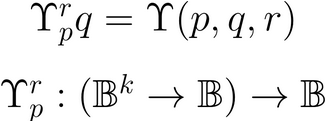
 evaluates the proposition
  on each model of the proposition
  and combines the results according to the method indicated by the connective parameter
  In principle, the index
  may specify any logical connective on as many as
  arguments but in practice we usually have a much simpler form of combination in mind, typically either products or sums. By convention, each of the accessory indices
  is assigned a default value understood to be in force when the corresponding argument place is left blank, specifically, the constant proposition
  for the lower index
  for the upper index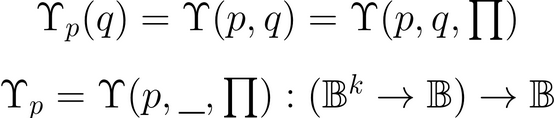
 if and only if
  In propositional terms, this is tantamount to the assertion that
  or that
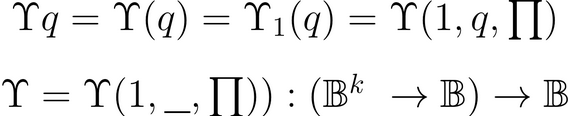
 if and only if
  The ambiguities of this usage are not a problem so long as we distinguish the context of definition from the context of application and restrict all shorthand notations to the latter.
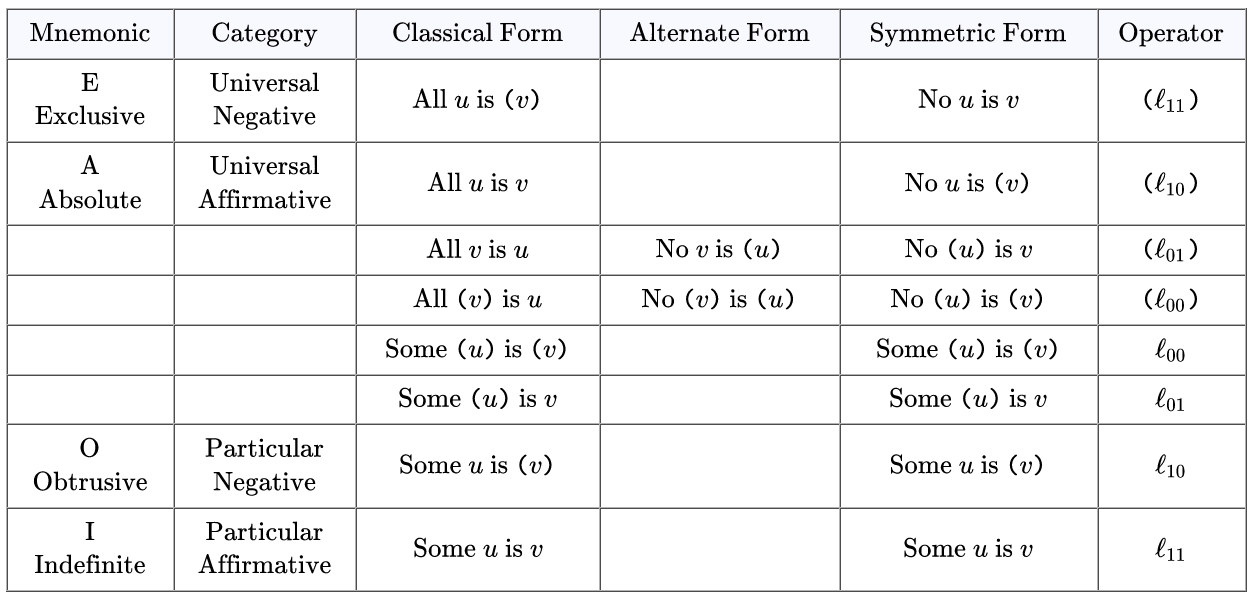

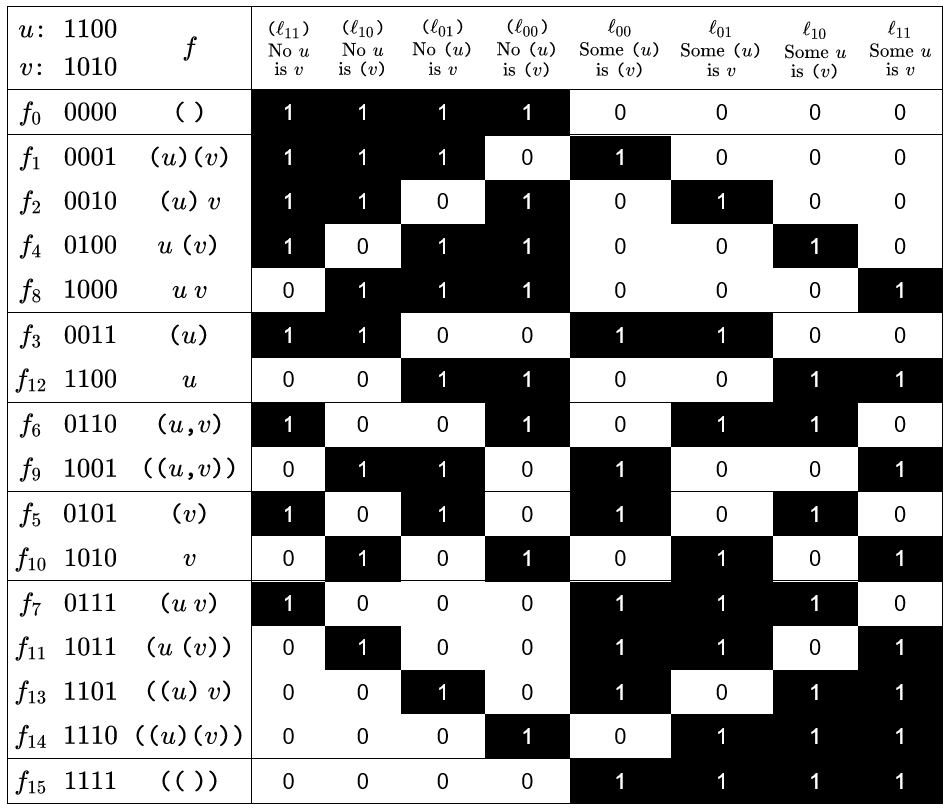

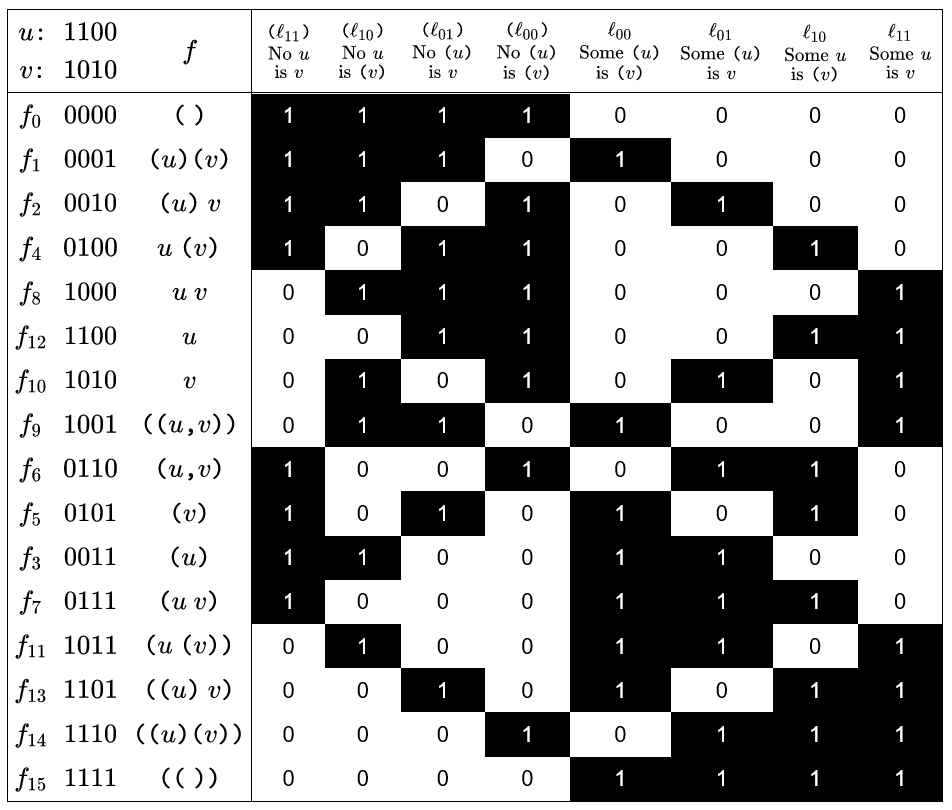

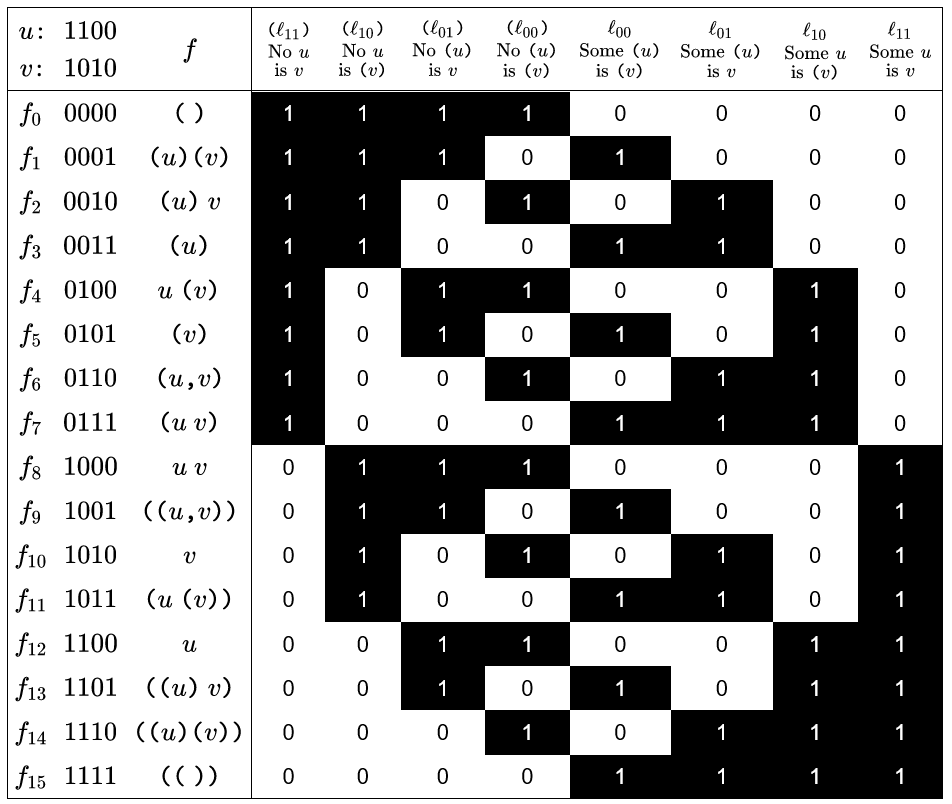
 where
where  is a pair of values indicating whether anything exists in the cells of the underlying universe of discourse. As usual, we won’t be too picky about the coding of those functions, reverting to binary codes whenever the intended interpretation is clear enough.
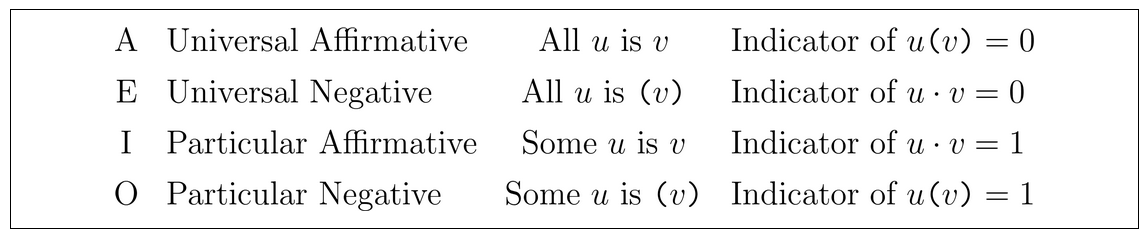
![X^\bullet = [u, v].](https://s0.wp.com/latex.php?latex=X%5E%5Cbullet+%3D+%5Bu%2C+v%5D.&bg=ffffff&fg=000000&s=0&c=20201002) A bridge between propositions and quantifications is afforded by a set of measures or qualifiers
A bridge between propositions and quantifications is afforded by a set of measures or qualifiers  defined by the following equations.
 namely, which elements in the space of type
  are assigned a positive value by
  Taken together, the
  operators give us a way to express many useful observations about the propositions in
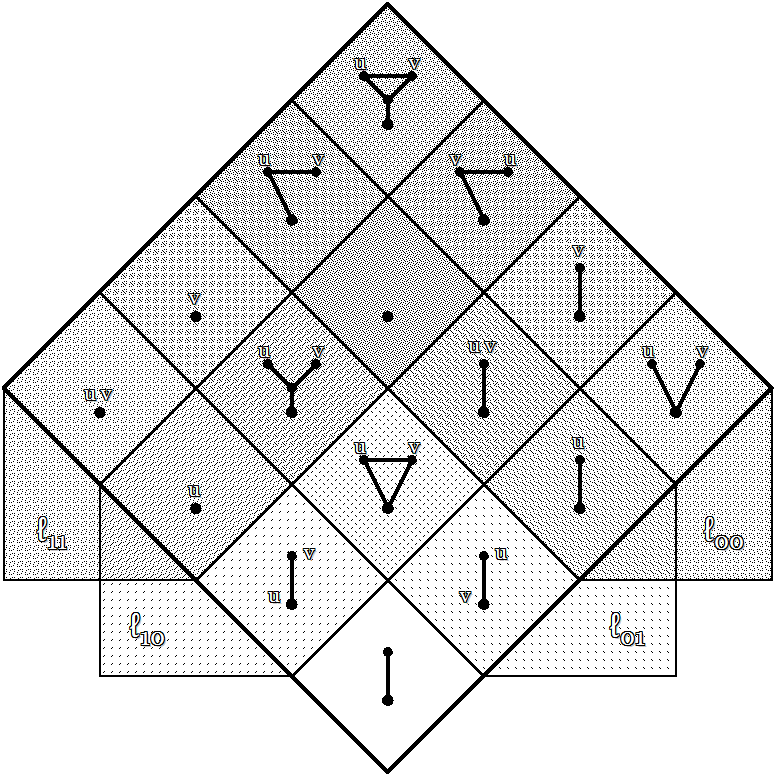
![\text{Figure 16. Higher Order Universe of Discourse}~ [ \ell_{00}, \ell_{01}, \ell_{10}, \ell_{11} ] \subseteq [[ u, v ]]](https://s0.wp.com/latex.php?latex=%5Ctext%7BFigure+16.+Higher+Order+Universe+of+Discourse%7D%7E+%5B+%5Cell_%7B00%7D%2C+%5Cell_%7B01%7D%2C+%5Cell_%7B10%7D%2C+%5Cell_%7B11%7D+%5D+%5Csubseteq+%5B%5B+u%2C+v+%5D%5D&bg=ffffff&fg=000000&s=0&c=20201002)

![\begin{matrix} \alpha_i f & = & \Upsilon (f_i, f) & = & \Upsilon (f_i \Rightarrow f), \\[6pt] \beta_i f & = & \Upsilon (f, f_i) & = & \Upsilon (f \Rightarrow f_i). \end{matrix}](https://s0.wp.com/latex.php?latex=%5Cbegin%7Bmatrix%7D++%5Calpha_i+f+%26+%3D+%26+%5CUpsilon+%28f_i%2C+f%29+%26+%3D+%26+%5CUpsilon+%28f_i+%5CRightarrow+f%29%2C++%5C%5C%5B6pt%5D++%5Cbeta_i+f+%26+%3D+%26+%5CUpsilon+%28f%2C+f_i%29+%26+%3D+%26+%5CUpsilon+%28f+%5CRightarrow+f_i%29.++%5Cend%7Bmatrix%7D&bg=ffffff&fg=000000&s=0&c=20201002)
 on each of the 16 boolean functions
  In terms of the implication ordering on the 16 functions,
  says that
  is above or identical to
  in the implication lattice, that is,
  in the implication ordering.

 on each of the 16 boolean functions
  says that
  in the implication ordering.
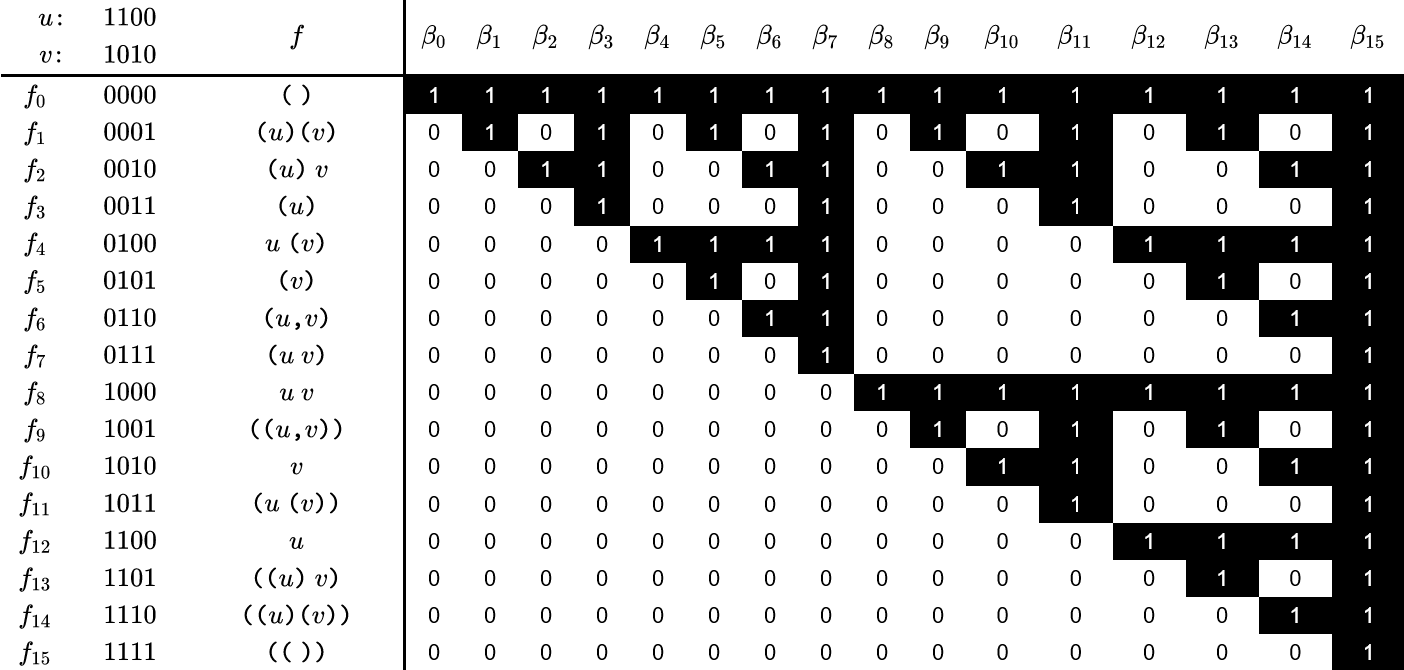
 the qualifiers
  respectively, in the implication ordering. By way of example, let us trace the effects of several such measures, namely, those which occupy the limiting positions in the Tables.
![\begin{array}{*{8}{r}} \alpha_{0} f = 1 & \mathrm{iff} & f_{0} \Rightarrow f & \mathrm{iff} & 0 \Rightarrow f, & \mathrm{hence} & \alpha_{0} f = 1 & \mathrm{for~all} ~ f. \\[4pt] \alpha_{15} f = 1 & \mathrm{iff} & f_{15} \Rightarrow f & \mathrm{iff} & 1 \Rightarrow f, & \mathrm{hence} & \alpha_{15} f = 1 & \mathrm{iff} ~ f = 1. \\[4pt] \beta_{0} f = 1 & \mathrm{iff} & f \Rightarrow f_{0} & \mathrm{iff} & f \Rightarrow 0, & \mathrm{hence} & \beta_{0} f = 1 & \mathrm{iff} ~ f = 0. \\[4pt] \beta_{15} f = 1 & \mathrm{iff} & f \Rightarrow f_{15} & \mathrm{iff} & f \Rightarrow 1, & \mathrm{hence} & \beta_{15} f = 1 & \mathrm{for~all} ~ f. \end{array}](https://s0.wp.com/latex.php?latex=%5Cbegin%7Barray%7D%7B%2A%7B8%7D%7Br%7D%7D++%5Calpha_%7B0%7D+f+%3D+1++%26+%5Cmathrm%7Biff%7D++%26+f_%7B0%7D+%5CRightarrow+f++%26+%5Cmathrm%7Biff%7D++%26+0+%5CRightarrow+f%2C++%26+%5Cmathrm%7Bhence%7D++%26+%5Calpha_%7B0%7D+f+%3D+1++%26+%5Cmathrm%7Bfor%7Eall%7D+%7E+f.++%5C%5C%5B4pt%5D++%5Calpha_%7B15%7D+f+%3D+1++%26+%5Cmathrm%7Biff%7D++%26+f_%7B15%7D+%5CRightarrow+f++%26+%5Cmathrm%7Biff%7D++%26+1+%5CRightarrow+f%2C++%26+%5Cmathrm%7Bhence%7D++%26+%5Calpha_%7B15%7D+f+%3D+1++%26+%5Cmathrm%7Biff%7D+%7E+f+%3D+1.++%5C%5C%5B4pt%5D++%5Cbeta_%7B0%7D+f+%3D+1++%26+%5Cmathrm%7Biff%7D++%26+f+%5CRightarrow+f_%7B0%7D++%26+%5Cmathrm%7Biff%7D++%26+f+%5CRightarrow+0%2C++%26+%5Cmathrm%7Bhence%7D++%26+%5Cbeta_%7B0%7D+f+%3D+1++%26+%5Cmathrm%7Biff%7D+%7E+f+%3D+0.++%5C%5C%5B4pt%5D++%5Cbeta_%7B15%7D+f+%3D+1++%26+%5Cmathrm%7Biff%7D++%26+f+%5CRightarrow+f_%7B15%7D++%26+%5Cmathrm%7Biff%7D++%26+f+%5CRightarrow+1%2C++%26+%5Cmathrm%7Bhence%7D++%26+%5Cbeta_%7B15%7D+f+%3D+1++%26+%5Cmathrm%7Bfor%7Eall%7D+%7E+f.++%5Cend%7Barray%7D&bg=ffffff&fg=000000&s=0&c=20201002)
 is a wholly indifferent or indiscriminate measure, accepting every proposition
  whereas the measures
  and
and  value the constant propositions
  and
and  respectively, above all others.
![\begin{matrix} [| \alpha_i |] & = & \alpha_i^{-1}(1), \\[6pt] [| \beta_i |] & = & \beta_i^{-1}(1), \\[6pt] [| \Upsilon_p |] & = & \Upsilon_p^{-1}(1). \end{matrix}](https://s0.wp.com/latex.php?latex=%5Cbegin%7Bmatrix%7D++%5B%7C+%5Calpha_i+%7C%5D+%26+%3D+%26+%5Calpha_i%5E%7B-1%7D%281%29%2C++%5C%5C%5B6pt%5D++%5B%7C+%5Cbeta_i+%7C%5D+%26+%3D+%26+%5Cbeta_i%5E%7B-1%7D%281%29%2C++%5C%5C%5B6pt%5D++%5B%7C+%5CUpsilon_p+%7C%5D+%26+%3D+%26+%5CUpsilon_p%5E%7B-1%7D%281%29.++%5Cend%7Bmatrix%7D&bg=ffffff&fg=000000&s=0&c=20201002)
 measures of type
  present a formidable array of propositions about propositions about 2‑dimensional universes of discourse. The early entries in their standard ordering define universes too amorphous to detain us for long on a first pass but as we turn toward the high end of the ordering we begin to recognize familiar structures worth examining from new angles.
 be a two‑dimensional boolean space,
  generated by two boolean variables or logical features
  and
and 
 as arguments, the relative umpire operator reports the value
  if the first implies the second, otherwise it reports the value



 it is possible to express this more succinctly as follows.

 defined by the equation
  In this case the subscript
  In most settings where
  is applied to arguments it is safe to omit the subscript
![[u, v],](https://s0.wp.com/latex.php?latex=%5Bu%2C+v%5D%2C&bg=ffffff&fg=000000&s=0&c=20201002) giving a score of
giving a score of  to everything else, counting all contingent statements as no better than falsehoods.


