Let’s stay with Peirce’s example of inductive inference a little longer and try to clear up the more troublesome confusions tending to arise.
Figure 2 shows the implication ordering of logical terms in the form of a lattice diagram.
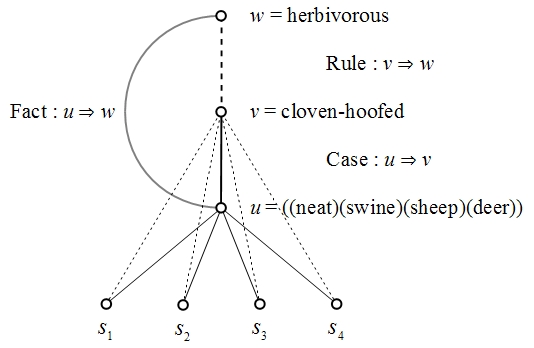

Figure 4 shows an inductive step of inquiry, as taken on the cue of an indicial sign.
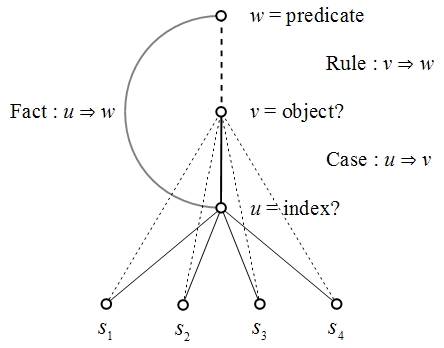

One final point needs to be stressed. It is important to recognize the disjunctive term itself — the syntactic formula “neat, swine, sheep, deer” or any logically equivalent formula — is not an index but a symbol.‡ It has the character of an artificial symbol which is constructed to fill a place in a formal system of symbols, for example, a propositional calculus. In that setting it would normally be interpreted as a logical disjunction of four elementary propositions, denoting anything in the universe of discourse which has any of the four corresponding properties.
The artificial symbol “neat, swine, sheep, deer” denotes objects which serve as indices of the genus herbivore by virtue of their belonging to one of the four named species of herbivore. But there is in addition a natural symbol which serves to unify the manifold of given species, namely, the concept of a cloven‑hoofed animal.
As a symbol or general representation, the concept of a cloven‑hoofed animal connotes an attribute and connotes it in such a way as to determine what it denotes. Thus we observe a natural expansion in the connotation of the symbol, amounting to what Peirce calls the “superfluous comprehension”, the information added by an “ampliative” or synthetic inference.
In sum we have sufficient information to motivate an inductive inference, from the Fact 


Remark
- Here, once again, I have departed from using symbol in the precise technical sense Peirce introduced at the beginning of this discussion, reverting to the more ordinary sense all of us, Peirce included, tend to use on other occasions. Perhaps the best way to smooth the wrinkle in usage is to mark a distinction among symbols, singling out the natural, normal, canonical, or simple symbols within the more general run of artificial, compound, or complex types. Taking that tack has the beneficial side‑effect of aligning the work of abduction and induction, at least, in a pre‑established universe of discourse, with the mainstream of work in computation which takes us from dubious terms to clear signs for the objects of our interest.
References
- Peirce, C.S. (1866), “The Logic of Science, or, Induction and Hypothesis”, Lowell Lectures of 1866, pp. 357–504 in Writings of Charles S. Peirce : A Chronological Edition, Volume 1, 1857–1866, Peirce Edition Project, Indiana University Press, Bloomington, IN, 1982.
- Peirce, C.S. (1867), “Upon Logical Comprehension and Extension”, Proceedings of the American Academy of Arts and Sciences, Vol. 7, pp. 416–432. Archive. Online.
Resources
cc: Academia.edu • Cybernetics • Laws of Form • Mathstodon
cc: Research Gate • Structural Modeling • Systems Science • Syscoi


Pingback: Survey of Pragmatic Semiotic Information • 9 | Inquiry Into Inquiry
Pingback: Survey of Pragmatic Semiotic Information • 9 | Systems Community of Inquiry