
Peirce’s 1885 “Algebra of Logic” • Selection 3

Selection from C.S. Peirce, “On the Algebra of Logic : A Contribution to the Philosophy of Notation” (1885)

§1.  Three Kinds Of Signs (cont.)

For instance, take the syllogistic formula,

\begin{array}{clcl}  \text{All} & M & \text{is} & P \\             & S & \text{is} & M \\  \therefore & S & \text{is} & P.  \end{array}

This is really a diagram of the relations of S, M, and P.  The fact that the middle term occurs in the two premisses is actually exhibited, and this must be done or the notation will be of no value.

As for algebra, the very idea of the art is that it presents formulæ which can be manipulated, and that by observing the effects of such manipulation we find properties not to be otherwise discerned.  In such manipulation, we are guided by previous discoveries which are embodied in general formulæ.  These are patterns which we have the right to imitate in our procedure, and are the icons par excellence of algebra.  The letters of applied algebra are usually tokens, but the x, y, z, etc. of a general formula, such as

(x + y)z = xz + yz,

are blanks to be filled up with tokens, they are indices of tokens.  Such a formula might, it is true, be replaced by an abstractly stated rule (say that multiplication is distributive);  but no application could be made of such an abstract statement without translating it into a sensible image.  (3.363).

References

  • Peirce, C.S. (1885), “On the Algebra of Logic : A Contribution to the Philosophy of Notation”, American Journal of Mathematics 7, 180–202.
  • Peirce, C.S., Collected Papers of Charles Sanders Peirce, vols. 1–6, Charles Hartshorne and Paul Weiss (eds.), vols. 7–8, Arthur W. Burks (ed.), Harvard University Press, Cambridge, MA, 1931–1935, 1958.  Volume 3 : Exact Logic (Published Papers), 1933.  CP 3.359–403.
  • Peirce, C.S., Writings of Charles S. Peirce : A Chronological Edition, Peirce Edition Project (eds.), Indiana University Press, Bloomington and Indianapolis, IN, 1981–.  Volume 5 (1884–1886), 1993.  Item 30, 162–190.

cc: FB | Peirce MattersLaws of FormMathstodonAcademia.edu
cc: Conceptual GraphsCyberneticsStructural ModelingSystems Science

Posted in Algebra of Logic, C.S. Peirce, Deduction, Diagrammatic Reasoning, Icon Index Symbol, Logic, Logic of Relatives, Mathematics, Philosophy of Notation, Relation Theory, Semiotics, Sign Relations, Triadic Relations, Visualization | Tagged , , , , , , , , , , , , , | 8 Comments

Peirce’s 1885 “Algebra of Logic” • Selection 2

Selection from C.S. Peirce, “On the Algebra of Logic : A Contribution to the Philosophy of Notation” (1885)

§1.  Three Kinds Of Signs (cont.)

I have taken pains to make my distinction of icons, indices, and tokens clear, in order to enunciate this proposition:  in a perfect system of logical notation signs of these several kinds must all be employed.  Without tokens there would be no generality in the statements, for they are the only general signs;  and generality is essential to reasoning.  Take, for example, the circles by which Euler represents the relations of terms.  They well fulfill the function of icons, but their want of generality and their incompetence to express propositions must have been felt by everybody who has used them.  Mr. Venn has, therefore, been led to add shading to them;  and this shading is a conventional sign of the nature of a token.  In algebra, the letters, both quantitative and functional, are of this nature.

But tokens alone do not state what is the subject of discourse;  and this can, in fact, not be described in general terms;  it can only be indicated.  The actual world cannot be distinguished from a world of imagination by any description.  Hence the need of pronouns and indices, and the more complicated the subject the greater the need of them.  The introduction of indices into the algebra of logic is the greatest merit of Mr. Mitchell’s system.  He writes F_1 to mean that the proposition F is true of every object in the universe, and F_u to mean that the same is true of some object.  This distinction can only be made in some such way as this.  Indices are also required to show in what manner other signs are connected together.
With these two kinds of signs alone any proposition can be expressed;  but it cannot be reasoned upon, for reasoning consists in the observation that where certain relations subsist certain others are found, and it accordingly requires the exhibition of the relations reasoned with in an icon.  It has long been a puzzle how it could be that, on the one hand, mathematics is purely deductive in its nature, and draws its conclusions apodictically, while on the other hand, it presents as rich and apparently unending a series of surprising discoveries as any observational science.  Various have been the attempts to solve the paradox by breaking down one or other of these assertions, but without success.  The truth, however, appears to be that all deductive reasoning, even simple syllogism, involves an element of observation;  namely, deduction consists in constructing an icon or diagram the relations of whose parts shall present a complete analogy with those of the parts of the object of reasoning, of experimenting upon this image in the imagination, and of observing the result so as to discover unnoticed and hidden relations among the parts.  (3.363).

References

  • Peirce, C.S. (1885), “On the Algebra of Logic : A Contribution to the Philosophy of Notation”, American Journal of Mathematics 7, 180–202.
  • Peirce, C.S., Collected Papers of Charles Sanders Peirce, vols. 1–6, Charles Hartshorne and Paul Weiss (eds.), vols. 7–8, Arthur W. Burks (ed.), Harvard University Press, Cambridge, MA, 1931–1935, 1958.  Volume 3 : Exact Logic (Published Papers), 1933.  CP 3.359–403.
  • Peirce, C.S., Writings of Charles S. Peirce : A Chronological Edition, Peirce Edition Project (eds.), Indiana University Press, Bloomington and Indianapolis, IN, 1981–.  Volume 5 (1884–1886), 1993.  Item 30, 162–190.

cc: FB | Peirce MattersLaws of FormMathstodon • Academia.edu (1) (2) (3)
cc: Conceptual GraphsCyberneticsStructural ModelingSystems Science

Posted in Algebra of Logic, C.S. Peirce, Deduction, Diagrammatic Reasoning, Icon Index Symbol, Logic, Logic of Relatives, Mathematics, Philosophy of Notation, Relation Theory, Semiotics, Sign Relations, Triadic Relations, Visualization | Tagged , , , , , , , , , , , , , | 8 Comments

Peirce’s 1885 “Algebra of Logic” • Selection 1

Selection from C.S. Peirce, “On the Algebra of Logic : A Contribution to the Philosophy of Notation” (1885)

§1.  Three Kinds Of Signs

Any character or proposition either concerns one subject, two subjects, or a plurality of subjects.  For example, one particle has mass, two particles attract one another, a particle revolves about the line joining two others.  A fact concerning two subjects is a dual character or relation;  but a relation which is a mere combination of two independent facts concerning the two subjects may be called degenerate, just as two lines are called a degenerate conic.  In like manner a plural character or conjoint relation is to be called degenerate if it is a mere compound of dual characters.  (3.359).

A sign is in a conjoint relation to the thing denoted and to the mind.  If this triple relation is not of a degenerate species, the sign is related to its object only in consequence of a mental association, and depends upon a habit.  Such signs are always abstract and general, because habits are general rules to which the organism has become subjected.  They are, for the most part, conventional or arbitrary.  They include all general words, the main body of speech, and any mode of conveying a judgment.  For the sake of brevity I will call them tokens.  [Note. Peirce more frequently calls these symbols.]  (3.360).

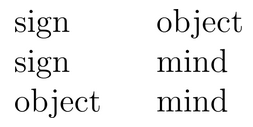
But if the triple relation between the sign, its object, and the mind, is degenerate, then of the three pairs

Peirce 1885 Sign Object Mind

two at least are in dual relations which constitute the triple relation.  One of the connected pairs must consist of the sign and its object, for if the sign were not related to its object except by the mind thinking of them separately, it would not fulfill the function of a sign at all.  Supposing, then, the relation of the sign to its object does not lie in a mental association, there must be a direct dual relation of the sign to its object independent of the mind using the sign.  In the second of the three cases just spoken of, this dual relation is not degenerate, and the sign signifies its object solely by virtue of being really connected with it.  Of this nature are all natural signs and physical symptoms.  I call such a sign an index, a pointing finger being the type of this class.

The index asserts nothing;  it only says “There!”  It takes hold of our eyes, as it were, and forcibly directs them to a particular object, and there it stops.  Demonstrative and relative pronouns are nearly pure indices, because they denote things without describing them;  so are the letters on a geometrical diagram, and the subscript numbers which in algebra distinguish one value from another without saying what those values are.  (3.361).

The third case is where the dual relation between the sign and its object is degenerate and consists in a mere resemblance between them.  I call a sign which stands for something merely because it resembles it, an icon.  Icons are so completely substituted for their objects as hardly to be distinguished from them.  Such are the diagrams of geometry.  A diagram, indeed, so far as it has a general signification, is not a pure icon;  but in the middle part of our reasonings we forget that abstractness in great measure, and the diagram is for us the very thing.  So in contemplating a painting, there is a moment when we lose consciousness that it is not the thing, the distinction of the real and the copy disappears, and it is for the moment a pure dream — not any particular existence, and yet not general.  At that moment we are contemplating an icon.  (3.362).

References

  • Peirce, C.S. (1885), “On the Algebra of Logic : A Contribution to the Philosophy of Notation”, American Journal of Mathematics 7, 180–202.
  • Peirce, C.S., Collected Papers of Charles Sanders Peirce, vols. 1–6, Charles Hartshorne and Paul Weiss (eds.), vols. 7–8, Arthur W. Burks (ed.), Harvard University Press, Cambridge, MA, 1931–1935, 1958.  Volume 3 : Exact Logic (Published Papers), 1933.  CP 3.359–403.
  • Peirce, C.S., Writings of Charles S. Peirce : A Chronological Edition, Peirce Edition Project (eds.), Indiana University Press, Bloomington and Indianapolis, IN, 1981–.  Volume 5 (1884–1886), 1993.  Item 30, 162–190.

cc: FB | Peirce MattersLaws of FormMathstodon • Academia.edu (1) (2) (3)
cc: Conceptual GraphsCyberneticsStructural ModelingSystems Science

Posted in Algebra of Logic, C.S. Peirce, Deduction, Diagrammatic Reasoning, Icon Index Symbol, Logic, Logic of Relatives, Mathematics, Philosophy of Notation, Relation Theory, Semiotics, Sign Relations, Triadic Relations, Visualization | Tagged , , , , , , , , , , , , , | 8 Comments

Survey of Relation Theory • 8

In the present Survey of blog and wiki resources for Relation Theory, relations are viewed from the perspective of combinatorics, in other words, as a topic in discrete mathematics, with special attention to finite structures and concrete set‑theoretic constructions, many of which arise quite naturally in applications.  This approach to relation theory is distinct from, though closely related to, its study from the perspectives of abstract algebra on the one hand and formal logic on the other.

Elements

Relational Concepts

Relation Composition Relation Construction Relation Reduction
Relative Term Sign Relation Triadic Relation
Logic of Relatives Hypostatic Abstraction Continuous Predicate

Illustrations

Information‑Theoretic Perspective

  • Mathematical Demonstration and the Doctrine of Individuals • (1)(2)

Blog Series

Peirce’s 1870 “Logic of Relatives”

Peirce’s 1880 “Algebra of Logic” Chapter 3

Peirce’s 1885 “Algebra of Logic”

  • C.S. Peirce • Algebra of Logic ∫ Philosophy of Notation • (1)(2)
  • C.S. Peirce • Algebra of Logic 1885 • Selections • (1)(2)(3)(4)

Resources

cc: FB | Relation TheoryLaws of FormMathstodonOntologAcademia.edu
cc: Conceptual GraphsCyberneticsStructural ModelingSystems Science

Posted in Algebra, Algebra of Logic, C.S. Peirce, Category Theory, Combinatorics, Discrete Mathematics, Duality, Dyadic Relations, Foundations of Mathematics, Graph Theory, Logic, Logic of Relatives, Mathematics, Peirce, Relation Theory, Semiotics, Set Theory, Sign Relational Manifolds, Sign Relations, Surveys, Triadic Relations, Triadicity, Type Theory | Tagged , , , , , , , , , , , , , , , , , , , , , , | 9 Comments

Pragmatic Semiotic Information • Comment 3

Memories are coming back to me more through the association of ideas than ordered by time or place.  I can sense, almost touch a tangle of thoughts interlaced with each other — the “information first” approach to ontology, the “arrows only”, element‑free angle on category theory, Peirce’s relativity of generals and individuals dispatching nominalism once and for all — but there is at core a hard knot of ideas so tightly wound it makes it difficult to articulate the links or see the untying if there is one to make.

cc: FB | SemeioticsLaws of FormMathstodonOntologAcademia.edu
cc: Conceptual GraphsCyberneticsStructural ModelingSystems Science

Posted in C.S. Peirce, Definition, Determination, Information, Information = Comprehension × Extension, Inquiry, Logic, Pragmatic Semiotic Information, Scientific Method, Semiosis, Semiotics, Sign Relations, Triadic Relations, Uncertainty | Tagged , , , , , , , , , , , , , | 3 Comments

Pragmatic Semiotic Information • Comment 2

I was at the time working as a “scanner” in the High Energy Physics Lab at Michigan State, sitting in a darkened room measuring tracks of particle interactions projected on a lighted scanning table from reels and reels of bubble chamber photographs gathered at CERN in a massive mad dash accelerator experiment some years before.  For my part it was a menial job, 4pm to midnight every worklong day, but even a minion can imagine himself sharing in a hunt for the \Omega^{-} particle, or whatever the Grail or Questying Beastie was at the time.

Meanwhile, in another part of the grove, I was spending my daylight hours checking off the final boxes for my Bachelor’s degree, the main thing being to get my paper on Peirce, “Complications of the Simplest Mathematics”, approved as a substitute for a field study requirement.  That had taken me two years’ work in MSU’s media library, poring through the microfilm reels of Peirce’s Nachlass in search of enlightenment about a single puzzling paragraph I tripped over in his Collected Papers.

cc: FB | SemeioticsLaws of FormMathstodonOntologAcademia.edu
cc: Conceptual GraphsCyberneticsStructural ModelingSystems Science

Posted in C.S. Peirce, Definition, Determination, Information, Information = Comprehension × Extension, Inquiry, Logic, Pragmatic Semiotic Information, Scientific Method, Semiosis, Semiotics, Sign Relations, Triadic Relations, Uncertainty | Tagged , , , , , , , , , , , , , | 4 Comments

Pragmatic Semiotic Information • Comment 1

I remember it was back in ’76 when I began to notice a subtle shift of focus in the computer science journals I was reading, from discussing X to discussing Information About X, a transformation I noted mentally as X \to \mathrm{Info}(X) whenever I ran across it.  I suppose that small arc of revolution had been building for years but it struck me as crossing a threshold to a more explicit, self‑conscious stage about that time.
cc: FB | SemeioticsLaws of FormMathstodonOntologAcademia.edu
cc: Conceptual GraphsCyberneticsStructural ModelingSystems Science

Posted in C.S. Peirce, Definition, Determination, Information, Information = Comprehension × Extension, Inquiry, Logic, Pragmatic Semiotic Information, Scientific Method, Semiosis, Semiotics, Sign Relations, Triadic Relations, Uncertainty | Tagged , , , , , , , , , , , , , | 4 Comments

Survey of Animated Logical Graphs • 7

This is a Survey of blog and wiki posts on Logical Graphs, encompassing several families of graph‑theoretic structures originally developed by Charles S. Peirce as graphical formal languages or visual styles of syntax amenable to interpretation for logical applications.

Beginnings

Elements

Examples

Blog Series

  • Logical Graphs • Interpretive Duality • (1)(2)(3)(4)
  • Logical Graphs, Iconicity, Interpretation • (1)(2)
  • Genus, Species, Pie Charts, Radio Buttons • (1)

Excursions

Applications

Anamnesis

cc: FB | Logical GraphsLaws of FormMathstodonOntologAcademia.edu
cc: Conceptual GraphsCyberneticsStructural ModelingSystems Science

Posted in Amphecks, Animata, Boolean Algebra, Boolean Functions, C.S. Peirce, Cactus Graphs, Computational Complexity, Constraint Satisfaction Problems, Differential Logic, Equational Inference, Graph Theory, Laws of Form, Logic, Logical Graphs, Mathematics, Minimal Negation Operators, Model Theory, Painted Cacti, Peirce, Proof Theory, Propositional Calculus, Propositional Equation Reasoning Systems, Spencer Brown, Theorem Proving, Visualization | Tagged , , , , , , , , , , , , , , , , , , , , , , , , | 46 Comments

Pragmatic Semiotic Information • 9

Information Recapped

Reflection on the inverse relation between uncertainty and information led us to define the information capacity of a communication channel as the average uncertainty reduction on receiving a sign, taking the acronym auroras as a reminder of the definition.

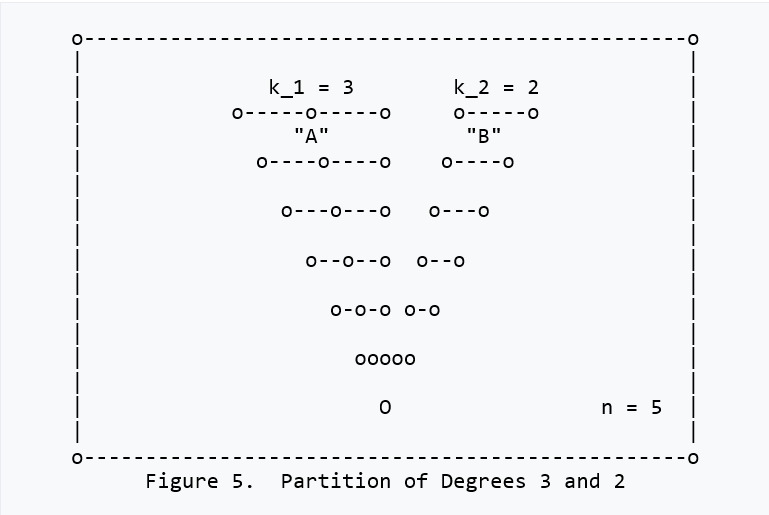
To see how channel capacity is computed in a concrete case let’s return to the scene of uncertainty shown in Figure 5.

Pragmatic Semiotic Information • Figure 5

For the sake of the illustration let’s assume we are dealing with the observational type of uncertainty and operating under the descriptive reading of signs, where the reception of a sign says something about what’s true of our situation.  Then we have the following cases.

  • On receiving the message “A” the additive measure of uncertainty is reduced from \log 5 to \log 3, so the net reduction is (\log 5 - \log 3).
  • On receiving the message “B” the additive measure of uncertainty is reduced from \log 5 to \log 2, so the net reduction is (\log 5 - \log 2).

The average uncertainty reduction per sign of the language is computed by taking a weighted average of the reductions occurring in the channel, where the weight of each reduction is the number of options or outcomes falling under the associated sign.

The uncertainty reduction (\log 5 - \log 3) is assigned a weight of 3.

The uncertainty reduction (\log 5 - \log 2) is assigned a weight of 2.

Finally, the weighted average of the two reductions is computed as follows.

{1 \over {2 + 3}}(3(\log 5 - \log 3) + 2(\log 5 - \log 2))

Extracting the pattern of calculation yields the following worksheet for computing the capacity of a two‑symbol channel with frequencies partitioned as n = k_1 + k_2.

Capacity of a channel {“A”, “B”} bearing the odds of 60 “A” to 40 “B”

\begin{array}{lcl}  & = & \quad {1 \over n}(k_1(\log n - \log k_1) + k_2(\log n - \log k_2))  \\[4pt]  & = & \quad {k_1 \over n}(\log n - \log k_1) + {k_2 \over n}(\log n - \log k_2)  \\[4pt]  & = & \quad - {k_1 \over n}(\log k_1 - \log n) - {k_2 \over n}(\log k_2 - \log n)  \\[4pt]  & = & \quad - {k_1 \over n}(\log {k_1 \over n}) - {k_2 \over n}(\log {k_2 \over n})  \\[4pt]  & = & \quad - (p_1 \log p_1 + p_2 \log p_2)  \\[4pt]  & = & \quad - (0.6 \log 0.6 + 0.4 \log 0.4)  \\[4pt]  & = & \quad 0.971  \end{array}

In other words, the capacity of the channel is slightly under 1 bit.  That makes intuitive sense in as much as 3 against 2 is a near‑even split of 5 and the measure of the channel capacity, otherwise known as the entropy, is especially designed to attain its maximum of 1 bit when a two‑way partition is split 50‑50, that is, when the distribution is uniform.

cc: FB | SemeioticsLaws of FormMathstodonOntologAcademia.edu
cc: Conceptual GraphsCyberneticsStructural ModelingSystems Science

Posted in C.S. Peirce, Definition, Determination, Information, Information = Comprehension × Extension, Inquiry, Logic, Pragmatic Semiotic Information, Scientific Method, Semiosis, Semiotics, Sign Relations, Triadic Relations, Uncertainty | Tagged , , , , , , , , , , , , , | 4 Comments

Pragmatic Semiotic Information • 8

Information Channeled

Suppose we find ourselves in the classification‑augmented or sign‑enhanced situation of uncertainty shown in Figure 5.  What difference does it make to our state of information regarding the objective outcome if we heed one or the other of the two signs, “A” or “B”, at least, operating on the charitable assumption we grasp the significance of each sign?

Pragmatic Semiotic Information • Figure 5

  • Under the sign “A” our uncertainty is reduced from \log 5 to \log 3.
  • Under the sign “B” our uncertainty is reduced from \log 5 to \log 2.

The above characteristics of the relation between uncertainty and information allow us to define the information capacity of a communication channel as the average uncertainty reduction on receiving a sign, a formula with the splendid mnemonic “AURORAS”.

cc: FB | SemeioticsLaws of FormMathstodonOntologAcademia.edu
cc: Conceptual GraphsCyberneticsStructural ModelingSystems Science

Posted in C.S. Peirce, Definition, Determination, Information, Information = Comprehension × Extension, Inquiry, Logic, Pragmatic Semiotic Information, Scientific Method, Semiosis, Semiotics, Sign Relations, Triadic Relations, Uncertainty | Tagged , , , , , , , , , , , , , | 4 Comments