Pragmatic Semiotic Information • 7

Uncertainty Moderated

In many ways the provision of information, a process which serves to reduce uncertainty, operates as an inverse process in relation to the type of uncertainty augmentation which takes place in compound decisions.  By way of illustrating the relation in question, let us return to our initial example.

A set of signs enters on a setup like that as a system of middle terms, a collection of signs one may regard, aptly enough, as constellating a medium.

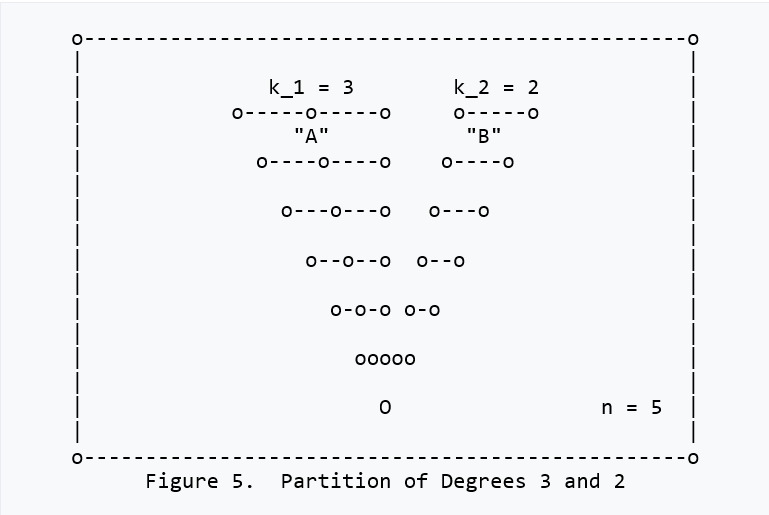
Pragmatic Semiotic Information • Figure 5

The language or medium in Figure 5 is the set of signs \{ ``A", ``B" \}.  On the assumption the initial 5 outcomes are equally likely it is possible to associate a frequency distribution (k_1, k_2) = (3, 2) and thus a probability distribution (p_1, p_2) = (\frac{3}{5}, \frac{2}{5}) = (0.6, 0.4) with the language, thereby defining a communication channel.

The most important thing at this stage of development is simply to get a first handle on the “conditions for the possibility of signs making sense”, but once we have that much in hand we can begin constructing the rough and ready pieces of information-theoretic furniture we need, like measures of uncertainty, channel capacity, and the amount of information associated with the reception or the recognition of a single sign.

cc: FB | SemeioticsLaws of FormMathstodonOntologAcademia.edu
cc: Conceptual GraphsCyberneticsStructural ModelingSystems Science

Posted in C.S. Peirce, Definition, Determination, Information, Information = Comprehension × Extension, Inquiry, Logic, Pragmatic Semiotic Information, Scientific Method, Semiosis, Semiotics, Sign Relations, Triadic Relations, Uncertainty | Tagged , , , , , , , , , , , , , | 4 Comments

Pragmatic Semiotic Information • 6

Uncertainty Multiplied

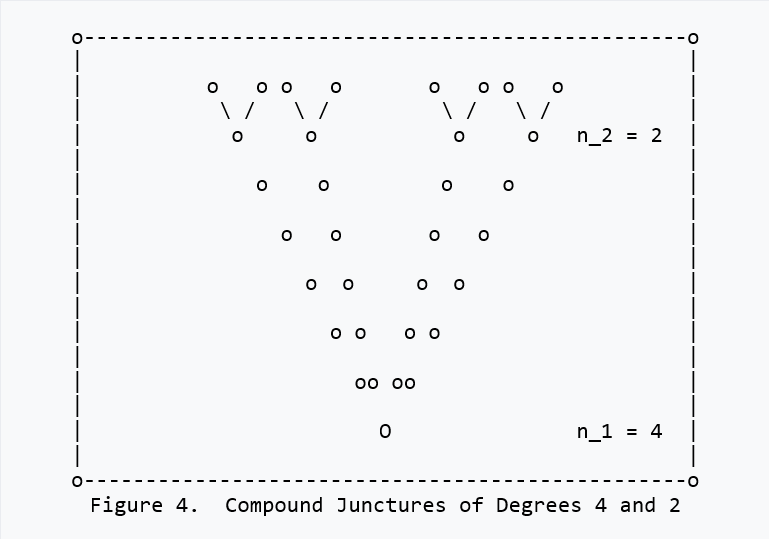
In our minds’ eyes last time we imagined ourselves coming to a fork in the road and seeing four paths diverge from that point.  Suppose a survey of the scene ahead now shows each path reaching a point where another decision has to be made, this time a choice between two alternatives.  Figure 4 gives us the picture so far.

Pragmatic Semiotic Information • Figure 4

The Figure illustrates the fact that the compound uncertainty, 8, is the product of the two component uncertainties, 4 \cdot 2.  To convert that to an additive measure, one simply takes the logarithms to a convenient base, say 2, and thus arrives at the not too astounding fact that the uncertainty of the first choice is 2 bits, the uncertainty of the next choice is 1 bit, and the total uncertainty is 2 + 1 = 3 bits.

cc: FB | SemeioticsLaws of FormMathstodonOntologAcademia.edu
cc: Conceptual GraphsCyberneticsStructural ModelingSystems Science

Posted in C.S. Peirce, Definition, Determination, Information, Information = Comprehension × Extension, Inquiry, Logic, Pragmatic Semiotic Information, Scientific Method, Semiosis, Semiotics, Sign Relations, Triadic Relations, Uncertainty | Tagged , , , , , , , , , , , , , | 4 Comments

Pragmatic Semiotic Information • 5

Uncertainty Measured

As a matter of fact, at least in the discrete types of cases we are currently considering, it would be possible to use the degree of a node, the number of paths fanning out from it, as a measure of uncertainty at that point.  That would give us a multiplicative measure of uncertainty rather than the sorts of additive measures we are more used to thinking about — no doubt someone would eventually think of taking logarithms to bring measures back to familiar ground — but that is getting ahead of the story.

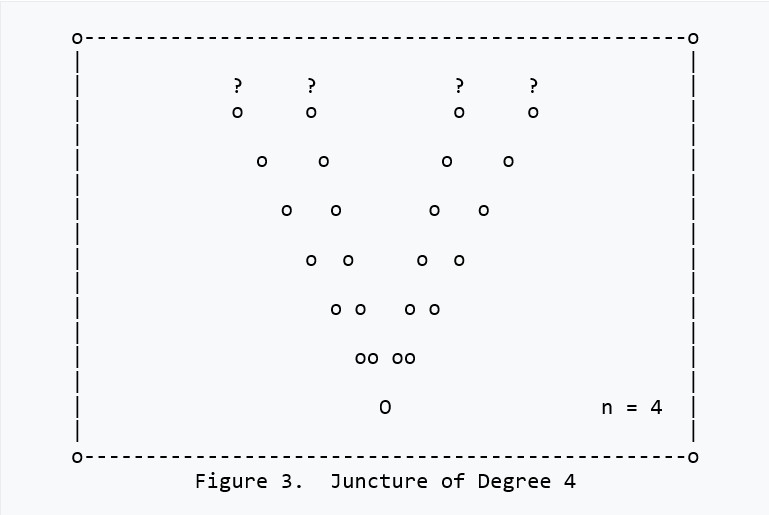
To illustrate how multiplicative measures of multiplicity, variety, or uncertainty would work out, let us take up a simpler example, one where the main choice point has a degree of four.  Figure 3 gives us the picture.

Pragmatic Semiotic Information • Figure 3

• cc: FB | SemeioticsLaws of FormMathstodonOntologAcademia.edu
cc: Conceptual GraphsCyberneticsStructural ModelingSystems Science

Posted in C.S. Peirce, Definition, Determination, Information, Information = Comprehension × Extension, Inquiry, Logic, Pragmatic Semiotic Information, Scientific Method, Semiosis, Semiotics, Sign Relations, Triadic Relations, Uncertainty | Tagged , , , , , , , , , , , , , | 4 Comments

Pragmatic Semiotic Information • 4

Sense and Obliviscence

In taking up a study of signs from a pragmatic point of view we naturally follow the advice of the pragmatic maxim on a way to make the relationship between our concepts and their objects as clear as necessary.  When it comes to our concept of the objects called signs we expand our conception of signs to a conception of their practical effects, conceiving the manifold of experiments and experiences involved in the use of signs.

In forming that expansion we bring to light many kinds of signs glossed over in the more conventional focus on words spoken and words written, that is, language in the strictest sense.  Signs in pragmatic perspective encompass all the data of the senses (dots) we take as informing us about inner and outer worlds, along with the concepts and terms we use to reason about everything from worlds of being to fields of action.

Ironically enough, we have just arrived at one of the junctures where it is tempting to try collapsing the triadic sign relation into a dyadic relation.  For if sense data were so closely identified with objects that we could scarcely imagine how they might be discrepant then we might imagine one role of beings could be eliminated from our picture of the world.

If that were true then the only things we’d need to bother informing ourselves about, via the inspection of sense data, would be yet more sense data, past, present, or prospective, nothing but sense data.  And that is the special form to which we frequently find the idea of an information channel being reduced, namely, to a source with nothing more to inform us about than its own conceivable conducts or its own potential issues.

cc: FB | SemeioticsLaws of FormMathstodonOntologAcademia.edu
cc: Conceptual GraphsCyberneticsStructural ModelingSystems Science

Posted in C.S. Peirce, Definition, Determination, Information, Information = Comprehension × Extension, Inquiry, Logic, Pragmatic Semiotic Information, Scientific Method, Semiosis, Semiotics, Sign Relations, Triadic Relations, Uncertainty | Tagged , , , , , , , , , , , , , | 4 Comments

Pragmatic Semiotic Information • 3

Where is information bred?  In reality or in its stead?

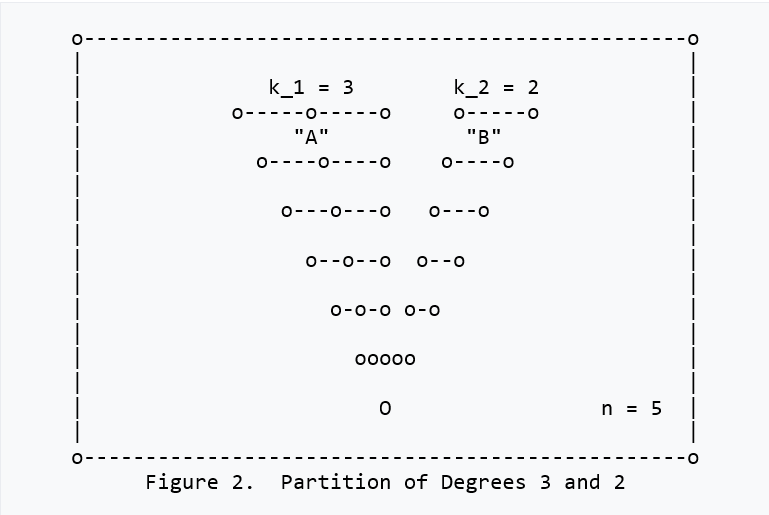
The way signs enter the scene is shown in Figure 2.

Pragmatic Semiotic Information • Figure 2

The Figure illustrates a scene of uncertainty which has been augmented by a classification.

In the pattern of classification shown the first three outcomes fall under the sign “A” and the next two outcomes fall under the sign “B”.

  • If the outcomes are things potentially true of an object or situation then the signs may be read as nomens (terms) or notions (concepts) in a relevant empirical or theoretical scheme, in effect, as predicates and predictors of the outcomes.
  • If the outcomes are things potentially worth doing to achieve a goal then the signs may be read as bits of advice or other indicators telling us what actions to try in a situation, relative to our active goals.

This will give us a practical framework for talking about information and signs in regard to communication, decision, and the uncertainties thereof.

cc: FB | SemeioticsLaws of FormMathstodonOntologAcademia.edu
cc: Conceptual GraphsCyberneticsStructural ModelingSystems Science

Posted in C.S. Peirce, Definition, Determination, Information, Information = Comprehension × Extension, Inquiry, Logic, Pragmatic Semiotic Information, Scientific Method, Semiosis, Semiotics, Sign Relations, Triadic Relations, Uncertainty | Tagged , , , , , , , , , , , , , | 4 Comments

Pragmatic Semiotic Information • 2

What is information that a sign may bear it?

Three more questions arise at this juncture.

  • How is a sign empowered to contain information?
  • What is the practical context of communication?
  • Why do we care about these bits of information?

A very rough answer to these questions might begin as follows.

Human beings are initially concerned solely with their own lives but then a world obtrudes on their subjective existence and so they find themselves forced to take an interest in the objective realities of its nature.

In pragmatic terms our initial aim, concern, interest, object, or pragma is expressed by the verbal infinitive to live, but the infinitive is soon reified into the derivative substantial forms of nature, reality, the world, and so on.  Against that backdrop we find ourselves cast as the protagonists on a scene of uncertainty.

The situation may be pictured as a juncture from which a manifold of options fan out before us.  It may be an issue of “truth”, “duty”, or “hope”, the last codifying a special type of uncertainty as to what regulative principle has any chance of success, but the chief uncertainty is that we are called on to make a choice and all too often we have very little clue which of the options is most fit to pick.

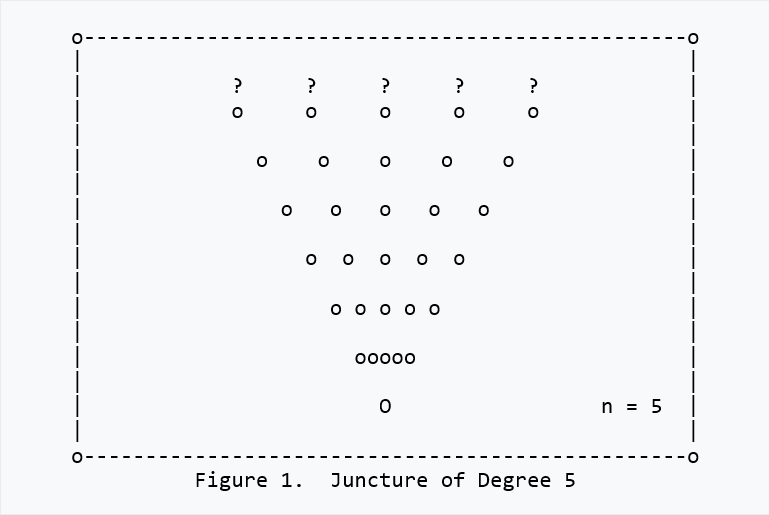
Just to make up a discrete example, let us suppose the cardinality of the choices before us is a finite integer n, and just to make it fully concrete let us say n = 5.  Figure 1 affords a rough picture of the situation.
Pragmatic Semiotic Information • Figure 1

This pictures a juncture, represented by a node marked ``\texttt{O}", where there are n options for the outcome of a conduct and we have no clue as to which it must be.  In a sense the degree of the node, in this case n = 5, measures the uncertainty we have at that point.

The Figure illustrates the minimal sort of setting in which a sign can make any sense at all.  A sign has significance for an agent, interpreter, or observer because its actualization, its being given or its being present, serves to reduce the uncertainty of a decision the agent has to make, whether it concerns the actions the agent ought to take in order to achieve some objective of interest, or whether it concerns the predicates the agent ought to treat as being true of some object or situation in the world.

cc: FB | SemeioticsLaws of FormMathstodonOntologAcademia.edu
cc: Conceptual GraphsCyberneticsStructural ModelingSystems Science

Posted in C.S. Peirce, Definition, Determination, Information, Information = Comprehension × Extension, Inquiry, Logic, Pragmatic Semiotic Information, Scientific Method, Semiosis, Semiotics, Sign Relations, Triadic Relations, Uncertainty | Tagged , , , , , , , , , , , , , | 4 Comments

Pragmatic Semiotic Information • 1

Information • What’s it good for?

The good of information is its use in reducing our uncertainty about an issue which comes before us.  But uncertainty comes in many flavors and so the information which serves to reduce uncertainty can be applied in several ways.  The situations of uncertainty human agents commonly find themselves facing have been investigated under many headings, literally for ages, and the categories subtle thinkers arrived at long before the dawn of modern information theory still have their uses in setting the stage of an introduction.

Picking an example of a subtle thinker almost at random, the philosopher‑scientist Immanuel Kant surveyed the questions of human existence within the span of the following three axes.

  • What’s true?
  • What’s to do?
  • What’s to hope?

The third question is a bit too subtle for the present frame of discussion but the first and second are easily recognizable as staking out the two main axes of information theory, namely, the dual dimensions of information and control.  Roughly the same space of concerns is elsewhere spanned by the dual axes of competence and performance, specification and optimization, or just plain knowledge and skill.

A question of what’s true is a descriptive question and there exist what are called descriptive sciences devoted to answering descriptive questions about any domain of phenomena one might care to name.

A question of what’s to do, in other words, what must be done by way of achieving a given aim, is a normative question and there exist what are called normative sciences devoted to answering normative questions about any domain of problems one might care to address.

Since information plays its role on a stage set by uncertainty, a big part of saying what information is will necessarily involve saying what uncertainty is.  There is little chance the vagaries of a word like uncertainty, given the nuances of its ordinary, poetic, and technical uses, can be corralled by a single pen, but there do exist established models and formal theories which manage to address definable aspects of uncertainty and these do have enough uses to make them worth looking into.

cc: FB | SemeioticsLaws of FormMathstodonOntologAcademia.edu
cc: Conceptual GraphsCyberneticsStructural ModelingSystems Science

Posted in C.S. Peirce, Definition, Determination, Information, Information = Comprehension × Extension, Inquiry, Logic, Pragmatic Semiotic Information, Scientific Method, Semiosis, Semiotics, Sign Relations, Triadic Relations, Uncertainty | Tagged , , , , , , , , , , , , , | 3 Comments

Survey of Pragmatic Semiotic Information • 8

This is a Survey of blog and wiki posts on a theory of information which grows out of pragmatic semiotic ideas.  All my projects are exploratory in character but this line of inquiry is more open‑ended than most.  The question is —

What is information and how does it impact the spectrum of activities answering to the name of inquiry?

Setting out on what would become his lifelong quest to explore and explain the “Logic of Science”, C.S. Peirce pierced the veil of historical confusions obscuring the issue and fixed on what he called the “laws of information” as the key to solving the puzzle.

The first hints of the Information Revolution in our understanding of scientific inquiry may be traced to Peirce’s lectures of 1865–1866 at Harvard University and the Lowell Institute.  There Peirce took up “the puzzle of the validity of scientific inference” and claimed it was “entirely removed by a consideration of the laws of information”.

Fast forward to the present and I see the Big Question as follows.  Having gone through the exercise of comparing and contrasting Peirce’s theory of information, however much it yet remains in a rough‑hewn state, with Shannon’s paradigm so pervasively informing the ongoing revolution in our understanding and use of information, I have reason to believe Peirce’s idea is root and branch more general and has the potential, with due development, to resolve many mysteries still bedeviling our grasp of inference, information, and inquiry.

Inference, Information, Inquiry

Pragmatic Semiotic Information

Semiotics, Semiosis, Sign Relations

Sign Relations, Triadic Relations, Relation Theory

  • Blog Series • (1)
    • Discusssions • (1)(2)

Excursions

Blog Dialogs

References

  • Peirce, C.S. (1867), “Upon Logical Comprehension and Extension”.  Online.
  • Awbrey, J.L., and Awbrey, S.M. (1995), “Interpretation as Action : The Risk of Inquiry”, Inquiry : Critical Thinking Across the Disciplines 15(1), 40–52.  ArchiveJournal.  Online (doc) (pdf).

cc: FB | SemeioticsLaws of FormMathstodonOntologAcademia.edu
cc: Conceptual GraphsCyberneticsStructural ModelingSystems Science

Posted in Abduction, C.S. Peirce, Communication, Control, Cybernetics, Deduction, Determination, Discovery, Doubt, Epistemology, Fixation of Belief, Induction, Information, Information = Comprehension × Extension, Information Theory, Inquiry, Inquiry Driven Systems, Inquiry Into Inquiry, Interpretation, Invention, Knowledge, Learning Theory, Logic, Logic of Relatives, Logic of Science, Mathematics, Peirce, Philosophy, Philosophy of Science, Pragmatic Information, Probable Reasoning, Process Thinking, Relation Theory, Scientific Inquiry, Scientific Method, Semeiosis, Semiosis, Semiotic Information, Semiotics, Sign Relational Manifolds, Sign Relations, Surveys, Triadic Relations, Uncertainty | Tagged , , , , , , , , , , , , , , , , , , , , , , , , , , , , , , , , , , , , , , , , , , , | 25 Comments

Being In Time

I need to be in the state I’m in.
I need to dwell on the indwelling.
I need to unpack the original source,
Too long hidebound by habit of force.

Posted in Anthem, Anthematics, Mantra, Maxim, Meditation, Poem, Reflection, Resource, Reverie, Verse | Tagged , , , , , , , , , | Leave a comment

Survey of Inquiry Driven Systems • 6

This is a Survey of work in progress on Inquiry Driven Systems, material I plan to refine toward a more compact and systematic treatment of the subject.

An inquiry driven system is a system having among its state variables some representing its state of information with respect to various questions of interest, for example, its own state and the states of potential object systems.  Thus it has a component of state tracing a trajectory though an information state space.

Anthem

Elements

Background

Blog Series

  • Pragmatic Cosmos • (1)

Blog Dialogs

  • Architectonics of Inquiry • (1)

Developments

Applications

  • Conceptual Barriers to Creating Integrative Universities
    (Abstract) (Online)
  • Interpretation as Action • The Risk of Inquiry
    (Journal) (doc) (pdf)
  • An Architecture for Inquiry • Building Computer Platforms for Discovery
    (Online)
  • Exploring Research Data Interactively • Theme One : A Program of Inquiry
    (Online)

cc: FB | Inquiry Driven SystemsLaws of FormMathstodonAcademia.edu
cc: Conceptual GraphsCyberneticsStructural ModelingSystems Science

Posted in Abduction, Adaptive Systems, Artificial Intelligence, Automated Research Tools, C.S. Peirce, Cognitive Science, Cybernetics, Deduction, Educational Systems Design, Educational Technology, Fixation of Belief, Induction, Information Theory, Inquiry, Inquiry Driven Systems, Inquiry Into Inquiry, Intelligent Systems, Interpretation, Logic, Logic of Science, Mathematics, Mental Models, Pragmatic Maxim, Semiotics, Sign Relations, Triadic Relations, Visualization | Tagged , , , , , , , , , , , , , , , , , , , , , , , , , , | 19 Comments