Grammar 1 (cont.)
The degree of intermediate organization in a grammar is measured by the number of its intermediate symbols and the complexity of their mutual interplay within the frame of the grammar’s productions.
Grammar 1 has no intermediate symbols at all,  and so remains at a trivial degree of intermediate organization. Some additions to the list of intermediate symbols are practically obligatory in order to arrive at any reasonable grammar at all. Other inclusions have a more optional character, though useful from the standpoints of clarity and ease of comprehension.
One of the troubles perceived to affect Grammar 1 is the way it wastes so much of the available potential for efficient description in recounting over and over again the simple fact that the empty string is present in the language. The problem arises partly from the covering relation  which has the following implications.

There is nothing wrong with the more expansive pan of the covered equation, since it follows straightforwardly from the definition of the kleene star operation. But the statement  is not a very productive piece of information, in the sense of telling us much about the language falling under the type of a sentence
In particular, implies  Since
Since  for any formal language
  the empty string
  is counted over and over in every term of the union, and every non‑empty sentence under
  appears again and again in every term of the union following the initial appearance of As a result, the overall style of characterization has to be classified as true but not very informative.
If at all possible, one prefers to partition the language of interest into a disjoint union of subsets, thereby accounting for each sentence under its proper term, and one whose place under the sum serves as a useful parameter of its character or its complexity. Such an ideal form of description is not always possible to achieve but it is usually worth the trouble to actualize it whenever one can.
Suppose one tries to deal with the problem by eliminating each use of the kleene star operation, by reducing it to a purely finitary set of steps, or by finding another way to cover the sublanguage it is used to generate. That amounts, in effect, to recognizing a type, a complex process involving the following steps.
- Noticing a category of strings which is generated by iteration or recursion.
- Acknowledging the fact that it needs to be covered by a non‑terminal symbol.
- Making a note of it by instituting an explicitly‑named grammatical category.
In sum, one introduces a non‑terminal symbol for each type of sentence and each part of speech or sentential component generated by means of iteration or recursion under the ruling constraints of the grammar. To do that one needs to analyze the iteration of each grammatical operation in a way which is analogous to a mathematically inductive definition but further in a way which is not forced explicitly to recognize a distinct and separate type of expression merely to account for and recount every increment in the parameter of iteration.
Resources
cc: Academia.edu • BlueSky • Laws of Form • Mathstodon • Research Gate
cc: Conceptual Graphs • Cybernetics • Structural Modeling • Systems Science





 and fixing the parameter
  for the moment, we have a language
  of painted and rooted cactus expressions. It serves the purpose of efficient accounting to divide the language into two sublanguages.
 which consists of a single empty string as its only sentence.
 which consists of everything else, namely, all the non‑empty strings in the language


 be the type of a non‑empty sentence.
 be the type of the empty sentence, in effect, the language
  containing a single empty string, and let a plus sign
  signify a disjoint union of types. In the most general type of situation, where the type
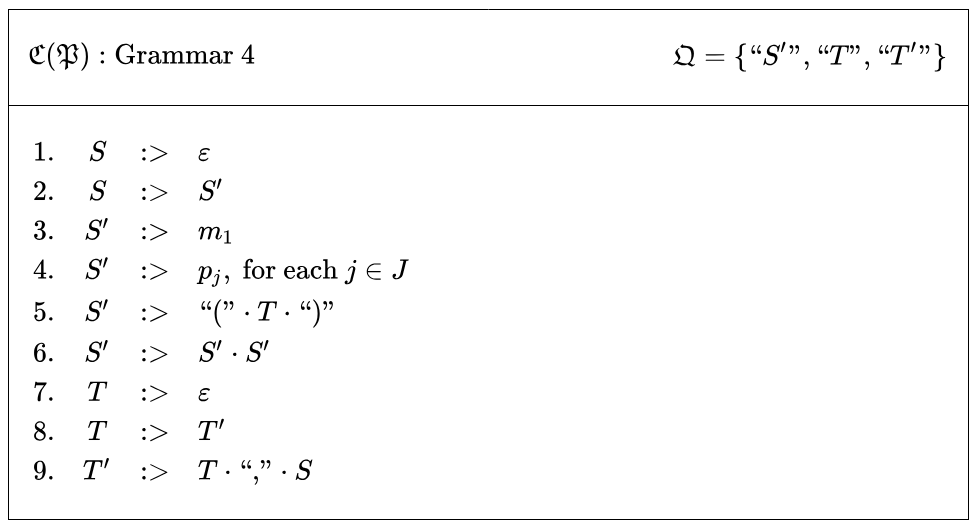
 afforded by Grammar 2, and, taking that as a point of departure, explore other avenues of possible improvement in the comprehension of its expressions.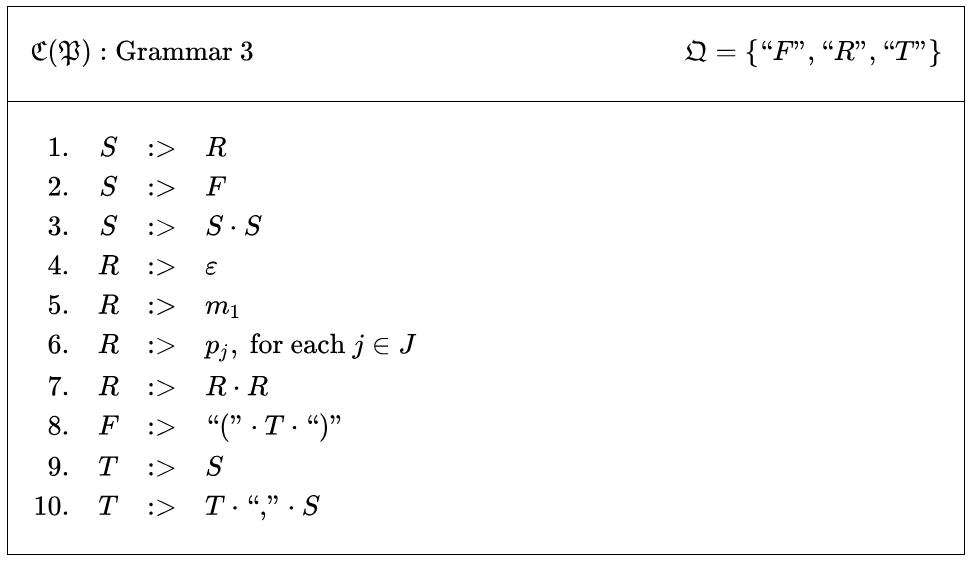
 ), a foil (a string of type
  ), or formed by concatenating strings of those two types.
 a blank symbol
  a paint
  or formed by concatenating strings of those three types.
 where
where  the problematic applications of indefinite iterations, like the kleene star operator, are now reduced to finite forms of concatenation but the problems stemming from permitting non‑terminal symbols to cover both themselves and empty strings have yet to be resolved.
 possibly the empty string.
 may be used either as a string variable ranging over the set of runes or as a type name for the class of runes. The latter reading amounts to the recruitment of a new intermediate symbol
  to form a new grammar for
  Thus
Thus  and
and 

 In the case where the sequence of sentences is empty and thus where the tract
 further articulating the structure of expressions and expanding the grammar for the language
 interpolated between each pair of adjacent sentences. Thus, a typical tract
 where the commas coming to mind, as if being called up to separate the successive sentences of the sequence, remain as partially abstract conceptions, or as signs retaining a disengaged status on the borderline between text and mind. The kinds of commas appearing in the abstract sequence continue to exist as conceptual abstractions and fail to be cognized in a wholly explicit fashion, either as concrete tokens in the object language or as marks in the text engaging one’s parsing attention.
 it is possible to put the assembled pieces of grammar together in the light of the adopted canons of style to refine our analysis of the fact that the concept of a sentence covers any concatenation of sentences and any surcatenation of sentences, and so arrive at the following form of grammar.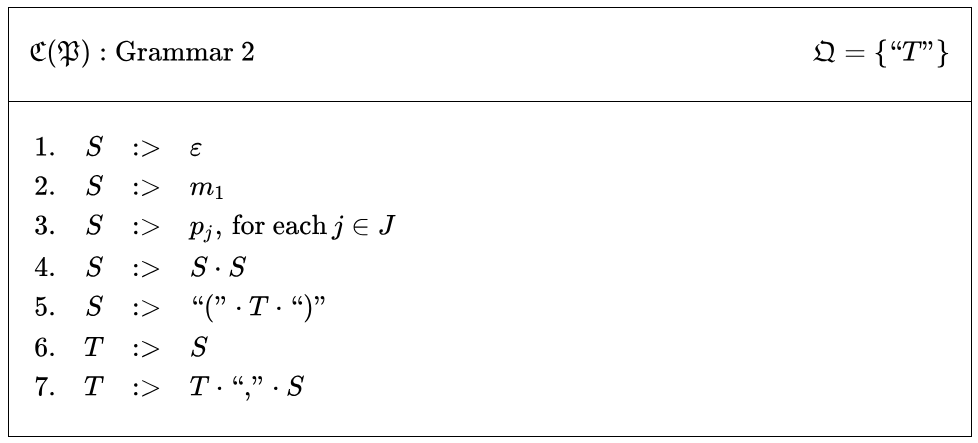
 means that
  namely,
  In accord with those simple beginnings it comes to pass that the rule
  with the substitutions
  and
and  , bears the germinal implication that
 but the number of symbols alone does not give a full account, as intermediate symbols are taken to serve a purpose, a purpose which is easy to recognize but not so easy to pin down and specify exactly. Nevertheless, it is worth the trouble to explore the intermediate level of organization and its development a little further.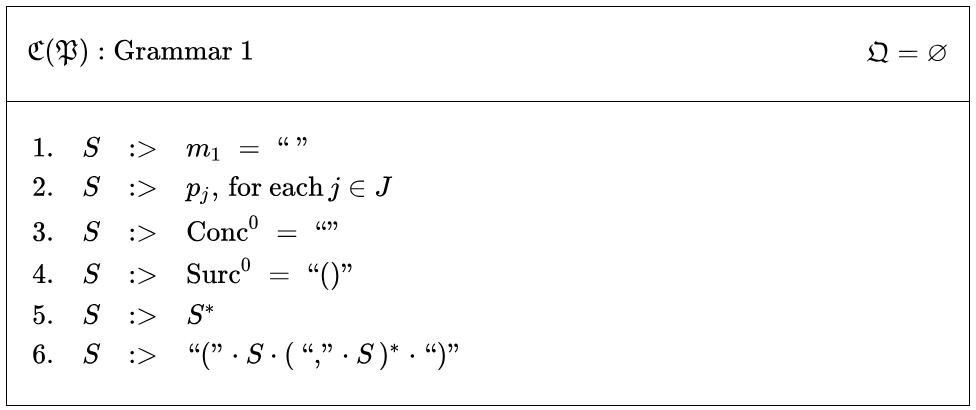
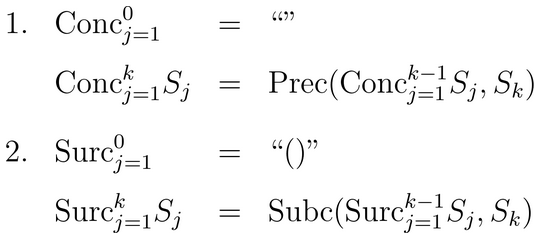
 and
and  corresponding to the operations of the same names but ignoring the inflexions of their individual parameters
  and
and  Recognizing the type of a sentence by means of the initial symbol
  as names for the types of strings generated by concatenation and by surcatenation, respectively, one arrives at the following transformation of the ruling operator definitions into the form of covering grammar rules.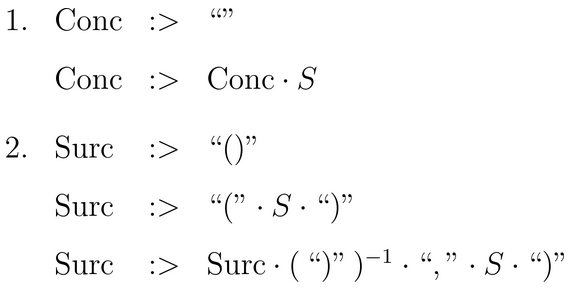
 the covering rule
  says no more than the covering rule
  Consequently, all the information contained in those two covering rules is already covered by the statement that
 coming with the territory of the cactus language
  covers any concatenation of sentences in
  continuing with a sentence, possibly empty, following with a finite number of phrases of the form
  and closing with a
 and
and  where the symbols
  may be taken to signify either the tokens or the subtypes of their covering types.

 Inquiry Into Inquiry