Survey of Precursors Of Category Theory • 4

A few years ago I began a sketch on the “Precursors of Category Theory”, tracing the continuities of the category concept from Aristotle, to Kant and Peirce, through Hilbert and Ackermann, to contemporary mathematical practice.  A Survey of resources on the topic is given below, still very rough and incomplete, but perhaps a few will find it of use.

Background

Blog Series

  • Notes On Categories • (1)
  • Precursors Of Category Theory • (1)(2)(3)

Categories à la Peirce

cc: FB | Peirce MattersLaws of FormMathstodonOntologAcademia.edu
cc: Conceptual GraphsCyberneticsStructural ModelingSystems Science

Posted in Abstraction, Ackermann, Analogy, Aristotle, C.S. Peirce, Carnap, Category Theory, Diagrams, Foundations of Mathematics, Functional Logic, Hilbert, History of Mathematics, Hypostatic Abstraction, Kant, Logic, Mathematics, Peirce, Propositions As Types Analogy, Relation Theory, Saunders Mac Lane, Semiotics, Type Theory, Universals | Tagged , , , , , , , , , , , , , , , , , , , , , , | 1 Comment

Survey of Relation Theory • 7

In the present Survey of blog and wiki resources for Relation Theory, relations are viewed from the perspective of combinatorics, in other words, as a topic in discrete mathematics, with special attention to finite structures and concrete set‑theoretic constructions, many of which arise quite naturally in applications.  This approach to relation theory is distinct from, though closely related to, its study from the perspectives of abstract algebra on the one hand and formal logic on the other.

Elements

Relational Concepts

Relation Composition Relation Construction Relation Reduction
Relative Term Sign Relation Triadic Relation
Logic of Relatives Hypostatic Abstraction Continuous Predicate

Illustrations

Information‑Theoretic Perspective

  • Mathematical Demonstration and the Doctrine of Individuals • (1)(2)

Blog Series

Peirce’s 1870 “Logic of Relatives”

Peirce’s 1880 “Algebra of Logic” Chapter 3

Resources

cc: FB | Relation TheoryLaws of FormMathstodonOntologAcademia.edu
cc: Conceptual GraphsCyberneticsStructural ModelingSystems Science

Posted in Algebra, Algebra of Logic, C.S. Peirce, Category Theory, Combinatorics, Discrete Mathematics, Duality, Dyadic Relations, Foundations of Mathematics, Graph Theory, Logic, Logic of Relatives, Mathematics, Peirce, Relation Theory, Semiotics, Set Theory, Sign Relational Manifolds, Sign Relations, Surveys, Triadic Relations, Triadicity, Type Theory | Tagged , , , , , , , , , , , , , , , , , , , , , , | Leave a comment

Survey of Pragmatic Semiotic Information • 7

This is a Survey of blog and wiki posts on a theory of information which grows out of pragmatic semiotic ideas.  All my projects are exploratory in character but this line of inquiry is more open‑ended than most.  The question is —

What is information and how does it impact the spectrum of activities answering to the name of inquiry?

Setting out on what would become his lifelong quest to explore and explain the “Logic of Science”, C.S. Peirce pierced the veil of historical confusions obscuring the issue and fixed on what he called the “laws of information” as the key to solving the puzzle.

The first hints of the Information Revolution in our understanding of scientific inquiry may be traced to Peirce’s lectures of 1865–1866 at Harvard University and the Lowell Institute.  There Peirce took up “the puzzle of the validity of scientific inference” and claimed it was “entirely removed by a consideration of the laws of information”.

Fast forward to the present and I see the Big Question as follows.  Having gone through the exercise of comparing and contrasting Peirce’s theory of information, however much it yet remains in a rough‑hewn state, with Shannon’s paradigm so pervasively informing the ongoing revolution in our understanding and use of information, I have reason to believe Peirce’s idea is root and branch more general and has the potential, with due development, to resolve many mysteries still bedeviling our grasp of inference, information, and inquiry.

Inference, Information, Inquiry

Pragmatic Semiotic Information

Semiotics, Semiosis, Sign Relations

Sign Relations, Triadic Relations, Relation Theory

  • Blog Series • (1)
    • Discusssions • (1)(2)

Excursions

Blog Dialogs

References

  • Peirce, C.S. (1867), “Upon Logical Comprehension and Extension”.  Online.
  • Awbrey, J.L., and Awbrey, S.M. (1992), “Interpretation as Action : The Risk of Inquiry”, The Eleventh International Human Science Research Conference, Oakland University, Rochester, Michigan.
  • Awbrey, J.L., and Awbrey, S.M. (1995), “Interpretation as Action : The Risk of Inquiry”, Inquiry : Critical Thinking Across the Disciplines 15(1), pp. 40–52.  ArchiveJournalOnline.

cc: FB | SemeioticsLaws of FormMathstodonOntologAcademia.edu
cc: Conceptual GraphsCyberneticsStructural ModelingSystems Science

Posted in Abduction, C.S. Peirce, Communication, Control, Cybernetics, Deduction, Determination, Discovery, Doubt, Epistemology, Fixation of Belief, Induction, Information, Information = Comprehension × Extension, Information Theory, Inquiry, Inquiry Driven Systems, Inquiry Into Inquiry, Interpretation, Invention, Knowledge, Learning Theory, Logic, Logic of Relatives, Logic of Science, Mathematics, Peirce, Philosophy, Philosophy of Science, Pragmatic Information, Probable Reasoning, Process Thinking, Relation Theory, Scientific Inquiry, Scientific Method, Semeiosis, Semiosis, Semiotic Information, Semiotics, Sign Relational Manifolds, Sign Relations, Surveys, Triadic Relations, Uncertainty | Tagged , , , , , , , , , , , , , , , , , , , , , , , , , , , , , , , , , , , , , , , , , , , | 3 Comments

Pragmatic Semiotic Information • Ψ

I remember it was back in ’76 when I began to notice a subtle shift of focus in the computer science journals I was reading, from discussing X to discussing Information About X, a transformation I noted mentally as X \to \mathrm{Info}(X) whenever I ran across it.  I suppose that small arc of revolution had been building for years but it struck me as crossing a threshold to a more explicit, self‑conscious stage about that time.

cc: FB | SemeioticsLaws of FormMathstodonOntologAcademia.edu
cc: Conceptual GraphsCyberneticsStructural ModelingSystems Science

Posted in Abduction, C.S. Peirce, Comprehension, Deduction, Definition, Determination, Extension, Hypothesis, Icon Index Symbol, Induction, Inference, Information, Information = Comprehension × Extension, Inquiry, Intension, Logic, Logic of Science, Peirce, Pragmatic Semiotic Information, Pragmatism, Scientific Method, Semiotics, Sign Relations | Tagged , , , , , , , , , , , , , , , , , , , , , , | 3 Comments

Functional Logic • Inquiry and Analogy • 21

Inquiry and AnalogyGeneralized Umpire Operators

To get a better handle on the space of higher order propositions and continue developing our functional approach to quantification theory, we’ll need a number of specialized tools.  To begin, we define a higher order operator \Upsilon, called the umpire operator, which takes 1, 2, or 3 propositions as arguments and returns a single truth value as the result.  Operators with optional numbers of arguments are called multigrade operators, typically defined as unions over function types.  Expressing \Upsilon in that form gives the following formula.

UMP 1

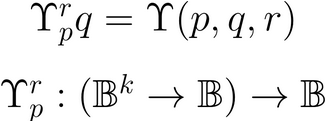
In contexts of application, that is, where a multigrade operator is actually being applied to arguments, the number of arguments in the argument list tells which of the optional types is “operative”.  In the case of \Upsilon, the first and last arguments appear as indices, the one in the middle serving as the main argument while the other two arguments serve to modify the sense of the operation in question.  Thus, we have the following forms.
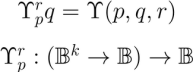
UMP 2

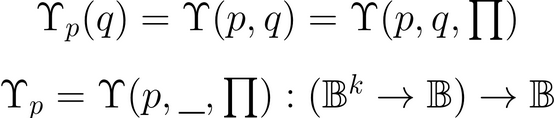
The operation \Upsilon_p^r q evaluates the proposition q on each model of the proposition p and combines the results according to the method indicated by the connective parameter r.  In principle, the index r may specify any logical connective on as many as 2^k arguments but in practice we usually have a much simpler form of combination in mind, typically either products or sums.  By convention, each of the accessory indices p, r is assigned a default value understood to be in force when the corresponding argument place is left blank, specifically, the constant proposition 1 : \mathbb{B}^k \to \mathbb{B} for the lower index p and the continued conjunction or continued product operation \textstyle\prod for the upper index r.  Taking the upper default value gives license to the following readings.

UMP 3

This means \Upsilon_p (q) = 1 if and only if q holds for all models of p.  In propositional terms, this is tantamount to the assertion that p \Rightarrow q, or that \texttt{(} p \texttt{(} q \texttt{))} = 1.

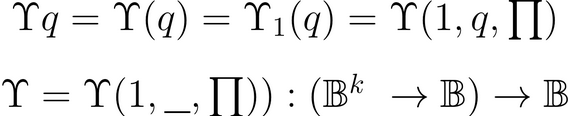
Throwing in the lower default value permits the following abbreviations.

UMP 4

This means \Upsilon q = 1 if and only if q holds for the whole universe of discourse in question, that is, if and only q is the constantly true proposition 1 : \mathbb{B}^k \to \mathbb{B}.  The ambiguities of this usage are not a problem so long as we distinguish the context of definition from the context of application and restrict all shorthand notations to the latter.

Resources

cc: FB | Peirce MattersLaws of FormMathstodonOntologAcademia.edu
cc: Conceptual GraphsCyberneticsStructural ModelingSystems Science

Posted in Abduction, Analogy, Argument, Aristotle, C.S. Peirce, Constraint, Deduction, Determination, Diagrammatic Reasoning, Diagrams, Differential Logic, Functional Logic, Hypothesis, Indication, Induction, Inference, Information, Inquiry, Logic, Logic of Science, Mathematics, Pragmatic Semiotic Information, Probable Reasoning, Propositional Calculus, Propositions, Reasoning, Retroduction, Semiotics, Sign Relations, Syllogism, Triadic Relations, Visualization | Tagged , , , , , , , , , , , , , , , , , , , , , , , , , , , , , , , | 4 Comments

Functional Logic • Inquiry and Analogy • 20

Inquiry and AnalogyApplication of Higher Order Propositions to Quantification Theory

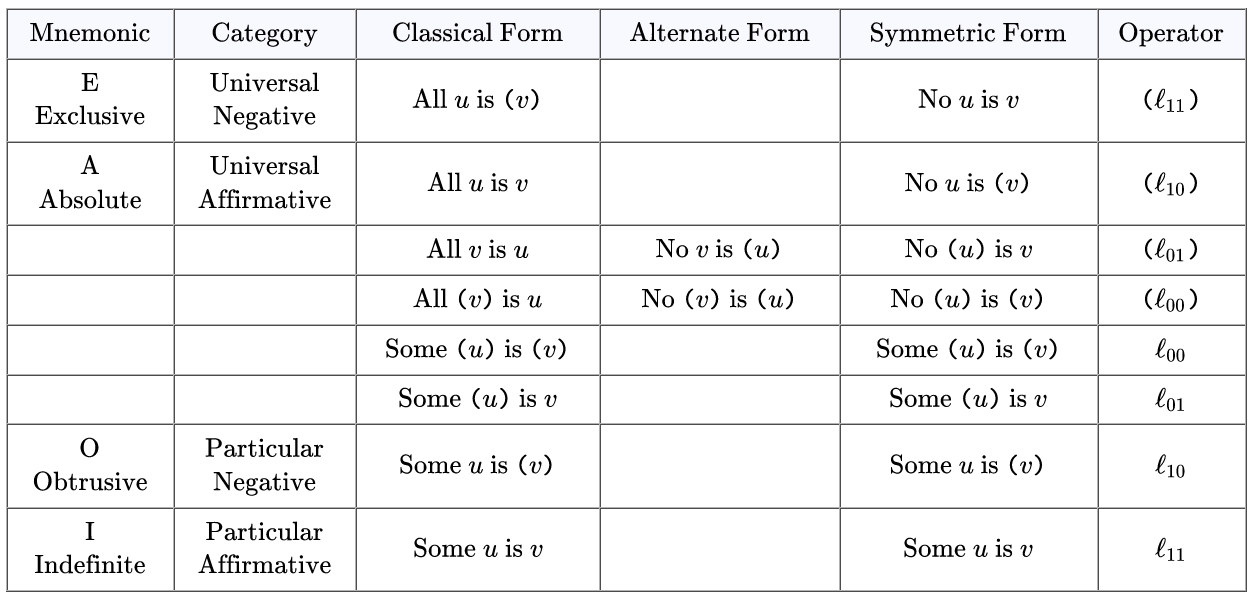
Table 21 provides a thumbnail sketch of the relationships discussed in this section.

\text{Table 21. Relation of Quantifiers to Higher Order Propositions}
Relation of Quantifiers to Higher Order Propositions

Resources

cc: FB | Peirce MattersLaws of FormMathstodonOntologAcademia.edu
cc: Conceptual GraphsCyberneticsStructural ModelingSystems Science

Posted in Abduction, Analogy, Argument, Aristotle, C.S. Peirce, Constraint, Deduction, Determination, Diagrammatic Reasoning, Diagrams, Differential Logic, Functional Logic, Hypothesis, Indication, Induction, Inference, Information, Inquiry, Logic, Logic of Science, Mathematics, Pragmatic Semiotic Information, Probable Reasoning, Propositional Calculus, Propositions, Reasoning, Retroduction, Semiotics, Sign Relations, Syllogism, Triadic Relations, Visualization | Tagged , , , , , , , , , , , , , , , , , , , , , , , , , , , , , , , | 4 Comments

Functional Logic • Inquiry and Analogy • 19

Inquiry and AnalogyApplication of Higher Order Propositions to Quantification Theory

Reflection is turning a topic over in various aspects and in various lights so that nothing significant about it shall be overlooked — almost as one might turn a stone over to see what its hidden side is like or what is covered by it.

John Dewey • How We Think

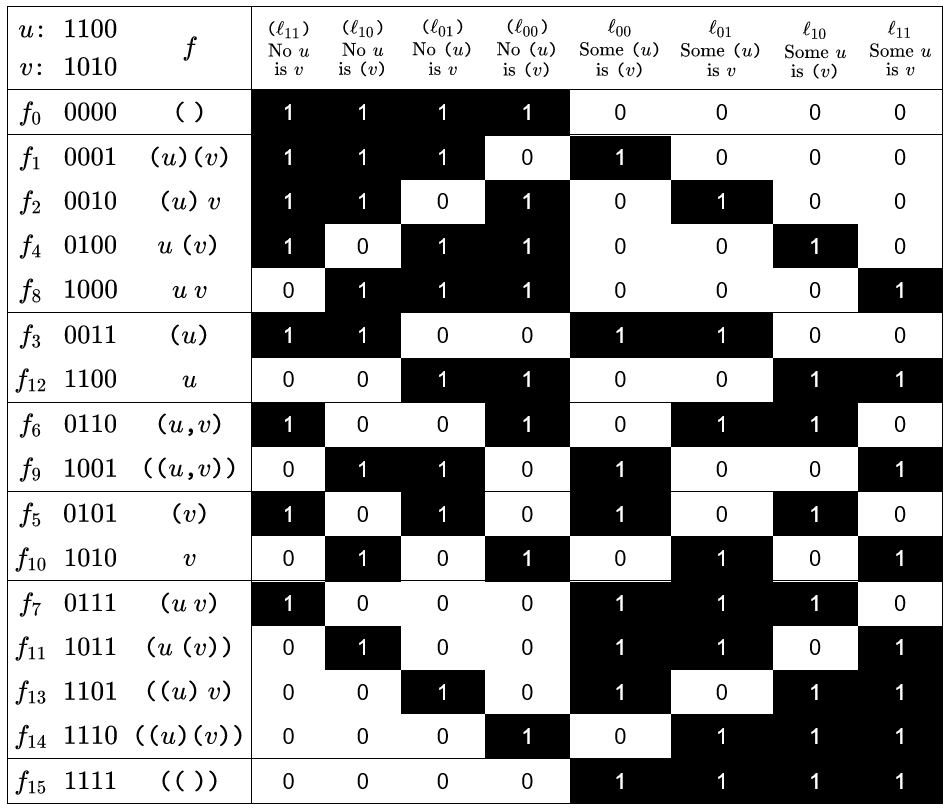
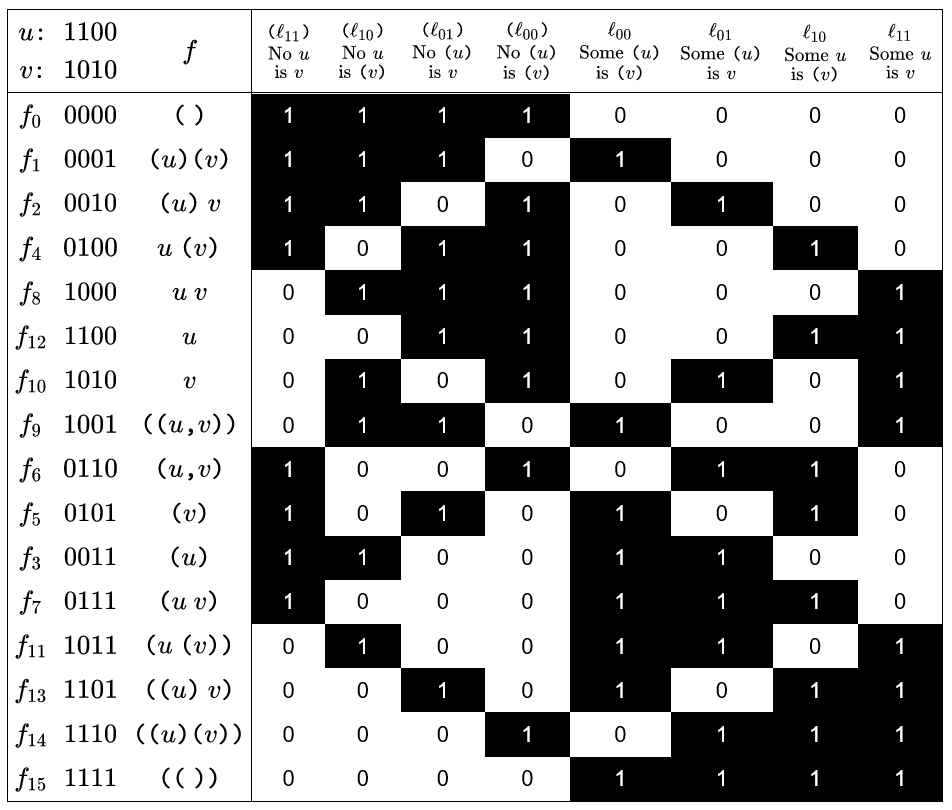
Tables 19 and 20 present the same information as Table 18, sorting the rows in different orders to reveal other symmetries in the arrays.

\text{Table 19. Simple Qualifiers of Propositions (Version 2)}
Simple Qualifiers of Propositions (Version 2)

\text{Table 20. Simple Qualifiers of Propositions (Version 3)}
Simple Qualifiers of Propositions (Version 3)

Resources

cc: FB | Peirce MattersLaws of FormMathstodonOntologAcademia.edu
cc: Conceptual GraphsCyberneticsStructural ModelingSystems Science

Posted in Abduction, Analogy, Argument, Aristotle, C.S. Peirce, Constraint, Deduction, Determination, Diagrammatic Reasoning, Diagrams, Differential Logic, Functional Logic, Hypothesis, Indication, Induction, Inference, Information, Inquiry, Logic, Logic of Science, Mathematics, Pragmatic Semiotic Information, Probable Reasoning, Propositional Calculus, Propositions, Reasoning, Retroduction, Semiotics, Sign Relations, Syllogism, Triadic Relations, Visualization | Tagged , , , , , , , , , , , , , , , , , , , , , , , , , , , , , , , | 4 Comments

Functional Logic • Inquiry and Analogy • 18

Inquiry and AnalogyApplication of Higher Order Propositions to Quantification Theory

Last time we took up a fourfold scheme of quantified propositional forms traditionally known as a “Square of Opposition”, relating it to a quartet of higher order propositions which, depending on context, are also known as measures, qualifiers, or higher order indicator functions.

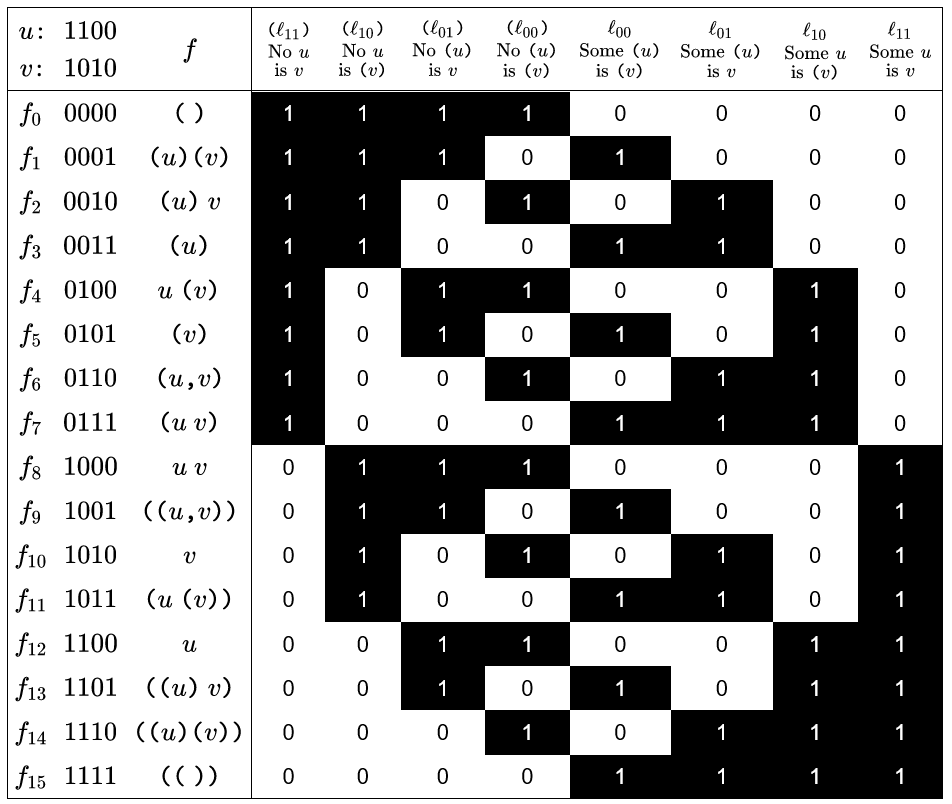
Table 18 develops the above ideas in further detail, expressing a larger set of quantified propositional forms by means of propositions about propositions.

\text{Table 18. Simple Qualifiers of Propositions (Version 1)}
Simple Qualifiers of Propositions (Version 1)

Resources

cc: FB | Peirce MattersLaws of FormMathstodonOntologAcademia.edu
cc: Conceptual GraphsCyberneticsStructural ModelingSystems Science

Posted in Abduction, Analogy, Argument, Aristotle, C.S. Peirce, Constraint, Deduction, Determination, Diagrammatic Reasoning, Diagrams, Differential Logic, Functional Logic, Hypothesis, Indication, Induction, Inference, Information, Inquiry, Logic, Logic of Science, Mathematics, Pragmatic Semiotic Information, Probable Reasoning, Propositional Calculus, Propositions, Reasoning, Retroduction, Semiotics, Sign Relations, Syllogism, Triadic Relations, Visualization | Tagged , , , , , , , , , , , , , , , , , , , , , , , , , , , , , , , | 4 Comments

Functional Logic • Inquiry and Analogy • 17

Inquiry and AnalogyApplication of Higher Order Propositions to Quantification Theory

Our excursion into the expanding landscape of higher order propositions has come round to the point where we can begin to open up new perspectives on quantificational logic.

Though it may be all the same from a purely formal point of view, it does serve intuition to adopt a slightly different interpretation for the two‑valued space we take as the target of our basic indicator functions.  In that spirit we declare a novel type of existence-valued functions f : \mathbb{B}^k \to \mathbb{E} where \mathbb{E} = \{ -e, +e \} = \{ \mathrm{empty}, \mathrm{existent} \} is a pair of values indicating whether anything exists in the cells of the underlying universe of discourse.  As usual, we won’t be too picky about the coding of those functions, reverting to binary codes whenever the intended interpretation is clear enough.

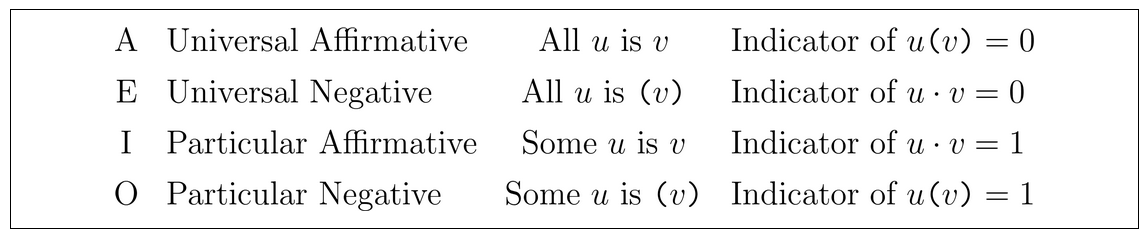
With that interpretation in mind we observe the following correspondence between classical quantifications and higher order indicator functions.

\text{Table 17. Syllogistic Premisses as Higher Order Indicator Functions}
Syllogistic Premisses as Higher Order Indicator Functions

Resources

cc: FB | Peirce MattersLaws of FormMathstodonOntologAcademia.edu
cc: Conceptual GraphsCyberneticsStructural ModelingSystems Science

Posted in Abduction, Analogy, Argument, Aristotle, C.S. Peirce, Constraint, Deduction, Determination, Diagrammatic Reasoning, Diagrams, Differential Logic, Functional Logic, Hypothesis, Indication, Induction, Inference, Information, Inquiry, Logic, Logic of Science, Mathematics, Pragmatic Semiotic Information, Probable Reasoning, Propositional Calculus, Propositions, Reasoning, Retroduction, Semiotics, Sign Relations, Syllogism, Triadic Relations, Visualization | Tagged , , , , , , , , , , , , , , , , , , , , , , , , , , , , , , , | 4 Comments

Functional Logic • Inquiry and Analogy • 16

Inquiry and AnalogyExtending the Existential Interpretation to Quantificational Logic

One of the resources we have for our investigation is a formal calculus based on C.S. Peirce’s logical graphs.  For the present we’ll adopt the existential interpretation of that calculus, fixing the meanings of logical constants and connectives at the core level of propositional logic.  To build on that core we’ll need to extend the existential interpretation to encompass the analysis of quantified propositions, or quantifications.  That in turn will take developing two further capacities of our calculus.  On the formal side we’ll need to consider higher order functional types, continuing our earlier venture above.  In terms of content we’ll need to consider new species of elemental or singular propositions.

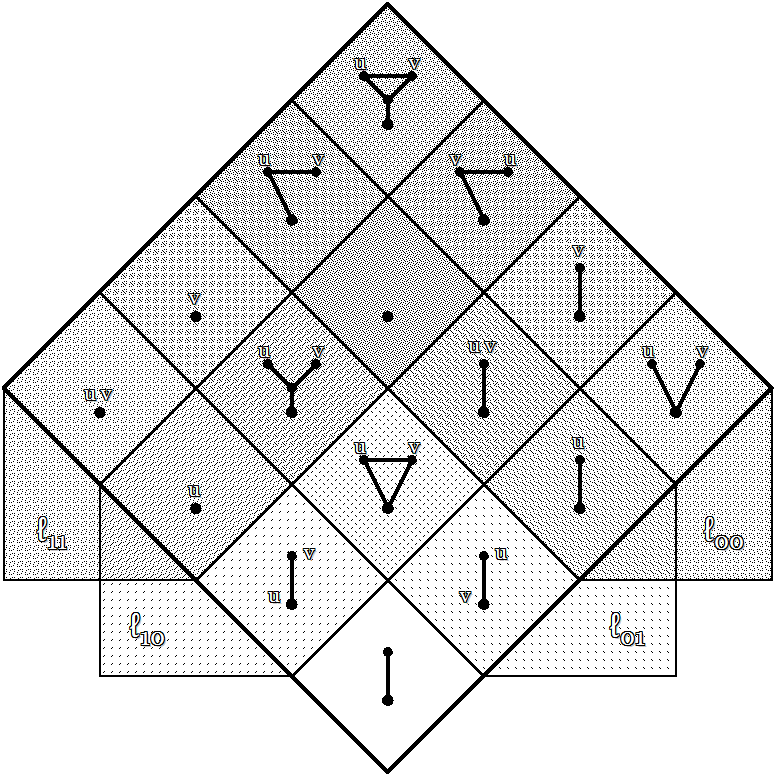
Let us return to the 2‑dimensional universe X^\bullet = [u, v].  A bridge between propositions and quantifications is afforded by a set of measures or qualifiers \ell_{ij} : (\mathbb{B} \times \mathbb{B} \to \mathbb{B}) \to \mathbb{B} defined by the following equations.

\begin{array}{*{11}{l}}  \ell_{00} f  & = & \ell_{\texttt{(} u \texttt{)(} v \texttt{)}} f  & = & \alpha_1 f  & = & \Upsilon_{\texttt{(} u \texttt{)(} v \texttt{)}} f  & = & \Upsilon_{\texttt{(} u \texttt{)(} v \texttt{)} \,\Rightarrow\, f}  & = & f ~\text{likes}~ \texttt{(} u \texttt{)(} v \texttt{)}  \\  \ell_{01} f  & = & \ell_{\texttt{(} u \texttt{)} v} f  & = & \alpha_2 f  & = & \Upsilon_{\texttt{(} u \texttt{)} v} f  & = & \Upsilon_{\texttt{(} u \texttt{)} v \,\Rightarrow\, f}  & = & f ~\text{likes}~ \texttt{(} u \texttt{)}  v  \\  \ell_{10} f  & = & \ell_{u  \texttt{(} v \texttt{)}} f  & = & \alpha_4 f  & = & \Upsilon_{u \texttt{(} v \texttt{)}} f  & = & \Upsilon_{u \texttt{(} v \texttt{)} \,\Rightarrow\, f}  & = & f ~\text{likes}~ u  \texttt{(} v \texttt{)}  \\  \ell_{11} f  & = & \ell_{u \, v} f  & = & \alpha_8 f  & = & \Upsilon_{u \, v} f  & = & \Upsilon_{u \, v \,\Rightarrow\, f}  & = & f ~\text{likes}~ u \, v  \end{array}

A higher order proposition \ell_{ij} : (\mathbb{B} \times \mathbb{B} \to \mathbb{B}) \to \mathbb{B} tells us something about the proposition f :\mathbb{B} \times \mathbb{B} \to \mathbb{B}, namely, which elements in the space of type \mathbb{B} \times \mathbb{B} are assigned a positive value by f.  Taken together, the \ell_{ij} operators give us a way to express many useful observations about the propositions in X^\bullet = [u, v].  Figure 16 summarizes the action of the \ell_{ij} operators on the propositions of type f :\mathbb{B} \times \mathbb{B} \to \mathbb{B}.

Higher Order Universe of Discourse
\text{Figure 16. Higher Order Universe of Discourse}~ [ \ell_{00}, \ell_{01}, \ell_{10}, \ell_{11} ] \subseteq [[ u, v ]]

Resources

cc: FB | Peirce MattersLaws of FormMathstodonOntologAcademia.edu
cc: Conceptual GraphsCyberneticsStructural ModelingSystems Science

Posted in Abduction, Analogy, Argument, Aristotle, C.S. Peirce, Constraint, Deduction, Determination, Diagrammatic Reasoning, Diagrams, Differential Logic, Functional Logic, Hypothesis, Indication, Induction, Inference, Information, Inquiry, Logic, Logic of Science, Mathematics, Pragmatic Semiotic Information, Probable Reasoning, Propositional Calculus, Propositions, Reasoning, Retroduction, Semiotics, Sign Relations, Syllogism, Triadic Relations, Visualization | Tagged , , , , , , , , , , , , , , , , , , , , , , , , , , , , , , , | 4 Comments