Inquiry Into Inquiry • Discussion 9

Re: Pragmatic Maxim
Re: Academia.edu • Milo Gardner

MG:
Do you agree that Peirce was limited to bivalent logic?

Taking classical logic as a basis for reasoning is no more limiting than taking Dedekind cuts as a basis for constructing the real number line.  For Peirce’s relational approach to logic as semiotics the number of dimensions in a relation is more important than the number of values in each dimension.  That is where 3 makes a difference over 2.

cc: Inquiry Driven SystemsLaws of FormMathstodonAcademia.edu
cc: Conceptual GraphsCyberneticsStructural ModelingSystems Science

Posted in Automata, C.S. Peirce, Category Theory, Compositionality, Formal Languages, Inference, Information, Information Fusion, Initiative, Inquiry, Logic, Relation Theory, Semiotics, Triadic Relation Irreducibility, Visualization | Tagged , , , , , , , , , , , , , , | 5 Comments

Inquiry Into Inquiry • Discussion 8

Re: Inquiry Into Inquiry • Discussion 7
Re: Academia.edu • Milo Gardner

MG:
Peirce sensed that bivalent syntax was superceded by trivalent syntax,
but never resolved that nagging question.

The main thing is not a question of syntax but a question of the mathematical models we use to cope with object realities and real objectives (pragmata).  Signs, syntax, and systems of representation can make a big difference in how well they represent the object domain and how well they serve the purpose at hand but they remain accessory to those objects and purposes.

cc: Inquiry Driven SystemsLaws of FormMathstodonAcademia.edu
cc: Conceptual GraphsCyberneticsStructural ModelingSystems Science

Posted in Automata, C.S. Peirce, Category Theory, Compositionality, Formal Languages, Inference, Information, Information Fusion, Initiative, Inquiry, Logic, Relation Theory, Semiotics, Triadic Relation Irreducibility, Visualization | Tagged , , , , , , , , , , , , , , | 5 Comments

Inquiry Into Inquiry • Discussion 7

Dan Everett has prompted a number of discussions on Facebook recently which touch on core issues in Peirce’s thought — but threads ravel on and fray so quickly in that medium one rarely gets a chance to fill out the warp.  Not exactly at random, here’s a loose thread I think may be worth the candle.

Re: Facebook • Daniel Everett

Compositionality started out as a well‑defined concept, arising from the composition of mathematical functions, abstracted to the composition of arrows and functors in category theory, and generalized to the composition of binary, two-place, or dyadic relations.  In terms of linguistic complexity it’s associated with properly context‑free languages.  That all keeps compositionality on the dyadic side of the border in Peirce’s universe.  More lately the term has been volatilized to encompass almost any sort of information fusion, which is all well and good so long as folks make it clear what they are talking about, for which use the term “information fusion” would probably be sufficiently vague.

cc: Inquiry Driven SystemsLaws of FormMathstodonAcademia.edu
cc: Conceptual GraphsCyberneticsStructural ModelingSystems Science

Posted in Automata, C.S. Peirce, Category Theory, Compositionality, Formal Languages, Inference, Information, Information Fusion, Initiative, Inquiry, Logic, Relation Theory, Semiotics, Triadic Relation Irreducibility, Visualization | Tagged , , , , , , , , , , , , , , | 5 Comments

Pragmatic Maxim

The pragmatic maxim is a guideline for the practice of inquiry formulated by Charles Sanders Peirce.  Serving as a practical recommendation or regulative principle in the normative science of logic, its function is to guide the conduct of thought toward the achievement of its purpose, advising the addressee on an optimal way of “attaining clearness of apprehension”.

Introduction

The “pragmatic maxim”, also known as the “maxim of pragmatism” or the “maxim of pragmaticism”, is a maxim of logic formulated by Charles Sanders Peirce.  Serving as a practical recommendation or regulative principle in the normative science of logic, its function is to guide the conduct of thought toward the achievement of its purpose, advising the addressee on an optimal way of “attaining clearness of apprehension”.

Seven Ways of Looking at a Pragmatic Maxim

Peirce stated the pragmatic maxim in many different ways over the years, each of which adds its own bit of clarity or correction to their collective corpus.

  • The first excerpt appears in the form of a dictionary entry, intended as a definition of pragmatism.

    Pragmatism.  The opinion that metaphysics is to be largely cleared up by the application of the following maxim for attaining clearness of apprehension:

    “Consider what effects, that might conceivably have practical bearings, we conceive the object of our conception to have.  Then, our conception of these effects is the whole of our conception of the object.”  (Peirce, CP 5.2, 1878/1902).

  • The second excerpt gives another version of the pragmatic maxim, a recommendation about a way of clarifying meaning that can be taken to stake out the general philosophy of pragmatism.

    Pragmaticism was originally enounced in the form of a maxim, as follows:  Consider what effects that might conceivably have practical bearings you conceive the objects of your conception to have.  Then, your conception of those effects is the whole of your conception of the object.

    I will restate this in other words, since ofttimes one can thus eliminate some unsuspected source of perplexity to the reader. This time it shall be in the indicative mood, as follows: The entire intellectual purport of any symbol consists in the total of all general modes of rational conduct which, conditionally upon all the possible different circumstances and desires, would ensue upon the acceptance of the symbol.  (Peirce, CP 5.438, 1878/1905).

  • The third excerpt puts a gloss on the meaning of a practical bearing and provides an alternative statement of the maxim.

    Such reasonings and all reasonings turn upon the idea that if one exerts certain kinds of volition, one will undergo in return certain compulsory perceptions.  Now this sort of consideration, namely, that certain lines of conduct will entail certain kinds of inevitable experiences is what is called a “practical consideration”.  Hence is justified the maxim, belief in which constitutes pragmatism;  namely:

    In order to ascertain the meaning of an intellectual conception one should consider what practical consequences might conceivably result by necessity from the truth of that conception;  and the sum of these consequences will constitute the entire meaning of the conception.  (Peirce, CP 5.9, 1905).

  • The fourth excerpt illustrates one of Peirce’s many attempts to get the sense of the pragmatic philosophy across by rephrasing the pragmatic maxim in an alternative way.  In introducing this version, he addresses an order of prospective critics who do not deem a simple heuristic maxim, much less one that concerns itself with a routine matter of logical procedure, as forming a sufficient basis for a full-grown philosophy.

    On their side, one of the faults that I think they might find with me is that I make pragmatism to be a mere maxim of logic instead of a sublime principle of speculative philosophy.  In order to be admitted to better philosophical standing I have endeavored to put pragmatism as I understand it into the same form of a philosophical theorem.  I have not succeeded any better than this:

    Pragmatism is the principle that every theoretical judgment expressible in a sentence in the indicative mood is a confused form of thought whose only meaning, if it has any, lies in its tendency to enforce a corresponding practical maxim expressible as a conditional sentence having its apodosis in the imperative mood.  (Peirce, CP 5.18, 1903).

  • The fifth excerpt is useful by way of additional clarification, and was aimed to correct a variety of historical misunderstandings that arose over time with regard to the intended meaning of the pragmatic maxim.

    The doctrine appears to assume that the end of man is action — a stoical axiom which, to the present writer at the age of sixty, does not recommend itself so forcibly as it did at thirty.  If it be admitted, on the contrary, that action wants an end, and that that end must be something of a general description, then the spirit of the maxim itself, which is that we must look to the upshot of our concepts in order rightly to apprehend them, would direct us towards something different from practical facts, namely, to general ideas, as the true interpreters of our thought.  (Peirce, CP 5.3, 1902).

  • A sixth excerpt is useful in stating the bearing of the pragmatic maxim on the topic of reflection, namely, that it makes all of pragmatism boil down to nothing more or less than a method of reflection.

    The study of philosophy consists, therefore, in reflexion, and pragmatism is that method of reflexion which is guided by constantly holding in view its purpose and the purpose of the ideas it analyzes, whether these ends be of the nature and uses of action or of thought. … It will be seen that pragmatism is not a Weltanschauung but is a method of reflexion having for its purpose to render ideas clear.  (Peirce, CP 5.13 note 1, 1902).

  • The seventh excerpt is a late reflection on the reception of pragmatism.  With a sense of exasperation that is almost palpable, Peirce tries to justify the maxim of pragmatism and to correct its misreadings by pinpointing a number of false impressions that the intervening years have piled on it, and he attempts once more to prescribe against the deleterious effects of these mistakes.  Recalling the very conception and birth of pragmatism, he reviews its initial promise and its intended lot in the light of its subsequent vicissitudes and its apparent fate.  Adopting the style of a post mortem analysis, he presents a veritable autopsy of the ways that the main idea of pragmatism, for all its practicality, can be murdered by a host of misdissecting disciplinarians, by what are ostensibly its most devoted followers.

    This employment five times over of derivates of concipere must then have had a purpose.  In point of fact it had two.  One was to show that I was speaking of meaning in no other sense than that of intellectual purport.  The other was to avoid all danger of being understood as attempting to explain a concept by percepts, images, schemata, or by anything but concepts.  I did not, therefore, mean to say that acts, which are more strictly singular than anything, could constitute the purport, or adequate proper interpretation, of any symbol.  I compared action to the finale of the symphony of thought, belief being a demicadence.  Nobody conceives that the few bars at the end of a musical movement are the purpose of the movement.  They may be called its upshot.  (Peirce, CP 5.402 note 3, 1906).

References

  • Peirce, C.S., Collected Papers of Charles Sanders Peirce, vols. 1–6, Charles Hartshorne and Paul Weiss (eds.), vols. 7–8, Arthur W. Burks (ed.), Harvard University Press, Cambridge, MA, 1931–1935, 1958.  Cited as CP n.m for volume n, paragraph m.

Readings

  • Awbrey, J.L., and Awbrey, S.M. (1995), “Interpretation as Action : The Risk of Inquiry”, Inquiry : Critical Thinking Across the Disciplines 15(1), 40–52.  ArchiveJournal.  Online (doc) (pdf).

Resources

cc: Peirce MattersLaws of FormMathstodonStructural Modeling
cc: Academia.eduConceptual GraphsCyberneticsSystems Science

Posted in C.S. Peirce, Logic, Method, Peirce, Philosophy, Pragmatic Maxim, Pragmatism, References, Sources | Tagged , , , , , , , , | 12 Comments

Survey of Precursors Of Category Theory • 4

A few years ago I began a sketch on the “Precursors of Category Theory”, tracing the continuities of the category concept from Aristotle, to Kant and Peirce, through Hilbert and Ackermann, to contemporary mathematical practice.  A Survey of resources on the topic is given below, still very rough and incomplete, but perhaps a few will find it of use.

Background

Blog Series

  • Notes On Categories • (1)
  • Precursors Of Category Theory • (1)(2)(3)

Categories à la Peirce

cc: FB | Peirce MattersLaws of FormMathstodonOntologAcademia.edu
cc: Conceptual GraphsCyberneticsStructural ModelingSystems Science

Posted in Abstraction, Ackermann, Analogy, Aristotle, C.S. Peirce, Carnap, Category Theory, Diagrams, Foundations of Mathematics, Functional Logic, Hilbert, History of Mathematics, Hypostatic Abstraction, Kant, Logic, Mathematics, Peirce, Propositions As Types Analogy, Relation Theory, Saunders Mac Lane, Semiotics, Type Theory, Universals | Tagged , , , , , , , , , , , , , , , , , , , , , , | 1 Comment

Survey of Relation Theory • 7

In the present Survey of blog and wiki resources for Relation Theory, relations are viewed from the perspective of combinatorics, in other words, as a topic in discrete mathematics, with special attention to finite structures and concrete set‑theoretic constructions, many of which arise quite naturally in applications.  This approach to relation theory is distinct from, though closely related to, its study from the perspectives of abstract algebra on the one hand and formal logic on the other.

Elements

Relational Concepts

Relation Composition Relation Construction Relation Reduction
Relative Term Sign Relation Triadic Relation
Logic of Relatives Hypostatic Abstraction Continuous Predicate

Illustrations

Information‑Theoretic Perspective

  • Mathematical Demonstration and the Doctrine of Individuals • (1)(2)

Blog Series

Peirce’s 1870 “Logic of Relatives”

Peirce’s 1880 “Algebra of Logic” Chapter 3

Resources

cc: FB | Relation TheoryLaws of FormMathstodonOntologAcademia.edu
cc: Conceptual GraphsCyberneticsStructural ModelingSystems Science

Posted in Algebra, Algebra of Logic, C.S. Peirce, Category Theory, Combinatorics, Discrete Mathematics, Duality, Dyadic Relations, Foundations of Mathematics, Graph Theory, Logic, Logic of Relatives, Mathematics, Peirce, Relation Theory, Semiotics, Set Theory, Sign Relational Manifolds, Sign Relations, Surveys, Triadic Relations, Triadicity, Type Theory | Tagged , , , , , , , , , , , , , , , , , , , , , , | Leave a comment

Survey of Pragmatic Semiotic Information • 7

This is a Survey of blog and wiki posts on a theory of information which grows out of pragmatic semiotic ideas.  All my projects are exploratory in character but this line of inquiry is more open‑ended than most.  The question is —

What is information and how does it impact the spectrum of activities answering to the name of inquiry?

Setting out on what would become his lifelong quest to explore and explain the “Logic of Science”, C.S. Peirce pierced the veil of historical confusions obscuring the issue and fixed on what he called the “laws of information” as the key to solving the puzzle.

The first hints of the Information Revolution in our understanding of scientific inquiry may be traced to Peirce’s lectures of 1865–1866 at Harvard University and the Lowell Institute.  There Peirce took up “the puzzle of the validity of scientific inference” and claimed it was “entirely removed by a consideration of the laws of information”.

Fast forward to the present and I see the Big Question as follows.  Having gone through the exercise of comparing and contrasting Peirce’s theory of information, however much it yet remains in a rough‑hewn state, with Shannon’s paradigm so pervasively informing the ongoing revolution in our understanding and use of information, I have reason to believe Peirce’s idea is root and branch more general and has the potential, with due development, to resolve many mysteries still bedeviling our grasp of inference, information, and inquiry.

Inference, Information, Inquiry

Pragmatic Semiotic Information

Semiotics, Semiosis, Sign Relations

Sign Relations, Triadic Relations, Relation Theory

  • Blog Series • (1)
    • Discusssions • (1)(2)

Excursions

Blog Dialogs

References

  • Peirce, C.S. (1867), “Upon Logical Comprehension and Extension”.  Online.
  • Awbrey, J.L., and Awbrey, S.M. (1992), “Interpretation as Action : The Risk of Inquiry”, The Eleventh International Human Science Research Conference, Oakland University, Rochester, Michigan.
  • Awbrey, J.L., and Awbrey, S.M. (1995), “Interpretation as Action : The Risk of Inquiry”, Inquiry : Critical Thinking Across the Disciplines 15(1), pp. 40–52.  ArchiveJournalOnline.

cc: FB | SemeioticsLaws of FormMathstodonOntologAcademia.edu
cc: Conceptual GraphsCyberneticsStructural ModelingSystems Science

Posted in Abduction, C.S. Peirce, Communication, Control, Cybernetics, Deduction, Determination, Discovery, Doubt, Epistemology, Fixation of Belief, Induction, Information, Information = Comprehension × Extension, Information Theory, Inquiry, Inquiry Driven Systems, Inquiry Into Inquiry, Interpretation, Invention, Knowledge, Learning Theory, Logic, Logic of Relatives, Logic of Science, Mathematics, Peirce, Philosophy, Philosophy of Science, Pragmatic Information, Probable Reasoning, Process Thinking, Relation Theory, Scientific Inquiry, Scientific Method, Semeiosis, Semiosis, Semiotic Information, Semiotics, Sign Relational Manifolds, Sign Relations, Surveys, Triadic Relations, Uncertainty | Tagged , , , , , , , , , , , , , , , , , , , , , , , , , , , , , , , , , , , , , , , , , , , | 3 Comments

Pragmatic Semiotic Information • Ψ

I remember it was back in ’76 when I began to notice a subtle shift of focus in the computer science journals I was reading, from discussing X to discussing Information About X, a transformation I noted mentally as X \to \mathrm{Info}(X) whenever I ran across it.  I suppose that small arc of revolution had been building for years but it struck me as crossing a threshold to a more explicit, self‑conscious stage about that time.

cc: FB | SemeioticsLaws of FormMathstodonOntologAcademia.edu
cc: Conceptual GraphsCyberneticsStructural ModelingSystems Science

Posted in Abduction, C.S. Peirce, Comprehension, Deduction, Definition, Determination, Extension, Hypothesis, Icon Index Symbol, Induction, Inference, Information, Information = Comprehension × Extension, Inquiry, Intension, Logic, Logic of Science, Peirce, Pragmatic Semiotic Information, Pragmatism, Scientific Method, Semiotics, Sign Relations | Tagged , , , , , , , , , , , , , , , , , , , , , , | 3 Comments

Functional Logic • Inquiry and Analogy • 21

Inquiry and AnalogyGeneralized Umpire Operators

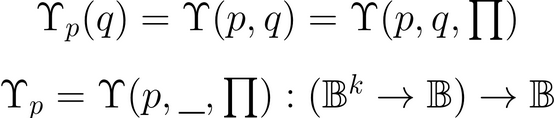
To get a better handle on the space of higher order propositions and continue developing our functional approach to quantification theory, we’ll need a number of specialized tools.  To begin, we define a higher order operator \Upsilon, called the umpire operator, which takes 1, 2, or 3 propositions as arguments and returns a single truth value as the result.  Operators with optional numbers of arguments are called multigrade operators, typically defined as unions over function types.  Expressing \Upsilon in that form gives the following formula.

UMP 1

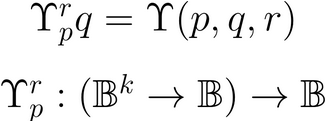
In contexts of application, that is, where a multigrade operator is actually being applied to arguments, the number of arguments in the argument list tells which of the optional types is “operative”.  In the case of \Upsilon, the first and last arguments appear as indices, the one in the middle serving as the main argument while the other two arguments serve to modify the sense of the operation in question.  Thus, we have the following forms.

UMP 2

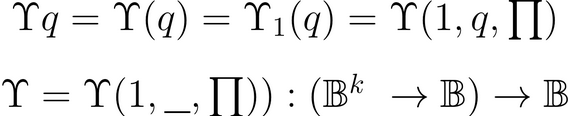
The operation \Upsilon_p^r q evaluates the proposition q on each model of the proposition p and combines the results according to the method indicated by the connective parameter r.  In principle, the index r may specify any logical connective on as many as 2^k arguments but in practice we usually have a much simpler form of combination in mind, typically either products or sums.  By convention, each of the accessory indices p, r is assigned a default value understood to be in force when the corresponding argument place is left blank, specifically, the constant proposition 1 : \mathbb{B}^k \to \mathbb{B} for the lower index p and the continued conjunction or continued product operation \textstyle\prod for the upper index r.  Taking the upper default value gives license to the following readings.

UMP 3

This means \Upsilon_p (q) = 1 if and only if q holds for all models of p.  In propositional terms, this is tantamount to the assertion that p \Rightarrow q, or that \texttt{(} p \texttt{(} q \texttt{))} = 1.

Throwing in the lower default value permits the following abbreviations.

UMP 4

This means \Upsilon q = 1 if and only if q holds for the whole universe of discourse in question, that is, if and only q is the constantly true proposition 1 : \mathbb{B}^k \to \mathbb{B}.  The ambiguities of this usage are not a problem so long as we distinguish the context of definition from the context of application and restrict all shorthand notations to the latter.
Resources

cc: FB | Peirce MattersLaws of FormMathstodonOntologAcademia.edu
cc: Conceptual GraphsCyberneticsStructural ModelingSystems Science

Posted in Abduction, Analogy, Argument, Aristotle, C.S. Peirce, Constraint, Deduction, Determination, Diagrammatic Reasoning, Diagrams, Differential Logic, Functional Logic, Hypothesis, Indication, Induction, Inference, Information, Inquiry, Logic, Logic of Science, Mathematics, Pragmatic Semiotic Information, Probable Reasoning, Propositional Calculus, Propositions, Reasoning, Retroduction, Semiotics, Sign Relations, Syllogism, Triadic Relations, Visualization | Tagged , , , , , , , , , , , , , , , , , , , , , , , , , , , , , , , | 4 Comments

Functional Logic • Inquiry and Analogy • 20

Inquiry and AnalogyApplication of Higher Order Propositions to Quantification Theory

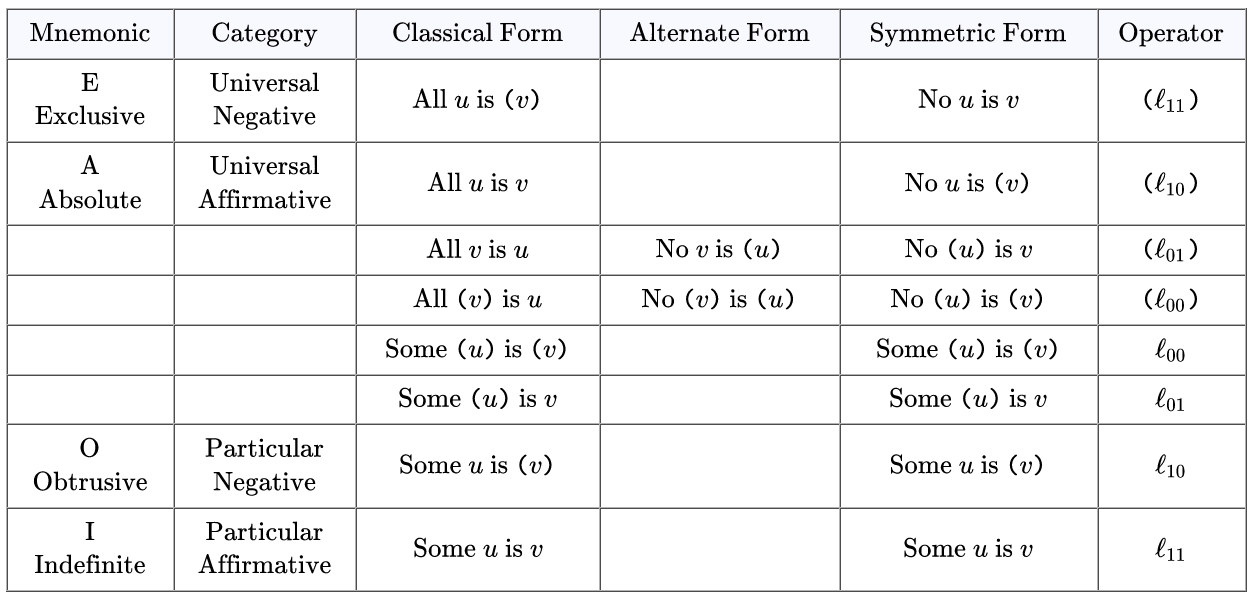
Table 21 provides a thumbnail sketch of the relationships discussed in this section.

\text{Table 21. Relation of Quantifiers to Higher Order Propositions}
Relation of Quantifiers to Higher Order Propositions

Resources

cc: FB | Peirce MattersLaws of FormMathstodonOntologAcademia.edu
cc: Conceptual GraphsCyberneticsStructural ModelingSystems Science

Posted in Abduction, Analogy, Argument, Aristotle, C.S. Peirce, Constraint, Deduction, Determination, Diagrammatic Reasoning, Diagrams, Differential Logic, Functional Logic, Hypothesis, Indication, Induction, Inference, Information, Inquiry, Logic, Logic of Science, Mathematics, Pragmatic Semiotic Information, Probable Reasoning, Propositional Calculus, Propositions, Reasoning, Retroduction, Semiotics, Sign Relations, Syllogism, Triadic Relations, Visualization | Tagged , , , , , , , , , , , , , , , , , , , , , , , , , , , , , , , | 4 Comments