Differential Logic and Dynamic Systems • Discussion 1

It is understandable that an engineer should be completely absorbed in his speciality, instead of pouring himself out into the freedom and vastness of the world of thought, even though his machines are being sent off to the ends of the earth;  for he no more needs to be capable of applying to his own personal soul what is daring and new in the soul of his subject than a machine is in fact capable of applying to itself the differential calculus on which it is based.  The same thing cannot, however, be said about mathematics;  for here we have the new method of thought, pure intellect, the very well-spring of the times, the fons et origo of an unfathomable transformation.

Robert Musil • The Man Without Qualities

Re: Michael HarrisDoes Mathematics “Progress”?

Just off-hand, by way of getting grounded and oriented, there are a few questions I’d have to ask first.

  • Is mathematics a science, or a form of scientific inquiry?
  • If so, what is the place of mathematics within the sciences?
  • Does science progress?
    • (I mean progress in the sense of progress toward a goal, not necessarily progressive jazz or progressions in music generally.)
  • If so, what is the goal of science?
  • If science has a goal, does mathematics serve it?
  • If so, how?

By science or scientific inquiry I meant to focus on species of goal-directed activity with the specific goal of “knowledge” and to ask whether mathematical arts and crafts and rites fall within that ballpark.  We come back to the antic Socratic question of whether we put another quarter in the machine for the sake of an external gain or simply to continue the play for its own sake.

MH:
In this post I was less concerned with philosophy than with philology — which, by the way, is another example of a term that was once seen as hopelessly antiquated and musty but that has been revived recently.
But when you introduce “knowledge” you have to grapple with “truth” and “objective reality”.  Philosophy has been so unsuccessful at pinning those down that some would prefer to give up on them altogether.  We can choose to call what mathematics generates “knowledge” but that just leads to the (philological) question of what this has to do with what other practices call “knowledge”.

Not that I don’t love wisdom and words, however often their stars may cross, but I invoked Musil rather for the way he syzygied the way of the engineer, the way of the mathematician, and the recursive point where their ways diverge.  It’s in this frame I think of the word entelechy, which I got from readings in Aristotle, Goethe, and Peirce and promptly gave a personal gloss as end in itself, partly on the influence of Conway’s game theory.

And that’s where I remember all those two-bit pieces I gave up to pinball machines in the early 70s and the critical point in my own trajectory when I realized I would never beat those machines, not that way, not ever, and I turned to the more collaboratory ends of teaching machines how to learn and reason.

♩ On A Related Note ♪ The Music Of The Primes ♫

Now there’s a progression of progressions I could enjoy, musically speaking, ad infinitum, and yet this pilgrim would consider it progress, mathematically speaking, if he could understand why the sequentiae should be sequenced as they are.  Would that understanding add to my enjoyment?  On jugera …

Resources

cc: CyberneticsOntolog • Peirce List (1) (2)Structural ModelingSystems Science
cc: FB | Differential LogicLaws of Form

Posted in Amphecks, Boolean Functions, C.S. Peirce, Cactus Graphs, Category Theory, Change, Computational Complexity, Cybernetics, Differential Analytic Turing Automata, Differential Calculus, Differential Logic, Discrete Dynamics, Dynamical Systems, Equational Inference, Functional Logic, Gradient Descent, Graph Theory, Group Theory, Hologrammautomaton, Indicator Functions, Logic, Logical Graphs, Mathematical Models, Mathematics, Minimal Negation Operators, Painted Cacti, Peirce, Propositional Calculus, Propositional Equation Reasoning Systems, Time, Visualization | Tagged , , , , , , , , , , , , , , , , , , , , , , , , , , , , , , | 7 Comments

Survey of Differential Logic • 3

This is a Survey of blog and wiki posts on Differential Logic, material I plan to develop toward a more compact and systematic account.

Note.  One effect of the pandemic has been been to blot out my memory of much work I blogged over the year and many group discussions I have in mind as “recent” and “I’ll get back to it” actually occurred several months ago.  Thinking it will serve memory to recycle the more eddifying currents of water under the bridge, here’s an update of my Survey page on Differential Logic.

Elements

Blog Series

Architectonics

Applications

Blog Dialogs

Explorations

cc: Conceptual GraphsCyberneticsOntologStructural ModelingSystems Science
cc: FB | Differential Logic • Laws of Form (1) (2)

Posted in Amphecks, Animata, Boolean Algebra, Boolean Functions, C.S. Peirce, Cactus Graphs, Category Theory, Change, Cybernetics, Differential Analytic Turing Automata, Differential Calculus, Differential Logic, Discrete Dynamics, Equational Inference, Frankl Conjecture, Functional Logic, Gradient Descent, Graph Theory, Hologrammautomaton, Indicator Functions, Inquiry Driven Systems, Leibniz, Logic, Logical Graphs, Mathematics, Minimal Negation Operators, Painted Cacti, Peirce, Propositional Calculus, Surveys, Time, Topology, Visualization, Zeroth Order Logic | Tagged , , , , , , , , , , , , , , , , , , , , , , , , , , , , , , , , , | 16 Comments

Differential Logic • Comment 5

Re: Peirce ListJohn Sowa : “Modal Logic Is An Immense Swamp”

Dear John,

Best title I’ve read in a long time!  But the really immense swamp critter here is the Naturally Evolved Organon known as ornery natural language which resists any augmentation by mathematics and keeps trying to get by with a motley assortment of evolution’s legacy software.

The way physics adapted to quantitative change was not by adding “tense operators” to Descartes’ analytic geometry but by Leibniz and Newton developing the differential calculus.  The way logic will handle qualitative change is by finding the appropriate logical analogue of differential calculus.  I took a few steps in that direction with the work linked on the following page.

cc: CyberneticsOntolog ForumPeirce ListStructural ModelingSystems Science
cc: FB | Differential LogicLaws of Form

Posted in Adaptive Systems, Amphecks, Belief Systems, Boole, Boolean Algebra, Boolean Functions, C.S. Peirce, Cactus Graphs, Cybernetics, Differential Logic, Discrete Dynamics, Fixation of Belief, Gradient Descent, Graph Theory, Hill Climbing, Hologrammautomaton, Inquiry, Inquiry Driven Systems, Laws of Form, Leibniz, Logic, Logical Graphs, Mathematics, Minimal Negation Operators, Optimization, Painted Cacti, Peirce, Propositional Calculus, Spencer Brown | Tagged , , , , , , , , , , , , , , , , , , , , , , , , , , , , | Comments Off on Differential Logic • Comment 5

Animated Logical Graphs • 75

Re: Richard J. LiptonThe Art Of Math
Re: Animated Logical Graphs • (30)(45)(57)(58)(59)(60)(61)(62)(63)(64)(65)(66)(69)(70)(71)(72)(73)(74)

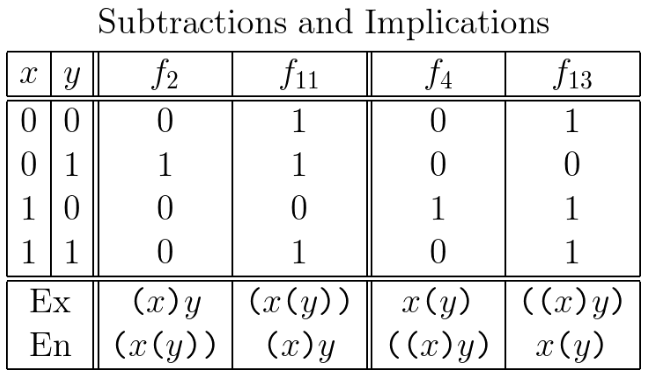
Continuing our scan of the Table in Episode 72, the next two orbits contain the logical graphs for the boolean functions f_{2}, f_{11}, f_{4}, f_{13}, in that order.  A first glance shows these two orbits have surprisingly intricate structures and relationships to each other — let’s isolate that section for a closer look.

\text{Peirce Duality} \stackrel{_\bullet}{} \text{Subtractions and Implications}

Peirce Duality • Subtractions and Implications

  • The boolean functions f_{2} and f_{4} are called subtraction functions.
  • The boolean functions f_{11} and f_{13} are called implication functions.
  • The logical graphs for f_{2} and f_{11} are dual to each other.
  • The logical graphs for f_{4} and f_{13} are dual to each other.

The values of the subtraction and implication functions for each (x, y) \in \mathbb{B} \times \mathbb{B} and the text expressions for their logical graphs are given in the following Table.

Subtractions and Implications

Resources

cc: Peirce List (1) (2) (3) (4) (5) (6) (7) (8) (9) (10) (11) (12) (13) (14) (15) (16)
cc: Structural Modeling (1) (2) • Systems Science (1) (2)
cc: Cybernetics (1) (2) • Ontolog Forum (1) (2)
cc: FB | Logical GraphsLaws of Form

Posted in Amphecks, Animata, Boolean Algebra, Boolean Functions, C.S. Peirce, Cactus Graphs, Constraint Satisfaction Problems, Deduction, Diagrammatic Reasoning, Duality, Equational Inference, Graph Theory, Laws of Form, Logic, Logical Graphs, Mathematics, Minimal Negation Operators, Model Theory, Painted Cacti, Peirce, Proof Theory, Propositional Calculus, Propositional Equation Reasoning Systems, Spencer Brown, Theorem Proving, Visualization | Tagged , , , , , , , , , , , , , , , , , , , , , , , , , | 7 Comments

Definition and Determination • 22

Re: Definition and Determination • (18)(19)(20)(21)
Re: Laws of FormLyle Anderson

Dear Lyle,

The labyrinth of Socratic switchbacks and dialogical detours in Excerpt 21 gave several readers fits of befuddlement.  I think I threaded the maze well enough in what I wrote last time to resolve the more difficult issues, but I guess time will tell.

The remainder of your reply invites us to consider a number of substantive topics, all of which arise quite naturally in this context and all of which will occupy us in the sequel, but for now I have only enough time to record the following outline of topics to take up.

  • Boundary, Content, Cybernetics, Difference, Differential Logic, Distinction, Essential Variable, Gradient, Interior, Motive, Tropism, Topology, Value.
  • Automata, Chomsky–Schützenberger Hierarchy, Computational Complexity,
    Formal Languages, Finite-State Machines, …, Turing Machines.
  • Perfect Information Observer, God’s Eye View, Hologrammautomaton.
  • Finite Information Observer, Human Eye View, Homunculomorphisms (1) (2).

Resources

cc: Inquiry List • Peirce List (1) (2) (3) (4)
cc: Cybernetics (1) (2)Ontolog Forum • Structural Modeling (1) (2)Systems Science
cc: FB | Inquiry Driven SystemsLaws of Form

Posted in C.S. Peirce, Definition, Determination, Inquiry, Logic, Mathematics, Peirce, Phenomenology, Semiotics | Tagged , , , , , , , , | 6 Comments

Definition and Determination • 21

Re: Definition and Determination • (18)(19)(20)
Re: FB | The Ecology of Systems ThinkingRichard Saunders

RS:
Don’t you think some little bit of unconscious knowledge and
logic comes preloaded, à priori, courtesy of our parents DNA? 
Is that simply experience one or more generations removed?

Dear Richard,

Excerpt 21 comes from a lecture on Kant in a series of lectures On the Logic of Science.  Peirce’s survey of conditions for the possibility of science reaches back through his time’s run of the mill dualism of deductive and inductive logic to encompass Aristotle’s notice of abductive reasoning.  This deeper perspective helps Peirce walk the line between empirical and rational sides of science without tumbling into either ism and it aids him in his quest for the questying beast of Kant’s synthetic à priori.  In this setting and under this sum of influences Peirce is led to his prescient theory of information, enabling him to integrate form and matter, intension and extension, into a unified whole.

With all that in mind, when Peirce says, “all our thought begins with experience, the mind furnishes no material for thought whatever”, we have to understand he is using “material” in the Aristotelian sense of matter versus form.  Saying the mind furnishes no material for thought still leaves room for the mind to furnish form for thought.  Much the same point is made in our contemporary literatures of cognitive psychology and linguistics under rubrics like “poverty of the stimulus” and “under-determination of theories by data”.

Resources

cc: Inquiry List • Peirce List (1) (2) (3) (4)
cc: Cybernetics (1) (2)Ontolog Forum • Structural Modeling (1) (2)Systems Science
cc: FB | Inquiry Driven SystemsLaws of Form

Posted in C.S. Peirce, Definition, Determination, Inquiry, Logic, Mathematics, Peirce, Phenomenology, Semiotics | Tagged , , , , , , , , | 6 Comments

Definition and Determination • 20

Re: Peirce ListRobert Marty

RM:
Thank you for this information.  I happen to have a work in progress (not yet written) on the question of determination.  I discovered that Peirce gave a quite remarkable definition in CP 8.361.

“We thus learn that the Object determines (i.e. renders definitely to be such as it will be,) the Sign in a particular manner.”  (CP 8.361, in CP 8.342–379, from M-20b, 1908).

It fits very well with what he writes in Excerpt 21.

“Hence universal and necessary elements of experience are not determined from without.  But are they, therefore, determined from within?  Are they determined at all?  Does not this very conception of determination imply causality and thus beg the whole question of causality at the very outset?  Not at all.  The determination here meant is not real determination but logical determination.  A cognition à priori is one which any experience contains reason for and therefore which no experience determines but which contains elements such as the mind introduces in working up the materials of sense, or rather as they are not new materials, they are the working up.”  (C.S. Peirce, Chronological Edition, CE 1, 246–247).

I have hosted this working paper on my personal website:  The Semiotics.Online, entitled DetermineWhat “Determine” Means.

I appreciate any suggestion or criticism, as usual.

Dear Robert,

Excerpt 21 comes from Peirce’s Harvard Lectures On the Logic of Science (1865).  It begins with a question about the possibility of knowledge à priori and draws conclusions about the grounds of validity for necessary and universal judgements.  For ease of discussion I copy the full excerpt below.

Is there any knowledge à priori?  All our thought begins with experience, the mind furnishes no material for thought whatever.  This is acknowledged by all the philosophers with whom we need concern ourselves at all.  The mind only works over the materials furnished by sense;  no dream is so strange but that all its elementary parts are reminiscences of appearance, the collocation of these alone are we capable of originating.

In one sense, therefore, everything may be said to be inferred from experience;  everything that we know, or think or guess or make up may be said to be inferred by some process valid or fallacious from the impressions of sense.  But though everything in this loose sense is inferred from experience, yet everything does not require experience to be as it is in order to afford data for the inference.  Give me the relations of any geometrical intuition you please and you give me the data for proving all the propositions of geometry.  In other words, everything is not determined by experience.

And this admits of proof.  For suppose there may be universal and necessary judgements;  as for example the moon must be made of green cheese.  But there is no element of necessity in an impression of sense for necessity implies that things would be the same as they are were certain accidental circumstances different from what they are.  I may here note that it is very common to misstate this point, as though the necessity here intended were a necessity of thinking.  But it is not meant to say that what we feel compelled to think we are absolutely compelled to think, as this would imply;  but that if we think a fact must be we cannot have observed that it must be.  The principle is thus reduced to an analytical one.  In the same way universality implies that the event would be the same were the things within certain limits different from what they are.

Hence universal and necessary elements of experience are not determined from without.  But are they, therefore, determined from within?  Are they determined at all?  Does not this very conception of determination imply causality and thus beg the whole question of causality at the very outset?  Not at all.  The determination here meant is not real determination but logical determination.  A cognition à priori is one which any experience contains reason for and therefore which no experience determines but which contains elements such as the mind introduces in working up the materials of sense, or rather as they are not new materials, they are the working up.  (C.S. Peirce, Chronological Edition, CE 1, 246–247).

Reference

  • Charles Sanders Peirce, “Harvard Lectures On the Logic of Science” (1865), Writings of Charles S. Peirce : A Chronological Edition, Volume 1, 1857–1866, Peirce Edition Project, Indiana University Press, Bloomington, IN, 1982.

Resources

cc: Inquiry List • Peirce List (1) (2) (3) (4)
cc: Cybernetics (1) (2)Ontolog Forum • Structural Modeling (1) (2)Systems Science
cc: FB | Inquiry Driven SystemsLaws of Form

Posted in C.S. Peirce, Definition, Determination, Inquiry, Logic, Mathematics, Peirce, Phenomenology, Semiotics | Tagged , , , , , , , , | 7 Comments

Definition and Determination • 19

Re: Peirce ListEdwina Taborsky

JA:
I needed to start thinking of semiotics and sign relations in the light of cybernetics and systems theory.  That required me to convert from understanding a sign relation as a relation among three sets, the Object, Sign, and Interpretant domains, to thinking of a sign relation as involving three active systems, Object, Sign, and Interpretant systems, respectively.
ET:
Sounds very interesting — that concept of semiosis as involving three active systems.

Dear Edwina,

Thanks for that.  As it happens, the transition from sets to systems is smoother than it may seem at first, since the first thing we need to know about a system evolving through time is its state space, which is a set among other things, and the next thing we need to know is the law governing its transition from one state to the next.  A mite steeper is the passage from dyadic, cause-effect, stimulus-response species of determination to more general orders of constraint, law, or rule-governed trajectory through state space.  And that is where Peirce’s anticipation of information theory comes into play.

Regards,

Jon

cc: Inquiry List • Peirce List (1) (2) (3) (4)
cc: Cybernetics (1) (2)Ontolog Forum • Structural Modeling (1) (2)Systems Science
cc: FB | Inquiry Driven SystemsLaws of Form

Posted in C.S. Peirce, Definition, Determination, Inquiry, Logic, Mathematics, Peirce, Phenomenology, Semiotics | Tagged , , , , , , , , | 7 Comments

Definition and Determination • 18

Various discussions in sundry places led me by a commodius vicus of recirculation back to the environs of old notes I gathered on the topics of Definition and Determination, that being on the occasion of a return to graduate school in a system engineering program where I needed to start thinking of semiotics and sign relations in the light of cybernetics and systems theory.

That required me to convert from understanding a sign relation as a relation among three sets, the Object, Sign, and Interpretant domains, to thinking of a sign relation as involving three active systems, Object, Sign, and Interpretant systems, respectively.

It will take a few posts to recover my notes from the Internet Archive (Wayback Machine), after which I’ll present the excerpts in a more digestible fashion and discuss more fully their implications.  Just for starters, a link-repaired version of the anchor post for this series is copied below.

Definition and Determination • 1

It looks like we might be due for one of our recurring reviews on the closely related subjects of definition and determination, with special reference to what Peirce himself wrote on the topics.

Arisbe List Archive

Here is a collection of excerpts on the subject of determination, mostly from Peirce but with a sampling of thoughts from other thinkers before and after him, on account of the larger questions of determinacy I was pursuing at the time

Collection Of Source Materials

One naturally looks to the Baldwin and Century dictionaries for Peirce-connected definitions of definition but I’d like to start with a series of texts I think are closer to Peirce’s own thoughts on definition, where he is not duty-bound to give a compendious account of every significant thinker’s point of view.  It may be a while before I get all the excerpts copied out.

cc: Inquiry List • Peirce List (1) (2) (3) (4)
cc: Cybernetics (1) (2)Ontolog Forum • Structural Modeling (1) (2)Systems Science
cc: FB | Inquiry Driven SystemsLaws of Form

Posted in C.S. Peirce, Definition, Determination, Inquiry, Logic, Mathematics, Peirce, Phenomenology, Semiotics | Tagged , , , , , , , , | 7 Comments

Survey of Animated Logical Graphs • 4

This is a Survey of blog and wiki posts on Logical Graphs, encompassing several families of graph-theoretic structures originally developed by Charles S. Peirce as graphical formal languages or visual styles of syntax amenable to interpretation for logical applications.

Beginnings

Elements

Examples

Excursions

Applications

Blog Series

  • Logical Graphs
  • Logical Graphs, Iconicity, Interpretation • (1)(2)
  • Genus, Species, Pie Charts, Radio Buttons • (1)

Anamnesis

Posted in Amphecks, Animata, Boolean Algebra, Boolean Functions, C.S. Peirce, Cactus Graphs, Computational Complexity, Constraint Satisfaction Problems, Differential Logic, Equational Inference, Graph Theory, Laws of Form, Logic, Logical Graphs, Mathematics, Minimal Negation Operators, Model Theory, Painted Cacti, Peirce, Proof Theory, Propositional Calculus, Propositional Equation Reasoning Systems, Spencer Brown, Theorem Proving, Visualization | Tagged , , , , , , , , , , , , , , , , , , , , , , , , | 33 Comments