
Introduction
The praeclarum theorema, or splendid theorem, is a theorem of propositional calculus noted and named by G.W. Leibniz, who stated and proved it in the following manner.
If a is b and d is c, then ad will be bc.
This is a fine theorem, which is proved in this way:
a is b, therefore ad is bd (by what precedes),
d is c, therefore bd is bc (again by what precedes),
ad is bd, and bd is bc, therefore ad is bc. Q.E.D.
— Leibniz • Logical Papers, p. 41.
Expressed in contemporary logical notation, the theorem may be written as follows.

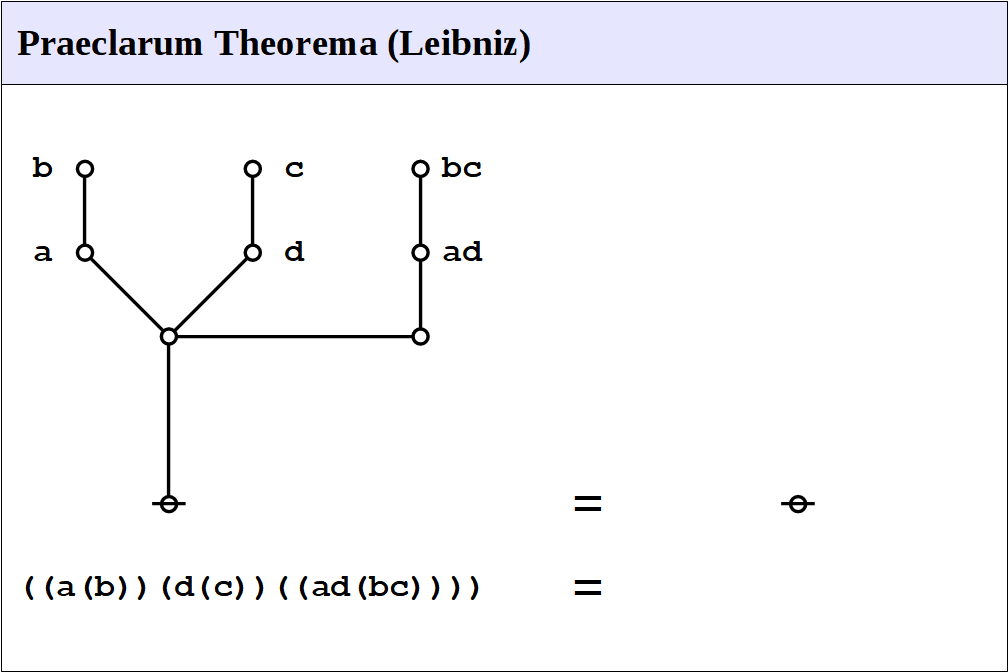
Expressed as a logical graph under the existential interpretation, the theorem takes the shape of the following formal equivalence or propositional equation.
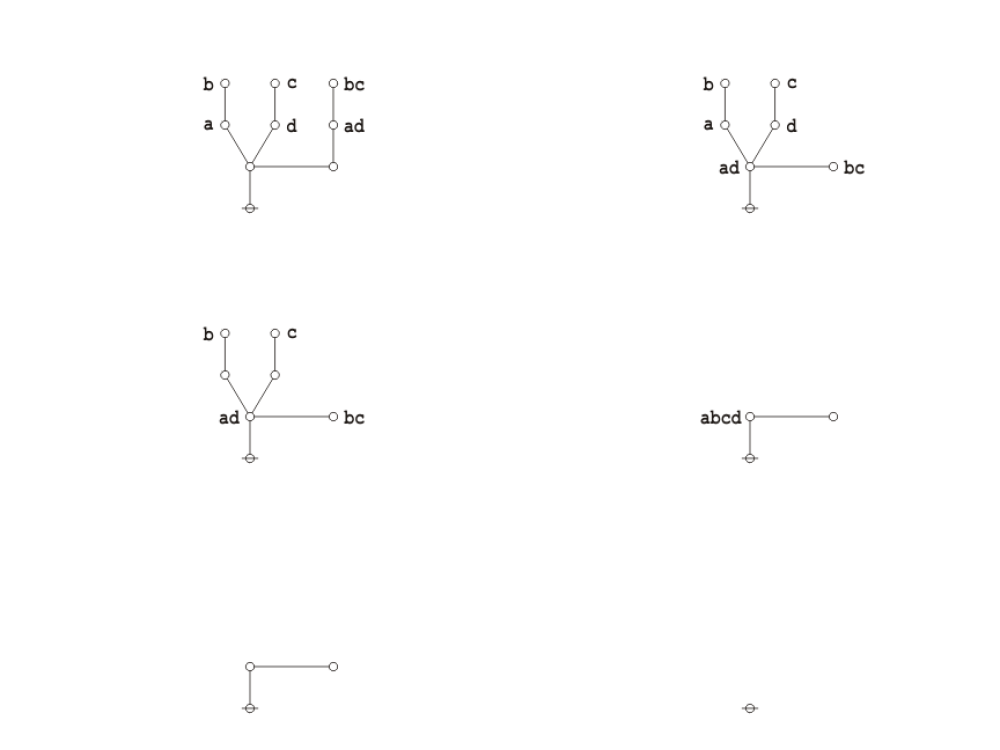
And here’s a neat proof of that nice theorem —

The steps of the proof are replayed in the following animation.
Reference
- Leibniz, Gottfried W. (1679–1686?), “Addenda to the Specimen of the Universal Calculus”, pp. 40–46 in G.H.R. Parkinson (ed., trans., 1966), Leibniz : Logical Papers, Oxford University Press, London, UK.
Readings
- Jon Awbrey • Propositional Equation Reasoning Systems
- John F. Sowa • Peirce’s Rules of Inference
Resources
- Logical Graphs
- Logical Graphs • First Impressions
- Logical Graphs • Formal Development
- Metamath Proof Explorer • Praeclarum Theorema
- Frithjof Dau • Animated Proof of Leibniz’s Praeclarum Theorema
cc: FB | Logical Graphs • Laws of Form • Mathstodon • Academia.edu
cc: Conceptual Graphs • Cybernetics • Structural Modeling • Systems Science

 Inquiry Into Inquiry
Pingback: Logical Graphs : 2 | Inquiry Into Inquiry
Pingback: How To Succeed In Proof Business Without Really Trying | Inquiry Into Inquiry
Pingback: Alpha Now, Omega Later : 1 | Inquiry Into Inquiry
Pingback: Survey of Animated Logical Graphs • 2 | Inquiry Into Inquiry
Pingback: Logical Graphs • 2 | Inquiry Into Inquiry
Pingback: Survey of Animated Logical Graphs • 3 | Inquiry Into Inquiry
Pingback: Animated Logical Graphs • 38 | Inquiry Into Inquiry
Pingback: Animated Logical Graphs • 40 | Inquiry Into Inquiry
Pingback: Animated Logical Graphs • 41 | Inquiry Into Inquiry
Pingback: Animated Logical Graphs • 42 | Inquiry Into Inquiry
Pingback: Animated Logical Graphs • 43 | Inquiry Into Inquiry
Pingback: Animated Logical Graphs • 44 | Inquiry Into Inquiry
Pingback: Survey of Animated Logical Graphs • 4 | Inquiry Into Inquiry
Pingback: Animated Logical Graphs • 78 | Inquiry Into Inquiry
Pingback: Survey of Animated Logical Graphs • 5 | Inquiry Into Inquiry
Pingback: Logical Graphs • Formal Development | Inquiry Into Inquiry
Pingback: Logical Graphs • Formal Development 8 | Inquiry Into Inquiry