Triadic Relations • Discussion 3

Re: Triadic Relations • (1)(2)(3)
Re: Conceptual GraphsEdwina Taborsky

ET:
A few comments on your outline of the Sign.  I think one has to be careful not to set up a Saussurian linguistic dyad.  …

Dear Edwina,

I copied your comments to a draft page and will take them up in the fullness of time, but a few remarks by way of general orientation to relations, triadic relations, sign relations, and sign transformations, partly prompted by the earlier discussion of complex systems, may be useful at this point.

One does not come to terms with systems of any complexity — adaptive, anticipatory, intelligent systems, and those with a capacity to support scientific inquiry, whether as autonomous agents or assistive utilities — without the use of mathematical models to negotiate the gap between our naturally evolved linguistic capacities and the just barely scrutable realities manifesting in phenomena.

Peirce’s quest to understand how science works takes its first big steps with his lectures on the Logic of Science at Harvard and the Lowell Institute (1865–1866), where he traces the bearings of deduction, induction, and hypothesis on the conduct of scientific inquiry.  There Peirce makes a good beginning by taking up Boole’s functional recasting of logic, a major advance over traditional logic rooted in the paradigms of historical grammars.  But developing a minimal adequate mathematical basis for the logic of science will take drilling down to a deeper core.

The mathematics we need to build models of inquiry as a sign-relational process appears for the first time in history with Peirce’s early work, especially his 1870 Logic of Relatives.  It has its sources in the mathematical realism of Leibniz and De Morgan, the functional logic of Boole, and the algebraic research of Peirce’s own father, Benjamin Peirce, whose Linear Associative Algebra Charles edited for publication in the American Journal of Mathematics (1881).

My own contributions to this pursuit I’ve collected over the years under the heading of Inquiry Driven Systems, portions of which I’ve shared here and there across the Web for lo! this whole millennium in progress.  A few resources along those lines are listed below.

References

  • Awbrey, S.M., and Awbrey, J.L. (2001), “Conceptual Barriers to Creating Integrative Universities”, Organization : The Interdisciplinary Journal of Organization, Theory, and Society 8(2), Sage Publications, London, UK, 269–284.  AbstractOnline.
  • Awbrey, J.L., and Awbrey, S.M. (1995), “Interpretation as Action • The Risk of Inquiry”, Inquiry : Critical Thinking Across the Disciplines 15(1), 40–52.
    ArchiveJournal.  Online (doc) (pdf).
  • Awbrey, S.M., and Awbrey, J.L. (1991), “An Architecture for Inquiry • Building Computer Platforms for Discovery”, Proceedings of the Eighth International Conference on Technology and Education, Toronto, Canada, 874–875.  Online.
  • Awbrey, J.L., and Awbrey, S.M. (1990), “Exploring Research Data Interactively. Theme One : A Program of Inquiry”, Proceedings of the Sixth Annual Conference on Applications of Artificial Intelligence and CD-ROM in Education and Training, Society for Applied Learning Technology, Washington, DC, 9–15.  Online.

Resources

cc: Category TheoryConceptual Graphs • Cybernetics (1) (2) • Ontolog (1) (2)
cc: Peirce List (1) (2) • Structural Modeling (1) (2) • Systems Science (1) (2)
cc: FB | Relation TheoryLaws of Form

Posted in C.S. Peirce, Category Theory, Dyadic Relations, Logic, Logic of Relatives, Logical Graphs, Mathematics, Nominalism, Peirce, Pragmatism, Realism, Relation Theory, Semiotics, Sign Relations, Triadic Relations, Visualization | Tagged , , , , , , , , , , , , , , , | 6 Comments

Survey of Semiotics, Semiosis, Sign Relations • 2

This is a Survey of blog and wiki resources on the theory of signs, variously known as semeiotic or semiotics, and the actions referred to as semiosis which transform signs among themselves in relation to their objects, all as based on C.S. Peirce’s concept of triadic sign relations.

Elements

Sources

Blog Series

  • C.S. Peirce • Algebra of Logic ∫ Philosophy of Notation • (1)(2)

Blog Dialogs

References

  • Awbrey, J.L., and Awbrey, S.M. (1992), “Interpretation as Action : The Risk of Inquiry”, The Eleventh International Human Science Research Conference, Oakland University, Rochester, Michigan.
  • Awbrey, J.L., and Awbrey, S.M. (1995), “Interpretation as Action : The Risk of Inquiry”, Inquiry : Critical Thinking Across the Disciplines 15(1), pp. 40–52.  ArchiveJournal.  Online (doc) (pdf).

cc: Conceptual GraphsCyberneticsLaws of FormOntolog
cc: FB | SemeioticsStructural ModelingSystems Science

Posted in C.S. Peirce, Logic, Mathematics, Peirce, Pragmatism, Relation Theory, Semiosis, Semiotics, Sign Relations | Tagged , , , , , , , , | 5 Comments

Genus, Species, Pie Charts, Radio Buttons • Discussion 5

Re: Genus, Species, Pie Charts, Radio Buttons • 1
Re: Laws of FormJohn Mingers

Dear John,

Once we grasp the utility of minimal negation operators for partitioning a universe of discourse into several regions and any region into further parts, there are quite a few directions we might explore as far as our next steps go.

One thing I always did when I reached a new level of understanding about any logical issue was to see if I could actualize the insight in whatever programming projects I was working on at the time.  Conversely and recursively the trials of doing that would often force me to modify my initial understanding in the direction of what works in brass tacks practice.

The use of cactus graphs to implement minimal negation operators made its way into the Theme One Program I worked on all through the 1980s and the applications I made of it went into the work I did for a master’s in psych.  At any rate, I can finally answer the “what next” question by pointing to one of the exercises I set for the logical reasoning module of that program, as described in the following excerpt from its User Guide.

  • Theme One Guide • Molly’s World (pdf)

The writing there is a little rough by my current standards, so I’ll work on revising it over the next few days.

Regards,

Jon

cc: CyberneticsOntolog ForumStructural ModelingSystems Science
cc: FB | Minimal Negation OperatorsLaws of Form • Peirce List (1) (2) (3)

Posted in Amphecks, Animata, Boolean Functions, C.S. Peirce, Cactus Graphs, Differential Logic, Functional Logic, Graph Theory, Laws of Form, Logic, Logical Graphs, Mathematics, Minimal Negation Operators, Painted Cacti, Peirce, Propositional Calculus, Propositional Equation Reasoning Systems, Semiotics, Venn Diagrams, Visualization | Tagged , , , , , , , , , , , , , , , , , , , | 6 Comments

Genus, Species, Pie Charts, Radio Buttons • Discussion 4

Re: Genus, Species, Pie Charts, Radio Buttons • 1
Re: Laws of FormJohn Mingers

JM:
I feel as though you have posted these same diagrams many times, and it is always portrayed as clearing the ground for something else.  But the something else never arrives!  I would be really interested to know what the next step is in your ideas.

Dear John,

Thanks for the question.  Bruce Schuman mentioned radio button logic and I jumped on it “like a duck on a June bug” — as they say in several southern States I know — because that very thing marks an important first step in the application of minimal negation operators to represent finite domains of values, contextual individuals, genus and species, partitions, and so on.  But some of the comments I got next gave me pause and made me feel I should go back and clarify a few points.

I wasn’t sure, but I got the sense Bruce was reading the cactus graphs I posted as an order of hierarchical, ontological, or taxonomic diagrams.  What they really amount to are the abstract, human-viewable renditions of linked data structures or “pointer” data structures in computer memory.  I explained the transformation from planar forms of enclosure to their topological dual trees to the pointer structures in one of the articles on logical graphs I wrote for Wikipedia and later for Google’s now-defunct Knol.  People can find a version of that on the following page of my blog.

Resources

cc: CyberneticsOntolog ForumStructural ModelingSystems Science
cc: FB | Minimal Negation OperatorsLaws of Form • Peirce List (1) (2) (3)

Posted in Amphecks, Animata, Boolean Functions, C.S. Peirce, Cactus Graphs, Differential Logic, Functional Logic, Graph Theory, Laws of Form, Logic, Logical Graphs, Mathematics, Minimal Negation Operators, Painted Cacti, Peirce, Propositional Calculus, Propositional Equation Reasoning Systems, Semiotics, Venn Diagrams, Visualization | Tagged , , , , , , , , , , , , , , , , , , , | 6 Comments

Genus, Species, Pie Charts, Radio Buttons • Discussion 3

Re: Genus, Species, Pie Charts, Radio Buttons • 1
Re: Laws of FormWilliam Bricken

Last time I alluded to the general problem of relating a variety of formal languages to a shared domain of formal objects, taking six notations for the boolean functions on two variables as a simple but critical illustration of the larger task.  This time we’ll take up a subtler example of cross-calculus communication, where the same syntactic forms bear different logical interpretations.

In each of the Tables below —

  • Column 1 shows a conventional name f_{i} and a venn diagram for each of the sixteen boolean functions on two variables.
  • Column 2 shows the logical graph canonically representing the boolean function in Column 1 under the entitative interpretation.  This is the interpretation C.S. Peirce used in his earlier work on entitative graphs and the one Spencer Brown used in his book Laws of Form.
  • Column 3 shows the logical graph canonically representing the boolean function in Column 1 under the existential interpretation.  This is the interpretation C.S. Peirce used in his later work on existential graphs.

\text{Boolean Functions and Logical Graphs on Two Variables} \stackrel{_\bullet}{} \text{Index Order}

Boolean Functions and Logical Graphs on Two Variables

\text{Boolean Functions and Logical Graphs on Two Variables} \stackrel{_\bullet}{} \text{Orbit Order}

Boolean Functions and Logical Graphs on Two Variables

Resources

  • Logical Graphs, Iconicity, Interpretation • (1)(2)
  • Minimal Negation Operators • (1)(2)(3)(4)

cc: CyberneticsOntolog ForumStructural ModelingSystems Science
cc: FB | Minimal Negation OperatorsLaws of Form • Peirce List (1) (2) (3)

Posted in Amphecks, Animata, Boolean Functions, C.S. Peirce, Cactus Graphs, Differential Logic, Functional Logic, Graph Theory, Laws of Form, Logic, Logical Graphs, Mathematics, Minimal Negation Operators, Painted Cacti, Peirce, Propositional Calculus, Propositional Equation Reasoning Systems, Semiotics, Venn Diagrams, Visualization | Tagged , , , , , , , , , , , , , , , , , , , | 6 Comments

Genus, Species, Pie Charts, Radio Buttons • Discussion 2

Re: Genus, Species, Pie Charts, Radio Buttons • 1
Re: Laws of FormWilliam Bricken

A problem we often encounter is the need to relate a variety of formal languages to the same domain of formal objects.  In our present engagement we are using languages not only to describe but further to compute with the objects in question and so we call our languages so many diverse calculi.

When it comes to propositional calculi, a couple of Tables may be useful at this point and also for future reference.  They present two arrangements of the sixteen boolean functions on two variables, collating their truth tables with their expressions in several systems of notation, including the parenthetical versions of cactus expressions, here read under the existential interpretation.  They appear as the first two Tables on the following page.

Differential Logic and Dynamic Systems • Appendices

The copies I posted to my blog will probably load faster.

Differential Logic • 8

Table A1.  Propositional Forms on Two Variables • Index Order

Table A1. Propositional Forms on Two Variables

Differential Logic • 9

Table A2.  Propositional Forms on Two Variables • Orbit Order

Table A2. Propositional Forms on Two Variables

cc: CyberneticsOntolog ForumStructural ModelingSystems Science
cc: FB | Minimal Negation OperatorsLaws of Form • Peirce List (1) (2) (3)

Posted in Amphecks, Animata, Boolean Functions, C.S. Peirce, Cactus Graphs, Differential Logic, Functional Logic, Graph Theory, Laws of Form, Logic, Logical Graphs, Mathematics, Minimal Negation Operators, Painted Cacti, Peirce, Propositional Calculus, Propositional Equation Reasoning Systems, Semiotics, Venn Diagrams, Visualization | Tagged , , , , , , , , , , , , , , , , , , , | 6 Comments

Genus, Species, Pie Charts, Radio Buttons • Discussion 1

Re: Genus, Species, Pie Charts, Radio Buttons • 1
Re: Laws of FormWilliam Bricken

WB:
Here’s an analysis of “Boolean” structure.  It’s actually a classification of the structure of distinctions containing 2 and 3 variables.  The work was originally done within the context of optimization of combinational silicon circuits, so I used “boolean” for that community, but we all know that “boolean” is just one interpretation of Laws of Form distinction structure.

  • Bricken, W. (1997/2002), “Symmetry in Boolean Functions
    with Examples for Two and Three Variables” (pdf).

And here’s some different visualizations of distinction structures in general.  Section 4 is relevant to us, the rest is just too many words for an academic community.

  • Bricken, W. (n.d.), “Syntactic Variety in Boundary Logic” (pdf).

Dear William,

Thanks for the readings.

Here’s a few resources on the angle I’ve been taking, greatly impacted from the beginning by reading Peirce and Spencer Brown in parallel and by implementing their forms as list and pointer data structures, first in Lisp and later in Pascal.

One thing my computational work taught me early on is that planar representations are an efficiency death trap on numerous grounds.  For one thing we don’t want to be computing on bitmap images and for another the representations of logical equality and exclusive disjunction, whether they require two occurrences of each variable or whether they introduce a new symbol like “=” requiring separate handling, lead to combinatorially explosive branching.  A decade of wrangling with that and other issues eventually led me to generalize trees to cacti, and this had the serendipitous benefit of leading to differential logic.

Not too coincidentally, differential logic is one of the very tools I needed to analyze and model Inquiry Driven Systems.

cc: CyberneticsOntolog ForumStructural ModelingSystems Science
cc: FB | Minimal Negation OperatorsLaws of Form • Peirce List (1) (2) (3)

Posted in Amphecks, Animata, Boolean Functions, C.S. Peirce, Cactus Graphs, Differential Logic, Functional Logic, Graph Theory, Laws of Form, Logic, Logical Graphs, Mathematics, Minimal Negation Operators, Painted Cacti, Peirce, Propositional Calculus, Propositional Equation Reasoning Systems, Semiotics, Venn Diagrams, Visualization | Tagged , , , , , , , , , , , , , , , , , , , | 6 Comments

Functional Logic • Inquiry and Analogy • Preliminaries

Functional Logic • Inquiry and Analogy

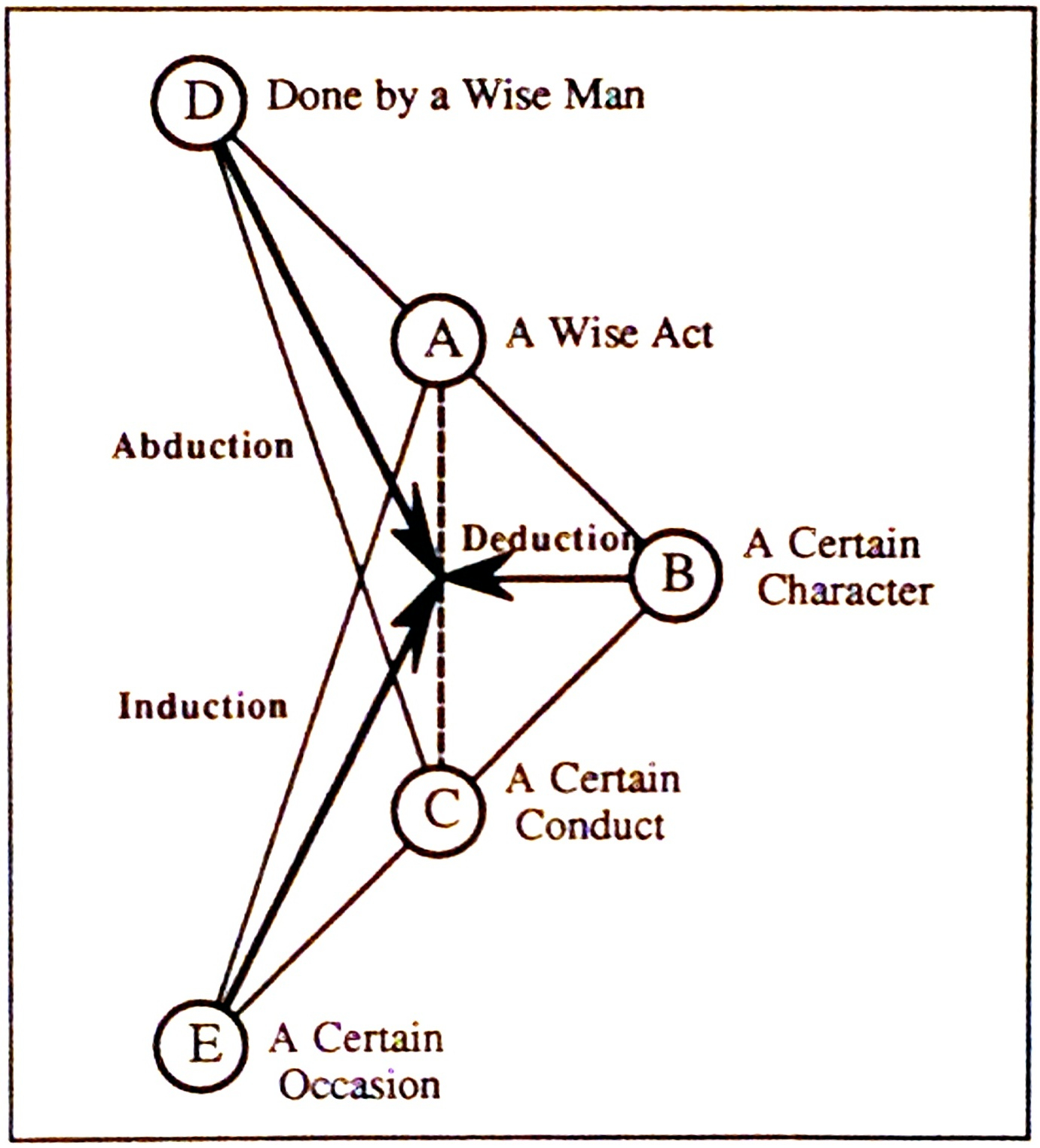
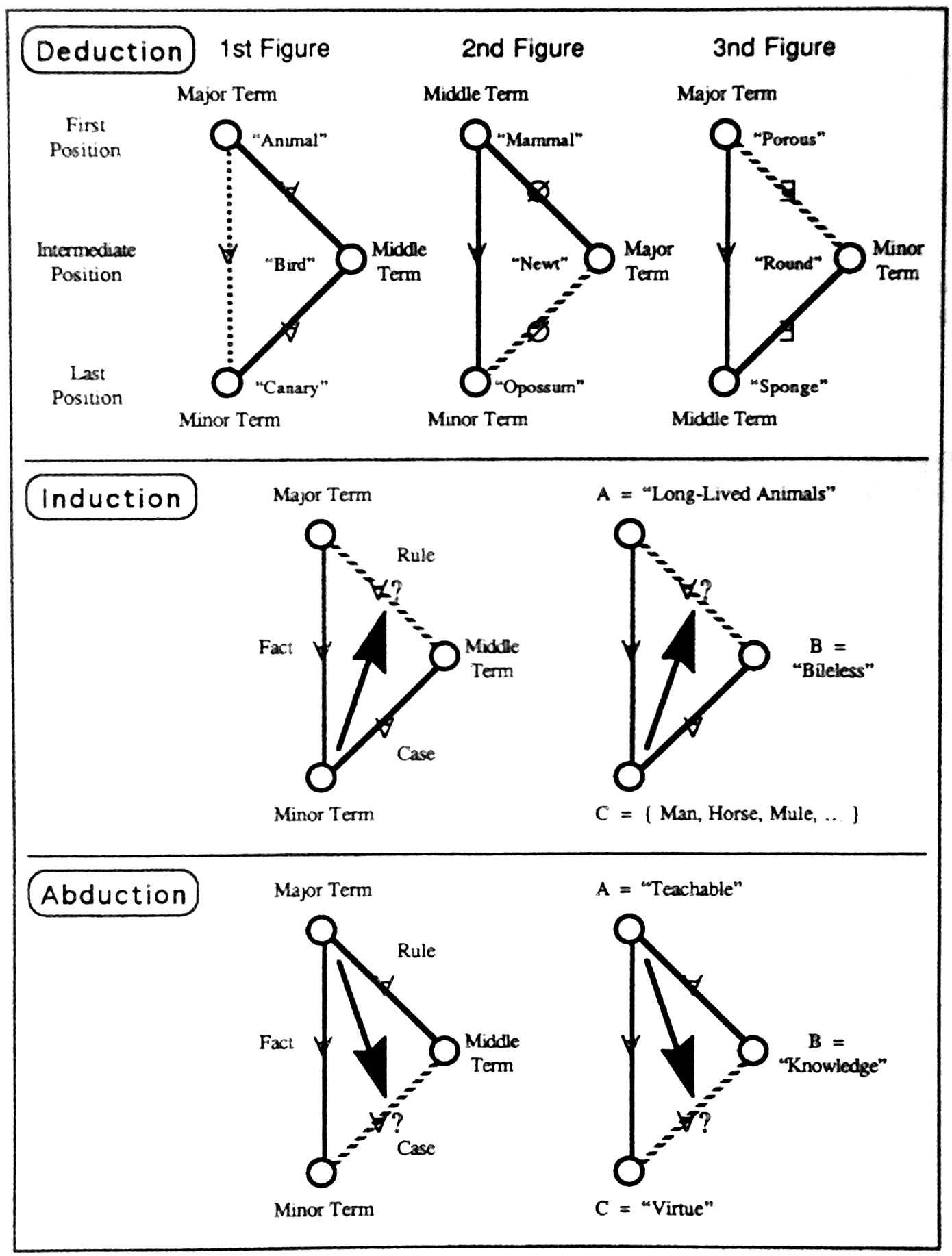
This report discusses C.S. Peirce’s treatment of analogy, placing it in relation to his overall theory of inquiry.  We begin by introducing three basic types of reasoning Peirce adopted from classical logic.  In Peirce’s analysis both inquiry and analogy are complex programs of logical inference which develop through stages of these three types, though normally in different orders.

Note on notation.  The discussion to follow uses logical conjunctions, expressed in the form of concatenated tuples e_1 ~\ldots~ e_k, and minimal negation operations, expressed in the form of bracketed tuples \texttt{(} e_1 \texttt{,} \ldots \texttt{,} e_k \texttt{)}, as the principal expression-forming operations of a calculus for boolean-valued functions, that is, for propositions.  The expressions of this calculus parse into data structures whose underlying graphs are called cacti by graph theorists.  Hence the name cactus language for this dialect of propositional calculus.

Resources

cc: FB | Peirce MattersLaws of FormMathstodonOntologAcademia.edu
cc: Conceptual GraphsCyberneticsStructural ModelingSystems Science

Posted in Abduction, Analogy, Argument, Aristotle, C.S. Peirce, Constraint, Deduction, Determination, Diagrammatic Reasoning, Diagrams, Differential Logic, Functional Logic, Hypothesis, Indication, Induction, Inference, Information, Inquiry, Logic, Logic of Science, Mathematics, Pragmatic Semiotic Information, Probable Reasoning, Propositional Calculus, Propositions, Reasoning, Retroduction, Semiotics, Sign Relations, Syllogism, Triadic Relations, Visualization | Tagged , , , , , , , , , , , , , , , , , , , , , , , , , , , , , , , | 2 Comments

Genus, Species, Pie Charts, Radio Buttons • 1

Re: Minimal Negation Operators • (1)(2)(3)(4)
Re: Laws of FormBruce Schuman

BS:
Leon Conrad’s presentation talks about “marked” and “unmarked” states.

He uses checkboxes to illustrate this choice, which seem to be “either/or” (and not, for example, “both”).

Just strictly in terms of programming and web forms, if Leon does mean “either/or” — maybe he should use “radio buttons” and not “checkboxes” […]

Dear Bruce,

What programmers call radio button logic is related to what physicists call exclusion principles, both of which fall under a theme from the first-linked post above.  As I wrote there, “taking minimal negations as primitive operators enables efficient expressions for many natural constructs and affords a bridge between boolean domains of two values and domains with finite numbers of values, for example, finite sets of individuals”.

To illustrate, let’s look at how the forms mentioned in the subject line have efficient and elegant representations in the cactus graph extension of C.S. Peirce’s logical graphs and Spencer Brown’s calculus of indications.

Keeping to the existential interpretation for now, we have the following readings of our formal expressions.

\begin{matrix}  \textit{tabula rasa} & = & \mathrm{true}  \\  \texttt{( )} & = & \mathrm{false}  \\  \texttt{(} x \texttt{)} & = & \lnot x  \\  x y & = & x \land y  \\  \texttt{(} x \texttt{(} y \texttt{))} & = & x \Rightarrow y  \\  \texttt{((} x \texttt{)(} y \texttt{))} & = & x \lor y  \\  \textit{and so on} & \ldots & \ldots  \end{matrix}

Take a look at the following article on minimal negation operators.

The cactus expression \texttt{(} x \texttt{,} y \texttt{,} z \texttt{)} evaluates to true if and only if exactly one of the variables x, y, z is false.  So the cactus expression \texttt{((} x \texttt{),(} y \texttt{),(} z \texttt{))} says exactly one of the variables x, y, z is true.  Push one variable “on” and the other two go “off”, just like radio buttons.  Drawn as a venn diagram, the proposition \texttt{((} x \texttt{),(} y \texttt{),(} z \texttt{))} partitions the universe of discourse into three mutually exclusive and exhaustive regions.

Refer now to Table 1 at the end of the following article.

Figure 1 shows the cactus graph for \texttt{((} a \texttt{),(} b \texttt{),(} c \texttt{))}.

((a),(b),(c))

Now consider the expression \texttt{(} x \texttt{,(} a \texttt{),(} b \texttt{),(} c \texttt{))}.

Figure 2 shows the cactus graph for \texttt{(} x \texttt{,(} a \texttt{),(} b \texttt{),(} c \texttt{))}.

(x, (a),(b),(c))

If x is true, i.e. blank, the expression \texttt{(} x \texttt{,(} a \texttt{),(} b \texttt{),(} c \texttt{))} reduces to \texttt{((} a \texttt{),(} b \texttt{),(} c \texttt{))}, so we have a partition of the region where x is true into three mutually exclusive and exhaustive regions where a, b, c, respectively, are true.

If x is false, it is the unique false variable, meaning \texttt{(} a \texttt{)} and \texttt{(} b \texttt{)} and \texttt{(} c \texttt{)} are all true, so none of a, b, c are true.

We can picture this as a pie chart where a pie x is divided into exactly three slices a, b, c.

It is the same thing as having a genus x with exactly three species a, b, c.

Regards,

Jon

cc: CyberneticsOntolog ForumStructural ModelingSystems Science
cc: FB | Minimal Negation OperatorsLaws of Form • Peirce List (1) (2) (3)

Posted in Amphecks, Animata, Boolean Functions, C.S. Peirce, Cactus Graphs, Differential Logic, Functional Logic, Graph Theory, Laws of Form, Logic, Logical Graphs, Mathematics, Minimal Negation Operators, Painted Cacti, Peirce, Propositional Calculus, Propositional Equation Reasoning Systems, Semiotics, Venn Diagrams, Visualization | Tagged , , , , , , , , , , , , , , , , , , , | 12 Comments

Survey of Relation Theory • 5

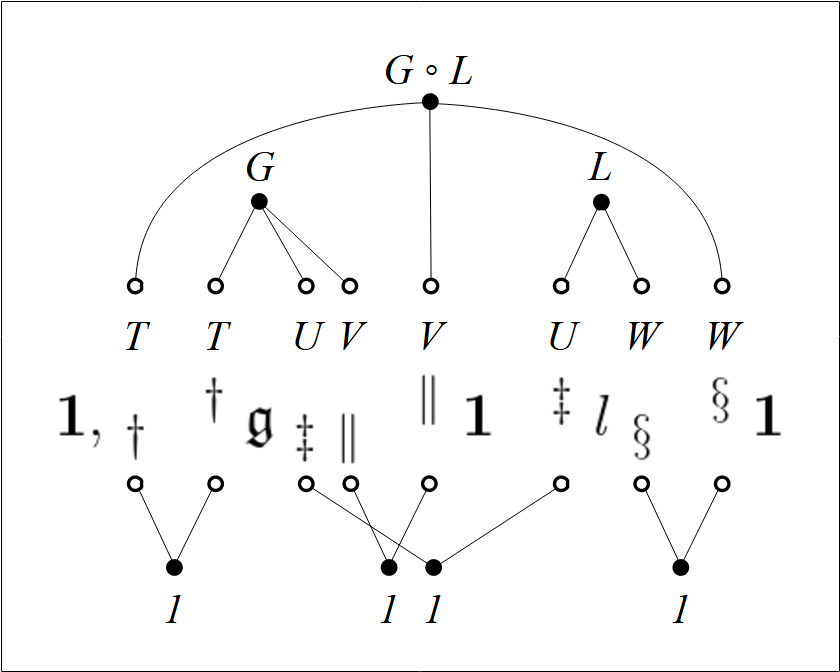
In this Survey of blog and wiki posts on Relation Theory, relations are viewed from the perspective of combinatorics, in other words, as a topic in discrete mathematics, with special attention to finite structures and concrete set-theoretic constructions, many of which arise quite naturally in applications.  This approach to relation theory is distinct from, though closely related to, its study from the perspectives of abstract algebra on the one hand and formal logic on the other.

Elements

Relational Concepts

Relation Construction Relation Composition Relation Reduction
Relative Term Sign Relation Triadic Relation
Logic of Relatives Hypostatic Abstraction Continuous Predicate

Illustrations

Blog Series

Peirce’s 1870 “Logic of Relatives”

Peirce’s 1880 “Algebra of Logic” Chapter 3

Resources

Posted in Algebra, Algebra of Logic, C.S. Peirce, Category Theory, Combinatorics, Discrete Mathematics, Duality, Dyadic Relations, Foundations of Mathematics, Graph Theory, Logic, Logic of Relatives, Mathematics, Peirce, Relation Theory, Semiotics, Set Theory, Sign Relational Manifolds, Sign Relations, Surveys, Triadic Relations, Triadicity, Type Theory | Tagged , , , , , , , , , , , , , , , , , , , , , , | Leave a comment