Systems of Interpretation • 1

Re: Peirce ListMike BergmanValentine Daniel

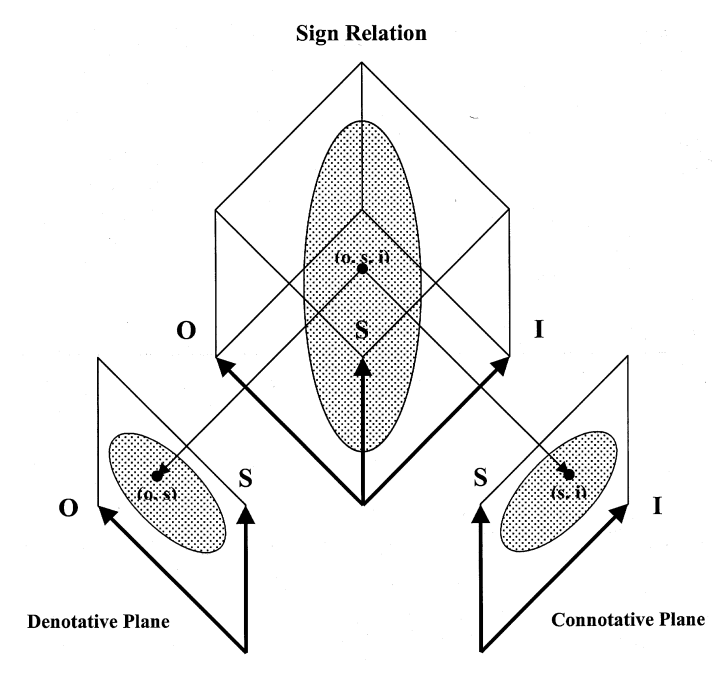
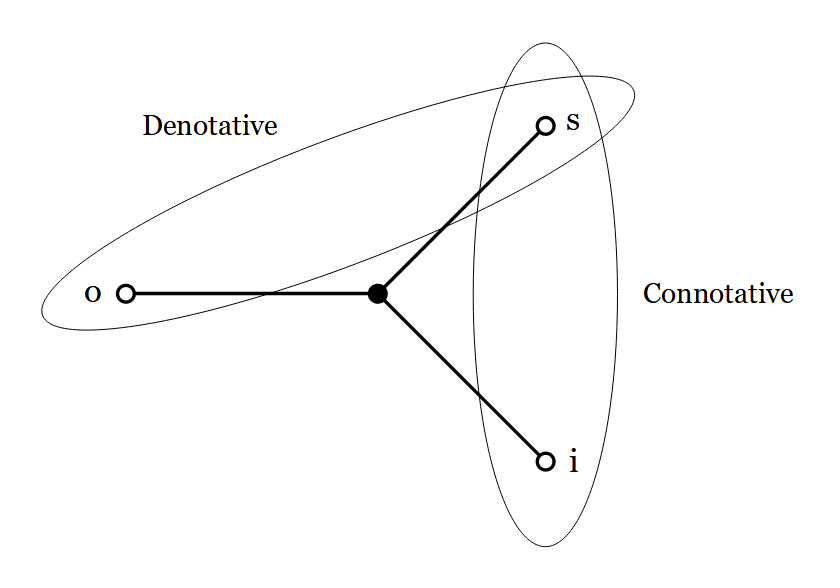
Questions have arisen about the different styles of diagrams and figures used to represent triadic sign relations in Peircean semiotics.  What do they mean?  Which style is best?  Among the most popular pictures some use geometric triangles while others use the three‑pronged graphs Peirce used in his logical graphs to represent triadic relations.

Diagrams and figures, like any signs, can serve to communicate the intended interpretants and thus to coordinate the conduct of interpreters toward the intended objects — but only in communities of interpretation where the conventions of interpretation are understood.  Conventions of interpretation are by comparison far more difficult to communicate.

That brings us to the first question we have to ask about the possibility of communication in this area, namely, what conventions of interpretation are needed to make sense of these diagrams, figures, and graphs?

cc: Conceptual GraphsCyberneticsStructural ModelingSystems Science
cc: FB | SemeioticsMathstodonLaws of FormAcademia.edu

Posted in C.S. Peirce, Diagrammatic Reasoning, Interpretive Frameworks, Logic, Logical Graphs, Objective Frameworks, Relation Theory, Semiotics, Sign Relations, Systems of Interpretation, Triadic Relations, Visualization | Tagged , , , , , , , , , , , | 5 Comments

Inquiry Into Inquiry • On Initiative 3

Re: Scott AaronsonShould GPT Exist?My Comment

The more fundamental problem I see here is the failure to grasp the nature of the task at hand, and this I attribute not to a program but to its developers.

Journalism, Research, and Scholarship are not matters of generating probable responses to prompts or other stimuli.  What matters is producing evidentiary and logical supports for statements.  That is the task requirement the developers of recent LLM‑Bots are failing to grasp.

There is nothing new about that failure.  There is a long history of attempts to account for intelligence and indeed the workings of scientific inquiry based on the principles of associationism, behaviorism, connectionism, and theories of that order.  But the relationship of empirical evidence, logical inference, and scientific information is more complex and intricate than is dreamt of in those reductive philosophies.

Note.  The above comment was originally posted on March 1st but appears to have been deleted accidentally.

Resources

cc: Conceptual GraphsCyberneticsStructural ModelingSystems Science
cc: FB | Inquiry Driven SystemsMathstodonLaws of FormOntolog Forum

Posted in Anthem, Initiative, Inquiry | Tagged , , | 5 Comments

Inquiry Into Inquiry • Discussion 6

Re: Mathstodon • Nicole Rust

NR:
Computations or Processes —
How do you think about the building blocks of the brain?

I keep coming back to this thread about levels, along with others on the related issue of paradigms, as those have long been major questions for me.  I am trying to clarify my current understanding for a blog post.  It will start out a bit like this —

A certain amount of “level” language is natural in the sciences but “level” metaphors come with hidden assumptions about higher and lower places in hierarchies which don’t always fit the case at hand.  In complex cases what look at first like parallel strata may in time be better comprehended as intersecting domains or mutually recursive and entangled orders of being.  When that happens we can guard against misleading imagery by speaking of domains or realms instead of levels.

To be continued …

cc: Conceptual GraphsCyberneticsStructural ModelingSystems Science
cc: FB | Inquiry Driven SystemsMathstodonLaws of Form • Ontolog Forum

Posted in Anthem, Initiative, Inquiry | Tagged , , | 4 Comments

Theory and Therapy of Representations • 5

Re: R.J. Lipton and K.W. ReganLegal Complexity

I do not pretend to understand the moral universe;
the arc is a long one, my eye reaches but little ways;
I cannot calculate the curve and complete the figure by
the experience of sight;  I can divine it by conscience.
And from what I see I am sure it bends towards justice.

🙞 Theodore Parker

The arc of the moral universe may bend toward justice — there’s hope it will.
For the logic of laws to converge on justice may take some doing on our part.

Resources

cc: Conceptual GraphsCyberneticsLaws of FormOntolog Forum
cc: FB | CyberneticsStructural ModelingSystems Science

Posted in Accountability, Adaptive Systems, C.S. Peirce, Cybernetics, Democracy, Economics, Education, Expectation, Governance, Information, Inquiry, Intention, Justice, Law, Logic, Max Weber, Observation, Plato, Pragmata, Representation, Science, Semiotics, Society, Statistics, Systems Theory | Tagged , , , , , , , , , , , , , , , , , , , , , , , , | 4 Comments

Survey of Cybernetics • 3

Again, in a ship, if a man were at liberty to do what he chose, but were devoid of mind and excellence in navigation (αρετης κυβερνητικης), do you perceive what must happen to him and his fellow sailors?

Plato • Alcibiades • 135 A

This is a Survey of blog posts relating to Cybernetics.  It includes the selections from Ashby’s Introduction and the comment on them I’ve posted so far, plus two series of reflections on the governance of social systems in light of cybernetic and semiotic principles.

Ashby’s Introduction to Cybernetics

  • Chapter 11 • Requisite Variety

Blog Series

  • Theory and Therapy of Representations • (1)(2)(3)(4)(5)

cc: FB | CyberneticsLaws of FormMathstodonOntologAcademia.edu
cc: Conceptual GraphsCyberneticsStructural ModelingSystems Science

Posted in Abduction, C.S. Peirce, Communication, Control, Cybernetics, Deduction, Determination, Discovery, Doubt, Epistemology, Fixation of Belief, Induction, Information, Information = Comprehension × Extension, Information Theory, Inquiry, Inquiry Driven Systems, Inquiry Into Inquiry, Interpretation, Invention, Knowledge, Learning Theory, Logic, Logic of Relatives, Logic of Science, Mathematics, Peirce, Philosophy, Philosophy of Science, Pragmatic Information, Probable Reasoning, Process Thinking, Relation Theory, Scientific Inquiry, Scientific Method, Semeiosis, Semiosis, Semiotic Information, Semiotics, Sign Relational Manifolds, Sign Relations, Surveys, Triadic Relations, Uncertainty | Tagged , , , , , , , , , , , , , , , , , , , , , , , , , , , , , , , , , , , , , , , , , , , | Leave a comment

Survey of Differential Logic • 5

This is a Survey of work in progress on Differential Logic, resources under development toward a more systematic treatment.

Differential logic is the component of logic whose object is the description of variation — the aspects of change, difference, distribution, and diversity — in universes of discourse subject to logical description.  A definition as broad as that naturally incorporates any study of variation by way of mathematical models, but differential logic is especially charged with the qualitative aspects of variation pervading or preceding quantitative models.  To the extent a logical inquiry makes use of a formal system, its differential component treats the use of a differential logical calculus — a formal system with the expressive capacity to describe change and diversity in logical universes of discourse.

Elements

Blog Series

Architectonics

Applications

Blog Dialogs

Explorations

cc: FB | Differential LogicLaws of FormMathstodonOntologAcademia.edu
cc: Conceptual GraphsCyberneticsStructural ModelingSystems Science

Posted in Amphecks, Animata, Boolean Algebra, Boolean Functions, C.S. Peirce, Cactus Graphs, Category Theory, Change, Cybernetics, Differential Analytic Turing Automata, Differential Calculus, Differential Logic, Discrete Dynamics, Equational Inference, Frankl Conjecture, Functional Logic, Gradient Descent, Graph Theory, Hologrammautomaton, Indicator Functions, Inquiry Driven Systems, Leibniz, Logic, Logical Graphs, Mathematics, Minimal Negation Operators, Painted Cacti, Peirce, Propositional Calculus, Surveys, Time, Topology, Visualization, Zeroth Order Logic | Tagged , , , , , , , , , , , , , , , , , , , , , , , , , , , , , , , , , | Leave a comment

Survey of Inquiry Driven Systems • 5

This is a Survey of work in progress on Inquiry Driven Systems, material I plan to refine toward a more compact and systematic treatment of the subject.

An inquiry driven system is a system having among its state variables some representing its state of information with respect to various questions of interest, for example, its own state and the states of potential object systems.  Thus it has a component of state tracing a trajectory though an information state space.

Elements

Background

Blog Dialogs

Blog Series

Developments

Applications

  • Conceptual Barriers to Creating Integrative Universities
    (Abstract) (Online)
  • Interpretation as Action • The Risk of Inquiry
    (Journal) (doc) (pdf)
  • An Architecture for Inquiry • Building Computer Platforms for Discovery
    (Online)
  • Exploring Research Data Interactively • Theme One : A Program of Inquiry
    (Online)

cc: FB | Inquiry Driven SystemsLaws of FormMathstodonOntologAcademia.edu
cc: Conceptual GraphsCyberneticsStructural ModelingSystems Science

Posted in Abduction, Adaptive Systems, Artificial Intelligence, Automated Research Tools, C.S. Peirce, Cognitive Science, Cybernetics, Deduction, Educational Systems Design, Educational Technology, Fixation of Belief, Induction, Information Theory, Inquiry, Inquiry Driven Systems, Inquiry Into Inquiry, Intelligent Systems, Interpretation, Logic, Logic of Science, Mathematics, Mental Models, Pragmatic Maxim, Semiotics, Sign Relations, Triadic Relations, Visualization | Tagged , , , , , , , , , , , , , , , , , , , , , , , , , , | 8 Comments

Relation Theory • Discussion 5

Re: Survey of Relation Theory
Re: Ontolog ForumRavi Sharma

RS:
Is there also an attempt at integrating these relation concepts?  Like a meta‑model of relations?

Dear Ravi,

I haven’t run across the concept of a meta‑model before so I wasn’t sure about the second part of your question.  If you get a chance, maybe you can tell me more about that.  Many past discussions of models and their theories tell me a thicket of failures to communicate is almost bound to arise at this point.  One or two pieces I’ve written in the past lay out the landscape a lot better than I’m likely to do off the cuff, so I’ll go look those up, but also see if I can find a fresh perspective on the scene.

Regards,

Jon

cc: Conceptual GraphsCyberneticsStructural ModelingSystems Science
cc: FB | Relation TheoryMathstodon • Laws of Form (1) (2)Ontolog Forum

Posted in Algebra, Algebra of Logic, C.S. Peirce, Category Theory, Combinatorics, Discrete Mathematics, Duality, Dyadic Relations, Foundations of Mathematics, Graph Theory, Logic, Logic of Relatives, Mathematics, Peirce, Relation Theory, Semiotics, Set Theory, Sign Relational Manifolds, Sign Relations, Triadic Relations, Type Theory, Visualization | Tagged , , , , , , , , , , , , , , , , , , , , , | 5 Comments

Relation Theory • Discussion 4

Re: Survey of Relation Theory
Re: Ontolog ForumRavi Sharma

RS:
Is there also an attempt at integrating these relation concepts?  Like a meta‑model of relations?

Dear Ravi,

Thanks for the question.  I believe I’d say yes to the first part, since integrating diverse concepts is a big part of what’s called for here.  If we look over the Relational Concepts listed on the above Survey Page, we can see they are all just so many facets exhibited by the family of mathematical objects known as relations.

Regards,

Jon

cc: Conceptual GraphsCyberneticsStructural ModelingSystems Science
cc: FB | Relation TheoryMathstodon • Laws of Form (1) (2)Ontolog Forum
cc: W3 | RDF Surfaces

Posted in Algebra, Algebra of Logic, C.S. Peirce, Category Theory, Combinatorics, Discrete Mathematics, Duality, Dyadic Relations, Foundations of Mathematics, Graph Theory, Logic, Logic of Relatives, Mathematics, Peirce, Relation Theory, Semiotics, Set Theory, Sign Relational Manifolds, Sign Relations, Triadic Relations, Type Theory, Visualization | Tagged , , , , , , , , , , , , , , , , , , , , , | 5 Comments

Theme One Program • Discussion 10

Re: Mathstodon • Seamus Bradley

SB:
I thought of a programming language where every function can only return one type:  the return type.  The return type is just a wrapper around a struct that contains the actual return value, but also a reference to the called function and arguments, and possibly an error code.

Way back in the last millennium I started work on a programming style I called an idea processor, where an idea is a pointer to a form and a form is a minimal type of record containing 1 character, 1 number, and 4 more ideas.

I implemented a functional style where all the main functions are transformations of one or more ideas to a return idea.  The principal data type is an idea‑form flag which serves a role analogous to a cons cell in Lisp.

Here’s one entry point —

Resources

cc: Conceptual GraphsCyberneticsStructural ModelingSystems Science
cc: FB | Theme One ProgramMathstodonLaws of FormOntolog Forum
cc: W3 | RDF Surfaces

Posted in Algorithms, Animata, Artificial Intelligence, Boolean Functions, C.S. Peirce, Cactus Graphs, Cognition, Computation, Constraint Satisfaction Problems, Data Structures, Differential Logic, Equational Inference, Formal Languages, Graph Theory, Inquiry Driven Systems, Laws of Form, Learning Theory, Logic, Logical Graphs, Mathematics, Minimal Negation Operators, Painted Cacti, Peirce, Propositional Calculus, Semiotics, Spencer Brown, Visualization | Tagged , , , , , , , , , , , , , , , , , , , , , , , , , , | 4 Comments