Survey of Precursors Of Category Theory • 2

A few years ago I began a sketch on the “Precursors of Category Theory”, tracing the continuities of the category concept from Aristotle, to Kant and Peirce, through Hilbert and Ackermann, to contemporary mathematical practice.  A Survey of resources on the topic is given below, still very rough and incomplete, but perhaps a few will find it of use.

Background

Blog Series

  • Notes On Categories • (1)
  • Precursors Of Category Theory • (1)(2)(3)

Categories à la Peirce

cc: CyberneticsOntolog ForumPeirce ListStructural ModelingSystems Science

Posted in Abstraction, Ackermann, Analogy, Aristotle, C.S. Peirce, Carnap, Category Theory, Diagrams, Foundations of Mathematics, Functional Logic, Hilbert, History of Mathematics, Hypostatic Abstraction, Kant, Logic, Mathematics, Peirce, Propositions As Types Analogy, Relation Theory, Saunders Mac Lane, Semiotics, Type Theory, Universals | Tagged , , , , , , , , , , , , , , , , , , , , , , | 7 Comments

Precursors Of Category Theory • Discussion 1

Re: FB | Medieval LogicEBJAJAEBJAEBJAJAEB

JA:  In the logic of Aristotle categories are adjuncts to reasoning designed to resolve ambiguities and thus to prepare equivocal signs, otherwise recalcitrant to being ruled by logic, for the application of logical laws.  The example of ζωον illustrates that we don’t need categories to make generalizations so much as we need them to control generalizations, to reign in abstractions and analogies that are stretched too far.

EB:  Aristotelian categories are “adjuncts to reasoning”?

I’ve been exploring a particular type of commonality or continuity in the way categorical references function in various systems of categories from Aristotle, through Kant and Peirce, to contemporary mathematical category theory.  The following posts give the background on that.

  • Precursors Of Category Theory • (1) (2) (3)

Viewing the discussion of Excluded Middle and Non-Contradiction in the light of Peirce’s observations about their relation to the General and the Vague, the upshot is that elements of natural language, indeed, all species of representation in the wild, do not as a rule obey the usual laws of logic, but violate them in various ways.  It is only after signs and symbols have been categorized, their equivocations “driven down” or “reduced” by reference to the appropriate category, that they become subject to logical laws.

References

Resources

cc: CyberneticsOntolog ForumPeirce ListStructural ModelingSystems Science

Posted in Abstraction, Ackermann, Aristotle, C.S. Peirce, Carnap, Category Theory, Hilbert, Kant, Logic, Logic of Relatives, Mathematics, Peirce, Peirce's Categories, Relation Theory, Saunders Mac Lane, Sign Relations, Type Theory | Tagged , , , , , , , , , , , , , , , , | 6 Comments

Animated Logical Graphs • 39

Re: Richard J. LiptonLogical Complexity Of Proofs

Happy Peirce’s Birthday, Everyone ❢

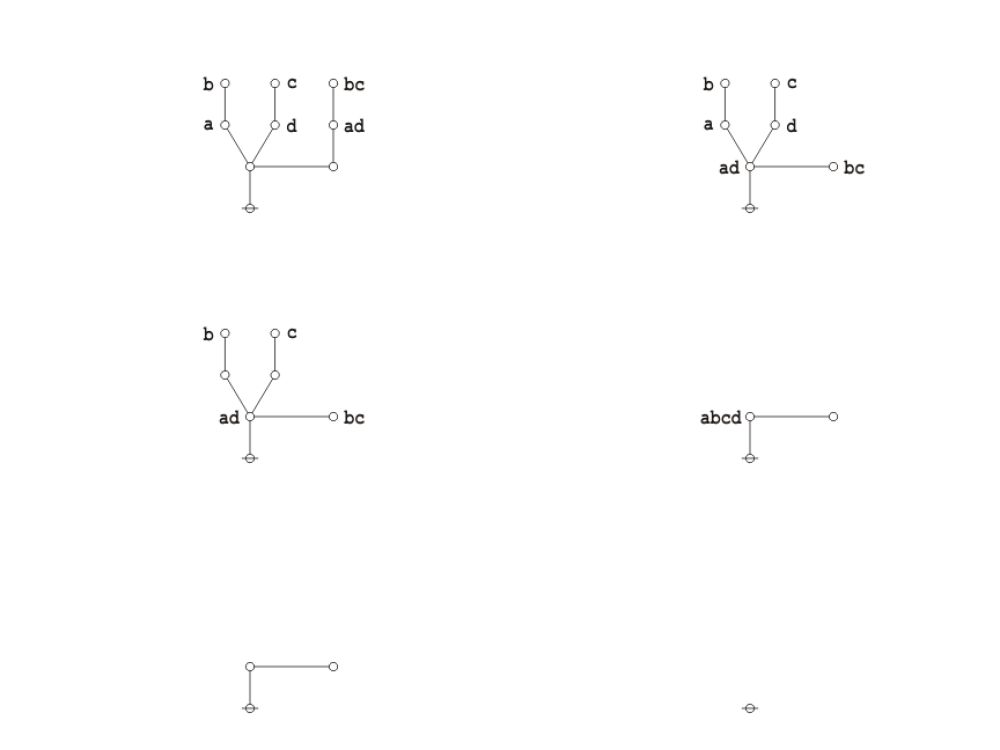
We’ve been discussing aspects of proof style arising in connection with the complexity of proofs.  In previous posts we took up (1) the aspect of formal duality, reflecting in passing on the prospect of higher symmetries, and (2) the spectrum ranging from information-reducing to information-preserving inference rules.  Here’s a quick recap —

A third aspect of proof style arising in this connection is the degree of insight demanded and demonstrated in the performance of a proof.  Generally speaking, the same endpoint can be reached in many different ways from given starting points, by paths ranging from those exhibiting appreciable insight to those exercising little more than persistence in sticking to a set routine.

A modicum of insight suffices to suggest the quality of “insight” resists pinning down in a succinct definition but we do tend to recognize it when we see it, so let me inch forward by highlighting its salient features in a graded series of examples.

To be continued …

Resources

Applications

cc: CyberneticsOntolog • Peirce (1) (2) (3) (4) (5) (6)Structural ModelingSystems

Posted in Amphecks, Animata, Boolean Algebra, Boolean Functions, C.S. Peirce, Cactus Graphs, Constraint Satisfaction Problems, Deduction, Diagrammatic Reasoning, Duality, Equational Inference, Graph Theory, Laws of Form, Logic, Logical Graphs, Mathematics, Minimal Negation Operators, Model Theory, Painted Cacti, Peirce, Proof Theory, Propositional Calculus, Propositional Equation Reasoning Systems, Spencer Brown, Theorem Proving, Visualization | Tagged , , , , , , , , , , , , , , , , , , , , , , , , , | 12 Comments

Survey of Definition and Determination • 1

In the early 1990s, “in the middle of life’s journey” as the saying goes, I returned to grad school in a systems engineering program with the idea of taking a more systems-theoretic approach to my development of Peircean themes, from signs and scientific inquiry to logic and information theory.

Two of the first questions calling for fresh examination were the closely related concepts of definition and determination, not only as Peirce used them in his logic and semiotics but as researchers in areas as diverse as computer science, cybernetics, physics, and systems science would find themselves forced to reconsider the concepts in later years.  That led me to collect a sample of texts where Peirce and a few other writers discuss the issues of definition and determination.  There are copies of those selections at the following sites.

What follows is a Survey of blog and wiki posts on Definition and Determination, with a focus on the part they play in Peirce’s interlinked theories of signs, information, and inquiry.  In classical logical traditions the concepts of definition and determination are closely related and their bond acquires all the more force when we view the overarching concept of constraint from an information-theoretic point of view, as Peirce did beginning in the 1860s.

Blog Dialogs

cc: CyberneticsOntolog ForumPeirce ListStructural ModelingSystems Science

Posted in C.S. Peirce, Comprehension, Constraint, Definition, Determination, Extension, Form, Indication, Information = Comprehension × Extension, Inquiry, Intension, Logic, Logic of Science, Mathematics, Peirce, Semiotics, Structure | Tagged , , , , , , , , , , , , , , , , | 9 Comments

Theme One • A Program Of Inquiry 18

Re: Michael HarrisThe Inevitable Questions About Automated Theorem Proving

MH:  Even if computers understand, they don’t understand in a human way.

I like the simple-mindedness of that.
(A simple mind is one with no proper normal submind.)

Fifty-plus years of roundhouse discussions about AI + ATP leave me with nothing new to say about it — so maybe I’ll revisit my earliest thoughts on the subject.  I’ve always liked Ashby’s pre-AI notion of IA = Intelligence Amplification and I often used the catchword Intelliscope to sum up my sense of the project worth pursuing.  We invented the telescope on analogy with the human eye by studying the anatomy and function of our naturally evolved organ of vision and gradually at first, astronomically in time extending its power to augment and correct our natural faculty and frailty.  I think everyone gets the drift of that.  It doesn’t mean we have to become cyborgs in any dystopian way — if we do it will be reckoned to some other factor in our erroneous essence or the accidents of history.

MH:  Would you call Google an accident of history?

I see the warp driving Googly Eyes towards Panopticon … if it goes that way it will be more like the angry ape in our glassy essence than anything else external.

cc: CyberneticsOntolog ForumPeirce ListStructural ModelingSystems Science

Posted in Algorithms, Animata, Artificial Intelligence, Boolean Functions, C.S. Peirce, Cactus Graphs, Cognition, Computation, Constraint Satisfaction Problems, Data Structures, Differential Logic, Equational Inference, Formal Languages, Graph Theory, Inquiry Driven Systems, Laws of Form, Learning Theory, Logic, Logical Graphs, Mathematics, Minimal Negation Operators, Painted Cacti, Peirce, Propositional Calculus, Semiotics, Spencer Brown, Visualization | Tagged , , , , , , , , , , , , , , , , , , , , , , , , , , | 6 Comments

Survey of Theme One Program • 3

This is a Survey of blog and wiki posts relating to the Theme One Program I worked on all through the 1980s.  The aim was to develop fundamental algorithms and data structures for integrating empirical learning with logical reasoning.  I had earlier developed separate programs for basic components of those tasks, namely, 2-level formal language learning and propositional constraint satisfaction, the latter using an extension of C.S. Peirce’s logical graphs as a syntax for propositional logic.  Thus arose the question of how well it might be possible to get “empiricist” and “rationalist” modes of operation to cooperate.  The long-term vision is the design and implementation of an Automated Research Tool able to double as a platform for Inquiry Driven Education.

Wiki Hub

Documentation

Blog Series

  • Theme One Program • Exposition • (1)(2)(3)

Blog Dialogs

Applications

References

  • Awbrey, S.M., and Awbrey, J.L. (May 1991), “An Architecture for Inquiry • Building Computer Platforms for Discovery”, Proceedings of the Eighth International Conference on Technology and Education, Toronto, Canada, pp. 874–875.  Online.
  • Awbrey, J.L., and Awbrey, S.M. (January 1991), “Exploring Research Data Interactively • Developing a Computer Architecture for Inquiry”, Poster presented at the Annual Sigma Xi Research Forum, University of Texas Medical Branch, Galveston, TX.
  • Awbrey, J.L., and Awbrey, S.M. (August 1990), “Exploring Research Data Interactively • Theme One : A Program of Inquiry”, Proceedings of the Sixth Annual Conference on Applications of Artificial Intelligence and CD-ROM in Education and Training, Society for Applied Learning Technology, Washington, DC, pp. 9–15.  Online.

cc: Conceptual Graphs • Cybernetics (1) (2) • Laws of Form (1) (2) (3)
cc: Ontolog Forum (1) (2) (3) • Structural Modeling (1) (2) • Systems Science (1) (2) (3)
cc: Peirce List (Dec 2012) (Feb 2018) (Mar 2018) (Sep 2020) (Oct 2020) (Oct 2021)
cc: FB | Theme One Program

Posted in Algorithms, Animata, Artificial Intelligence, Boolean Functions, C.S. Peirce, Cactus Graphs, Cognition, Computation, Constraint Satisfaction Problems, Data Structures, Differential Logic, Equational Inference, Formal Languages, Graph Theory, Inquiry Driven Systems, Laws of Form, Learning Theory, Logic, Logical Graphs, Mathematics, Minimal Negation Operators, Painted Cacti, Peirce, Propositional Calculus, Semiotics, Spencer Brown, Visualization | Tagged , , , , , , , , , , , , , , , , , , , , , , , , , , | 42 Comments

Animated Logical Graphs • 38

Re: Richard J. LiptonLogical Complexity Of Proofs

Three examples of propositional proofs in logical graphs using equational inference rules can be found at the following location.

Animated proofs of the three examples, along with links to detailed descriptions, are shown below.

Peirce's Law

Praeclarum Theorema

  • Two-Thirds Majority Function • (1)(2)(3)

Two-Thirds Majority Function

Resources

Applications

cc: CyberneticsOntolog • Peirce (1) (2) (3) (4) (5) (6)Structural ModelingSystems

Posted in Amphecks, Animata, Boolean Algebra, Boolean Functions, C.S. Peirce, Cactus Graphs, Constraint Satisfaction Problems, Deduction, Diagrammatic Reasoning, Duality, Equational Inference, Graph Theory, Laws of Form, Logic, Logical Graphs, Mathematics, Minimal Negation Operators, Model Theory, Painted Cacti, Peirce, Proof Theory, Propositional Calculus, Propositional Equation Reasoning Systems, Spencer Brown, Theorem Proving, Visualization | Tagged , , , , , , , , , , , , , , , , , , , , , , , , , | 13 Comments

Survey of Animated Logical Graphs • 3

This is one of several Survey posts I’ll be drafting from time to time, starting with minimal stubs and collecting links to the better variations on persistent themes I’ve worked on over the years.  After that I’ll look to organizing and revising the assembled material with an eye toward developing more polished articles.

Beginnings

Elements

Examples

Excursions

Applications

Blog Dialogs

Anamnesis

Posted in Amphecks, Animata, Boolean Algebra, Boolean Functions, C.S. Peirce, Cactus Graphs, Computational Complexity, Constraint Satisfaction Problems, Differential Logic, Equational Inference, Graph Theory, Laws of Form, Logic, Logical Graphs, Mathematics, Minimal Negation Operators, Model Theory, Painted Cacti, Peirce, Proof Theory, Propositional Calculus, Propositional Equation Reasoning Systems, Spencer Brown, Theorem Proving, Visualization | Tagged , , , , , , , , , , , , , , , , , , , , , , , , | 26 Comments

Animated Logical Graphs • 37

Re: Richard J. LiptonLogical Complexity Of Proofs

Another dimension of proof style has to do with how much information is kept or lost as the argument develops.  For the moment let’s focus on classical deductive reasoning at the propositional level.  Then we can distinguish between equational inferences, which keep all the information represented by the input propositions, and implicational inferences, which permit information to be lost as the proof proceeds.

Information-Preserving vs. Information-Reducing Inferences
Implicit in Peirce’s systems of logical graphs is the ability to use equational inferences.  Spencer Brown drew this out and turned it to great advantage in his revival of Peirce’s graphical forms.  As it affects “logical flow” this allows for bi-directional or reversible flows, you might even say a “logical equilibrium” between two states of information.

It is probably obvious when we stop to think about it, but seldom remarked, that all the more familiar inference rules, like modus ponens and resolution or transitivity, entail in general a loss of information as we traverse their arrows or turnstiles.

For example, the usual form of modus ponens takes us from knowing p and p \Rightarrow q to knowing q but in fact we know more, we actually know p \land q.  With that in mind we can formulate two variants of modus ponens, one reducing and one preserving the actual state of information, as shown in the following figure.

1-Way and 2-Way

There’s more discussion of this topic at the following location.

To be continued …

Resources

Applications

cc: CyberneticsOntolog • Peirce (1) (2) (3) (4) (5) (6)Structural ModelingSystems

Posted in Amphecks, Animata, Boolean Algebra, Boolean Functions, C.S. Peirce, Cactus Graphs, Constraint Satisfaction Problems, Deduction, Diagrammatic Reasoning, Duality, Equational Inference, Graph Theory, Laws of Form, Logic, Logical Graphs, Mathematics, Minimal Negation Operators, Model Theory, Painted Cacti, Peirce, Proof Theory, Propositional Calculus, Propositional Equation Reasoning Systems, Spencer Brown, Theorem Proving, Visualization | Tagged , , , , , , , , , , , , , , , , , , , , , , , , , | 13 Comments

Animated Logical Graphs • 36

Re: Richard J. LiptonLogical Complexity Of Proofs

Dear Dick,

You asked, “Is this measure, the logical flow of a proof, of any interest?”

I was not sure how you define the measure of flow in a proof — it seemed to have something to do with the number of implication arrows in the argument structure?

But this does bring up interesting issues of “proof style” …

Propositional calculus as a formal language and boolean functions as an object domain form an instructive microcosm for many issues of logic writ large.  The relation between proof theory and model theory is one of those issues, the status of propositional logic as a special case notwithstanding.

Folks who pursue the CSP–GSB line of development in graphical syntax for propositional calculus are especially likely to notice the following dimensions of proof style.

Formal Duality
This goes back to Peirce’s discovery of the “amphecks” as sole sufficient primitives for propositional calculus and the duality between Both Not (nnor) and Not Both (nand).  The same duality is present in Peirce’s graphical systems for propositional calculus.  It is analogous to the duality in projective geometry and it means we are always proving two theorems for the price of one.  That’s a reduction in complexity — it raises the question of how many such group-theoretic reductions we can find.

To be continued …

Resources

Applications

cc: CyberneticsOntolog • Peirce (1) (2) (3) (4) (5) (6)Structural ModelingSystems

Posted in Amphecks, Animata, Boolean Algebra, Boolean Functions, C.S. Peirce, Cactus Graphs, Constraint Satisfaction Problems, Deduction, Diagrammatic Reasoning, Duality, Equational Inference, Graph Theory, Laws of Form, Logic, Logical Graphs, Mathematics, Minimal Negation Operators, Model Theory, Painted Cacti, Peirce, Proof Theory, Propositional Calculus, Propositional Equation Reasoning Systems, Spencer Brown, Theorem Proving, Visualization | Tagged , , , , , , , , , , , , , , , , , , , , , , , , , | 13 Comments