
Problems In Philosophy • 7

Re: FB | Charles S. Peirce Society
(a) John Corcoran • Cosmic Justice Hypotheses
(b) John Corcoran • The Inseparability of Logic and Ethics

Peirce emphasized the intricate relationships among the Big Three Normative Sciences — Aesthetics, Ethics, Logic — a topic early and often discussed in the secondary literature and on the Peirce List.  One might also compare Theodore Parker’s well-known thesis:

I do not pretend to understand the moral universe;
the arc is a long one, my eye reaches but little ways;
I cannot calculate the curve and complete the figure by
the experience of sight;  I can divine it by conscience.
And from what I see I am sure it bends towards justice.

— Theodore Parker

Questions about the interdependence of the principal normative sciences — Aesthetics, Ethics, Logic — just came up on another blog and prompted me to go looking for some of my earlier grapplings with the subject.  There’s an initial fragment of that harvest in the following post.

cc: Cybernetics • Ontolog Forum • Peirce List • Structural Modeling • Systems Science
Posted in Aesthetics, Algorithms, Animata, Automata, Beauty, C.S. Peirce, Ethics, Inquiry, Justice, Logic, Model Theory, Normative Science, Peirce, Philosophy, Pragmatism, Problem Solving, Proof Theory, Summum Bonum, Truth, Virtue | Tagged , , , , , , , , , , , , , , , , , , , | Leave a comment

Problems In Philosophy • 6

Another one of those recurring questions I’m constantly forgetting what I wrote about or where before just came up again on the Gödel’s Lost Letter blog.

Re: R.J. Lipton and K.W. Regan • The Night Of The Ethical Algorithm

Classical tradition views logic as a normative science, one whose object is truth.  This puts logic on a par with ethics, whose object is justice or morality in action, and aesthetics, whose object is beauty or the admirable for its own sake.

The pragmatic spin on this line of thinking treats logic, ethics, aesthetics as a concentric series of normative sciences, each a subdiscipline of the next.  Logic tells us how we ought to conduct our reasoning in order to achieve the goals of reasoning in general.  Thus logic is a special case of ethics.  Ethics tells us how we ought to conduct our activities in general in order to achieve the good appropriate to each enterprise.  What makes the difference between a normative science and a prescriptive dogma is whether this telling is based on actual inquiry into the relationship of conduct to result, or not.

Here’s a bit I wrote on this a long time ago in a galaxy not far away —

cc: Cybernetics • Ontolog Forum • Peirce List • Structural Modeling • Systems Science

Posted in Aesthetics, Algorithms, Animata, Automata, Beauty, C.S. Peirce, Ethics, Inquiry, Justice, Logic, Model Theory, Normative Science, Peirce, Philosophy, Pragmatism, Problem Solving, Proof Theory, Summum Bonum, Truth, Virtue | Tagged , , , , , , , , , , , , , , , , , , , | 2 Comments

Survey of Pragmatic Semiotic Information • 5

This is a Survey of previous blog and wiki posts on the Semiotic Theory Of Information.  All my projects are exploratory in essence but this line of inquiry is more open-ended than most.  The question is:

What is information and how does it impact the spectrum of activities answering to the name of inquiry?

Setting out on what would become his lifelong quest to explore and explain the “Logic of Science”, C.S. Peirce pierced the veil of historical confusions obscuring the issue and fixed on what he called the “laws of information” as the key to solving the puzzle.  This was in 1865 and 1866, detailed in his lectures at Harvard University and the Lowell Institute.

Fast forward to the present and I see the Big Question as follows.  Having gone through the exercise of comparing and contrasting Peirce’s theory of information, however much it yet remains in a rough-hewn state, with Shannon’s paradigm so pervasively informing the ongoing revolution in our understanding and use of information, I have reason to believe Peirce’s idea is root and branch more general and has the potential, with due development, to resolve many mysteries still bedeviling our grasp of inference, information, and inquiry.

Inference, Information, Inquiry

Pragmatic Semiotic Information

Semiotics, Semiosis, Sign Relations

Sign Relations, Triadic Relations, Relation Theory

  • Blog Series • (1)
    • Discusssions • (1) • (2)

Excursions

Blog Dialogs

References

  • Peirce, C.S. (1867), “Upon Logical Comprehension and Extension”.  Online.
  • Awbrey, J.L., and Awbrey, S.M. (1992), “Interpretation as Action : The Risk of Inquiry”, The Eleventh International Human Science Research Conference, Oakland University, Rochester, Michigan.
  • Awbrey, J.L., and Awbrey, S.M. (1995), “Interpretation as Action : The Risk of Inquiry”, Inquiry : Critical Thinking Across the Disciplines 15(1), pp. 40–52.  Archive.  Journal.  Online.

cc: Cybernetics (1) (2) • Ontolog • Peirce (1) (2) • Structural Modeling • Systems Science

Posted in Abduction, C.S. Peirce, Communication, Control, Cybernetics, Deduction, Determination, Discovery, Doubt, Epistemology, Fixation of Belief, Induction, Information, Information = Comprehension × Extension, Information Theory, Inquiry, Inquiry Driven Systems, Inquiry Into Inquiry, Interpretation, Invention, Knowledge, Learning Theory, Logic, Logic of Relatives, Logic of Science, Mathematics, Peirce, Philosophy, Philosophy of Science, Pragmatic Information, Probable Reasoning, Process Thinking, Relation Theory, Scientific Inquiry, Scientific Method, Semeiosis, Semiosis, Semiotic Information, Semiotics, Sign Relational Manifolds, Sign Relations, Surveys, Triadic Relations, Uncertainty | Tagged , , , , , , , , , , , , , , , , , , , , , , , , , , , , , , , , , , , , , , , , , , , | 10 Comments

Theme One • A Program Of Inquiry 20

Re: Richard J. Lipton • Vaccines Are Not Developing

Back in the day when I was making The Big Bucks (inflation-adjusted dollars) consulting on research statistics in bioscience-medical-nursing-public-health settings, I noticed a certain analogy between propositional calculus research (PCR0) and polymerase chain reactions (PCR1).  I was going to say something about it on a previous thread where these topics collided but then I lost track of the links I needed, so I will go dig them up now.

Resource

cc: Cybernetics • Ontolog • Peirce List (1) (2) • Structural Modeling • Systems Science
cc: FB | Theme One • Laws of Form

Posted in Algorithms, Animata, Artificial Intelligence, Boolean Functions, C.S. Peirce, Cactus Graphs, Cognition, Computation, Constraint Satisfaction Problems, Data Structures, Differential Logic, Equational Inference, Formal Languages, Graph Theory, Inquiry Driven Systems, Laws of Form, Learning Theory, Logic, Logical Graphs, Mathematics, Minimal Negation Operators, Painted Cacti, Peirce, Propositional Calculus, Semiotics, Spencer Brown, Visualization | Tagged , , , , , , , , , , , , , , , , , , , , , , , , , , | 7 Comments

Sign Relations, Triadic Relations, Relation Theory • Discussion 2

Re: Peirce List • Edwina Taborsky

Dear Edwina,

Analytic frameworks, our various theories of categories, sets, sorts, and types, have their uses but they tend to become à priori, autonomous, top-down, and top-heavy unless they are supported by a robust population of concrete examples arising in practical experience, one of the things the maxim of pragmatism advises us to remember.  That is why Peirce’s tackling of information and inquiry is even-handed with respect to their extensional and intensional sides.  And it’s why we need to pay attention when anomalies accumulate and the population of presenting cases rebels against the dictates of Procrustean predicates.  Times like that tell us we may need to reconceive our customary conceptual frameworks.

As it happens, I’ve been thinking a lot lately about a particular class of sign sequences, namely, proofs in propositional calculus regarded as cases of sign process, or semiosis.  Naturally I’ve been thinking of delving more deeply into Robert Marty’s work on paths through the lattice of sign classes but so far I’m still in the early stages of that venture.

For what they’re worth, here are my blog posts so far on Proof As Semiosis.

Resources

cc: Cybernetics • Ontolog Forum • Peirce List • Structural Modeling • Systems Science

Posted in C.S. Peirce, Icon Index Symbol, Information, Inquiry Driven Systems, Logic, Logic of Relatives, Mathematics, Peirce, Pragmatism, Relation Theory, Semiosis, Semiotics, Sign Relations, Triadic Relations, Triadicity, Visualization | Tagged , , , , , , , , , , , , , , , | 16 Comments

Sign Relations, Triadic Relations, Relation Theory • Discussion 1

Re: Peirce List • Edwina Taborsky

ET:
I particularly like your comment that “signhood is a role in a triadic relation, a role that a thing bears or plays in a given context of relationships — it is not an absolute, non-relative property of a thing-in-itself, one that it possesses independently of all relationships to other things”.
I myself emphasize that this context of the role is made up of relationships (plural) — which gives the triad its capacity for complexity.  Therefore, as we see in Robert Marty’s lattice, a thing is never a thing-in-itself but is an action, a process, composed of complex relations.

Dear Edwina,

Things grow complex rather quickly once we start to think about all the roles a sign may play on all the stages where it struts and frets its parts.  There is no unique setting, no one scene, but concentric and overlapping contexts of relationship all have their bearing on the sign’s significance.

One strategy we have for dealing with these complexities and avoiding being overwhelmed by them is to build up a stock of well-studied examples, graded in complexity from the very simplest to the increasingly complex.  The wide world may always present us with situations more complex than any in our inventory of familiar cases but the better our stock of ready examples the more aspects of novel situations we can capture and the greater our odds of coping with them.

Resources

cc: Cybernetics • Ontolog Forum • Peirce List • Structural Modeling • Systems Science

Posted in C.S. Peirce, Icon Index Symbol, Information, Inquiry Driven Systems, Logic, Logic of Relatives, Mathematics, Peirce, Pragmatism, Relation Theory, Semiosis, Semiotics, Sign Relations, Triadic Relations, Triadicity, Visualization | Tagged , , , , , , , , , , , , , , , | 15 Comments

Sign Relations, Triadic Relations, Relation Theory • 1

To understand how signs work in Peirce’s theory of triadic sign relations, or “semiotics”, we have to understand, in order of increasing generality, sign relations, triadic relations, and relations in general, each as conceived in Peirce’s logic of relative terms and the corresponding mathematics of relations.

Toward that understanding, here are the current versions of articles I long ago contributed to Wikipedia and Wikiversity and continue to develop at a number of other places.

cc: Cybernetics • Ontolog Forum • Peirce List • Structural Modeling • Systems Science

Posted in C.S. Peirce, Icon Index Symbol, Information, Inquiry Driven Systems, Logic, Logic of Relatives, Mathematics, Peirce, Pragmatism, Relation Theory, Semiosis, Semiotics, Sign Relations, Triadic Relations, Triadicity, Visualization | Tagged , , , , , , , , , , , , , , , | 12 Comments

Theme One • A Program Of Inquiry 19

Re: Richard J. Lipton • Knowledge Is Good

It’s the usual thing to say scientific inquiry involves a combination of deductive and inductive reasoning.  A slightly different, 3-phase model, going back to Aristotle and revived by Charles S. Peirce, analyzes the process producing knowledge into abductive, deductive, and inductive stages.  Abductive inference is used to generate a hypothesis, deduction is used to derive its logical consequences, and inductive reasoning is how we test the hypothesis against experimental observations.

Here’s a few thoughts toward the design of software platforms for integrating these three components of inquiry.  (Also research and teaching.)

Resource

cc: Cybernetics • Ontolog Forum • Peirce (1) (2) • Structural Modeling • Systems Science

Posted in Algorithms, Animata, Artificial Intelligence, Boolean Functions, C.S. Peirce, Cactus Graphs, Cognition, Computation, Constraint Satisfaction Problems, Data Structures, Differential Logic, Equational Inference, Formal Languages, Graph Theory, Inquiry Driven Systems, Laws of Form, Learning Theory, Logic, Logical Graphs, Mathematics, Minimal Negation Operators, Painted Cacti, Peirce, Propositional Calculus, Semiotics, Spencer Brown, Visualization | Tagged , , , , , , , , , , , , , , , , , , , , , , , , , , | 6 Comments

Animated Logical Graphs • 44

Re: FB | Ecology Of Systems Thinking • Richard Saunders

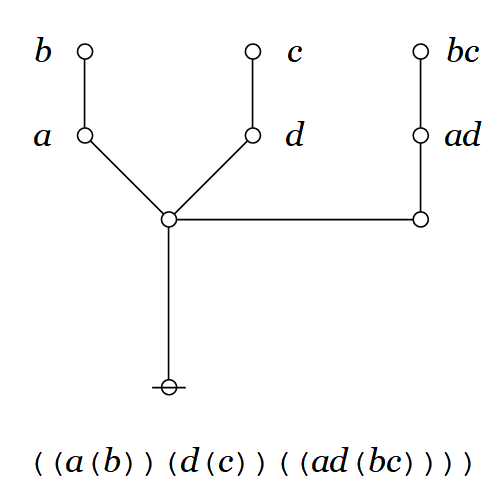
Praeclarum Theorema Parse Graph

RS:  DNA and proteins might be good places to look for logical graphs in nature since our tech for mapping those structures has become fairly proficient lately.  Do you think we could train some kind of neural net to find the patterns?  Might that lead to a real breakthrough in computational microbiology?

Dear Richard,

Models of neural nets are extremely various.  I don’t especially cotton to the ones based on threshold computation, as I think they’re bound to remain rather dumb.   I view all those blinking neurons as something like a night view of the earth’s cities from space.  What we see is only a measure of the raw power consumption occurring in the cities, buildings, and homes, not anything like the actual processes going on inside those sites.

Reference

  • Leibniz, Gottfried W. (1679–1686?), “Addenda to the Specimen of the Universal Calculus”, pp. 40–46 in G.H.R. Parkinson (ed., trans., 1966), Leibniz : Logical Papers, Oxford University Press, London, UK.

Praeclarum Theorema

Resources

Applications

cc: Cybernetics • Ontolog • Peirce (1) (2) (3) (4) (5) (6) (7) • Structural Modeling • Systems

Posted in Amphecks, Animata, Boolean Algebra, Boolean Functions, C.S. Peirce, Cactus Graphs, Constraint Satisfaction Problems, Deduction, Diagrammatic Reasoning, Duality, Equational Inference, Graph Theory, Laws of Form, Logic, Logical Graphs, Mathematics, Minimal Negation Operators, Model Theory, Painted Cacti, Peirce, Proof Theory, Propositional Calculus, Propositional Equation Reasoning Systems, Spencer Brown, Theorem Proving, Visualization | Tagged , , , , , , , , , , , , , , , , , , , , , , , , , | 7 Comments

Animated Logical Graphs • 43

Re: FB | Ecology Of Systems Thinking • Richard Saunders

Praeclarum Theorema Parse Graph

RS:  I wonder if we might find such graphs in the physical microstructures of brains, cells, proteins, etc.

Dear Richard,

You are reading my mind.  See the following post on the Standard Upper Ontology List, where I took a simple example of a propositional expression and proceeded by way of logical graphs to prove its equivalence to a syntactically simpler expression.

Reflecting on the form of the proof, I concluded with the following remark.

JA:  For some reason I always think of that as the way that our DNA would prove it.

There’s further discussion of that example at the following location.

Reference

  • Leibniz, Gottfried W. (1679–1686?), “Addenda to the Specimen of the Universal Calculus”, pp. 40–46 in G.H.R. Parkinson (ed., trans., 1966), Leibniz : Logical Papers, Oxford University Press, London, UK.

Praeclarum Theorema

Resources

Applications

cc: Cybernetics • Ontolog • Peirce (1) (2) (3) (4) (5) (6) (7) • Structural Modeling • Systems

Posted in Amphecks, Animata, Boolean Algebra, Boolean Functions, C.S. Peirce, Cactus Graphs, Constraint Satisfaction Problems, Deduction, Diagrammatic Reasoning, Duality, Equational Inference, Graph Theory, Laws of Form, Logic, Logical Graphs, Mathematics, Minimal Negation Operators, Model Theory, Painted Cacti, Peirce, Proof Theory, Propositional Calculus, Propositional Equation Reasoning Systems, Spencer Brown, Theorem Proving, Visualization | Tagged , , , , , , , , , , , , , , , , , , , , , , , , , | 9 Comments