A Curious Truth of Classical Logic
Peirce’s law is a propositional calculus formula which states a non‑obvious truth of classical logic and affords a novel way of defining classical propositional calculus.
Introduction
Peirce’s law is commonly expressed in the following form.

Peirce’s law holds in classical propositional calculus, but not in intuitionistic propositional calculus. The precise axiom system one chooses for classical propositional calculus determines whether Peirce’s law is taken as an axiom or proven as a theorem.
History
Here is Peirce’s own statement and proof of the law:
Peirce goes on to point out an immediate application of the law:
Note. Peirce uses the sign of illation  for implication. In one place he explains as a variant of the sign
  for less than or equal to; in another place he suggests that
  is an iconic way of representing a state of affairs where
  in every way that it can be, is
Graphical Representation
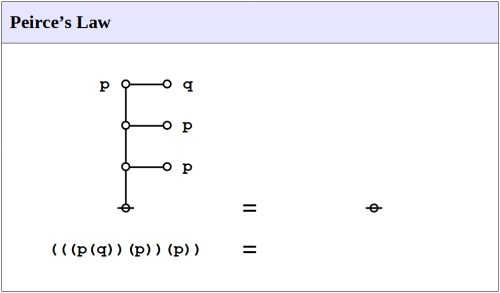
Representing propositions in the language of logical graphs, and operating under the existential interpretation, Peirce’s law is expressed by means of the following formal equivalence or logical equation.
Graphical Proof
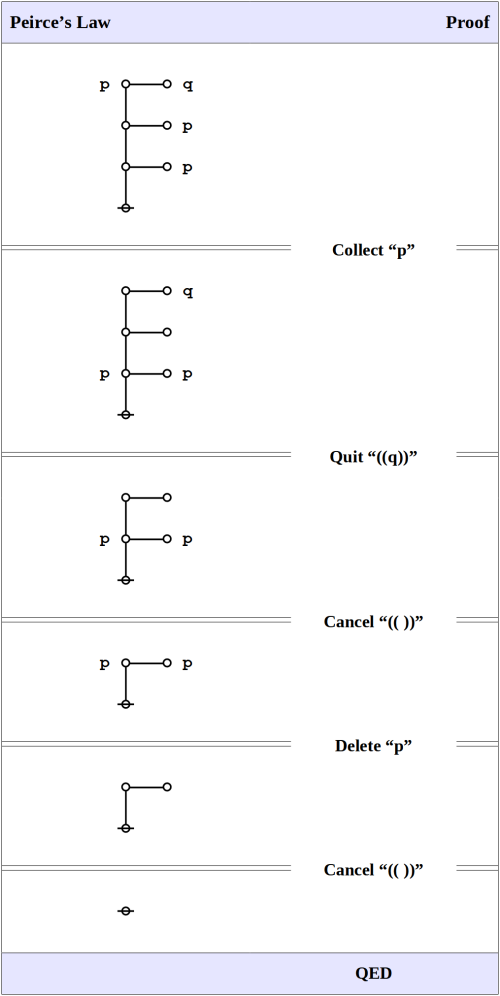
Using the axiom set given in the articles on logical graphs, Peirce’s law may be proved in the following manner.
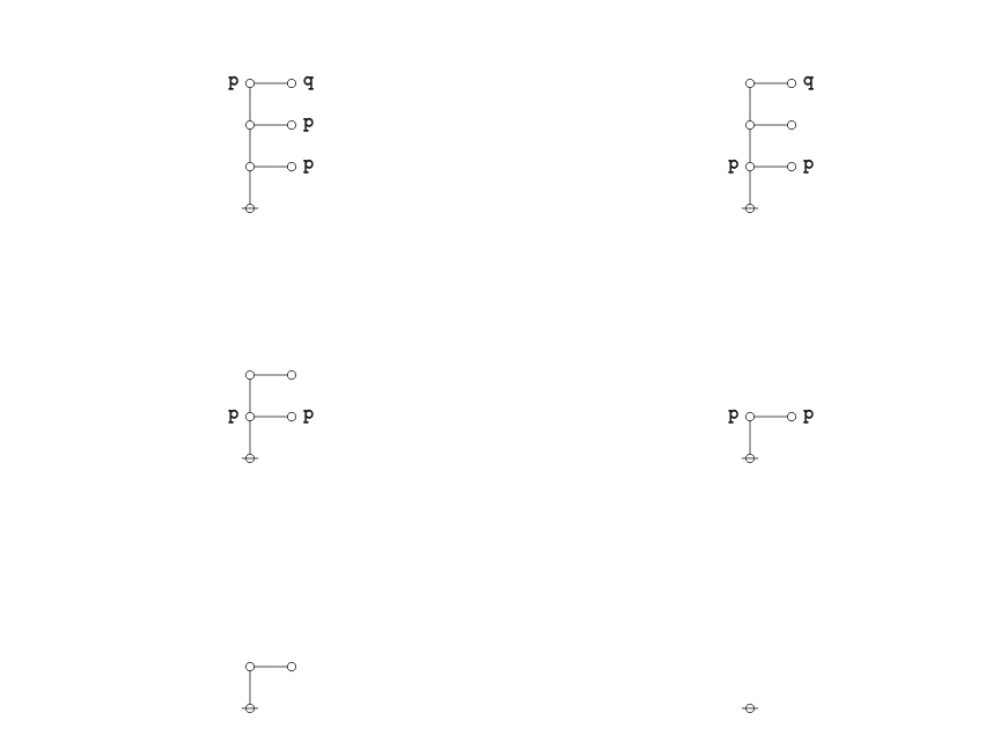
The following animation replays the steps of the proof.
Equational Form
A stronger form of Peirce’s law also holds, in which the final implication is observed to be reversible, resulting in the following equivalence.

The converse implication  is clear enough on general principles, since
  holds for any proposition
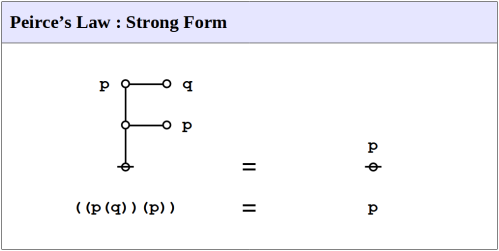
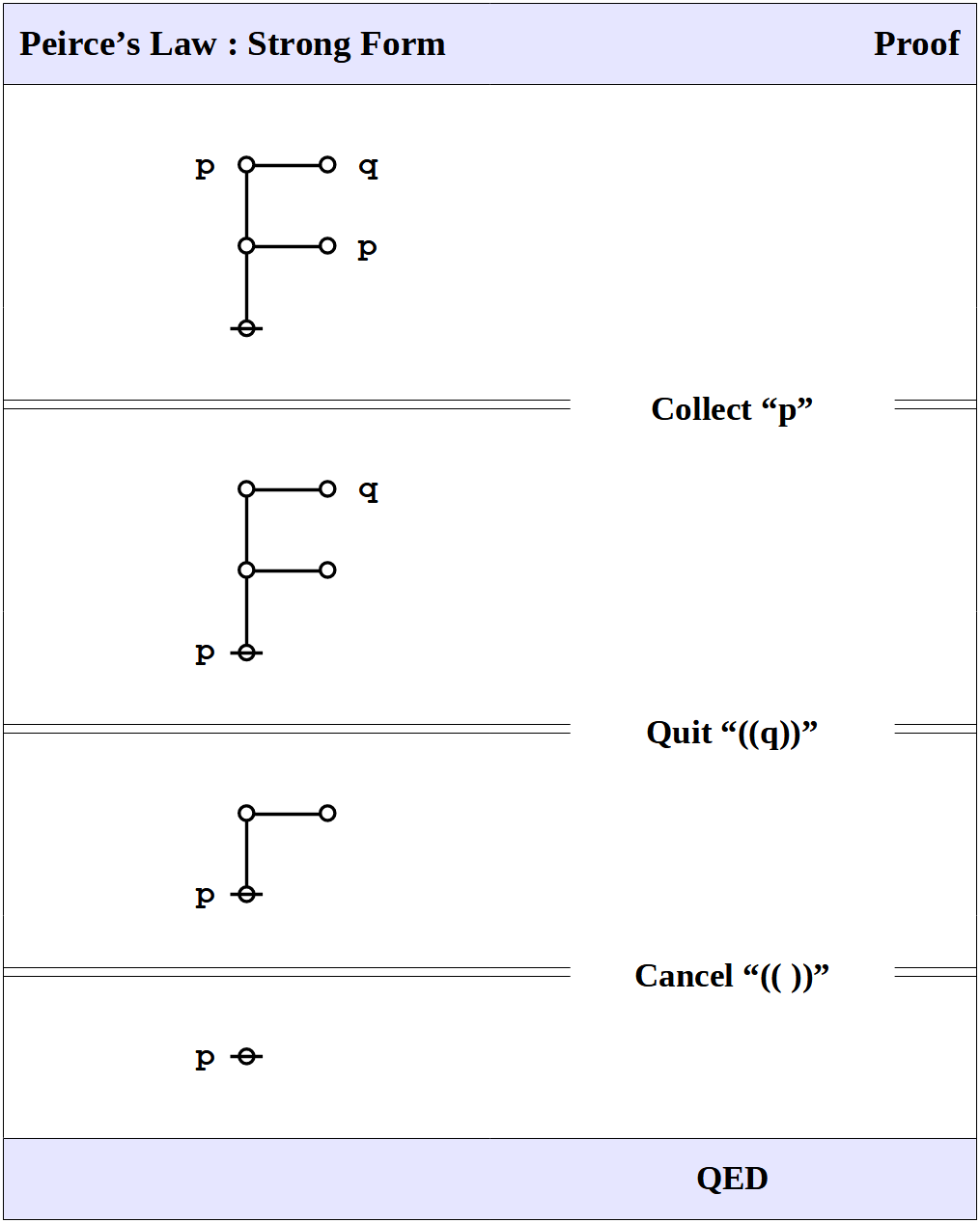
Representing propositions as logical graphs under the existential interpretation, the strong form of Peirce’s law is expressed by the following equation.
Using the axioms and theorems listed in the entries on logical graphs, the equational form of Peirce’s law may be proved in the following manner.

The following animation replays the steps of the proof.

References
- Peirce, Charles Sanders (1885), “On the Algebra of Logic : A Contribution to the Philosophy of Notation”, American Journal of Mathematics 7 (1885), 180–202. Reprinted (CP 3.359–403), (CE 5, 162–190).
- Peirce, Charles Sanders (1931–1935, 1958), Collected Papers of Charles Sanders Peirce, vols. 1–6, Charles Hartshorne and Paul Weiss (eds.), vols. 7–8, Arthur W. Burks (ed.), Harvard University Press, Cambridge, MA. Cited as (CP volume.paragraph).
- Peirce, Charles Sanders (1981–), Writings of Charles S. Peirce : A Chronological Edition, Peirce Edition Project (eds.), Indiana University Press, Bloomington and Indianapolis, IN. Cited as (CE volume, page).
Resources
cc: FB | Logical Graphs • Laws of Form • Mathstodon • Academia.edu
cc: Conceptual Graphs • Cybernetics • Structural Modeling • Systems Science




 being false while its antecedent
  is true. If this is true, either its consequent,
  is true, when the whole formula would be true, or its antecedent
  is false. But in the last case the antecedent of
  that is
 is used in such a sense that
  means that from
  every proposition follows. With that understanding, the formula states the principle of excluded middle, that from the falsity of the denial of
  (Peirce, CP 3.384).


 Inquiry Into Inquiry