
Failing to fetch me at first keep encouraged,
Missing me one place search another,
I stop some where waiting for you
— Walt Whitman • Leaves of Grass
Life on Easy Street
The finite character of the extended universe ![[\mathrm{E}\mathcal{A}]](https://s0.wp.com/latex.php?latex=%5B%5Cmathrm%7BE%7D%5Cmathcal%7BA%7D%5D&bg=ffffff&fg=000000&s=0&c=20201002)


Being in possession of complete algorithms for propositional calculus modeling, theorem checking, and theorem proving makes the analytic task fairly simple in principle, even if the question of efficiency in the face of arbitrary complexity remains another matter entirely.
The NP‑completeness of propositional satisfiability may weigh against the prospects of a single efficient algorithm capable of covering the whole space
Resources
cc: FB | Differential Logic • Laws of Form • Mathstodon • Academia.edu
cc: Conceptual Graphs (1) (2) • Cybernetics • Structural Modeling • Systems Science
 of a universe of discourse
 ![[\mathcal{A}]](https://s0.wp.com/latex.php?latex=%5B%5Cmathcal%7BA%7D%5D&bg=ffffff&fg=000000&s=0&c=20201002) is formed by taking the initial basis
is formed by taking the initial basis  together with the differential basis
  Thus we have the following formula.
 also called the tangent bundle of


![\mathrm{E}A^\bullet = [\mathrm{E}\mathcal{A}]](https://s0.wp.com/latex.php?latex=%5Cmathrm%7BE%7DA%5E%5Cbullet+%3D+%5B%5Cmathrm%7BE%7D%5Cmathcal%7BA%7D%5D&bg=ffffff&fg=000000&s=0&c=20201002) is the full collection of points and functions, or interpretations and propositions, based on the extended set of features
is the full collection of points and functions, or interpretations and propositions, based on the extended set of features  a fact summed up in the following notation.
![\mathrm{E}A^\bullet ~=~ [\mathrm{E}\mathcal{A}] ~=~ [a_1, \ldots, a_n, \mathrm{d}a_1, \ldots, \mathrm{d}a_n].](https://s0.wp.com/latex.php?latex=%5Cmathrm%7BE%7DA%5E%5Cbullet+%7E%3D%7E+%5B%5Cmathrm%7BE%7D%5Cmathcal%7BA%7D%5D+%7E%3D%7E+%5Ba_1%2C+%5Cldots%2C+a_n%2C+%5Cmathrm%7Bd%7Da_1%2C+%5Cldots%2C+%5Cmathrm%7Bd%7Da_n%5D.&bg=ffffff&fg=000000&s=0&c=20201002)
 the following type.
 we arrive at the launchpad of our space explorations.

 taken by itself. In like fashion, the adjective extended or the substantive bundle is systematically attached to any construct associated with the full complement of
  features.
 at one of its points
  sometimes written
  takes the form


 Strictly speaking, the name cotangent space is probably more correct for this construction but since we take up spaces and their duals in pairs to form our universes of discourse it allows our language to be pliable here.
 is a set consisting of two differential propositions,
  where
where  is a proposition with the logical value of
  Each component
  operating under the ordered correspondence
  A measure of clarity is achieved, however, by acknowledging the differential usage with a superficially distinct type
  whose sense may be indicated as follows.
 and
and  may appear to be identical sets of binary vectors, but taking a view at that level of abstraction would be like ignoring the qualitative units and the diverse dimensions that distinguish position and momentum, or the different roles of quantity and impulse.
 to include a set of symbols for differential features, or basic changes capable of occurring in
 ![[\mathcal{A}].](https://s0.wp.com/latex.php?latex=%5B%5Cmathcal%7BA%7D%5D.&bg=ffffff&fg=000000&s=0&c=20201002) The added symbols are taken to denote primitive features of change, qualitative attributes of motion, or propositions about how items in the universe of discourse may change or move in relation to features noted in the original alphabet.
The added symbols are taken to denote primitive features of change, qualitative attributes of motion, or propositions about how items in the universe of discourse may change or move in relation to features noted in the original alphabet.
 in principle just an arbitrary alphabet of symbols, disjoint from the initial alphabet
  and given the meanings just indicated.
 Indeed, for all we know, the state space
 supplies the groundwork for any number of further extensions, beginning with the first order differential extension
  The construction of
  is extended by a first order differential alphabet
  resulting in a first order extended alphabet
  defined as follows.
 is extended by a first order differential basis
  resulting in a first order extended basis
 is extended by a first order differential space or tangent space
  at each point of
![A^\bullet = [ a_1, \ldots, a_n ]](https://s0.wp.com/latex.php?latex=A%5E%5Cbullet+%3D+%5B+a_1%2C+%5Cldots%2C+a_n+%5D&bg=ffffff&fg=000000&s=0&c=20201002) is extended by a first order differential universe or tangent universe
is extended by a first order differential universe or tangent universe ![\mathrm{d}A^\bullet = [ \mathrm{d}a_1, \ldots, \mathrm{d}a_n ]](https://s0.wp.com/latex.php?latex=%5Cmathrm%7Bd%7DA%5E%5Cbullet+%3D+%5B+%5Cmathrm%7Bd%7Da_1%2C+%5Cldots%2C+%5Cmathrm%7Bd%7Da_n+%5D&bg=ffffff&fg=000000&s=0&c=20201002) at each point of
at each point of  resulting in a first order extended universe or tangent bundle universe
 ![\mathrm{E}A^\bullet ~=~ [ \mathrm{E}\mathcal{A} ] ~=~ [ \mathcal{A} ~\cup~ \mathrm{d}\mathcal{A} ] ~=~ [ a_1, \ldots, a_n, \mathrm{d}a_1, \ldots, \mathrm{d}a_n ].](https://s0.wp.com/latex.php?latex=%5Cmathrm%7BE%7DA%5E%5Cbullet+%7E%3D%7E+%5B+%5Cmathrm%7BE%7D%5Cmathcal%7BA%7D+%5D+%7E%3D%7E+%5B+%5Cmathcal%7BA%7D+%7E%5Ccup%7E+%5Cmathrm%7Bd%7D%5Cmathcal%7BA%7D+%5D+%7E%3D%7E+%5B+a_1%2C+%5Cldots%2C+a_n%2C+%5Cmathrm%7Bd%7Da_1%2C+%5Cldots%2C+%5Cmathrm%7Bd%7Da_n+%5D.&bg=ffffff&fg=000000&s=0&c=20201002)
![[ \mathbb{B}^n \times \mathbb{D}^n ] ~=~ (\mathbb{B}^n \times \mathbb{D}^n\ +\!\!\to \mathbb{B}) ~=~ (\mathbb{B}^n \times \mathbb{D}^n, \mathbb{B}^n \times \mathbb{D}^n \to \mathbb{B}).](https://s0.wp.com/latex.php?latex=%5B+%5Cmathbb%7BB%7D%5En+%5Ctimes+%5Cmathbb%7BD%7D%5En+%5D+%7E%3D%7E+%28%5Cmathbb%7BB%7D%5En+%5Ctimes+%5Cmathbb%7BD%7D%5En%5C+%2B%5C%21%5C%21%5Cto+%5Cmathbb%7BB%7D%29+%7E%3D%7E+%28%5Cmathbb%7BB%7D%5En+%5Ctimes+%5Cmathbb%7BD%7D%5En%2C+%5Cmathbb%7BB%7D%5En+%5Ctimes+%5Cmathbb%7BD%7D%5En+%5Cto+%5Cmathbb%7BB%7D%29.&bg=ffffff&fg=000000&s=0&c=20201002)
 we arrive at the foothills of differential logic.
 to a set of two values, in other words, indicator functions of the form
  singular propositions are those singling out the minimal distinct regions of the universe, represented by single cells of the corresponding venn diagram.
 may be written as products:
 there are
  singular propositions. Their venn diagrams are shown in Figure 10.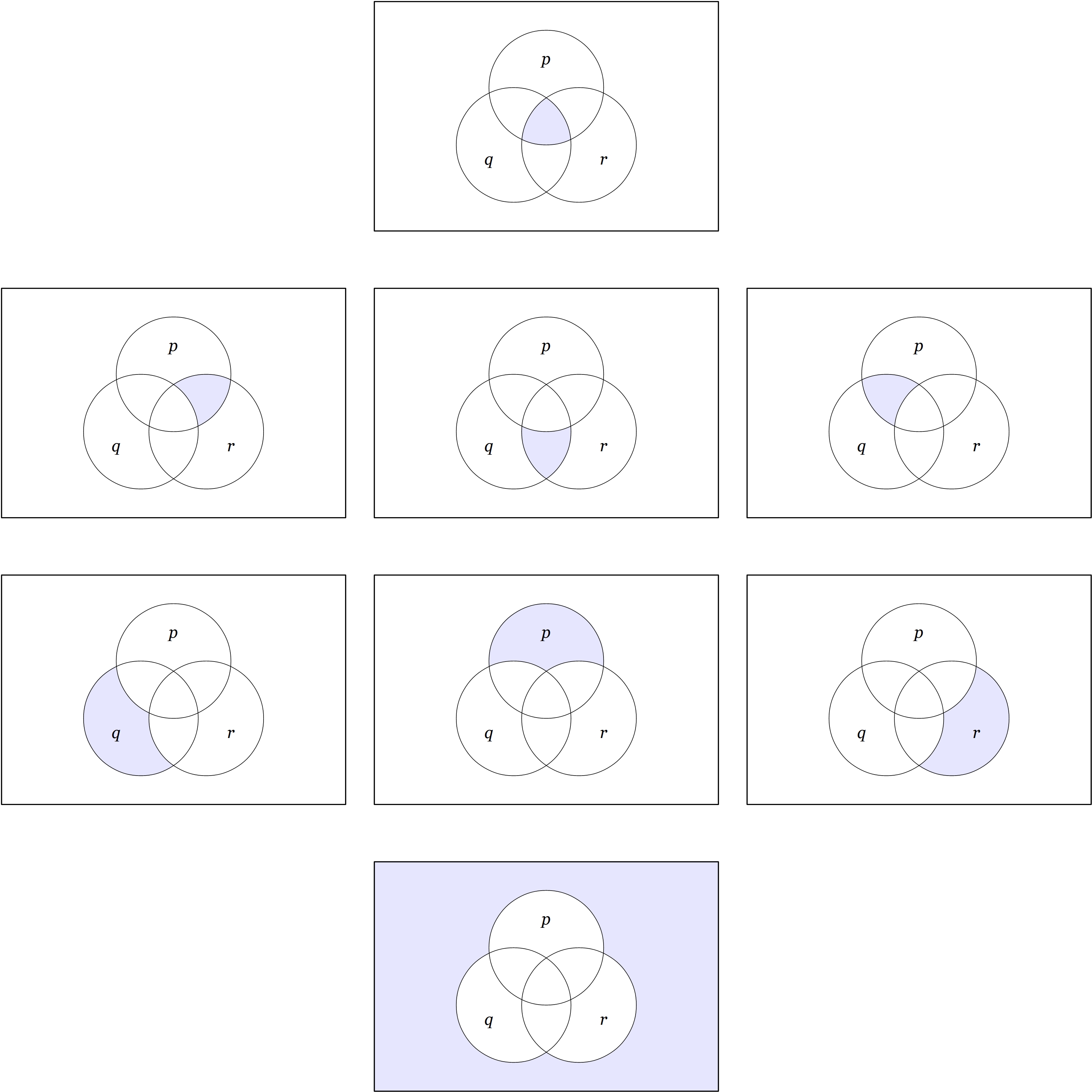

 and identical with the positive proposition of rank 3.


 may be written as products:


 respectively.
 function, which may be expressed by the form
  or by a simple


 Inquiry Into Inquiry