Praeclarum Theorema • 1

The praeclarum theorema, or splendid theorem, is a theorem of propositional calculus noted and named by G.W. Leibniz, who stated and proved it in the following manner.

If a is b and d is c, then ad will be bc.
This is a fine theorem, which is proved in this way:
a is b, therefore ad is bd (by what precedes),
d is c, therefore bd is bc (again by what precedes),
ad is bd, and bd is bc, therefore ad is bc.  Q.E.D.

— Leibniz • Logical Papers, p. 41.

Expressed in contemporary logical notation, the theorem may be written as follows.

((a \Rightarrow b) \land (d \Rightarrow c)) \Rightarrow ((a \land d) \Rightarrow (b \land c))

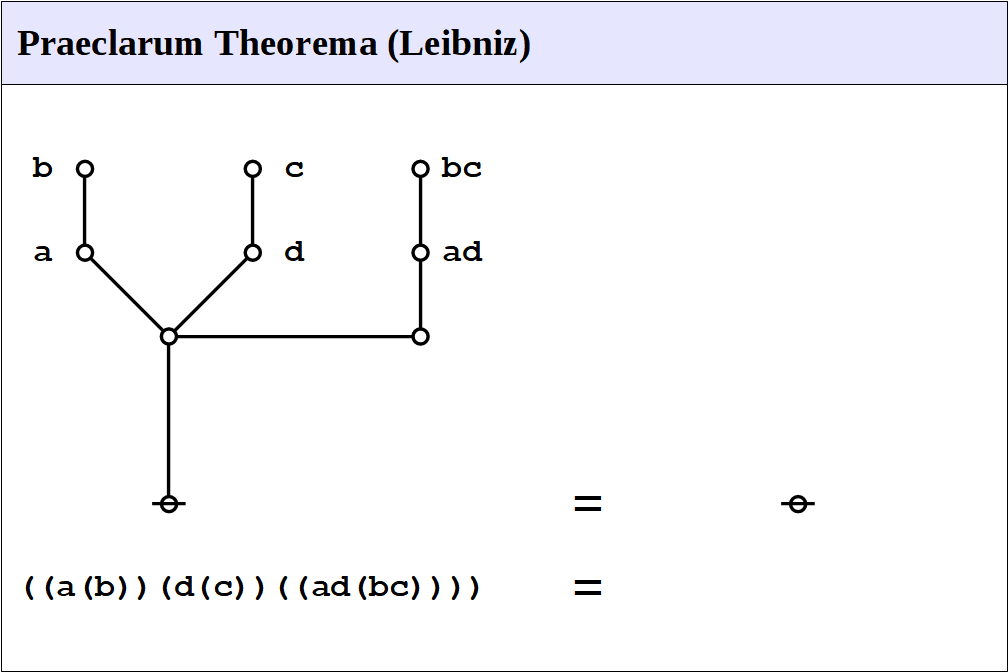
Expressed as a logical graph under the existential interpretation, the theorem takes the shape of the following formal equivalence or propositional equation.
Praeclarum Theorema (Leibniz)

Reference

  • Leibniz, Gottfried W. (1679–1686?), “Addenda to the Specimen of the Universal Calculus”, pp. 40–46 in G.H.R. Parkinson (ed., trans., 1966), Leibniz : Logical Papers, Oxford University Press, London, UK.

Readings

Resources

cc: FB | Logical GraphsLaws of Form • Mathstodon • Academia.edu
cc: Conceptual GraphsCyberneticsStructural ModelingSystems Science

Posted in Animata, C.S. Peirce, Cactus Graphs, Deduction, Equational Inference, Form, Laws of Form, Leibniz, Logic, Logical Graphs, Mathematics, Model Theory, Painted Cacti, Praeclarum Theorema, Proof Theory, Propositional Calculus, Propositional Equation Reasoning Systems, Relation Theory, Semiotics, Spencer Brown, Visualization | Tagged , , , , , , , , , , , , , , , , , , , , | 9 Comments

Logical Graphs • Discussion 9

Re: Logical Graphs • Formal Development
Re: Laws of FormLyle Anderson

LA:
The Gestalt Switch from parenthesis to graphs is stimulating.  There are probably things in Laws of Form that we didn’t see because we were blinded by the crosses.

Lyle,

That has been my experience.  Viewing a space of mathematical objects from a new angle and changing the basis of representation can bring out new and surprising aspects of their form and even expand the field of view to novel directions of generalization.

One of the first things I learned in the early years of computing with logical graphs is how essential it is to “slip the surly bonds” of the planar embedding and work with free trees in a space of their own.

cc: FB | Logical GraphsLaws of FormMathstodonAcademia.edu
cc: Conceptual GraphsCyberneticsStructural ModelingSystems Science

Posted in Amphecks, Animata, Boolean Algebra, Boolean Functions, C.S. Peirce, Cactus Graphs, Constraint Satisfaction Problems, Deduction, Diagrammatic Reasoning, Duality, Equational Inference, Graph Theory, Laws of Form, Logic, Logical Graphs, Mathematics, Minimal Negation Operators, Painted Cacti, Propositional Calculus, Propositional Equation Reasoning Systems, Relation Theory, Semiotics, Sign Relations, Spencer Brown, Topology, Visualization | Tagged , , , , , , , , , , , , , , , , , , , , , , , , , | 5 Comments

Praeclarum Theorema

Introduction

The praeclarum theorema, or splendid theorem, is a theorem of propositional calculus noted and named by G.W. Leibniz, who stated and proved it in the following manner.

If a is b and d is c, then ad will be bc.
This is a fine theorem, which is proved in this way:
a is b, therefore ad is bd (by what precedes),
d is c, therefore bd is bc (again by what precedes),
ad is bd, and bd is bc, therefore ad is bc.  Q.E.D.

— Leibniz • Logical Papers, p. 41.

Expressed in contemporary logical notation, the theorem may be written as follows.

((a \Rightarrow b) \land (d \Rightarrow c)) \Rightarrow ((a \land d) \Rightarrow (b \land c))

Expressed as a logical graph under the existential interpretation, the theorem takes the shape of the following formal equivalence or propositional equation.

Praeclarum Theorema (Leibniz)

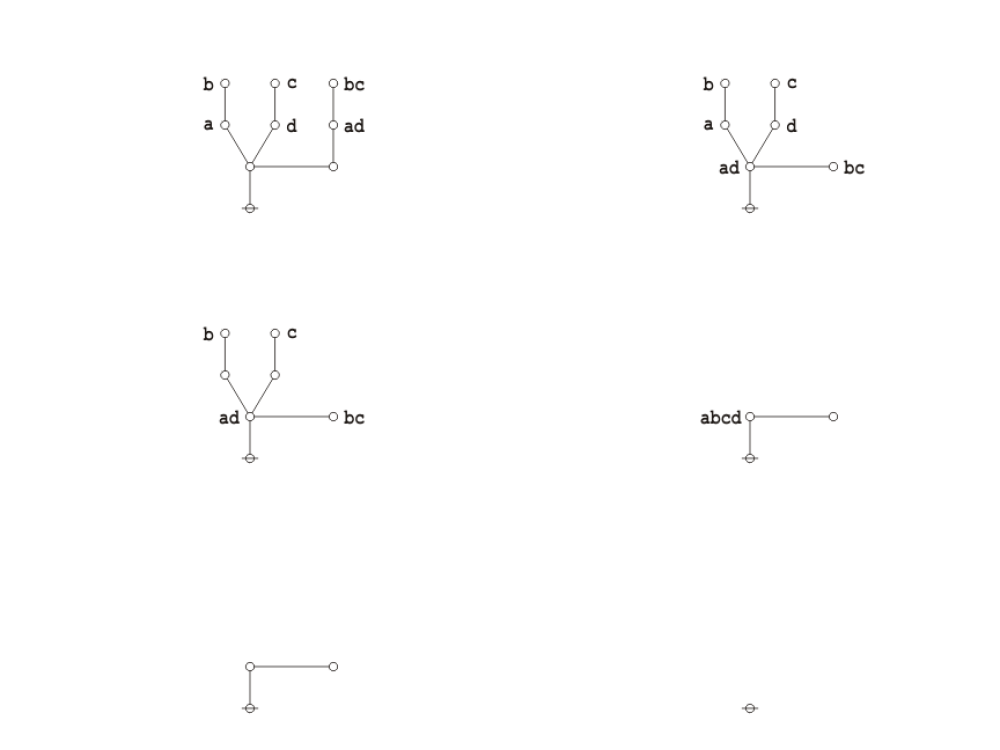
And here’s a neat proof of that nice theorem —

Praeclarum Theorema • Proof

The steps of the proof are replayed in the following animation.

Praeclarum Theorema • Proof Animation

Reference

  • Leibniz, Gottfried W. (1679–1686?), “Addenda to the Specimen of the Universal Calculus”, pp. 40–46 in G.H.R. Parkinson (ed., trans., 1966), Leibniz : Logical Papers, Oxford University Press, London, UK.

Readings

Resources

cc: FB | Logical Graphs • Laws of Form • Mathstodon • Academia.edu
cc: Conceptual Graphs • Cybernetics • Structural Modeling • Systems Science

Posted in Animata, C.S. Peirce, Cactus Graphs, Deduction, Equational Inference, Form, Laws of Form, Leibniz, Logic, Logical Graphs, Mathematics, Model Theory, Painted Cacti, Praeclarum Theorema, Proof Theory, Propositional Calculus, Propositional Equation Reasoning Systems, Relation Theory, Semiotics, Spencer Brown, Visualization | Tagged , , , , , , , , , , , , , , , , , , , , | 8 Comments

Logical Graphs • Discussion 8

Re: Logical Graphs • Formal Development
Re: Laws of FormAlex Shkotin

Hi Alex,

I got my first brush with graph theory in a course on the Foundations of Mathematics Frank Harary taught at the University of Michigan in 1970.  Frank was the don, founder, mover, and shaker of what we affectionately called the “MiGhTy” school of graph theory, spawned at U of M, Michigan State, Illinois, Indiana, and eventually spreading to other hotbeds of research in the Midwest and beyond.  Later I took my first graduate course in graph theory from Ed Palmer at Michigan State, using Harary’s Graph Theory as the text of choice.

Definitions of graphs vary in style and substance in accord with the level of abstraction required by a particular approach or application.  The following is a classic formulation, one which covers the essential ideas in a very short space, and one whose elegance and power I’ve come to appreciate more and more as time goes by.

A graph G consists of a finite nonempty set V = V(G) of p points together with a prescribed set X of q unordered pairs of distinct points of V.  Each pair x = \{ u, v \} of points in X is a line of G, and x is said to join u and v.  We write x = uv and say that u and v are adjacent points (sometimes denoted u ~\mathrm{adj}~ v);  point u and line x are incident with each other, as are v and x.  If two distinct lines x and y are incident with a common point, then they are adjacent lines.  A graph with p points and q lines is called a (p, q) graph.  The (1, 0) graph is trivial.  (Harary, Graph Theory, p. 9).
I’ll be hewing fairly close to that definition and terminology, though most graph theorists are used to the more common variations, like nodes instead of points and edges instead of lines — except for the notion of painted graphs where I had to invent a new term due to the fact that labels and colors were already taken for other uses.

References

  • Harary, F. (1969), Graph Theory, Addison-Wesley, Reading, MA.
  • Harary, F., and Palmer, E.M. (1973), Graphical Enumeration, Academic Press, New York, NY.
  • Palmer, E.M. (1985), Graphical Evolution : An Introduction to the Theory of Random Graphs, John Wiley and Sons, New York, NY.

cc: FB | Logical GraphsLaws of FormMathstodonAcademia.edu
cc: Conceptual GraphsCyberneticsStructural ModelingSystems Science

Posted in Amphecks, Animata, Boolean Algebra, Boolean Functions, C.S. Peirce, Cactus Graphs, Constraint Satisfaction Problems, Deduction, Diagrammatic Reasoning, Duality, Equational Inference, Graph Theory, Laws of Form, Logic, Logical Graphs, Mathematics, Minimal Negation Operators, Painted Cacti, Propositional Calculus, Propositional Equation Reasoning Systems, Relation Theory, Semiotics, Sign Relations, Spencer Brown, Topology, Visualization | Tagged , , , , , , , , , , , , , , , , , , , , , , , , , | 5 Comments

Logical Graphs • Discussion 7

Re: Logical Graphs • Formal Development
Re: Laws of FormAlex Shkotin

AS:
When we look at undirected graph it is usual, before describing a rules of graph transformation, to describe exactly what kind of graphs we are working with —

Hi Alex,

I am traveling this week, with limited internet.  There’s a quickie glossary under the heading “Painted And Rooted Cacti” on the following blog page.

Regards,
Jon

cc: FB | Logical GraphsLaws of FormMathstodonAcademia.edu
cc: Conceptual GraphsCyberneticsStructural ModelingSystems Science

Posted in Amphecks, Animata, Boolean Algebra, Boolean Functions, C.S. Peirce, Cactus Graphs, Constraint Satisfaction Problems, Deduction, Diagrammatic Reasoning, Duality, Equational Inference, Graph Theory, Laws of Form, Logic, Logical Graphs, Mathematics, Minimal Negation Operators, Painted Cacti, Propositional Calculus, Propositional Equation Reasoning Systems, Relation Theory, Semiotics, Sign Relations, Spencer Brown, Topology, Visualization | Tagged , , , , , , , , , , , , , , , , , , , , , , , , , | 5 Comments

Logical Graphs • Formal Development 8

Exemplary Proofs

Using no more than the axioms and theorems recorded so far, it is possible to prove a multitude of much more complex theorems.  A couple of all‑time favorites are linked below.

cc: FB | Logical GraphsLaws of FormMathstodonAcademia.edu
cc: Conceptual GraphsCyberneticsStructural ModelingSystems Science

Posted in Animata, Boolean Algebra, Boolean Functions, C.S. Peirce, Cactus Graphs, Deduction, Diagrammatic Reasoning, Equational Inference, Graph Theory, Laws of Form, Logic, Logical Graphs, Mathematics, Painted Cacti, Peirce, Propositional Calculus, Propositional Equation Reasoning Systems, Semiotics, Spencer Brown, Visualization | Tagged , , , , , , , , , , , , , , , , , , , | 3 Comments

Logical Graphs • Formal Development 7

Frequently Used Theorems (concl.)

C3.  Dominant Form Theorem

The third of the frequently used theorems of service to this survey is one Spencer Brown annotates as Consequence 3 (C3) or Integration.  A better mnemonic might be dominance and recession theorem (DART), but perhaps the brevity of dominant form theorem (DFT) is sufficient reminder of its double‑edged role in proofs.

Dominant Form Theorem

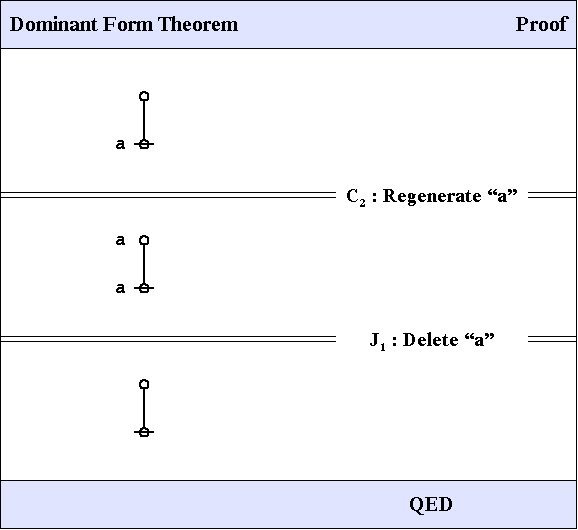
Here is a proof of the Dominant Form Theorem.

Dominant Form Theorem • Proof

cc: FB | Logical GraphsLaws of FormMathstodonAcademia.edu
cc: Conceptual GraphsCyberneticsStructural ModelingSystems Science

Posted in Animata, Boolean Algebra, Boolean Functions, C.S. Peirce, Cactus Graphs, Deduction, Diagrammatic Reasoning, Equational Inference, Graph Theory, Laws of Form, Logic, Logical Graphs, Mathematics, Painted Cacti, Peirce, Propositional Calculus, Propositional Equation Reasoning Systems, Semiotics, Spencer Brown, Visualization | Tagged , , , , , , , , , , , , , , , , , , , | 3 Comments

Logical Graphs • Formal Development 6

Frequently Used Theorems (cont.)

C2.  Generation Theorem

One theorem of frequent use goes under the nickname of the weed and seed theorem (WAST).  The proof is just an exercise in mathematical induction, once a suitable basis is laid down, and it will be left as an exercise for the reader.  What the WAST says is that a label can be freely distributed or freely erased anywhere in a subtree whose root is labeled with that label.  The second in our list of frequently used theorems is in fact the base case of this weed and seed theorem.  In Laws of Form it goes by the names of Consequence 2 (C2) or Generation.

Generation Theorem

Here is a proof of the Generation Theorem.

Generation Theorem • Proof

cc: FB | Logical GraphsLaws of FormMathstodonAcademia.edu
cc: Conceptual GraphsCyberneticsStructural ModelingSystems Science

Posted in Animata, Boolean Algebra, Boolean Functions, C.S. Peirce, Cactus Graphs, Deduction, Diagrammatic Reasoning, Equational Inference, Graph Theory, Laws of Form, Logic, Logical Graphs, Mathematics, Painted Cacti, Peirce, Propositional Calculus, Propositional Equation Reasoning Systems, Semiotics, Spencer Brown, Visualization | Tagged , , , , , , , , , , , , , , , , , , , | 3 Comments

Logical Graphs • Formal Development 5

Frequently Used Theorems

To familiarize ourselves with equational proofs in logical graphs let’s run though the proofs of a few basic theorems in the primary algebra.

C1.  Double Negation Theorem

The first theorem goes under the names of Consequence 1 (C1), the double negation theorem (DNT), or Reflection.

Double Negation Theorem

The proof that follows is adapted from the one George Spencer Brown gave in his book Laws of Form and credited to two of his students, John Dawes and D.A. Utting.

Double Negation Theorem • Proof

cc: FB | Logical GraphsLaws of FormMathstodonAcademia.edu
cc: Conceptual GraphsCyberneticsStructural ModelingSystems Science

Posted in Animata, Boolean Algebra, Boolean Functions, C.S. Peirce, Cactus Graphs, Deduction, Diagrammatic Reasoning, Equational Inference, Graph Theory, Laws of Form, Logic, Logical Graphs, Mathematics, Painted Cacti, Peirce, Propositional Calculus, Propositional Equation Reasoning Systems, Semiotics, Spencer Brown, Visualization | Tagged , , , , , , , , , , , , , , , , , , , | 3 Comments

Logical Graphs • Formal Development 4

Equational Inference

All the initials I_1, I_2, J_1, J_2 have the form of equations.  This means the inference steps they license are reversible.  The proof annotation scheme employed below makes use of double bars =\!=\!=\!=\!=\!= to mark this fact, though it will often be left to the reader to decide which of the two possible directions is the one required for applying the indicated axiom.

The actual business of proof is a far more strategic affair than the routine cranking of inference rules might suggest.  Part of the reason for this lies in the circumstance that the customary types of inference rules combine the moving forward of a state of inquiry with the losing of information along the way that doesn’t appear immediately relevant, at least, not as viewed in the local focus and short run of the proof in question.  Over the long haul, this has the pernicious side‑effect that one is forever strategically required to reconstruct much of the information one had strategically thought to forget at earlier stages of proof, where “before the proof started” can be counted as an earlier stage of the proof in view.

This is just one of the reasons it can be very instructive to study equational inference rules of the sort our axioms have just provided.  Although equational forms of reasoning are paramount in mathematics, they are less familiar to the student of the usual logic textbooks, who may find a few surprises here.

cc: FB | Logical GraphsLaws of FormMathstodonAcademia.edu
cc: Conceptual GraphsCyberneticsStructural ModelingSystems Science

Posted in Animata, Boolean Algebra, Boolean Functions, C.S. Peirce, Cactus Graphs, Deduction, Diagrammatic Reasoning, Equational Inference, Graph Theory, Laws of Form, Logic, Logical Graphs, Mathematics, Painted Cacti, Peirce, Propositional Calculus, Propositional Equation Reasoning Systems, Semiotics, Spencer Brown, Visualization | Tagged , , , , , , , , , , , , , , , , , , , | 3 Comments