Sign Relations • Anthesis

Thus, if a sunflower, in turning towards the sun, becomes by that very act fully capable, without further condition, of reproducing a sunflower which turns in precisely corresponding ways toward the sun, and of doing so with the same reproductive power, the sunflower would become a Representamen of the sun.

— C.S. Peirce, Collected Papers, CP 2.274

In his picturesque illustration of a sign relation, along with his tracing of a corresponding sign process, or semiosis, Peirce uses the technical term representamen for his concept of a sign, but the shorter word is precise enough, so long as one recognizes its meaning in a particular theory of signs is given by a specific definition of what it means to be a sign.

Resources

cc: CyberneticsOntolog • Peirce List (1) (2)Structural ModelingSystems Science

Posted in C.S. Peirce, Logic, Logic of Relatives, Mathematics, Peirce, Peirce's Categories, Philosophy, Pragmatic Semiotic Information, Pragmatism, Relation Theory, Semiotics, Sign Relations, Thirdness, Triadic Relations, Triadicity | Tagged , , , , , , , , , , , , , , | 7 Comments

Triadic Relations • Discussion 1

Re: CyberneticsLoet Leydesdorff

Loet Leydesdorff mentioned making extensive use of triads in a new paper.

  • Leydesdorff, Loet, and Ivanova, Inga (2020), “The Measurement of ‘Interdisciplinarity’ and ‘Synergy’ in Scientific and Extra-Scientific Collaborations”. Online (1) (2).

Just off-hand this looks like the right ballpark for my long run interests but it will take me a few more posts just dusting off home plate and clearing the base lines.

Here’s a paper Susan Awbrey and I wrote a while back giving some hint of the Big Game in play here, the “scholarship of integration” needed to bring the harvests of information locked away in so many isolated silos to bear on our world of common problems.

  • Awbrey, S.M., and Awbrey, J.L. (2001), “Conceptual Barriers to Creating Integrative Universities”, Organization : The Interdisciplinary Journal of Organization, Theory, and Society 8(2), Sage Publications, London, UK, pp. 269–284. Abstract. Online.

cc: CyberneticsOntolog ForumPeirce ListStructural ModelingSystems Science

Posted in C.S. Peirce, Logic, Logic of Relatives, Mathematics, Peirce, Peirce's Categories, Philosophy, Pragmatic Semiotic Information, Pragmatism, Relation Theory, Semiotics, Sign Relations, Thirdness, Triadic Relations, Triadicity | Tagged , , , , , , , , , , , , , , | 6 Comments

Triadic Relations • Examples 2

Examples from Semiotics

The study of signs — the full variety of significant forms of expression — in relation to all the affairs signs are significant of, and in relation to all the beings signs are significant to, is known as semiotics or the theory of signs.  As described, semiotics treats of a 3-place relation among signs, their objects, and their interpreters.

The term semiosis refers to any activity or process involving signs.  Studies of semiosis focusing on its abstract form are not concerned with every concrete detail of the entities acting as signs, as objects, or as agents of semiosis, but only with the most salient patterns of relationship among those three roles.  In particular, the formal theory of signs does not consider all the properties of the interpretive agent but only the more striking features of the impressions signs make on a representative interpreter.  From a formal point of view this impact or influence may be treated as just another sign, called the interpretant sign, or the interpretant for short.  A triadic relation of this type, among objects, signs, and interpretants, is called a sign relation.

For example, consider the aspects of sign use involved when two people, say Ann and Bob, use their own proper names, “Ann” and “Bob”, along with the pronouns, “I” and “you”, to refer to themselves and each other.  For brevity, these four signs may be abbreviated to the set \{ {}^{\backprime\backprime} \mathrm{A} {}^{\prime\prime}, {}^{\backprime\backprime} \mathrm{B} {}^{\prime\prime}, {}^{\backprime\backprime} \mathrm{i} {}^{\prime\prime}, {}^{\backprime\backprime} \mathrm{u} {}^{\prime\prime} \}.  The abstract consideration of how \mathrm{A} and \mathrm{B} use this set of signs leads to the contemplation of a pair of triadic relations, the sign relations L_\mathrm{A} and L_\mathrm{B}, reflecting the differential use of these signs by \mathrm{A} and \mathrm{B}, respectively.

Each of the sign relations L_\mathrm{A} and L_\mathrm{B} consists of eight triples of the form (x, y, z), where the object x belongs to the object domain O = \{ \mathrm{A}, \mathrm{B} \}, the sign y belongs to the sign domain S, the interpretant sign z belongs to the interpretant domain I, and where it happens in this case that S = I = \{ {}^{\backprime\backprime} \mathrm{A} {}^{\prime\prime}, {}^{\backprime\backprime} \mathrm{B} {}^{\prime\prime}, {}^{\backprime\backprime} \mathrm{i} {}^{\prime\prime}, {}^{\backprime\backprime} \mathrm{u} {}^{\prime\prime} \}.  The union S \cup I is often referred to as the syntactic domain, but in this case S = I = S \cup I.


The set-up so far is summarized as follows:

\begin{array}{ccc}  L_\mathrm{A}, L_\mathrm{B} & \subseteq & O \times S \times I  \\[8pt]  O & = & \{ \mathrm{A}, \mathrm{B} \}  \\[8pt]  S & = & \{ \, {}^{\backprime\backprime} \mathrm{A} {}^{\prime\prime}, \, {}^{\backprime\backprime} \mathrm{B} {}^{\prime\prime}, \, {}^{\backprime\backprime} \mathrm{i} {}^{\prime\prime}, \, {}^{\backprime\backprime} \mathrm{u} {}^{\prime\prime} \, \}  \\[8pt]  I & = & \{ \, {}^{\backprime\backprime} \mathrm{A} {}^{\prime\prime}, \, {}^{\backprime\backprime} \mathrm{B} {}^{\prime\prime}, \, {}^{\backprime\backprime} \mathrm{i} {}^{\prime\prime}, \, {}^{\backprime\backprime} \mathrm{u} {}^{\prime\prime} \, \}  \end{array}

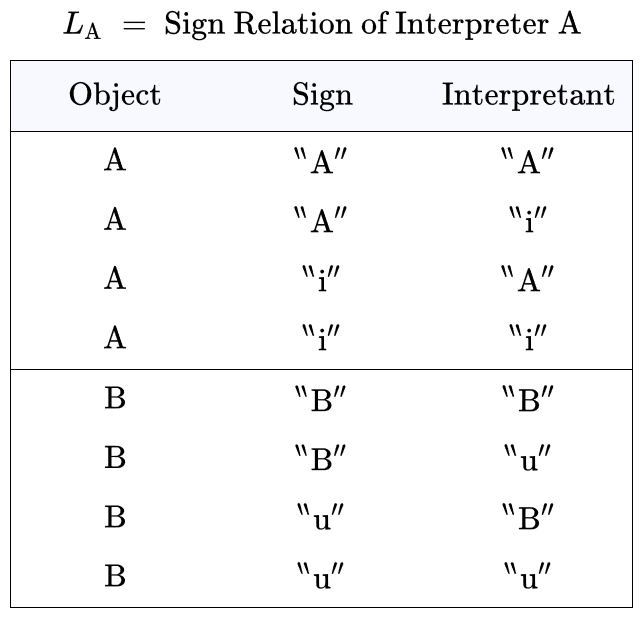
The relation L_\mathrm{A} is the following set of eight triples in O \times S \times I.

\begin{array}{cccccc}  \{ &  (\mathrm{A}, \, {}^{\backprime\backprime} \mathrm{A} {}^{\prime\prime}, \, {}^{\backprime\backprime} \mathrm{A} {}^{\prime\prime}), &  (\mathrm{A}, \, {}^{\backprime\backprime} \mathrm{A} {}^{\prime\prime}, \, {}^{\backprime\backprime} \mathrm{i} {}^{\prime\prime}), &  (\mathrm{A}, \, {}^{\backprime\backprime} \mathrm{i} {}^{\prime\prime}, \, {}^{\backprime\backprime} \mathrm{A} {}^{\prime\prime}), &  (\mathrm{A}, \, {}^{\backprime\backprime} \mathrm{i} {}^{\prime\prime}, \, {}^{\backprime\backprime} \mathrm{i} {}^{\prime\prime}), &  \\  &  (\mathrm{B}, \, {}^{\backprime\backprime} \mathrm{B} {}^{\prime\prime}, \, {}^{\backprime\backprime} \mathrm{B} {}^{\prime\prime}), &  (\mathrm{B}, \, {}^{\backprime\backprime} \mathrm{B} {}^{\prime\prime}, \, {}^{\backprime\backprime} \mathrm{u} {}^{\prime\prime}), &  (\mathrm{B}, \, {}^{\backprime\backprime} \mathrm{u} {}^{\prime\prime}, \, {}^{\backprime\backprime} \mathrm{B} {}^{\prime\prime}), &  (\mathrm{B}, \, {}^{\backprime\backprime} \mathrm{u} {}^{\prime\prime}, \, {}^{\backprime\backprime} \mathrm{u} {}^{\prime\prime}) &  \}.  \end{array}

The triples in L_\mathrm{A} represent the way interpreter \mathrm{A} uses signs.  For example, the presence of ( \mathrm{B}, {}^{\backprime\backprime} \mathrm{u} {}^{\prime\prime}, {}^{\backprime\backprime} \mathrm{B} {}^{\prime\prime} ) in L_\mathrm{A} says \mathrm{A} uses {}^{\backprime\backprime} \mathrm{B} {}^{\prime\prime} to mean the same thing \mathrm{A} uses {}^{\backprime\backprime} \mathrm{u} {}^{\prime\prime} to mean, namely, \mathrm{B}.

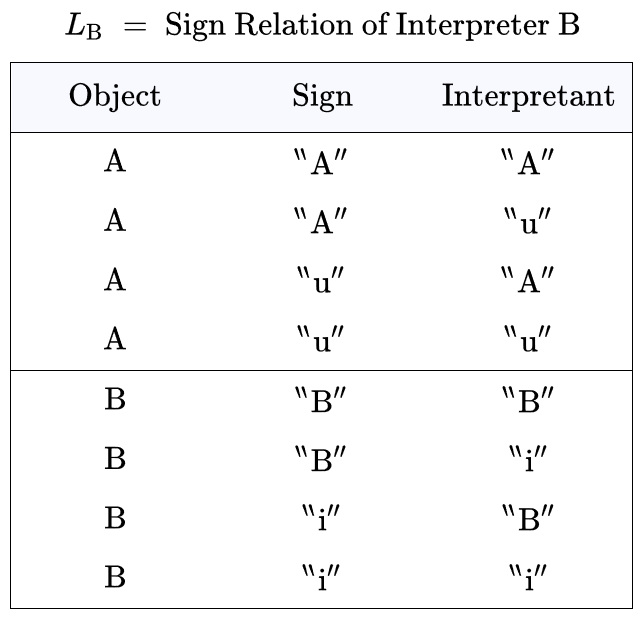
The relation L_\mathrm{B} is the following set of eight triples in O \times S \times I.

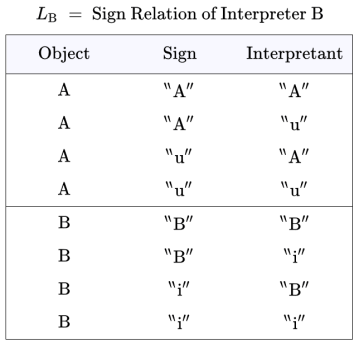
\begin{array}{cccccc}  \{ &  (\mathrm{A}, \, {}^{\backprime\backprime} \mathrm{A} {}^{\prime\prime}, \, {}^{\backprime\backprime} \mathrm{A} {}^{\prime\prime}), &  (\mathrm{A}, \, {}^{\backprime\backprime} \mathrm{A} {}^{\prime\prime}, \, {}^{\backprime\backprime} \mathrm{u} {}^{\prime\prime}), &  (\mathrm{A}, \, {}^{\backprime\backprime} \mathrm{u} {}^{\prime\prime}, \, {}^{\backprime\backprime} \mathrm{A} {}^{\prime\prime}), &  (\mathrm{A}, \, {}^{\backprime\backprime} \mathrm{u} {}^{\prime\prime}, \, {}^{\backprime\backprime} \mathrm{u} {}^{\prime\prime}), &  \\  &  (\mathrm{B}, \, {}^{\backprime\backprime} \mathrm{B} {}^{\prime\prime}, \, {}^{\backprime\backprime} \mathrm{B} {}^{\prime\prime}), &  (\mathrm{B}, \, {}^{\backprime\backprime} \mathrm{B} {}^{\prime\prime}, \, {}^{\backprime\backprime} \mathrm{i} {}^{\prime\prime}), &  (\mathrm{B}, \, {}^{\backprime\backprime} \mathrm{i} {}^{\prime\prime}, \, {}^{\backprime\backprime} \mathrm{B} {}^{\prime\prime}), &  (\mathrm{B}, \, {}^{\backprime\backprime} \mathrm{i} {}^{\prime\prime}, \, {}^{\backprime\backprime} \mathrm{i} {}^{\prime\prime}) &  \}.  \end{array}

The triples in L_\mathrm{B} represent the way interpreter \mathrm{B} uses signs.  For example, the presence of ( \mathrm{B}, {}^{\backprime\backprime} \mathrm{i} {}^{\prime\prime}, {}^{\backprime\backprime} \mathrm{B} {}^{\prime\prime} ) in L_\mathrm{B} says \mathrm{B} uses {}^{\backprime\backprime} \mathrm{B} {}^{\prime\prime} to mean the same thing \mathrm{B} uses {}^{\backprime\backprime} \mathrm{i} {}^{\prime\prime} to mean, namely, \mathrm{B}.

The triples in the relations L_\mathrm{A} and L_\mathrm{B} are conveniently arranged in the form of relational data tables, as shown below.
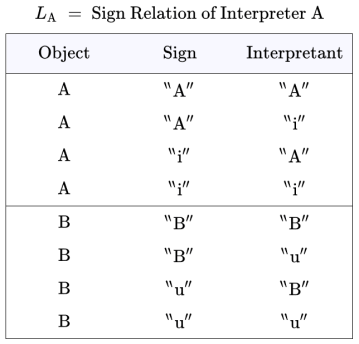
LA = Sign Relation of Interpreter A

LB = Sign Relation of Interpreter B

Resources

Document History

Portions of the above article were adapted from the following sources under the GNU Free Documentation License, under other applicable licenses, or by permission of the copyright holders.

cc: CyberneticsOntolog ForumPeirce ListStructural ModelingSystems Science

Posted in C.S. Peirce, Logic, Logic of Relatives, Mathematics, Peirce, Peirce's Categories, Philosophy, Pragmatic Semiotic Information, Pragmatism, Relation Theory, Semiotics, Sign Relations, Thirdness, Triadic Relations, Triadicity | Tagged , , , , , , , , , , , , , , | 9 Comments

Triadic Relations • Examples 1

Examples from Mathematics

For the sake of topics to be taken up later, it is useful to examine a pair of triadic relations in tandem.  We will construct two triadic relations, L_0 and L_1, each of which is a subset of the same cartesian product X \times Y \times Z.  The structures of L_0 and L_1 can be described in the following way.

Each space X, Y, Z is isomorphic to the boolean domain \mathbb{B} = \{ 0, 1 \} so L_0 and L_1 are subsets of the cartesian power \mathbb{B} \times \mathbb{B} \times \mathbb{B} or the boolean cube \mathbb{B}^3.

The operation of boolean addition, + : \mathbb{B} \times \mathbb{B} \to \mathbb{B}, is equivalent to addition modulo 2, where 0 acts in the usual manner but 1 + 1 = 0.  In its logical interpretation, the plus sign can be used to indicate either the boolean operation of exclusive disjunction or the boolean relation of logical inequality.

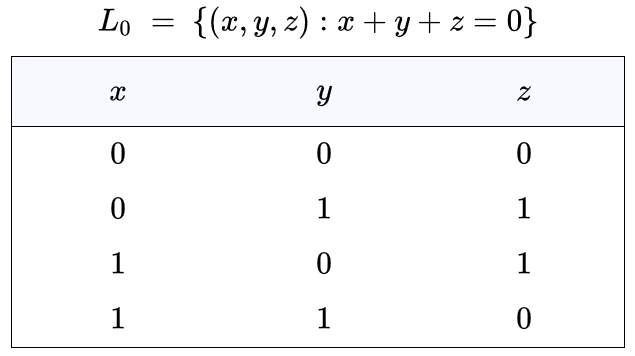
The relation L_0 is defined by the following formula.

L_0 ~=~ \{ (x, y, z) \in \mathbb{B}^3 : x + y + z = 0 \}.

The relation L_0 is the following set of four triples in \mathbb{B}^3.

L_0 ~=~ \{ ~ (0, 0, 0), ~ (0, 1, 1), ~ (1, 0, 1), ~ (1, 1, 0) ~ \}.

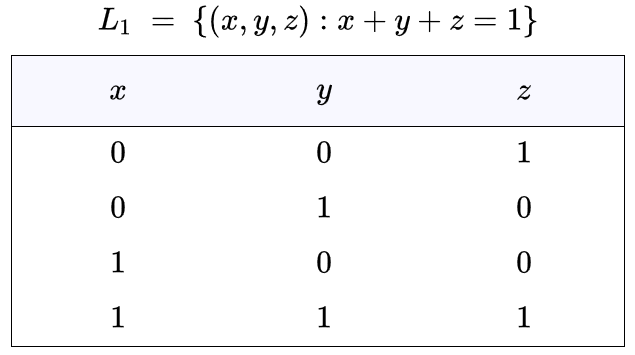
The relation L_1 is defined by the following formula.

L_1 ~=~ \{ (x, y, z) \in \mathbb{B}^3 : x + y + z = 1 \}.

The relation L_1 is the following set of four triples in \mathbb{B}^3.

L_1 ~=~ \{ ~ (0, 0, 1), ~ (0, 1, 0), ~ (1, 0, 0), ~ (1, 1, 1) ~ \}.

The triples in the relations L_0 and L_1 are conveniently arranged in the form of relational data tables, as shown below.
Triadic Relation L0 Bit Sum 0

Triadic Relation L1 Bit Sum 1

Resources

Document History

Portions of the above article were adapted from the following sources under the GNU Free Documentation License, under other applicable licenses, or by permission of the copyright holders.

cc: CyberneticsOntolog ForumPeirce ListStructural ModelingSystems Science

Posted in C.S. Peirce, Logic, Logic of Relatives, Mathematics, Peirce, Peirce's Categories, Philosophy, Pragmatic Semiotic Information, Pragmatism, Relation Theory, Semiotics, Sign Relations, Thirdness, Triadic Relations, Triadicity | Tagged , , , , , , , , , , , , , , | 8 Comments

Triadic Relations • Preamble

Of triadic Being the multitude of forms is so terrific that I have usually shrunk from the task of enumerating them;  and for the present purpose such an enumeration would be worse than superfluous:  it would be a great inconvenience.

C.S. Peirce, Collected Papers, CP 6.347

A triadic relation (or ternary relation) is a special case of a polyadic or finitary relation, one in which the number of places in the relation is three.  One may also see the adjectives 3‑adic, 3‑ary, 3‑dimensional, or 3‑place being used to describe these relations.

Mathematics is positively rife with examples of triadic relations and the field of semiotics is rich in its harvest of sign relations, which are special cases of triadic relations.  In either subject, as Peirce observes, the multitude of forms is truly terrific, so it’s best to begin with concrete examples just complex enough to illustrate the distinctive features of each type.  The discussion to follow takes up a pair of simple but instructive examples from each of the realms of mathematics and semiotics.

Resources

Document History

Portions of the above article were adapted from the following sources under the GNU Free Documentation License, under other applicable licenses, or by permission of the copyright holders.

cc: CyberneticsOntolog ForumPeirce ListStructural ModelingSystems Science

Posted in C.S. Peirce, Logic, Logic of Relatives, Mathematics, Peirce, Peirce's Categories, Philosophy, Pragmatic Semiotic Information, Pragmatism, Relation Theory, Semiotics, Sign Relations, Thirdness, Triadic Relations, Triadicity | Tagged , , , , , , , , , , , , , , | 8 Comments

Relation Theory • Discussion 1

Re: CyberneticsArthur Phillips

Responding to what I’ll abductively interpret as a plea for relevance from the cybernetic galley, let me give a quick review of where we are in this many-oared expedition.

Our reading of Ashby (see Survey of Cybernetics) veered off at a point (Selection 13) where we needed to look more closely at the structures of triadic relations and the ways in which pragmatic, semiotic, and systems thinking all have triadic relations at their core.  As often happens, one side-trip leads to another, but I think our excursions through sign relations, triadic relations, and relations in general will prove useful in the long run as we get back to the question of how signs bear information of use to intelligent systems with a capacity for methodical scientific inquiry.

cc: Category Theory • Cybernetics (1) (2) • Ontolog Forum (1) (2)
cc: Structural Modeling (1) (2) • Systems Science (1) (2)
cc: FB | Relation TheoryLaws of FormPeirce List

Posted in Algebra, Algebra of Logic, C.S. Peirce, Category Theory, Combinatorics, Discrete Mathematics, Duality, Dyadic Relations, Foundations of Mathematics, Graph Theory, Logic, Logic of Relatives, Mathematics, Peirce, Relation Theory, Semiotics, Set Theory, Sign Relational Manifolds, Sign Relations, Triadic Relations, Type Theory, Visualization | Tagged , , , , , , , , , , , , , , , , , , , , , | 9 Comments

Survey of Relation Theory • 4

In this Survey of blog and wiki posts on Relation Theory, relations are viewed from the perspective of combinatorics, in other words, as a topic in discrete mathematics, with special attention to finite structures and concrete set-theoretic constructions, many of which arise quite naturally in applications.  This approach to relation theory is distinct from, though closely related to, its study from the perspectives of abstract algebra on the one hand and formal logic on the other.

Elements

Relational Concepts

Relation Construction Relation Composition Relation Reduction
Relative Term Sign Relation Triadic Relation
Logic of Relatives Hypostatic Abstraction Continuous Predicate

Illustrations

Blog Series

Peirce’s 1870 “Logic of Relatives”

Peirce’s 1880 “Algebra of Logic” Chapter 3

Resources

Posted in Algebra, Algebra of Logic, C.S. Peirce, Category Theory, Combinatorics, Discrete Mathematics, Duality, Dyadic Relations, Foundations of Mathematics, Graph Theory, Logic, Logic of Relatives, Mathematics, Peirce, Relation Theory, Semiotics, Set Theory, Sign Relational Manifolds, Sign Relations, Surveys, Triadic Relations, Triadicity, Type Theory | Tagged , , , , , , , , , , , , , , , , , , , , , , | 14 Comments

Peirce’s Categories • 20

Re: Peirce’s Categories • 15

Understanding another person’s thought can be difficult.  Understanding the way another understands a third person’s thought, all the more so, even if that third person is not so formidable a thinker as Charles Sanders Peirce.  Measures of misunderstanding may be moderated if all thoughts and thinkers are guided by common objectives but the proof of the pudding is in the partaking, as they say.  So let’s step carefully and focus on the task of determining whether category theories, old and new, make good tools for understanding sign relations.

The interaction recorded in my last post continued as follows.

RM:
I do not see how we can talk here about an operative relationship that would be a triad relationship.  It is not anything other than the composition of two morphisms and I do not ask for more.  3, 2, and 1 are the “place names” and “involves” are arrow names that I usually call alpha and beta.  Now if you think about the determinations in the sign, I have always assumed after much study of the 76 definitions, this idea that the composition of applications captures the presence in the mind of each of the elements of the sign, in such a way that they are themselves ipso facto connected by a triadic relationship.

There is a relationship of tricoexistence that is established as in this case evoked by Peirce:  “It predicates the genuinely Triadic relationship of tricoexistence, P ~\mathrm{and}~ Q ~\mathrm{and}~ R ~\mathrm{coexist}” (CP 2.318, unfortunately there is a hole in my PDF of CP right after and I [left] my paper edition at the library of my university, inaccessible at the moment).

We have a mutual incomprehension?

JA:
I don’t often join the debates over classification so frequently animating the animadversions of the Peirce List.  As more the observer than the participant I see the same pattern over and over, with occasional hints but never any hue of resolution fast enough to last and satisfy every dyehard.

Situations of that sort are no novelty in philosophy, or politics, or even math and science on occasion.  And when they occur it is usually because the “place to stand” from which the subject appears in its proper light has yet to be reached by every viewer.

So I’ll back up a little and say how I see things from where I am.

Resources

cc: CyberneticsOntolog • Peirce List (1) (2)Structural ModelingSystems Science

Posted in Abstraction, Aristotle, C.S. Peirce, Category Theory, Logic, Mathematics, Peirce's Categories, Phenomenology, Pragmatic Maxim, Relation Theory, Semiotics, Triadic Relations, Type Theory | Tagged , , , , , , , , , , , , | 6 Comments

Peirce’s Categories • 19

Re: Peirce’s Categories • 15

Another point where the onrush of discussion and the impact of worldly distractions caused my train of thought to jump the track occurred about here —

RM:
First I note that the formulation “3ns involves 2ns, which involves 1ns” is very dangerous [as] it forgets that 2ns has its autonomy and 1ns too.  If you look at the podium [one] remains in the inner cylinder.  It seems to me that Peirce’s reproach to Hegel is:

“He has usually overlooked external Secondness, altogether.  In other words, he has committed the trifling oversight of forgetting that there is a real world with real actions and reactions.  Rather a serious oversight that.”

It is therefore important to prefer “3ns involves 2ns and 1ns, while 2ns involves 1ns” which preserves the autonomy of the Peircian categories so as not to encourage the idea of a possible peircean hegelianism.

JA:
I’ve been working on a comment about your first point but I’ll post it … when and if I manage to put it in respectable shape.  Just by way of a hint for now, the issue turns on whether we take involves or presupposes to be a dyadic relation and a transitive one at that, as we would if we pass from “3 involves 2” and “2 involves 1” to the conclusion “3 involves 1”.  That may be true for some concepts of involution or presupposition but I think the operative relation in this case is a thoroughly irreducible triadic relation, one whose properties do not reduce to the composition of two dyadic relations.

I think it will take a little more work to get clear about this.  I will go back to the draft remarks I was working on and see if I can bring them to bear on the question.

Resources

cc: CyberneticsOntolog • Peirce List (1) (2)Structural ModelingSystems Science

Posted in Abstraction, Aristotle, C.S. Peirce, Category Theory, Logic, Mathematics, Peirce's Categories, Phenomenology, Pragmatic Maxim, Relation Theory, Semiotics, Triadic Relations, Type Theory | Tagged , , , , , , , , , , , , | 8 Comments

Peirce’s Categories • 18

Re: Peirce’s Categories • 15

In These Uncertain Times, as people keep saying, it’s become even harder to concentrate than usual and I keep losing track of tricky points coming up in discussion which cry out for further discussion but then “human voices wake us, and we drown” or something … So let me go back to the list of loose ends I put together at the first of the month and try to address a few of them.

Here’s one juncture deserving of another look:

JAS:
Every proposition is collective and copulative;  as I stated in a recent post, its dynamical object is “the entire universe” (CP 5.448n, EP 2:394, 1906), which is “the totality of all real objects” (CP 5.152, EP 2:209, 1903), while its immediate object is “the logical universe of discourse” (CP 2.323, EP 2:283, 1903).

This is a very important point, not the least because of the light it throws on a question John Corcoran raised on Facebook and elsewhere as to whether the logical universes of Peirce, or logicians in general, are conceived as referring to something like a holistic totality of existence or only a more limited universe of discourse relevant to a particular discussion.  I thought that significant enough to blog on it here:

JA:
Incidentally … lack of care in distinguishing different objects of the same signs, in particular, immediate and ultimate objects and their corresponding universes or object domains, has been the source of many misunderstandings in scattered discussions on Facebook of late.

But then I added:

JA:
Another issue arising here has to do with the difference between the “dimensionality of a relation” and the “number of correlates”.  Signs may have any number of correlates in the object domain without requiring the dimensionality of the relevant sign relation to be greater than three.  This is one of the consequences of “triadic relation irreducibility”.

And that raised a number of further replies from HR and objections from JAS … which I’ll say more about when I get a chance.

Resources

cc: CyberneticsOntolog • Peirce List (1) (2)Structural ModelingSystems Science

Posted in Abstraction, Aristotle, C.S. Peirce, Category Theory, Logic, Logic of Relatives, Mathematics, Peirce, Peirce's Categories, Phenomenology, Pragmatic Maxim, Relation Theory, Semiotics, Triadic Relations, Triadicity, Type Theory | Tagged , , , , , , , , , , , , , , , | 6 Comments