In the Way of Inquiry • Initial Unpleasantness

Clouds and thunder:
The image of Difficulty at the Beginning.
Thus the superior man
Brings order out of confusion.

I Ching Hexagram 3

Inquiry begins in doubt, a debit of certainty and a drought of information, never a pleasant condition to acknowledge, and one of the primary obstacles to inquiry may be reckoned as owing to the onus one naturally feels on owning up to that debt.  Human nature far prefers to revel in the positive features of whatever scientific knowledge it already possesses and the mind defers as long as possible the revolt it feels arising on facing the uncertainties that still persist, the “nots” and “not yets” it cannot as yet and ought not deny.

Reference

  • The I Ching, or Book of Changes, R. Wilhelm and C.F. Baynes (trans.), Foreword by C.G. Jung, Bollingen Series 19, Princeton University Press, Princeton, NJ.  1st edition 1950, 2nd edition 1961, 3rd edition 1967.

Resource

cc: FB | Inquiry Driven SystemsLaws of FormMathstodonAcademia.edu
cc: Conceptual GraphsCyberneticsStructural ModelingSystems Science

Posted in Animata, C.S. Peirce, Inquiry, Inquiry Driven Systems, Inquiry Into Inquiry, Intelligent Systems, Semiotics | Tagged , , , , , , | 6 Comments

In the Way of Inquiry • Obstacles

Upon this first, and in one sense this sole, rule of reason, that in order to learn you must desire to learn, and in so desiring not be satisfied with what you already incline to think, there follows one corollary which itself deserves to be inscribed upon every wall of the city of philosophy:

Do not block the way of inquiry.

C.S. Peirce, Collected Papers, CP 1.135–136.
From an unpaginated ms. “F.R.L.”, c. 1899.

The discussion in this Chapter addresses a set of conceptual and methodological obstacles standing in the way of the current inquiry, threatening to undermine a reasonable level of confidence in the viability of its proceeding, all of which problems I think can be overcome.

Often the biggest obstacle to learning more is the need to feel one already knows.  And yet there are some things a person knows, at least, in comparison to other things, and it makes sense to use what we already know well enough to learn what we need to know better.  The question is, how does one know which is which?  What test can tell what is known so well it can be trusted in learning what is not?

One way to test a supposed knowledge is to try to formulate it in such a way that it can be taught to other people.  A related test, harder in some ways but easier in others, is to try to formalize it so completely that even a computer could go through the motions that are supposed to be definitive of its practice.

Both ways of testing a supposition of knowledge depend on putting knowledge in forms which can be communicated or transported from one medium or system of interpretation to another.  Knowledge already in concrete form takes no more than a simple reformation or transformation, otherwise it takes a more radical metamorphosis, from a wholly disorganized condition to the first inklings of a portable or sharable form.

Resource

cc: FB | Inquiry Driven SystemsLaws of FormMathstodonAcademia.edu
cc: Conceptual GraphsCyberneticsStructural ModelingSystems Science

Posted in Animata, C.S. Peirce, Inquiry, Inquiry Driven Systems, Inquiry Into Inquiry, Intelligent Systems, Semiotics | Tagged , , , , , , | 5 Comments

In the Way of Inquiry • Recircus

I must lie down where all the ladders start
In the foul rag and bone shop of the heart.

W.B. Yeats

I have in mind circling back to a point in my project on Inquiry Driven Systems, namely, the chapter addressing various Obstacles to the Project.

cc: FB | Inquiry Driven SystemsLaws of FormMathstodonAcademia.edu
cc: Conceptual GraphsCyberneticsStructural ModelingSystems Science

Posted in Animata, C.S. Peirce, Inquiry, Inquiry Driven Systems, Inquiry Into Inquiry, Intelligent Systems, Semiotics | Tagged , , , , , , | 4 Comments

Riffs and Rotes • Happy New Year 2023

\text{Let} ~ p_n = \text{the} ~ n^\text{th} ~ \text{prime}.

\text{Then} ~ 2023 = 7 \cdot {17}^2 = p_{4} p_{7}^{2} = p_{{p_1}^{p_1}} p_{{p_4}}^{p_1} = p_{{p_1}^{p_1}} p_{{p_{{p_1}^{p_1}}}}^{p_1}

No information is lost by dropping the terminal 1s.  Thus we may write the following form.

2023 = p_{p^p} p_{{p_{p^p}}}^p

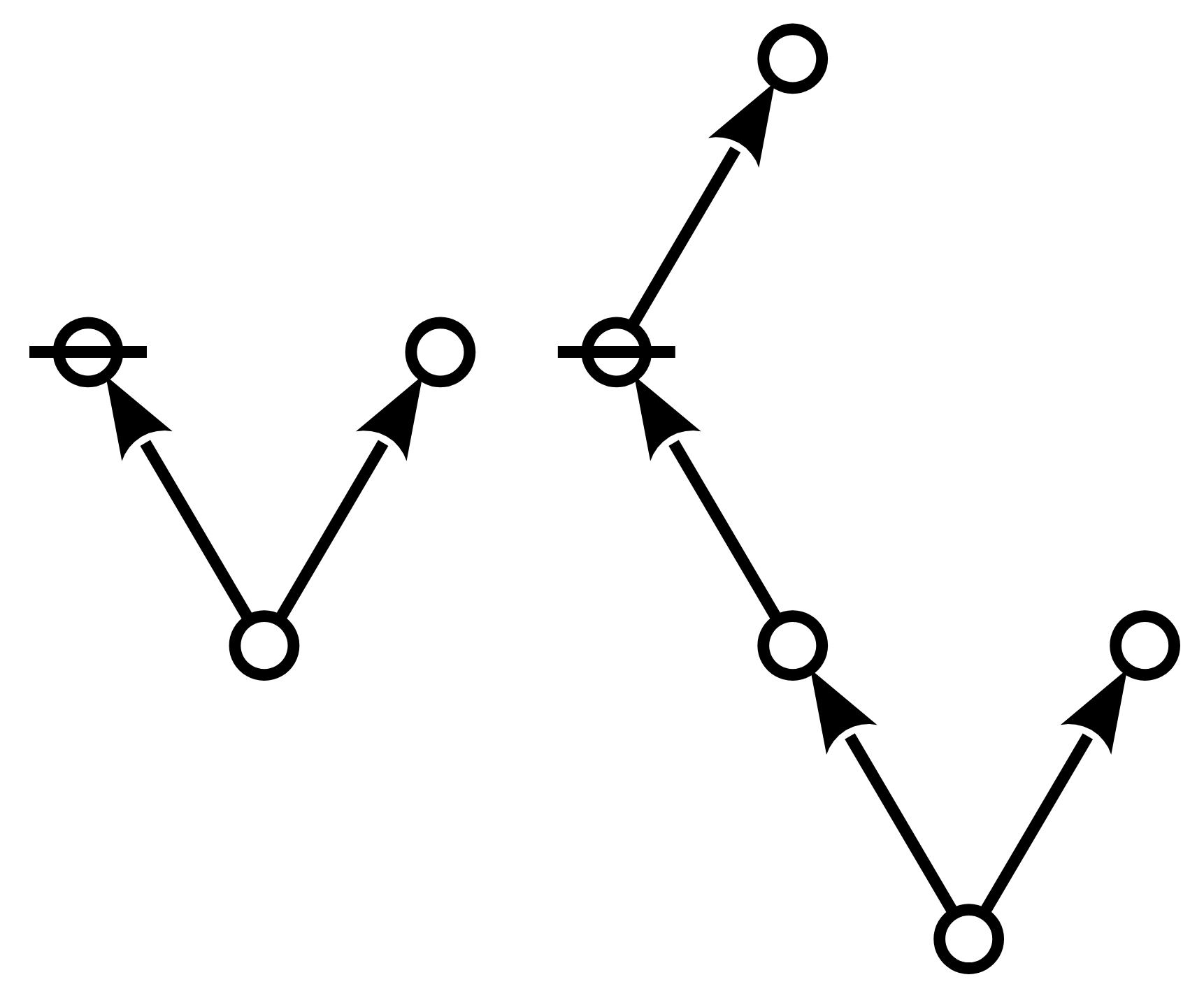
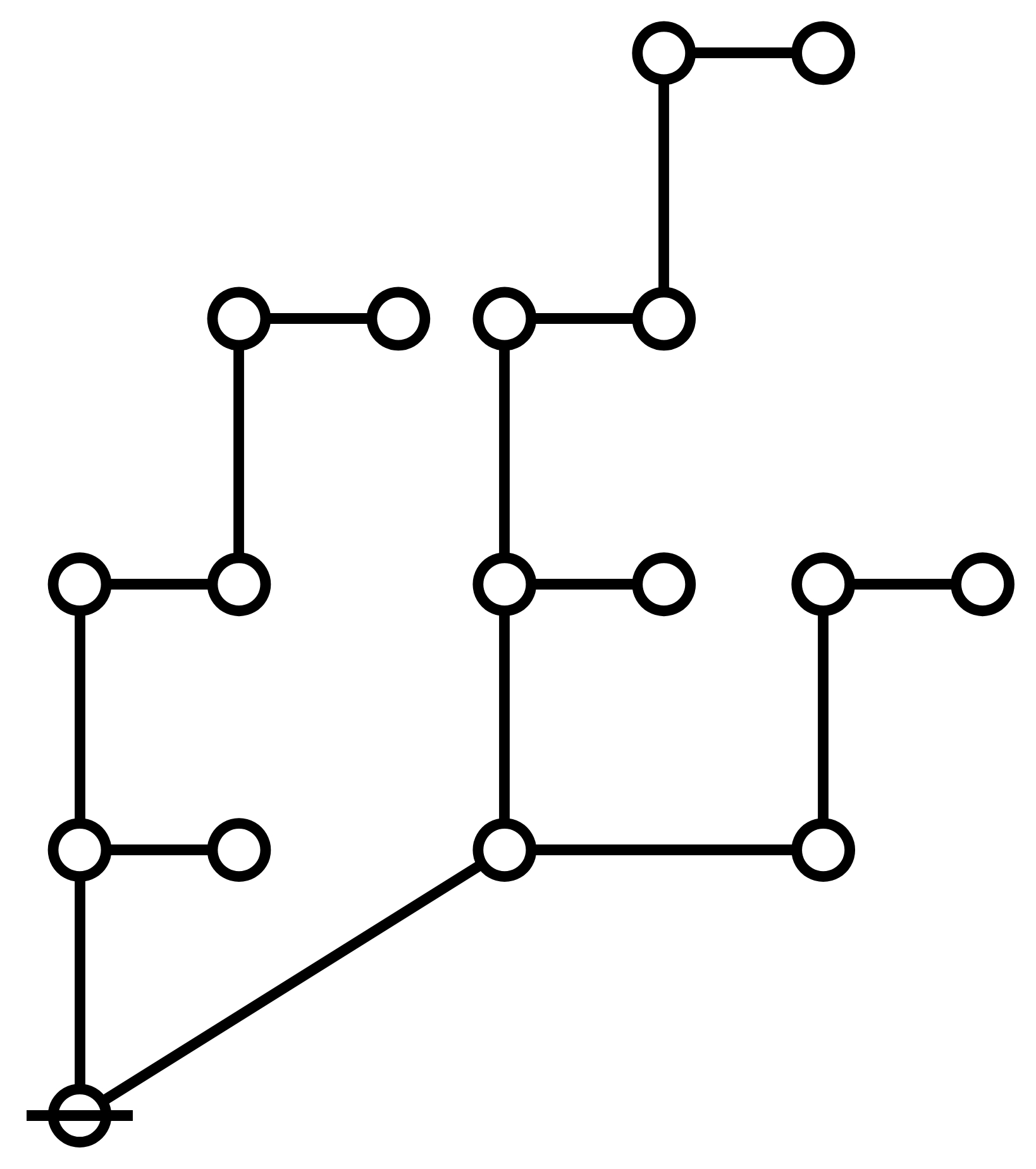
The article referenced below tells how forms like these correspond to a family of digraphs called riffs and a family of graphs called rotes.  The riff and rote for 2023 are shown in the next two displays.

Riff 2023

Riff 2023

Rote 2023

Rote 2023

Reference

cc: Conceptual GraphsCyberneticsLaws of FormMathstodonOntolog
cc: FB | Riffs and RotesSeqFanStructural ModelingSystems Science

Posted in Algebra, Combinatorics, Graph Theory, Group Theory, Logic, Mathematics, Number Theory, Riffs and Rotes | Tagged , , , , , , , | Leave a comment

Zeroth Law Of Semiotics • Discussion 4

Re: Zeroth Law Of SemioticsAll Liar, No Paradox
Re: FB | Pattern Languages for Systemic TransformationEsteban Trev

JA:
A statement S_0 asserts that a statement S_1 is a statement that S_1 is false.

The statement S_0 violates an axiom of logic, so it doesn’t really matter whether the ostensible statement S_1, the so-called liar, really is a statement or has a truth value.

ET:
Well the truth value can be true or false or something else — akin to 5 + 5 = 12 being a true statement, if one knows what base it involves, else it may be false.  The same for 4 + 4 = 10 being a true statement, if one knows what base it involves.

Esteban is calling attention to the fact that our place-value systems of representation for integers and other numbers are relative to the basis chosen to generate the sequence of implied place values.  The basis is, in effect, the key to the code.  We may take this as a special case of a more general fact, one I summed up as follows.

  • Reference is relative to a frame of reference.  In pragmatic semiotics, frames of reference are called sign relations.

cc: Conceptual GraphsCyberneticsLaws of FormOntolog Forum
cc: FB | SemeioticsMathstodonStructural ModelingSystems Science

Posted in Animata, C.S. Peirce, Denotation, Information = Comprehension × Extension, Liar Paradox, Logic, Logical Graphs, Mathematics, Nominalism, Pragmatic Maxim, Semiositis, Semiotics, Sign Relations, Zeroth Law Of Semiotics | Tagged , , , , , , , , , , , , , | 6 Comments

Zeroth Law Of Semiotics • Discussion 3

Re: Zeroth Law Of SemioticsAll Liar, No Paradox
Re: FB | Charles S. Peirce SocietyKent Olson

KO:
The liar paradox is a self-referential paradox, yes?
I think Russell answered these.

Dear Kent,

Russell had no inkling of pragmatic semiotics so his perspective on signs and sign relations was bound to remain mired in syntacticism, in effect, a species of nominalism.  From a fully three-dimensional Peircean point of view we are able to ask, and we have to ask, what could it possibly mean for a sign to refer to itself?  Indeed, do signs refer to themselves at all, or is it only that interpreters refer signs to their objects?  The whole problem looks very different once we take that point of view.

Regards,

Jon

cc: Conceptual GraphsCyberneticsLaws of FormOntolog Forum
cc: FB | SemeioticsMathstodonStructural ModelingSystems Science

Posted in Animata, C.S. Peirce, Denotation, Information = Comprehension × Extension, Liar Paradox, Logic, Logical Graphs, Mathematics, Nominalism, Pragmatic Maxim, Semiositis, Semiotics, Sign Relations, Zeroth Law Of Semiotics | Tagged , , , , , , , , , , , , , | 6 Comments

Survey of Differential Logic • 4

This is a Survey of blog and wiki posts on Differential Logic, material I plan to develop toward a more compact and systematic account.

Elements

Blog Series

Architectonics

Applications

Blog Dialogs

Explorations

cc: Conceptual GraphsCyberneticsOntologStructural ModelingSystems Science
cc: FB | Differential LogicMathstodon | Differential Logic • Laws of Form (1) (2)

Posted in Amphecks, Animata, Boolean Algebra, Boolean Functions, C.S. Peirce, Cactus Graphs, Category Theory, Change, Cybernetics, Differential Analytic Turing Automata, Differential Calculus, Differential Logic, Discrete Dynamics, Equational Inference, Frankl Conjecture, Functional Logic, Gradient Descent, Graph Theory, Hologrammautomaton, Indicator Functions, Inquiry Driven Systems, Leibniz, Logic, Logical Graphs, Mathematics, Minimal Negation Operators, Painted Cacti, Peirce, Propositional Calculus, Surveys, Time, Topology, Visualization, Zeroth Order Logic | Tagged , , , , , , , , , , , , , , , , , , , , , , , , , , , , , , , , , | Leave a comment

Sign Relational Manifolds • Discussion 3

Re: FB | ParadoxologyAlex Shkotin  

AS:
I see — “sign relation” is a special term for triadic relations of some kind (with some properties);  like this:  thing in first position and thing in second position must refer to the thing in third position.  Where “refer” is an unary partial function from one thing to another.  Am I on a right direction?

Hi Alex,

It is not uncommon in practice to find a sign s having many interpretant signs i and many referent objects o.  Generally speaking, then, we start out with a sign relation L as a subset of a cartesian product L \subseteq O \times S \times I, where O, S, I are sets called the object domain, sign domain, interpretant sign domain, respectively.  A definition of a sign relation — there are a few canonical ones we find useful in practice — will specify what sort of constraint is involved in forming that subset.

Regards,

Jon

cc: Conceptual GraphsCyberneticsLaws of FormOntolog Forum
cc: FB | SemeioticsStructural ModelingSystems Science

Posted in C.S. Peirce, Cybernetics, Differential Geometry, Differential Logic, Geometry, Interoperability, Logic, Manifolds, Mathematics, Riemann, Semiotics, Sign Relational Manifolds, Sign Relations, Triadic Relations, Visualization | Tagged , , , , , , , , , , , , , , | 6 Comments

Sign Relational Manifolds • Discussion 2

Re: FB | ParadoxologyAlex Shkotin  

AS:
Not on a narrow topic, but maybe you have a desire to answer.
Hypothesis.  Any material something can be a sign.
Is it possible to give an example of something material that cannot be a sign?

Hi Alex,

Sign relations are mathematical relations we can use to model processes of communication, learning, reasoning, just plain talking and thinking in general.  Anytime we can imagine a triadic relation where one thing, material or otherwise, is related to a second thing in such a way that both refer to a third thing, and that whole relationship is useful in modeling one of the above mentioned processes, then we have a candidate which may be suitable for serving the purpose of a sign relation in the pragmatic conception of the term.

Regards,

Jon

cc: Conceptual GraphsCyberneticsLaws of FormOntolog Forum
cc: FB | SemeioticsStructural ModelingSystems Science

Posted in C.S. Peirce, Cybernetics, Differential Geometry, Differential Logic, Geometry, Interoperability, Logic, Manifolds, Mathematics, Riemann, Semiotics, Sign Relational Manifolds, Sign Relations, Triadic Relations, Visualization | Tagged , , , , , , , , , , , , , , | 6 Comments

Sign Relational Manifolds • Discussion 1

Semiotic Orbits, Manifolds, Arcs

The arc of the semiotic universe is long but it bends towards universal harmony.

Re: FB | Semiotics, Books, Links, NewsWhat’s at the End of a Chain of Interpretants?

Semiotic manifolds, like physical and mathematical manifolds, may be finite and bounded or infinite and unbounded but they may also be finite and unbounded, having no boundary in the topological sense.  Thus unbounded semiosis does not imply infinite semiosis.

Here are two points in previous discussions where the question of infinite semiosis came up.

Resource

cc: Conceptual GraphsCyberneticsLaws of FormOntolog Forum
cc: FB | SemeioticsStructural ModelingSystems Science

Posted in C.S. Peirce, Cybernetics, Differential Geometry, Differential Logic, Geometry, Interoperability, Logic, Manifolds, Mathematics, Riemann, Semiotics, Sign Relational Manifolds, Sign Relations, Triadic Relations, Visualization | Tagged , , , , , , , , , , , , , , | 6 Comments