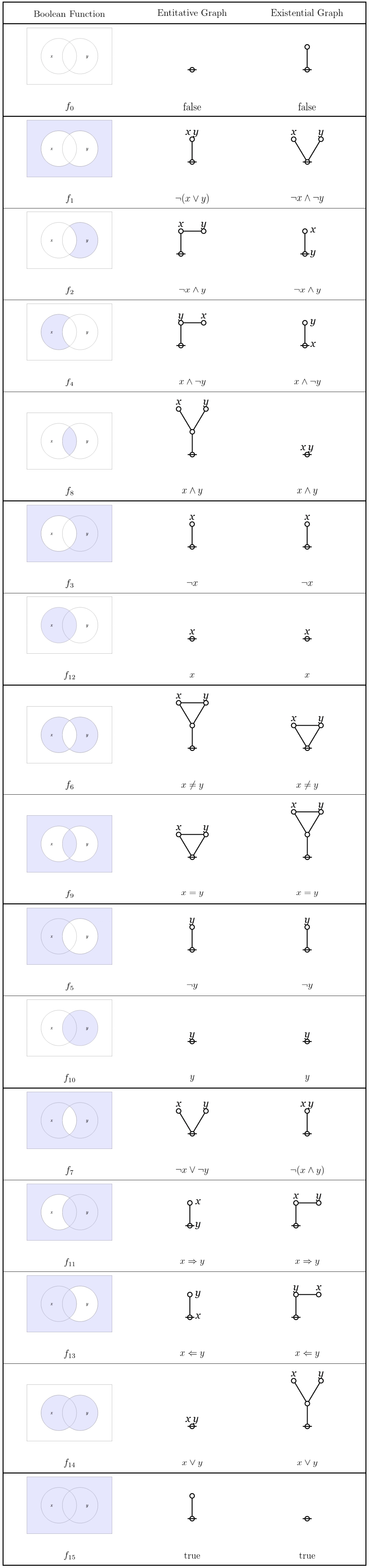
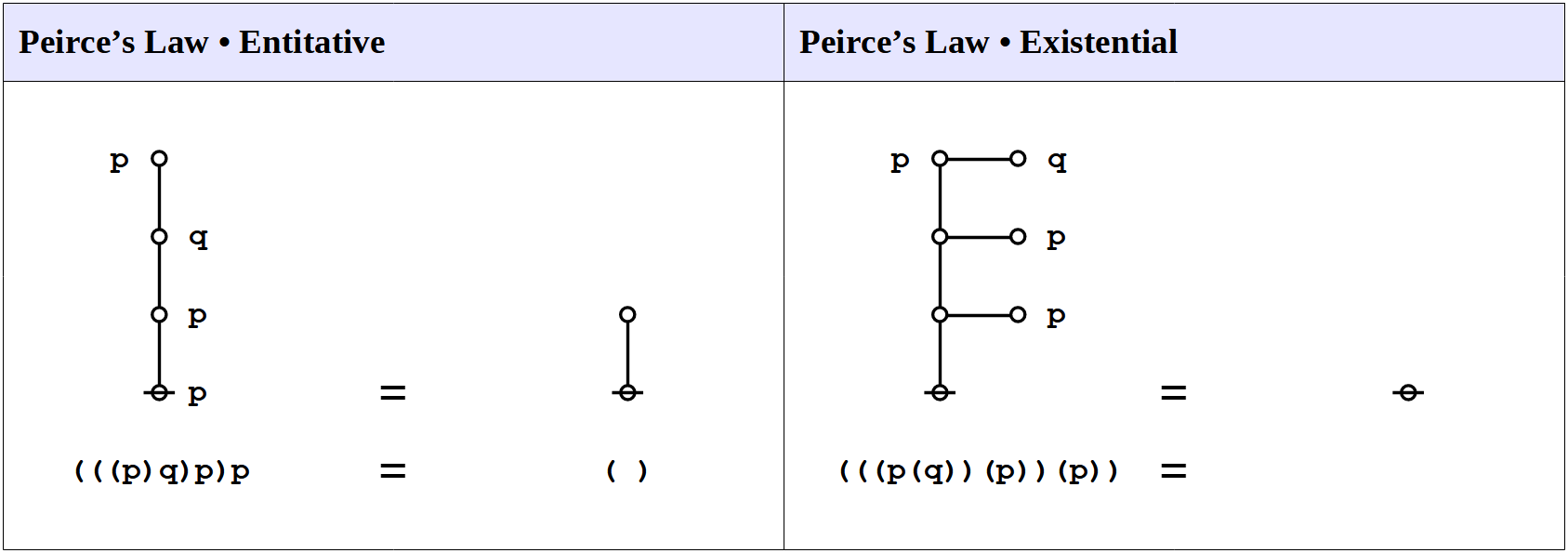
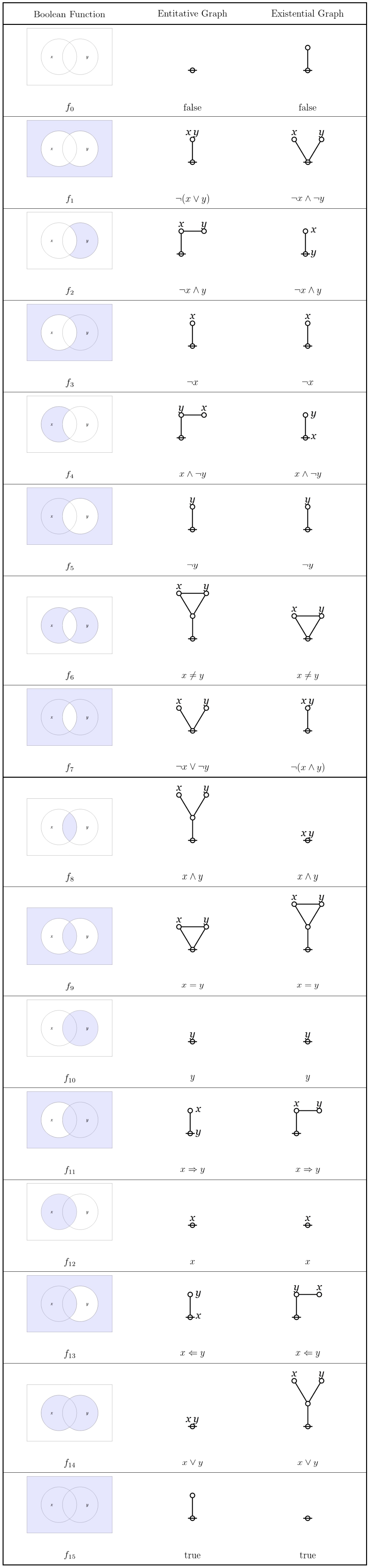
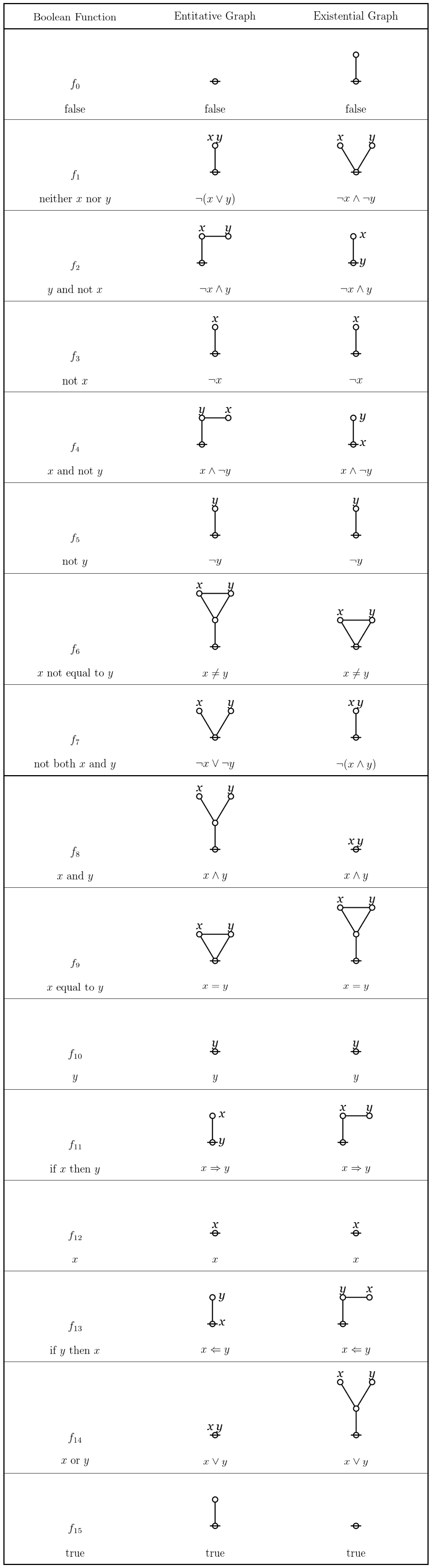
Operator Variables in Logical Graphs • 2

Operand Variables

In George Spencer Brown’s Laws of Form the relation between the primary arithmetic and the primary algebra is founded on the idea that a variable name appearing as an operand in an algebraic expression indicates the contemplated absence or presence of any expression in the arithmetic, with the understanding that each appearance of the same variable name indicates the same state of contemplation with respect to the same expression of the arithmetic.

For example, consider the following expression:

Cactus Graph (a(a))

We may regard this algebraic expression as a general expression for an infinite set of arithmetic expressions, starting like so:

Cactus Graph Series (a(a))

Now consider what that says about the following algebraic law:

Cactus Graph Equation (a(a)) =

It permits us to understand the algebraic law as saying, in effect, that every one of the arithmetic expressions of the contemplated pattern evaluates to the very same canonical expression as the upshot of that evaluation.  That is, as far as I know, just about as close as we come to a conceptually and ontologically minimal way of understanding the relation between an algebra and its corresponding arithmetic.

cc: FB | Logical GraphsLaws of FormMathstodonAcademia.edu
cc: Conceptual GraphsCyberneticsStructural ModelingSystems Science

Posted in Amphecks, Animata, Boolean Algebra, Boolean Functions, C.S. Peirce, Cactus Graphs, Constraint Satisfaction Problems, Deduction, Diagrammatic Reasoning, Duality, Equational Inference, Graph Theory, Laws of Form, Logic, Logical Graphs, Mathematics, Minimal Negation Operators, Model Theory, Painted Cacti, Peirce, Proof Theory, Propositional Calculus, Propositional Equation Reasoning Systems, Spencer Brown, Theorem Proving, Visualization | Tagged , , , , , , , , , , , , , , , , , , , , , , , , , | 4 Comments

Operator Variables in Logical Graphs • 1

In lieu of a field study requirement for my bachelor’s degree I spent two years in various state and university libraries reading everything I could find by and about Peirce, poring most memorably through reels of microfilmed Peirce manuscripts Michigan State had at the time, all in trying to track down some hint of a clue to a puzzling passage in Peirce’s “Simplest Mathematics”, most acutely coming to a head with that bizarre line of type at CP 4.306, which the editors of Peirce’s Collected Papers, no doubt compromised by the typographer’s reluctance to cut new symbols, transmogrified into a script more cryptic than even the manuscript’s original hieroglyphic.

I found one key to the mystery in Peirce’s use of operator variables, which he and his students Christine Ladd‑Franklin and O.H. Mitchell explored in depth.  I will shortly discuss that theme as it affects logical graphs but it may be useful to give a shorter and sweeter explanation of how the basic idea typically arises in common logical practice.

Consider De Morgan’s rules:

\begin{array}{lll}  \lnot (A \land B) & = & \lnot A \lor \lnot B  \\[6px]  \lnot (A \lor B) & = & \lnot A \land \lnot B  \end{array}

The common form exhibited by the two rules could be captured in a single formula by taking ``o_1" and ``o_2" as variable names ranging over a family of logical operators, then asking what substitutions for o_1 and o_2 would satisfy the following equation.

\begin{array}{lll}  \lnot (A ~o_1~ B) & = & \lnot A ~o_2~ \lnot B  \end{array}

We already know two solutions to this operator equation, namely, (o_1, o_2) = (\land, \lor) and (o_1, o_2) = (\lor, \land).  Wouldn’t it be just like Peirce to ask if there are others?

Having broached the subject of logical operator variables, I will leave it for now in the same way Peirce himself did:

I shall not further enlarge upon this matter at this point, although the conception mentioned opens a wide field;  because it cannot be set in its proper light without overstepping the limits of dichotomic mathematics.  (Collected Papers, CP 4.306).

Further exploration of operator variables and operator invariants treads on grounds traditionally known as second intentional logic and “opens a wide field”, as Peirce says.  For now, however, I will tend to that corner of the field where our garden variety logical graphs grow, observing the ways in which operative variations and operative themes naturally develop on those grounds.

cc: FB | Logical GraphsLaws of FormMathstodonAcademia.edu
cc: Conceptual GraphsCyberneticsStructural ModelingSystems Science

Posted in Amphecks, Animata, Boolean Algebra, Boolean Functions, C.S. Peirce, Cactus Graphs, Constraint Satisfaction Problems, Deduction, Diagrammatic Reasoning, Duality, Equational Inference, Graph Theory, Laws of Form, Logic, Logical Graphs, Mathematics, Minimal Negation Operators, Model Theory, Painted Cacti, Peirce, Proof Theory, Propositional Calculus, Propositional Equation Reasoning Systems, Spencer Brown, Theorem Proving, Visualization | Tagged , , , , , , , , , , , , , , , , , , , , , , , , , | 6 Comments

Peirce’s 1885 “Algebra of Logic” • Discussion 2

Re: FB | Daniel Everett

One thing I’ve been trying to understand for a very long time is the changes in Peirce’s writing about math and logic from 1865 to 1885.  If there’s anything I’ve learned from reading Peirce in the often dim light of intellectual history it is to be wary of progressivist assumptions — but unlike many of his other fans I apply that caution also within the body of his own work.  Long story short, from 1865 to 1885 I see progress on several fronts but also bits of backsliding from his more prescient early insights.  So it’s a puzzle … and it will take more study to ravel out the reasons why.

Resources

  • Peirce’s 1885 “Algebra of Logic” • Selections • (1)(2)(3)(4)
  • Peirce, C.S. (1885), “On the Algebra of Logic : A Contribution to the Philosophy of Notation”, American Journal of Mathematics 7, 180–202.  Online.

cc: FB | Peirce MattersLaws of FormMathstodonAcademia.edu
cc: Conceptual GraphsCyberneticsStructural ModelingSystems Science

Posted in Algebra of Logic, C.S. Peirce, Deduction, Diagrammatic Reasoning, Icon Index Symbol, Logic, Logic of Relatives, Mathematics, Philosophy of Notation, Relation Theory, Semiotics, Sign Relations, Triadic Relations, Visualization | Tagged , , , , , , , , , , , , , | 2 Comments

Peirce’s 1885 “Algebra of Logic” • Discussion 1

Re: FB | Daniel Everett

DE:
One of the most important papers in the history of logic.  “On the Algebra of Logic” was the first to introduce the term “quantifier”.

  • Peirce, C.S. (1885), “On the Algebra of Logic : A Contribution to the Philosophy of Notation”, American Journal of Mathematics 7, 180–202.  Online.

Daniel,

As far as quantification by any other word goes, Peirce had already introduced a more advanced and “functional” concept of quantification in his 1870 “Logic of Relatives”.  The subsequent passage to Fregean styles of first order logic would turn out to be a retrograde movement toward syntacticism (a species of nominalism), as seen in the general run of what fol‑lowed in the fol‑lowing years.

See ☞ Peirce’s 1870 “Logic of Relatives”

Especially ☞ “The Sign of Involution”

The connection between logical involution and universal quantification which Peirce put to use in his 1870 Logic of Relatives will turn up again a century later with the application of category theory to computer science and both of those in turn to logic.  Just one more time Peirce was that far ahead of it.

See ☞ Lambek and Scott (1986), Introduction to Higher Order Categorical Logic, Cambridge University Press.  Note.

Resources

cc: FB | Peirce MattersLaws of FormMathstodonAcademia.edu
cc: Conceptual GraphsCyberneticsStructural ModelingSystems Science

Posted in Algebra of Logic, C.S. Peirce, Deduction, Diagrammatic Reasoning, Icon Index Symbol, Logic, Logic of Relatives, Mathematics, Philosophy of Notation, Relation Theory, Semiotics, Sign Relations, Triadic Relations, Visualization | Tagged , , , , , , , , , , , , , | 2 Comments

Peirce’s 1885 “Algebra of Logic” • Selection 4

Selection from C.S. Peirce, “On the Algebra of Logic : A Contribution to the Philosophy of Notation” (1885)

§1.  Three Kinds Of Signs (concl.)

In this paper, I purpose to develop an algebra adequate to the treatment of all problems of deductive logic, showing as I proceed what kinds of signs have necessarily to be employed at each stage of the development.  I shall thus attain three objects.  The first is the extension of the power of logical algebra over the whole of its proper realm.  The second is the illustration of principles which underlie all algebraic notation.  The third is the enumeration of the essentially different kinds of necessary inference;  for when the notation which suffices for exhibiting one inference is found inadequate for explaining another, it is clear that the latter involves an inferential element not present to the former.  Accordingly, the procedure contemplated should result in a list of categories of reasoning, the interest of which is not dependent upon the algebraic way of considering the subject.

I shall not be able to perfect the algebra sufficiently to give facile methods of reaching logical conclusions:  I can only give a method by which any legitimate conclusion may be reached and any fallacious one avoided.  But I cannot doubt that others, if they will take up the subject, will succeed in giving the notation a form in which it will be highly useful in mathematical work.  I even hope that what I have done may prove a first step toward the resolution of one of the main problems of logic, that of producing a method for the discovery of methods in mathematics.  (3.364).

References

  • Peirce, C.S. (1885), “On the Algebra of Logic : A Contribution to the Philosophy of Notation”, American Journal of Mathematics 7, 180–202.
  • Peirce, C.S., Collected Papers of Charles Sanders Peirce, vols. 1–6, Charles Hartshorne and Paul Weiss (eds.), vols. 7–8, Arthur W. Burks (ed.), Harvard University Press, Cambridge, MA, 1931–1935, 1958.  Volume 3 : Exact Logic (Published Papers), 1933.  CP 3.359–403.
  • Peirce, C.S., Writings of Charles S. Peirce : A Chronological Edition, Peirce Edition Project (eds.), Indiana University Press, Bloomington and Indianapolis, IN, 1981–.  Volume 5 (1884–1886), 1993.  Item 30, 162–190.

cc: FB | Peirce MattersLaws of FormMathstodonAcademia.edu
cc: Conceptual GraphsCyberneticsStructural ModelingSystems Science

Posted in Algebra of Logic, C.S. Peirce, Deduction, Diagrammatic Reasoning, Icon Index Symbol, Logic, Logic of Relatives, Mathematics, Philosophy of Notation, Relation Theory, Semiotics, Sign Relations, Triadic Relations, Visualization | Tagged , , , , , , , , , , , , , | 8 Comments

Peirce’s 1885 “Algebra of Logic” • Selection 3

Selection from C.S. Peirce, “On the Algebra of Logic : A Contribution to the Philosophy of Notation” (1885)

§1.  Three Kinds Of Signs (cont.)

For instance, take the syllogistic formula,

\begin{array}{clcl}  \text{All} & M & \text{is} & P \\             & S & \text{is} & M \\  \therefore & S & \text{is} & P.  \end{array}

This is really a diagram of the relations of S, M, and P.  The fact that the middle term occurs in the two premisses is actually exhibited, and this must be done or the notation will be of no value.

As for algebra, the very idea of the art is that it presents formulæ which can be manipulated, and that by observing the effects of such manipulation we find properties not to be otherwise discerned.  In such manipulation, we are guided by previous discoveries which are embodied in general formulæ.  These are patterns which we have the right to imitate in our procedure, and are the icons par excellence of algebra.  The letters of applied algebra are usually tokens, but the x, y, z, etc. of a general formula, such as

(x + y)z = xz + yz,

are blanks to be filled up with tokens, they are indices of tokens.  Such a formula might, it is true, be replaced by an abstractly stated rule (say that multiplication is distributive);  but no application could be made of such an abstract statement without translating it into a sensible image.  (3.363).

References

  • Peirce, C.S. (1885), “On the Algebra of Logic : A Contribution to the Philosophy of Notation”, American Journal of Mathematics 7, 180–202.
  • Peirce, C.S., Collected Papers of Charles Sanders Peirce, vols. 1–6, Charles Hartshorne and Paul Weiss (eds.), vols. 7–8, Arthur W. Burks (ed.), Harvard University Press, Cambridge, MA, 1931–1935, 1958.  Volume 3 : Exact Logic (Published Papers), 1933.  CP 3.359–403.
  • Peirce, C.S., Writings of Charles S. Peirce : A Chronological Edition, Peirce Edition Project (eds.), Indiana University Press, Bloomington and Indianapolis, IN, 1981–.  Volume 5 (1884–1886), 1993.  Item 30, 162–190.

cc: FB | Peirce MattersLaws of FormMathstodonAcademia.edu
cc: Conceptual GraphsCyberneticsStructural ModelingSystems Science

Posted in Algebra of Logic, C.S. Peirce, Deduction, Diagrammatic Reasoning, Icon Index Symbol, Logic, Logic of Relatives, Mathematics, Philosophy of Notation, Relation Theory, Semiotics, Sign Relations, Triadic Relations, Visualization | Tagged , , , , , , , , , , , , , | 8 Comments

Peirce’s 1885 “Algebra of Logic” • Selection 2

Selection from C.S. Peirce, “On the Algebra of Logic : A Contribution to the Philosophy of Notation” (1885)

§1.  Three Kinds Of Signs (cont.)

I have taken pains to make my distinction of icons, indices, and tokens clear, in order to enunciate this proposition:  in a perfect system of logical notation signs of these several kinds must all be employed.  Without tokens there would be no generality in the statements, for they are the only general signs;  and generality is essential to reasoning.  Take, for example, the circles by which Euler represents the relations of terms.  They well fulfill the function of icons, but their want of generality and their incompetence to express propositions must have been felt by everybody who has used them.  Mr. Venn has, therefore, been led to add shading to them;  and this shading is a conventional sign of the nature of a token.  In algebra, the letters, both quantitative and functional, are of this nature.

But tokens alone do not state what is the subject of discourse;  and this can, in fact, not be described in general terms;  it can only be indicated.  The actual world cannot be distinguished from a world of imagination by any description.  Hence the need of pronouns and indices, and the more complicated the subject the greater the need of them.  The introduction of indices into the algebra of logic is the greatest merit of Mr. Mitchell’s system.  He writes F_1 to mean that the proposition F is true of every object in the universe, and F_u to mean that the same is true of some object.  This distinction can only be made in some such way as this.  Indices are also required to show in what manner other signs are connected together.

With these two kinds of signs alone any proposition can be expressed;  but it cannot be reasoned upon, for reasoning consists in the observation that where certain relations subsist certain others are found, and it accordingly requires the exhibition of the relations reasoned with in an icon.  It has long been a puzzle how it could be that, on the one hand, mathematics is purely deductive in its nature, and draws its conclusions apodictically, while on the other hand, it presents as rich and apparently unending a series of surprising discoveries as any observational science.  Various have been the attempts to solve the paradox by breaking down one or other of these assertions, but without success.  The truth, however, appears to be that all deductive reasoning, even simple syllogism, involves an element of observation;  namely, deduction consists in constructing an icon or diagram the relations of whose parts shall present a complete analogy with those of the parts of the object of reasoning, of experimenting upon this image in the imagination, and of observing the result so as to discover unnoticed and hidden relations among the parts.  (3.363).

References

  • Peirce, C.S. (1885), “On the Algebra of Logic : A Contribution to the Philosophy of Notation”, American Journal of Mathematics 7, 180–202.
  • Peirce, C.S., Collected Papers of Charles Sanders Peirce, vols. 1–6, Charles Hartshorne and Paul Weiss (eds.), vols. 7–8, Arthur W. Burks (ed.), Harvard University Press, Cambridge, MA, 1931–1935, 1958.  Volume 3 : Exact Logic (Published Papers), 1933.  CP 3.359–403.
  • Peirce, C.S., Writings of Charles S. Peirce : A Chronological Edition, Peirce Edition Project (eds.), Indiana University Press, Bloomington and Indianapolis, IN, 1981–.  Volume 5 (1884–1886), 1993.  Item 30, 162–190.

cc: FB | Peirce MattersLaws of FormMathstodon • Academia.edu (1) (2) (3)
cc: Conceptual GraphsCyberneticsStructural ModelingSystems Science

Posted in Algebra of Logic, C.S. Peirce, Deduction, Diagrammatic Reasoning, Icon Index Symbol, Logic, Logic of Relatives, Mathematics, Philosophy of Notation, Relation Theory, Semiotics, Sign Relations, Triadic Relations, Visualization | Tagged , , , , , , , , , , , , , | 8 Comments

Peirce’s 1885 “Algebra of Logic” • Selection 1

Selection from C.S. Peirce, “On the Algebra of Logic : A Contribution to the Philosophy of Notation” (1885)

§1.  Three Kinds Of Signs

Any character or proposition either concerns one subject, two subjects, or a plurality of subjects.  For example, one particle has mass, two particles attract one another, a particle revolves about the line joining two others.  A fact concerning two subjects is a dual character or relation;  but a relation which is a mere combination of two independent facts concerning the two subjects may be called degenerate, just as two lines are called a degenerate conic.  In like manner a plural character or conjoint relation is to be called degenerate if it is a mere compound of dual characters.  (3.359).

A sign is in a conjoint relation to the thing denoted and to the mind.  If this triple relation is not of a degenerate species, the sign is related to its object only in consequence of a mental association, and depends upon a habit.  Such signs are always abstract and general, because habits are general rules to which the organism has become subjected.  They are, for the most part, conventional or arbitrary.  They include all general words, the main body of speech, and any mode of conveying a judgment.  For the sake of brevity I will call them tokens.  [Note. Peirce more frequently calls these symbols.]  (3.360).

But if the triple relation between the sign, its object, and the mind, is degenerate, then of the three pairs

Peirce 1885 Sign Object Mind

two at least are in dual relations which constitute the triple relation.  One of the connected pairs must consist of the sign and its object, for if the sign were not related to its object except by the mind thinking of them separately, it would not fulfill the function of a sign at all.  Supposing, then, the relation of the sign to its object does not lie in a mental association, there must be a direct dual relation of the sign to its object independent of the mind using the sign.  In the second of the three cases just spoken of, this dual relation is not degenerate, and the sign signifies its object solely by virtue of being really connected with it.  Of this nature are all natural signs and physical symptoms.  I call such a sign an index, a pointing finger being the type of this class.

The index asserts nothing;  it only says “There!”  It takes hold of our eyes, as it were, and forcibly directs them to a particular object, and there it stops.  Demonstrative and relative pronouns are nearly pure indices, because they denote things without describing them;  so are the letters on a geometrical diagram, and the subscript numbers which in algebra distinguish one value from another without saying what those values are.  (3.361).

The third case is where the dual relation between the sign and its object is degenerate and consists in a mere resemblance between them.  I call a sign which stands for something merely because it resembles it, an icon.  Icons are so completely substituted for their objects as hardly to be distinguished from them.  Such are the diagrams of geometry.  A diagram, indeed, so far as it has a general signification, is not a pure icon;  but in the middle part of our reasonings we forget that abstractness in great measure, and the diagram is for us the very thing.  So in contemplating a painting, there is a moment when we lose consciousness that it is not the thing, the distinction of the real and the copy disappears, and it is for the moment a pure dream — not any particular existence, and yet not general.  At that moment we are contemplating an icon.  (3.362).

References

  • Peirce, C.S. (1885), “On the Algebra of Logic : A Contribution to the Philosophy of Notation”, American Journal of Mathematics 7, 180–202.
  • Peirce, C.S., Collected Papers of Charles Sanders Peirce, vols. 1–6, Charles Hartshorne and Paul Weiss (eds.), vols. 7–8, Arthur W. Burks (ed.), Harvard University Press, Cambridge, MA, 1931–1935, 1958.  Volume 3 : Exact Logic (Published Papers), 1933.  CP 3.359–403.
  • Peirce, C.S., Writings of Charles S. Peirce : A Chronological Edition, Peirce Edition Project (eds.), Indiana University Press, Bloomington and Indianapolis, IN, 1981–.  Volume 5 (1884–1886), 1993.  Item 30, 162–190.

cc: FB | Peirce MattersLaws of FormMathstodon • Academia.edu (1) (2) (3)
cc: Conceptual GraphsCyberneticsStructural ModelingSystems Science

Posted in Algebra of Logic, C.S. Peirce, Deduction, Diagrammatic Reasoning, Icon Index Symbol, Logic, Logic of Relatives, Mathematics, Philosophy of Notation, Relation Theory, Semiotics, Sign Relations, Triadic Relations, Visualization | Tagged , , , , , , , , , , , , , | 8 Comments

Survey of Relation Theory • 8

In the present Survey of blog and wiki resources for Relation Theory, relations are viewed from the perspective of combinatorics, in other words, as a topic in discrete mathematics, with special attention to finite structures and concrete set‑theoretic constructions, many of which arise quite naturally in applications.  This approach to relation theory is distinct from, though closely related to, its study from the perspectives of abstract algebra on the one hand and formal logic on the other.

Elements

Relational Concepts

Relation Composition Relation Construction Relation Reduction
Relative Term Sign Relation Triadic Relation
Logic of Relatives Hypostatic Abstraction Continuous Predicate

Illustrations

Information‑Theoretic Perspective

  • Mathematical Demonstration and the Doctrine of Individuals • (1)(2)

Blog Series

Peirce’s 1870 “Logic of Relatives”

Peirce’s 1880 “Algebra of Logic” Chapter 3

Peirce’s 1885 “Algebra of Logic”

  • C.S. Peirce • Algebra of Logic ∫ Philosophy of Notation • (1)(2)
  • C.S. Peirce • Algebra of Logic 1885 • Selections • (1)(2)(3)(4)

Resources

cc: FB | Relation TheoryLaws of FormMathstodonOntologAcademia.edu
cc: Conceptual GraphsCyberneticsStructural ModelingSystems Science

Posted in Algebra, Algebra of Logic, C.S. Peirce, Category Theory, Combinatorics, Discrete Mathematics, Duality, Dyadic Relations, Foundations of Mathematics, Graph Theory, Logic, Logic of Relatives, Mathematics, Peirce, Relation Theory, Semiotics, Set Theory, Sign Relational Manifolds, Sign Relations, Surveys, Triadic Relations, Triadicity, Type Theory | Tagged , , , , , , , , , , , , , , , , , , , , , , | 9 Comments

Pragmatic Semiotic Information • Comment 3

Memories are coming back to me more through the association of ideas than ordered by time or place.  I can sense, almost touch a tangle of thoughts interlaced with each other — the “information first” approach to ontology, the “arrows only”, element‑free angle on category theory, Peirce’s relativity of generals and individuals dispatching nominalism once and for all — but there is at core a hard knot of ideas so tightly wound it makes it difficult to articulate the links or see the untying if there is one to make.

cc: FB | SemeioticsLaws of FormMathstodonOntologAcademia.edu
cc: Conceptual GraphsCyberneticsStructural ModelingSystems Science

Posted in C.S. Peirce, Definition, Determination, Information, Information = Comprehension × Extension, Inquiry, Logic, Pragmatic Semiotic Information, Scientific Method, Semiosis, Semiotics, Sign Relations, Triadic Relations, Uncertainty | Tagged , , , , , , , , , , , , , | 3 Comments