
Survey of Relation Theory • 4

In this Survey of blog and wiki posts on Relation Theory, relations are viewed from the perspective of combinatorics, in other words, as a topic in discrete mathematics, with special attention to finite structures and concrete set-theoretic constructions, many of which arise quite naturally in applications.  This approach to relation theory is distinct from, though closely related to, its study from the perspectives of abstract algebra on the one hand and formal logic on the other.

Elements

Relational Concepts

Relation Construction Relation Composition Relation Reduction
Relative Term Sign Relation Triadic Relation
Logic of Relatives Hypostatic Abstraction Continuous Predicate

Illustrations

Blog Series

Peirce’s 1870 “Logic of Relatives”

Peirce’s 1880 “Algebra of Logic” Chapter 3

Resources

Posted in Algebra, Algebra of Logic, C.S. Peirce, Category Theory, Combinatorics, Discrete Mathematics, Duality, Dyadic Relations, Foundations of Mathematics, Graph Theory, Logic, Logic of Relatives, Mathematics, Peirce, Relation Theory, Semiotics, Set Theory, Sign Relational Manifolds, Sign Relations, Surveys, Triadic Relations, Triadicity, Type Theory | Tagged , , , , , , , , , , , , , , , , , , , , , , | 14 Comments

Peirce’s Categories • 20

Re: Peirce’s Categories • 15

Understanding another person’s thought can be difficult.  Understanding the way another understands a third person’s thought, all the more so, even if that third person is not so formidable a thinker as Charles Sanders Peirce.  Measures of misunderstanding may be moderated if all thoughts and thinkers are guided by common objectives but the proof of the pudding is in the partaking, as they say.  So let’s step carefully and focus on the task of determining whether category theories, old and new, make good tools for understanding sign relations.

The interaction recorded in my last post continued as follows:

RM:
I do not see how we can talk here about an operative relationship that would be a triad relationship.  It is not anything other than the composition of two morphisms and I do not ask for more.  3, 2, and 1 are the “place names” and “involves” are arrow names that I usually call alpha and beta.  Now if you think about the determinations in the sign, I have always assumed after much study of the 76 definitions, this idea that the composition of applications captures the presence in the mind of each of the elements of the sign, in such a way that they are themselves ipso facto connected by a triadic relationship.  There is a relationship of tricoexistence that is established as in this case evoked by Peirce:  “It predicates the genuinely Triadic relationship of tricoexistence, P ~\mathrm{and}~ Q ~\mathrm{and}~ R ~\mathrm{coexist}” (CP 2.318, unfortunately there is a hole in my PDF of CP right after and I [left] my paper edition at the library of my university, inaccessible at the moment).
We have a mutual incomprehension?

JA:
I don’t often join the debates over sign classification so frequently animating the animadversions of the Peirce List.  As more the observer than the participant I see the same pattern over and over, with occasional hints but never any hue of resolution fast enough to last and satisfy every dyehard.

Situations of that sort are no novelty in philosophy, or politics, or even math and science on occasion.  And when they occur it is usually because the “place to stand” from which the subject appears in its proper light has yet to be reached by every viewer.

So I’ll back up a little and say how I see things from where I am.

Resources

cc: CyberneticsOntolog • Peirce List (1) (2)Structural ModelingSystems Science

Posted in Abstraction, Aristotle, C.S. Peirce, Category Theory, Logic, Logic of Relatives, Mathematics, Peirce, Peirce's Categories, Phenomenology, Pragmatic Maxim, Relation Theory, Semiotics, Triadic Relations, Triadicity, Type Theory | Tagged , , , , , , , , , , , , , , , | 6 Comments

Peirce’s Categories • 19

Re: Peirce’s Categories • 15

Another point where the onrush of discussion and the impact of worldly distractions caused my train of thought to jump the track is here:

RM:
First I note that the formulation “3ns involves 2ns, which involves 1ns” is very dangerous [as] it forgets that 2ns has its autonomy and 1ns too.  If you look at the podium [one] remains in the inner cylinder.  It seems to me that Peirce’s reproach to Hegel is:

“He has usually overlooked external Secondness, altogether.  In other words, he has committed the trifling oversight of forgetting that there is a real world with real actions and reactions.  Rather a serious oversight that.”

It is therefore important to prefer “3ns involves 2ns and 1ns, while 2ns involves 1ns” which preserves the autonomy of the Peircian categories so as not to encourage the idea of a possible peircean hegelianism.

JA:
I’ve been working on a comment about your first point but I’ll post it … when and if I manage to put it in respectable shape.  Just by way of a hint for now, the issue turns on whether we take involves or presupposes to be a dyadic relation and a transitive one at that, as we would if we pass from “3 involves 2” and “2 involves 1” to the conclusion “3 involves 1”.  That may be true for some concepts of involution or presupposition but I think the operative relation in this case is a thoroughly irreducible triadic relation, one whose properties do not reduce to the composition of two dyadic relations.

I think it will take a little more work to get clear about this.  I will go back to the draft remarks I was working on and see if I can bring them to bear on the question.

Resources

cc: CyberneticsOntolog • Peirce List (1) (2)Structural ModelingSystems Science

Posted in Abstraction, Aristotle, C.S. Peirce, Category Theory, Logic, Logic of Relatives, Mathematics, Peirce, Peirce's Categories, Phenomenology, Pragmatic Maxim, Relation Theory, Semiotics, Triadic Relations, Triadicity, Type Theory | Tagged , , , , , , , , , , , , , , , | 7 Comments

Peirce’s Categories • 18

Re: Peirce’s Categories • 15

In These Uncertain Times, as people keep saying, it’s become even harder to concentrate than usual and I keep losing track of tricky points coming up in discussion which cry out for further discussion but then “human voices wake us, and we drown” or something … So let me go back to the list of loose ends I put together at the first of the month and try to address a few of them.

Here’s one juncture deserving of another look:

JAS:
Every proposition is collective and copulative;  as I stated in a recent post, its dynamical object is “the entire universe” (CP 5.448n, EP 2:394, 1906), which is “the totality of all real objects” (CP 5.152, EP 2:209, 1903), while its immediate object is “the logical universe of discourse” (CP 2.323, EP 2:283, 1903).

This is a very important point, not the least because of the light it throws on a question John Corcoran raised on Facebook and elsewhere as to whether the logical universes of Peirce, or logicians in general, are conceived as referring to something like a holistic totality of existence or only a more limited universe of discourse relevant to a particular discussion.  I thought that significant enough to blog on it here:

JA:
Incidentally … lack of care in distinguishing different objects of the same signs, in particular, immediate and ultimate objects and their corresponding universes or object domains, has been the source of many misunderstandings in scattered discussions on Facebook of late.

But then I added:

JA:
Another issue arising here has to do with the difference between the “dimensionality of a relation” and the “number of correlates”.  Signs may have any number of correlates in the object domain without requiring the dimensionality of the relevant sign relation to be greater than three.  This is one of the consequences of “triadic relation irreducibility”.

And that raised a number of further replies from HR and objections from JAS … which I’ll say more about when I get a chance.

Resources

cc: CyberneticsOntolog • Peirce List (1) (2)Structural ModelingSystems Science

Posted in Abstraction, Aristotle, C.S. Peirce, Category Theory, Logic, Logic of Relatives, Mathematics, Peirce, Peirce's Categories, Phenomenology, Pragmatic Maxim, Relation Theory, Semiotics, Triadic Relations, Triadicity, Type Theory | Tagged , , , , , , , , , , , , , , , | 6 Comments

Peirce’s Categories • 17

I’ve been too immersed in the Peirce List discussion of Robert Marty’s “Podium” paper to write much here — before I lose track of what I’ve been thinking the last several days I’ll need to ravel up my off-the-cuff remarks and pen them on the sleeves of this blog.

Re: Peirce List (1) (2) • Helmut Raulien (1) (2)

Helmut Raulien asked several questions about the composition, irreducibility, and reducibility of relations.  For background on relation composition as Peirce originally treated it, I referred him to Peirce’s 1870 Logic Of Relatives, especially the section titled “The Signs for Multiplication”, along with my commentary linked below.

There is also this article:

For readers who want to skip to the chase for the quickest possible overview, the sorts of pictures floating through my head when I’m thinking about relational composition are the bipartite graph or “bigraph” pictures in the following section.

The ways in which relations are reducible or irreducible to simpler relations are covered in the following article.

The following set of articles, in order of increasing generality, may be useful on these scores, providing background and concrete examples.

Resources

cc: CyberneticsOntolog • Peirce List (1) (2)Structural ModelingSystems Science

Posted in Abstraction, Aristotle, C.S. Peirce, Category Theory, Logic, Logic of Relatives, Mathematics, Peirce, Peirce's Categories, Phenomenology, Pragmatic Maxim, Relation Theory, Semiotics, Triadic Relations, Triadicity, Type Theory | Tagged , , , , , , , , , , , , , , , | 6 Comments

Peirce’s Categories • 16

Re: Peirce’s Categories • 15
Re: Robert MartyThe Podium of the Universal Categories of C.S. Peirce

A feature of particular interest to me in Robert Marty’s paper is the resonance he finds between category theory, as it’s known in contemporary mathematics, and the study of Peirce’s Categories.  I’ve long felt the cross-pollination of these two fields was naturally bound to bear fruit.  In that light I’ll refer again to the “brouillon projet” I wrote on the Precursors of Category Theory, where I trace a common theme uniting the function of categorical paradigms from Aristotle through Peirce to present day logic and math.

By way of orientation to the perspective I’ll adopt in reading Marty’s “Podium” paper, here’s the first of the excerpts I collected, from a primer of category theory on the shelves of every student of the subject, giving a thumbnail genealogy of categories from classical philosophy to current mathematics.

Now the discovery of ideas as general as these is chiefly the willingness to make a brash or speculative abstraction, in this case supported by the pleasure of purloining words from the philosophers:  “Category” from Aristotle and Kant, “Functor” from Carnap (Logische Syntax der Sprache), and “natural transformation” from then current informal parlance.

— Saunders Mac Lane, Categories for the Working Mathematician, 29–30.

Resource

cc: CyberneticsOntolog • Peirce List (1) (2)Structural ModelingSystems Science

Posted in Abstraction, Aristotle, C.S. Peirce, Category Theory, Logic, Mathematics, Peirce's Categories, Phenomenology, Pragmatic Maxim, Relation Theory, Semiotics, Triadic Relations, Universals | Tagged , , , , , , , , , , , , | 9 Comments

Peirce’s Categories • 15

Re: Peirce ListRobert Marty

RM:
I submit for your review this preprint which is awaiting publication:

The Podium of the Universal Categories of C.S. Peirce

Abstract

This article organizes Peirce’s universal categories and their degenerate forms from their presupposition relationships.  These relationships are formally clarified on the basis of Frege’s definition of presupposition.  They are visualized in a “podium” diagram.  With these forms, we then follow step by step the well-known and very often cited third Peirce Lowell Conference of 1903 (third draft) in which he sets out his entire method of analysis based on these categories.  The very strong congruence that is established between the podium and the text validates the importance, even the necessity, of taking into account these presuppositions in order to correctly understand Peirce’s phenomenology.

I would be very happy to read your comments.

There were numerous issues stemming from Robert Marty’s post and paper, some central and some tangential, which attracted my interest and which I hope I can get back to.  Seeing as how some of the earliest issues got a little lost in the flood of discussion that followed I thought I would take a moment to record a few threads for future follow up.

I made a start at rehashing some of these questions on my blog:

  • Semiotics, Semiosis, Sign Relations • (9)
  • Peirce’s Categories • (13)(14)
  • Readings On Determination • Discussion • (4)

If I get inspiration and time enough, I may try to organize the issues and further comment on my blog.

cc: CyberneticsOntolog • Peirce List (1) (2)Structural ModelingSystems Science

Posted in Abstraction, Aristotle, C.S. Peirce, Category Theory, Logic, Logic of Relatives, Mathematics, Peirce, Peirce's Categories, Phenomenology, Pragmatic Maxim, Relation Theory, Semiotics, Triadic Relations, Triadicity, Type Theory | Tagged , , , , , , , , , , , , , , , | 13 Comments

Readings On Determination • Discussion 4

Re: Peirce ListGary Fuhrman

Determination, along with the related concepts of constraint, definition, form, structure, etc., are subjects of recurring discussion.  Here are links to readings I collected back when I began approaching inference, information, inquiry, logic, sign processes, sign relations, and all that from more dedicated systems-theoretic and systems-engineering angles.

cc: CyberneticsOntolog Forum • Peirce (1) (2)Structural ModelingSystems Science

Posted in C.S. Peirce, Comprehension, Constraint, Definition, Determination, Differential Logic, Extension, Form, Indication, Information = Comprehension × Extension, Inquiry, Inquiry Driven Systems, Intension, Leibniz, Logic, Logic of Relatives, Mathematics, Peirce, Prigogine, Relation Theory, Relational Programming, Semiotics, Sign Relations | Tagged , , , , , , , , , , , , , , , , , , , , , , | 6 Comments

Differential Logic • 10

It’s been a while, so let’s review …

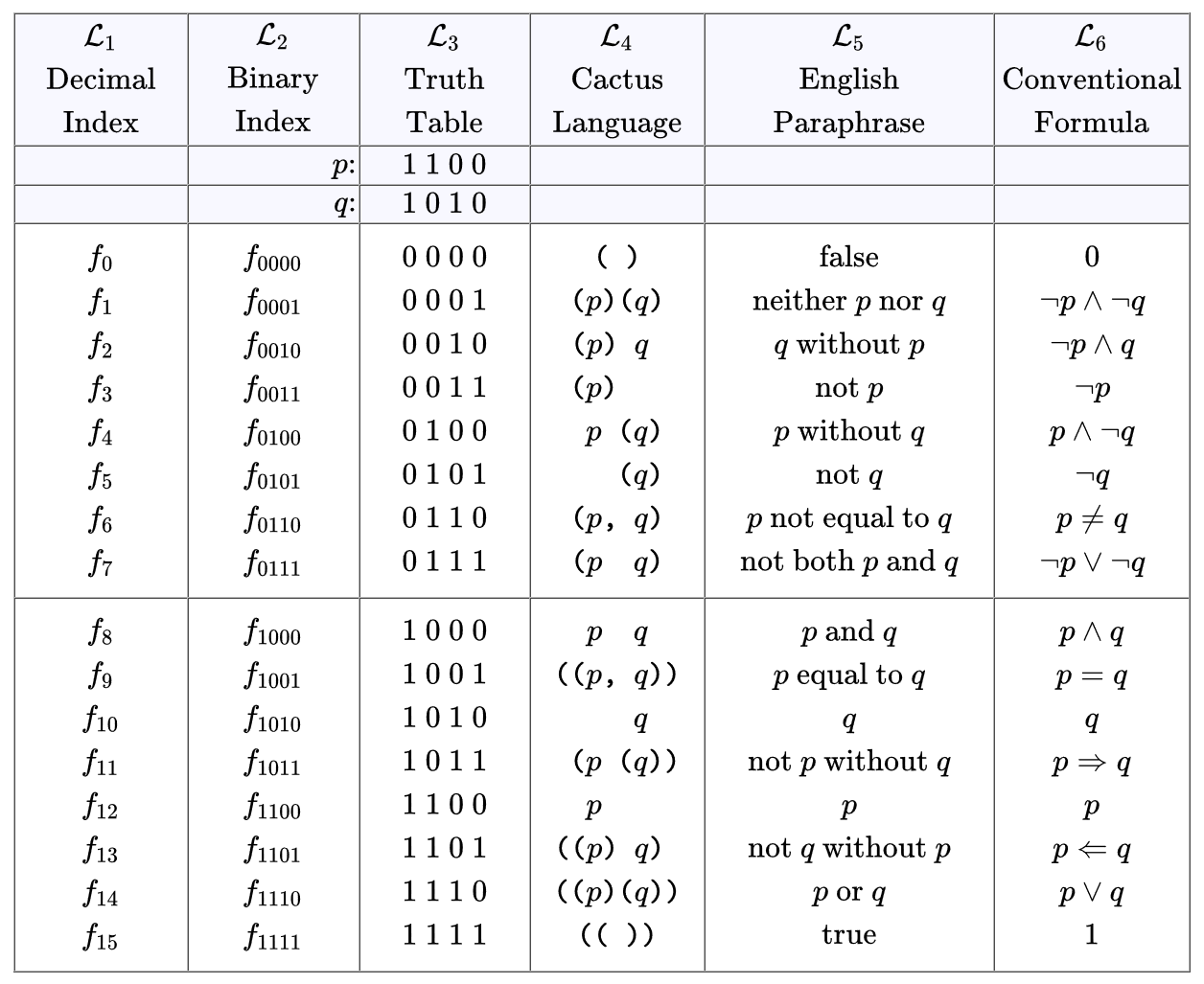
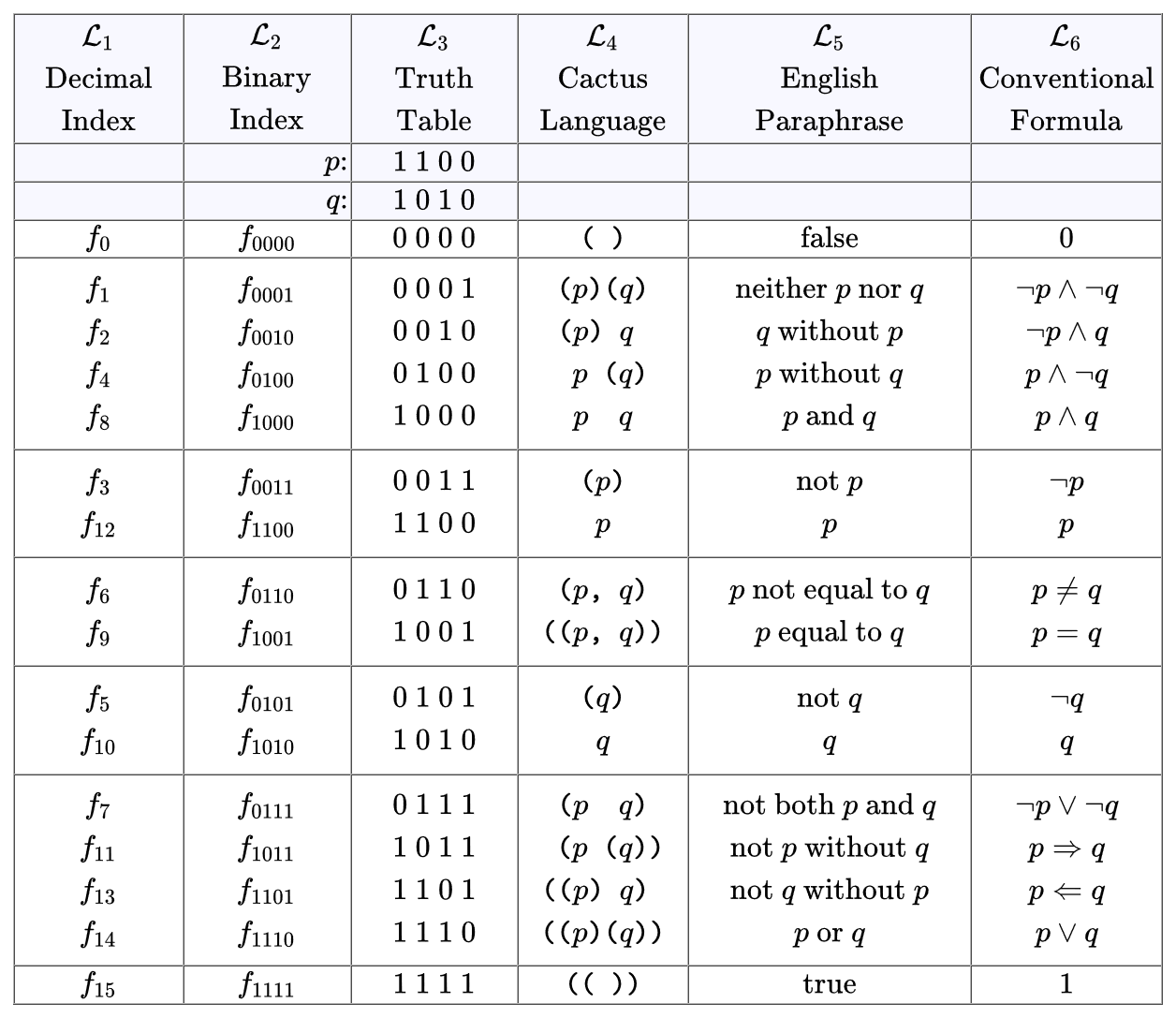
Tables A1 and A2 showed two ways of organizing the sixteen boolean functions or propositional forms on two variables, as expressed in several notations.  For ease of reference, here are fresh copies of those Tables.

Table A1.  Propositional Forms on Two Variables

Table A1. Propositional Forms on Two Variables

Table A2.  Propositional Forms on Two Variables

Table A2. Propositional Forms on Two Variables

We took as our first example the boolean function f_{8}(p, q) = pq corresponding to the logical conjunction p \land q and examined how the differential operators \mathrm{E} and \mathrm{D} act on f_{8}.  Each differential operator takes a boolean function of two variables f_{8}(p, q) and gives back a boolean function of four variables, \mathrm{E}f_{8}(p, q, \mathrm{d}p, \mathrm{d}q) and \mathrm{D}f_{8}(p, q, \mathrm{d}p, \mathrm{d}q), respectively.

In the next several posts we’ll extend our scope to the full set of boolean functions on two variables and examine how the differential operators \mathrm{E} and \mathrm{D} act on that set.  There being some advantage to singling out the enlargement or shift operator \mathrm{E} in its own right, we’ll begin by computing \mathrm{E}f for each function f in the above tables.

cc: Category TheoryCyberneticsOntologStructural ModelingSystems Science
cc: FB | Differential LogicLaws of Form • Peirce (1) (2) (3) (4)

Posted in Amphecks, Animata, Boolean Algebra, Boolean Functions, C.S. Peirce, Cactus Graphs, Category Theory, Change, Cybernetics, Differential Analytic Turing Automata, Differential Calculus, Differential Logic, Discrete Dynamics, Equational Inference, Frankl Conjecture, Functional Logic, Gradient Descent, Graph Theory, Hologrammautomaton, Indicator Functions, Inquiry Driven Systems, Leibniz, Logic, Logical Graphs, Mathematics, Minimal Negation Operators, Painted Cacti, Peirce, Propositional Calculus, Surveys, Time, Topology, Visualization, Zeroth Order Logic | Tagged , , , , , , , , , , , , , , , , , , , , , , , , , , , , , , , , , | 6 Comments

Peirce’s Categories • 14

Re: Peirce ListRobert Marty

RM:
What do you think of the presuppositions between the levels?
Do they make sense to you?

At this point I have mostly questions, which would take further research to answer, not to mention unpacking many books still in boxes from our move a year and a half ago, none of which I’m at liberty to do right now.  So, just off the cuff …

Presupposition is one of those words I tend to avoid, as it has too many uses at odds with each other.  There are at least the architectonic, causal, and logical meanings.  It it were only a matter of logic, I would say P ~\mathrm{presupposes}~ Q means P \Rightarrow Q.  But usually people have something more pragmatic or rhetorical in mind than pure logic would require, something like enthymeme.

It’s also common for people to confound the implication order P \Rightarrow Q with the causal order P ~\mathrm{causes}~ Q, whereas it’s more like the reverse of that.  In more complex settings we usually have the architectonic sense in mind, and that is what I sensed in the case of the normative sciences.  Viewed with regard to their bases, logic is a special case of ethics and ethics is a special case of aesthetics, but with regard to their level of oversight, aesthetics must submit to ethical control and ethics must submit to logical control.

Early on, Peirce used involution with the meaning it has in arithmetic or number theory, namely, exponentiation, where x^y means \text{taking}~ x ~\text{to the power of}~ y.  See the following passage and commentary.

As far as the boolean or propositional analogue goes, x^y ~\text{for}~ x, y ~\text{in}~ \{ 0, 1 \} means the same thing as x \Leftarrow y, as one can tell by comparing the following two operation tables.
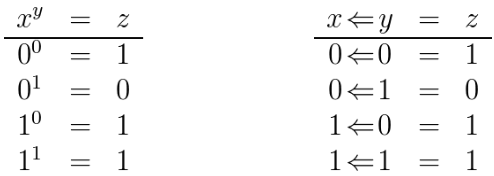
Exponentiation and Converse Implication

I haven’t looked into whether Peirce uses “involution” or “involvement” with that sense in his later writings.

Resources

cc: CyberneticsOntolog ForumPeirce ListStructural ModelingSystems Science

Posted in Abstraction, Aristotle, C.S. Peirce, Category Theory, Logic, Logic of Relatives, Mathematics, Peirce, Peirce's Categories, Phenomenology, Pragmatic Maxim, Relation Theory, Semiotics, Triadic Relations, Triadicity, Type Theory | Tagged , , , , , , , , , , , , , , , | 7 Comments


