Differential Logic and Dynamic Systems • Discussion 7

Re: Differential Logic and Dynamic SystemsIntentional Propositions
Re: FB | Differential LogicMarius V. Constantin

Marius Constantin asks about the logical value of an intention which is not carried out.

MVC:
I have in my intention to give like, but I didn’t.
What is the value (logic) of this proposition?

Dear Marius,

A difference between an expected state and an observed state is called a Surprise.  A surprise calls for an explanation.

A difference between an intended state and an observed state is called a Problem.  A problem calls for a plan of action.

There’s more discussion in the following essay and section.

Resources

cc: Conceptual GraphsCyberneticsOntologStructural ModelingSystems Science
cc: FB | Differential LogicLaws of Form • Peirce List (1) (2) (3)

Posted in Amphecks, Boolean Functions, C.S. Peirce, Cactus Graphs, Category Theory, Change, Computational Complexity, Cybernetics, Differential Analytic Turing Automata, Differential Calculus, Differential Logic, Discrete Dynamics, Dynamical Systems, Equational Inference, Functional Logic, Gradient Descent, Graph Theory, Group Theory, Hologrammautomaton, Indicator Functions, Logic, Logical Graphs, Mathematical Models, Mathematics, Minimal Negation Operators, Painted Cacti, Propositional Calculus, Propositional Equation Reasoning Systems, Time, Visualization | Tagged , , , , , , , , , , , , , , , , , , , , , , , , , , , , , | 7 Comments

Peirce’s 1870 “Logic of Relatives” • Comment 3

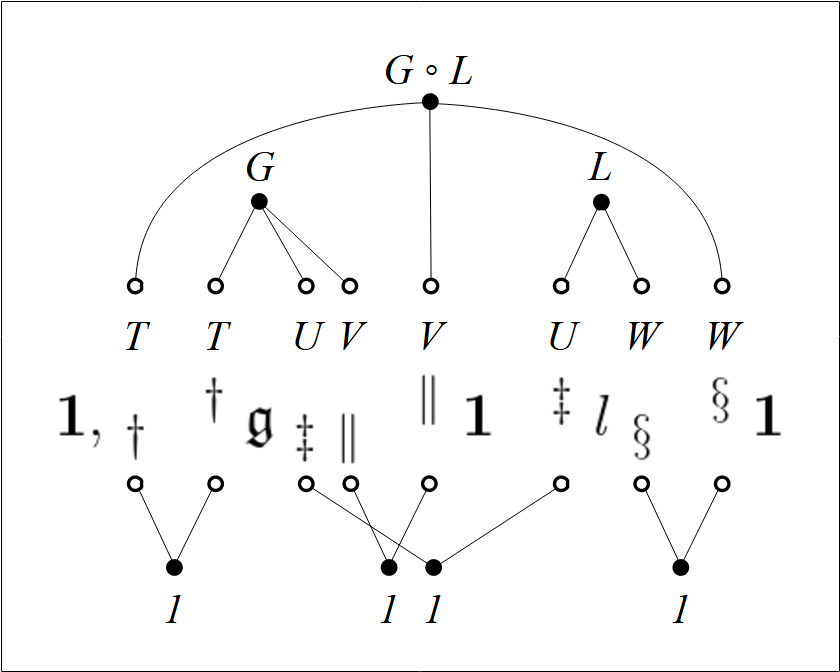
Anything that is a Giver of Anything to a Lover of Anything
\text{Figure 21. Anything that is a Giver of Anything to a Lover of Anything}

In passing to more complex combinations of relative terms and the extensional relations they denote, as we began to do in Comments 10.6 and 10.7, I used words like composite and composition along with the usual composition sign ``\circ" to describe their structures.  That amounts to loose speech on my part and I may have to reform my Sprach at a later stage of the Spiel.

At any rate, we need to distinguish the more complex forms of combination encountered here from the ordinary composition of dyadic relations symbolized by ``\circ", whose result must stay within the class of dyadic relations.  We can draw that distinction by means of an adjective or a substantive term — so long as we see it we can parse the words later.

Resources

cc: Conceptual GraphsCyberneticsOntolog Forum
cc: Peirce (1) (2)Structural ModelingSystems Science
cc: FB | Peirce MattersLaws of Form

Posted in C.S. Peirce, Category Theory, Differential Logic, Duality, Dyadic Relations, Graph Theory, Group Theory, Logic, Logic of Relatives, Logical Graphs, Logical Matrices, Mathematics, Peirce, Peirce's Categories, Predicate Calculus, Propositional Calculus, Relation Theory, Semiotics, Sign Relations, Teridentity, Triadic Relations, Visualization | Tagged , , , , , , , , , , , , , , , , , , , , , | 6 Comments

Charles Sanders Peirce, George Spencer Brown, and Me • 16

Re: Conceptual GraphsGary Zhu

GZ:
I’m quite confused on why people are interested in Laws of Form.
What is LOF trying to do? Is it just rewriting logic or is there
something more fundamental. e.g. a universal algebraic system?
What does GSB has to do with DNA, or DNA computing?
What does Lou’s work in topology has to do with GSB?
What does GSB’s theory has to do with knot theory?
What does GSB’s theory has to do with quaternions?
How can GSB’s theory be used for designing circuits?
What’s wrong with Frege?

Dear Gary,

I am deep in the middle of other work right now, but here’s a smattering of resources relevant to the relation between Peirce’s logical graphs and Spencer Brown’s calculus of indications, at least so far as the core subjects of boolean functions and propositional calculus are concerned.

As far as the extension to relations and quantification, I start from where Peirce started in 1870 and follow up several of his more radical ideas, ones he himself did not fully develop.  That is what I’m doing on the 1870 Logic of Relatives thread.

Regards,

Jon

Re: Conceptual GraphsCyberneticsOntologStructural ModelingSystems Science
cc: FB | Peirce MattersLaws of Form

Posted in Abstraction, Amphecks, Analogy, Animata, Boolean Algebra, Boolean Functions, C.S. Peirce, Cactus Graphs, Cybernetics, Deduction, Differential Logic, Duality, Form, Graph Theory, Inquiry, Inquiry Driven Systems, Laws of Form, Logic, Logical Graphs, Mathematics, Minimal Negation Operators, Model Theory, Peirce, Proof Theory, Propositional Calculus, Semiotics, Sign Relational Manifolds, Sign Relations, Spencer Brown, Theorem Proving, Time, Topology | Tagged , , , , , , , , , , , , , , , , , , , , , , , , , , , , , , , | 5 Comments

Peirce’s 1870 “Logic of Relatives” • Discussion 5

Re: Conceptual GraphsPeiyuan Zhu

PZ:
I’m studying imprecise probabilities which initially works as an extension in Boole’s Laws of Thoughts.  It seems like Boole was solving a set of algebraic equations for probabilities where some of the probabilities do not have precise values therefore need to be bounded.  Has anyone studied Boole’s algebraic system of probabilities?  Is Peirce extending Boole’s algebraic system in his Logic of Relatives?

Dear Peiyuan,

Issues related to the ones you mention will come up in the Selections and Commentary I’m posting on Peirce’s 1870 Logic of Relatives, the full title of which, “Description of a Notation for the Logic of Relatives, Resulting from an Amplification of the Conceptions of Boole’s Calculus of Logic”, is sufficient hint of the author’s intent, namely, to extend the correspondence Boole discovered between the calculus of propositions and the statistics of simple events to a correspondence between the calculus of relations and the statistics of complex events, contingency matrices, higher order correlations, and ultimately the full range of information theory.

But it will take a while to develop all that …

Regards,
Jon

Resources

cc: Conceptual GraphsCyberneticsOntolog Forum
cc: Peirce (1) (2)Structural ModelingSystems Science
cc: FB | Peirce MattersLaws of Form

Posted in C.S. Peirce, Category Theory, Differential Logic, Duality, Dyadic Relations, Graph Theory, Group Theory, Logic, Logic of Relatives, Logical Graphs, Logical Matrices, Mathematics, Peirce, Peirce's Categories, Predicate Calculus, Propositional Calculus, Relation Theory, Semiotics, Sign Relations, Teridentity, Triadic Relations, Visualization | Tagged , , , , , , , , , , , , , , , , , , , , , | 6 Comments

Peirce’s 1870 “Logic of Relatives” • Discussion 4

Re: Peirce’s 1870 “Logic of Relatives” • Proto-Graphical Syntax
Re: FB | Ancient LogicHenning Engebretsen

HE:
What’s your point, it’s obviously too graphical, but perhaps you are driving at something else.  Explain?

Dear Henning,

My aim here is to survey the source from which radiates all our most enlightening graphical systems of logic — from Peirce’s own entitative and existential graphs, to Spencer Brown’s calculus of indications, to John Sowa’s conceptual graphs.  The first glimmerings of that evolution go further back than widely appreciated, being especially well marked in Peirce’s 1870 “Logic of Relatives”, as I hope to make clear in time.

Regards,
Jon

Resources

cc: Conceptual GraphsCyberneticsOntolog Forum
cc: Peirce (1) (2)Structural ModelingSystems Science
cc: FB | Peirce MattersLaws of Form

Posted in C.S. Peirce, Category Theory, Differential Logic, Duality, Dyadic Relations, Graph Theory, Group Theory, Logic, Logic of Relatives, Logical Graphs, Logical Matrices, Mathematics, Peirce, Peirce's Categories, Predicate Calculus, Propositional Calculus, Relation Theory, Semiotics, Sign Relations, Teridentity, Triadic Relations, Visualization | Tagged , , , , , , , , , , , , , , , , , , , , , | 5 Comments

Peirce’s 1870 “Logic of Relatives” • Discussion 3

All other sciences without exception depend upon the principles of mathematics;  and mathematics borrows nothing from them but hints.

C.S. Peirce • “Logic of Number”

A principal intention of this essay is to separate what are known as algebras of logic from the subject of logic, and to re‑align them with mathematics.

G. Spencer Brown • Laws of Form

Re: Peirce’s 1870 “Logic of Relatives” • Overview
Re: Laws of Form • James Bowery (1) (2)

Dear James,

I am pleased to see you engaging the material on Peirce’s Logic of Relatives.  For my part I’ll need to lay out several more Selections before the major themes of Peirce’s essay begin to emerge from the supporting but sometimes distracting details.

In the meantime two clues to the Big Picture can be gleaned from the paired epigraphs I put up in lights at the top of the post.  For what we have here is a return to the thrilling days of yesteryear when the mathematics of logic was still mathematics, shortly before Frege (maybe unwittingly) and Russell (in a way less wittingly) detoured it down the linguistic U‑turn to nominalism.

Regards,
Jon

cc: Conceptual GraphsCyberneticsOntolog Forum
cc: Peirce (1) (2)Structural ModelingSystems Science
cc: FB | Peirce MattersLaws of Form

Posted in C.S. Peirce, Category Theory, Differential Logic, Duality, Dyadic Relations, Graph Theory, Group Theory, Logic, Logic of Relatives, Logical Graphs, Logical Matrices, Mathematics, Peirce, Peirce's Categories, Predicate Calculus, Propositional Calculus, Relation Theory, Semiotics, Sign Relations, Teridentity, Triadic Relations, Visualization | Tagged , , , , , , , , , , , , , , , , , , , , , | 6 Comments

Triadic Relations • Discussion 3

Re: Triadic Relations • (1)(2)(3)
Re: Conceptual GraphsEdwina Taborsky

ET:
A few comments on your outline of the Sign.  I think one has to be careful not to set up a Saussurian linguistic dyad.  …

Dear Edwina,

I copied your comments to a draft page and will take them up in the fullness of time, but a few remarks by way of general orientation to relations, triadic relations, sign relations, and sign transformations, partly prompted by the earlier discussion of complex systems, may be useful at this point.

One does not come to terms with systems of any complexity — adaptive, anticipatory, intelligent systems, and those with a capacity to support scientific inquiry, whether as autonomous agents or assistive utilities — without the use of mathematical models to negotiate the gap between our naturally evolved linguistic capacities and the just barely scrutable realities manifesting in phenomena.

Peirce’s quest to understand how science works takes its first big steps with his lectures on the Logic of Science at Harvard and the Lowell Institute (1865–1866), where he traces the bearings of deduction, induction, and hypothesis on the conduct of scientific inquiry.  There Peirce makes a good beginning by taking up Boole’s functional recasting of logic, a major advance over traditional logic rooted in the paradigms of historical grammars.  But developing a minimal adequate mathematical basis for the logic of science will take drilling down to a deeper core.

The mathematics we need to build models of inquiry as a sign-relational process appears for the first time in history with Peirce’s early work, especially his 1870 Logic of Relatives.  It has its sources in the mathematical realism of Leibniz and De Morgan, the functional logic of Boole, and the algebraic research of Peirce’s own father, Benjamin Peirce, whose Linear Associative Algebra Charles edited for publication in the American Journal of Mathematics (1881).

My own contributions to this pursuit I’ve collected over the years under the heading of Inquiry Driven Systems, portions of which I’ve shared here and there across the Web for lo! this whole millennium in progress.  A few resources along those lines are listed below.

References

  • Awbrey, S.M., and Awbrey, J.L. (2001), “Conceptual Barriers to Creating Integrative Universities”, Organization : The Interdisciplinary Journal of Organization, Theory, and Society 8(2), Sage Publications, London, UK, 269–284.  AbstractOnline.
  • Awbrey, J.L., and Awbrey, S.M. (1995), “Interpretation as Action • The Risk of Inquiry”, Inquiry : Critical Thinking Across the Disciplines 15(1), 40–52.
    ArchiveJournal.  Online (doc) (pdf).
  • Awbrey, S.M., and Awbrey, J.L. (1991), “An Architecture for Inquiry • Building Computer Platforms for Discovery”, Proceedings of the Eighth International Conference on Technology and Education, Toronto, Canada, 874–875.  Online.
  • Awbrey, J.L., and Awbrey, S.M. (1990), “Exploring Research Data Interactively. Theme One : A Program of Inquiry”, Proceedings of the Sixth Annual Conference on Applications of Artificial Intelligence and CD-ROM in Education and Training, Society for Applied Learning Technology, Washington, DC, 9–15.  Online.

Resources

cc: Category TheoryConceptual Graphs • Cybernetics (1) (2) • Ontolog (1) (2)
cc: Peirce List (1) (2) • Structural Modeling (1) (2) • Systems Science (1) (2)
cc: FB | Relation TheoryLaws of Form

Posted in C.S. Peirce, Category Theory, Dyadic Relations, Logic, Logic of Relatives, Logical Graphs, Mathematics, Nominalism, Peirce, Pragmatism, Realism, Relation Theory, Semiotics, Sign Relations, Triadic Relations, Visualization | Tagged , , , , , , , , , , , , , , , | 6 Comments

Survey of Semiotics, Semiosis, Sign Relations • 2

This is a Survey of blog and wiki resources on the theory of signs, variously known as semeiotic or semiotics, and the actions referred to as semiosis which transform signs among themselves in relation to their objects, all as based on C.S. Peirce’s concept of triadic sign relations.

Elements

Sources

Blog Series

  • C.S. Peirce • Algebra of Logic ∫ Philosophy of Notation • (1)(2)

Blog Dialogs

References

  • Awbrey, J.L., and Awbrey, S.M. (1992), “Interpretation as Action : The Risk of Inquiry”, The Eleventh International Human Science Research Conference, Oakland University, Rochester, Michigan.
  • Awbrey, J.L., and Awbrey, S.M. (1995), “Interpretation as Action : The Risk of Inquiry”, Inquiry : Critical Thinking Across the Disciplines 15(1), pp. 40–52.  ArchiveJournal.  Online (doc) (pdf).

cc: Conceptual GraphsCyberneticsLaws of FormOntolog
cc: FB | SemeioticsStructural ModelingSystems Science

Posted in C.S. Peirce, Logic, Mathematics, Peirce, Pragmatism, Relation Theory, Semiosis, Semiotics, Sign Relations | Tagged , , , , , , , , | 5 Comments

Genus, Species, Pie Charts, Radio Buttons • Discussion 5

Re: Genus, Species, Pie Charts, Radio Buttons • 1
Re: Laws of FormJohn Mingers

Dear John,

Once we grasp the utility of minimal negation operators for partitioning a universe of discourse into several regions and any region into further parts, there are quite a few directions we might explore as far as our next steps go.

One thing I always did when I reached a new level of understanding about any logical issue was to see if I could actualize the insight in whatever programming projects I was working on at the time.  Conversely and recursively the trials of doing that would often force me to modify my initial understanding in the direction of what works in brass tacks practice.

The use of cactus graphs to implement minimal negation operators made its way into the Theme One Program I worked on all through the 1980s and the applications I made of it went into the work I did for a master’s in psych.  At any rate, I can finally answer the “what next” question by pointing to one of the exercises I set for the logical reasoning module of that program, as described in the following excerpt from its User Guide.

  • Theme One Guide • Molly’s World (pdf)

The writing there is a little rough by my current standards, so I’ll work on revising it over the next few days.

Regards,

Jon

cc: CyberneticsOntolog ForumStructural ModelingSystems Science
cc: FB | Minimal Negation OperatorsLaws of Form • Peirce List (1) (2) (3)

Posted in Amphecks, Animata, Boolean Functions, C.S. Peirce, Cactus Graphs, Differential Logic, Functional Logic, Graph Theory, Laws of Form, Logic, Logical Graphs, Mathematics, Minimal Negation Operators, Painted Cacti, Peirce, Propositional Calculus, Propositional Equation Reasoning Systems, Semiotics, Venn Diagrams, Visualization | Tagged , , , , , , , , , , , , , , , , , , , | 6 Comments

Genus, Species, Pie Charts, Radio Buttons • Discussion 4

Re: Genus, Species, Pie Charts, Radio Buttons • 1
Re: Laws of FormJohn Mingers

JM:
I feel as though you have posted these same diagrams many times, and it is always portrayed as clearing the ground for something else.  But the something else never arrives!  I would be really interested to know what the next step is in your ideas.

Dear John,

Thanks for the question.  Bruce Schuman mentioned radio button logic and I jumped on it “like a duck on a June bug” — as they say in several southern States I know — because that very thing marks an important first step in the application of minimal negation operators to represent finite domains of values, contextual individuals, genus and species, partitions, and so on.  But some of the comments I got next gave me pause and made me feel I should go back and clarify a few points.

I wasn’t sure, but I got the sense Bruce was reading the cactus graphs I posted as an order of hierarchical, ontological, or taxonomic diagrams.  What they really amount to are the abstract, human-viewable renditions of linked data structures or “pointer” data structures in computer memory.  I explained the transformation from planar forms of enclosure to their topological dual trees to the pointer structures in one of the articles on logical graphs I wrote for Wikipedia and later for Google’s now-defunct Knol.  People can find a version of that on the following page of my blog.

Resources

cc: CyberneticsOntolog ForumStructural ModelingSystems Science
cc: FB | Minimal Negation OperatorsLaws of Form • Peirce List (1) (2) (3)

Posted in Amphecks, Animata, Boolean Functions, C.S. Peirce, Cactus Graphs, Differential Logic, Functional Logic, Graph Theory, Laws of Form, Logic, Logical Graphs, Mathematics, Minimal Negation Operators, Painted Cacti, Peirce, Propositional Calculus, Propositional Equation Reasoning Systems, Semiotics, Venn Diagrams, Visualization | Tagged , , , , , , , , , , , , , , , , , , , | 6 Comments