Sign Relations • Signs and Inquiry

There is a close relationship between the pragmatic theory of signs and the pragmatic theory of inquiry.  In fact, the correspondence between the two studies exhibits so many congruences and parallels it is often best to treat them as integral parts of one and the same subject.  In a very real sense, inquiry is the process by which sign relations come to be established and continue to evolve.  In other words, inquiry, “thinking” in its best sense, “is a term denoting the various ways in which things acquire significance” (John Dewey).  Tracing the passage of inquiry through the medium of signs calls for an active, intricate form of cooperation between our converging modes of investigation.  Its proper character is best understood by realizing the theory of inquiry is adapted to study the developmental aspects of sign relations, whose evolution the theory of signs is specialized to treat from comparative and structural points of view.

References

  • Charles S. Peirce (1902), “Parts of Carnegie Application” (L 75), in Carolyn Eisele (ed., 1976), The New Elements of Mathematics by Charles S. Peirce, vol. 4, 13–73.  Online.
  • Awbrey, J.L., and Awbrey, S.M. (1995), “Interpretation as Action : The Risk of Inquiry”, Inquiry : Critical Thinking Across the Disciplines 15(1), pp. 40–52.  ArchiveJournal.  Online (doc) (pdf).

Resources

Document History

See OEIS Wiki • Sign Relation • Document History.

cc: FB | SemeioticsCyberneticsLaws of FormOntolog Forum
cc: Conceptual GraphsStructural ModelingSystems Science

Posted in C.S. Peirce, Logic, Mathematics, Peirce, Relation Theory, Semiosis, Semiotics, Sign Relations | Tagged , , , , , , , | 3 Comments

Sign Relations • Definition

One of Peirce’s clearest and most complete definitions of a sign is one he gives in the context of providing a definition for logic, and so it is informative to view it in that setting.

Logic will here be defined as formal semiotic.  A definition of a sign will be given which no more refers to human thought than does the definition of a line as the place which a particle occupies, part by part, during a lapse of time.  Namely, a sign is something, A, which brings something, B, its interpretant sign determined or created by it, into the same sort of correspondence with something, C, its object, as that in which itself stands to C.  It is from this definition, together with a definition of “formal”, that I deduce mathematically the principles of logic.  I also make a historical review of all the definitions and conceptions of logic, and show, not merely that my definition is no novelty, but that my non-psychological conception of logic has virtually been quite generally held, though not generally recognized.  (C.S. Peirce, NEM 4, 20–21).

In the general discussion of diverse theories of signs, the question frequently arises whether signhood is an absolute, essential, indelible, or ontological property of a thing, or whether it is a relational, interpretive, and mutable role a thing can be said to have only within a particular context of relationships.

Peirce’s definition of a sign defines it in relation to its object and its interpretant sign, and thus defines signhood in relative terms, by means of a predicate with three places.  In this definition, signhood is a role in a triadic relation, a role a thing bears or plays in a given context of relationships — it is not an absolute, non-relative property of a thing-in-itself, a status it maintains independently of all relationships to other things.

Some of the terms Peirce uses in his definition of a sign may need to be elaborated for the contemporary reader.

  • Correspondence.  From the way Peirce uses this term throughout his work it is clear he means what he elsewhere calls a “triple correspondence”, in short, just another way of referring to the whole triadic sign relation itself.  In particular, his use of this term should not be taken to imply a dyadic correspondence, as in the varieties of “mirror image” correspondence between realities and representations bandied about in contemporary controversies about “correspondence theories of truth”.
  • Determination.  Peirce’s concept of determination is broader in several ways than the sense of the word referring to strictly deterministic causal-temporal processes.  First, and especially in this context, he uses a more general concept of determination, what is known as formal or informational determination, as we use in geometry when we say “two points determine a line”, rather than the more special cases of causal or temporal determinisms.  Second, he characteristically allows for the broader concept of determination in measure, that is, an order of determinism admitting a full spectrum of more and less determined relationships.
  • Non-psychological.  Peirce’s “non-psychological conception of logic” must be distinguished from any variety of anti-psychologism.  He was quite interested in matters of psychology and had much of import to say about them.  But logic and psychology operate on different planes of study even when they happen to view the same data, as logic is a normative science where psychology is a descriptive science.  Thus they have distinct aims, methods, and rationales.

Reference

  • Charles S. Peirce (1902), “Parts of Carnegie Application” (L 75), in Carolyn Eisele (ed., 1976), The New Elements of Mathematics by Charles S. Peirce, vol. 4, 13–73.  Online.

Resources

Document History

See OEIS Wiki • Sign Relation • Document History.

cc: FB | SemeioticsCyberneticsLaws of FormOntolog Forum
cc: Conceptual GraphsStructural ModelingSystems Science

Posted in C.S. Peirce, Logic, Mathematics, Peirce, Relation Theory, Semiosis, Semiotics, Sign Relations | Tagged , , , , , , , | 5 Comments

Sign Relations • Anthesis

Thus, if a sunflower, in turning towards the sun, becomes by that very act fully capable, without further condition, of reproducing a sunflower which turns in precisely corresponding ways toward the sun, and of doing so with the same reproductive power, the sunflower would become a Representamen of the sun.

— C.S. Peirce, Collected Papers, CP 2.274

In his picturesque illustration of a sign relation, along with his tracing of a corresponding sign process, or semiosis, Peirce uses the technical term representamen for his concept of a sign, but the shorter word is precise enough, so long as one recognizes its meaning in a particular theory of signs is given by a specific definition of what it means to be a sign.

Resources

Document History

Portions of the above article were adapted from the following sources under the GNU Free Documentation License, under other applicable licenses, or by permission of the copyright holders.

cc: FB | SemeioticsCyberneticsLaws of FormOntolog Forum
cc: Conceptual GraphsStructural ModelingSystems Science

Posted in C.S. Peirce, Logic, Mathematics, Peirce, Relation Theory, Semiosis, Semiotics, Sign Relations | Tagged , , , , , , , | 3 Comments

Theme One Program • Discussion 8

Re: Theme One Program • Exposition (1) (2) (3) (4)
Re: Theme One Program • Discussion (7)
Re: Ontolog Forum • Alex Shkotin (1) (2)
Re: Logical Graphs • Animated Proofs

AS:
The animation is mesmerizing:  I would watch and watch.  But without the pause, next frame, and playback speed settings, it’s just a work of art that calls to see it step by step.

And on [the following] page you start with the double negation theorem.

Have a look at a few of my comments as a reader, and only on the graph topic taken separately.

Dear Alex,

Thanks for viewing the animations and taking the time to work through that first proof.  Clearly a lot could be done to improve the production values — what you see is what I got with whatever app I had umpteen years ago.

For the time being I’m focusing on the implementation layer of the Theme One Program, which combines a learning component and a reasoning component.  The first implements a two‑level sequence learner and the second implements a propositional calculator based on a variant of Peirce’s logical graphs.  (I meant to say more about the learning function this time around but I’m still working up to tackling that.)

To address your comments and questions we’ll need to step back for a moment to a more abstract, implementation-independent treatment of logical graphs.  There’s a number of resources along that line linked on the following Survey page.

The post “Logical Graphs • Formal Development” gives a quick but systematic account of the formal system I use throughout.  The OEIS wiki article “Logical Graphs” gives a more detailed development.

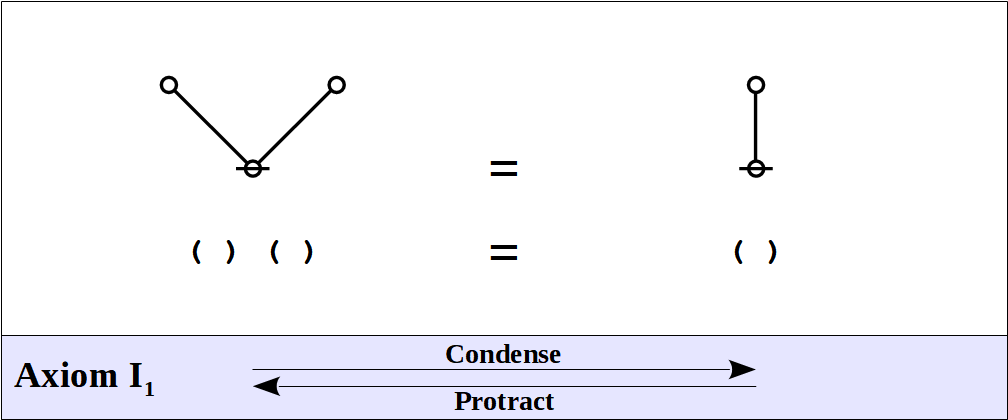
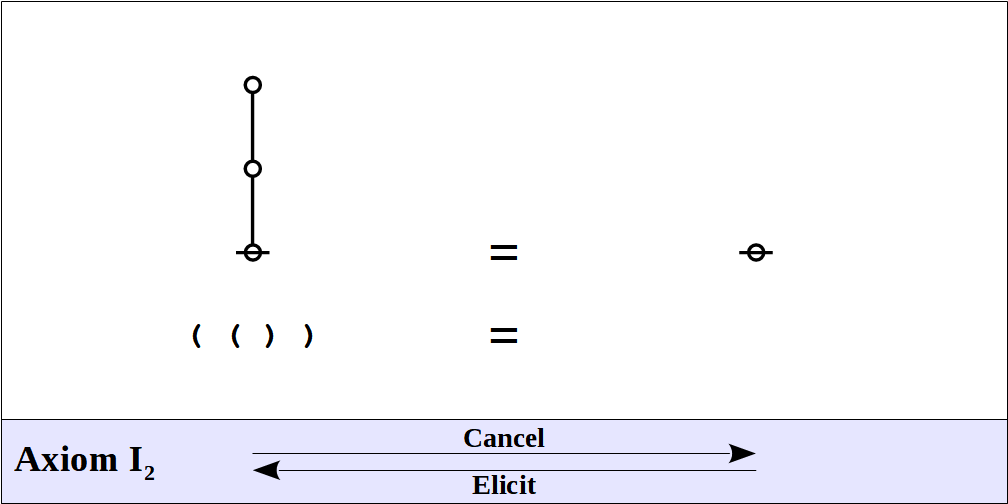
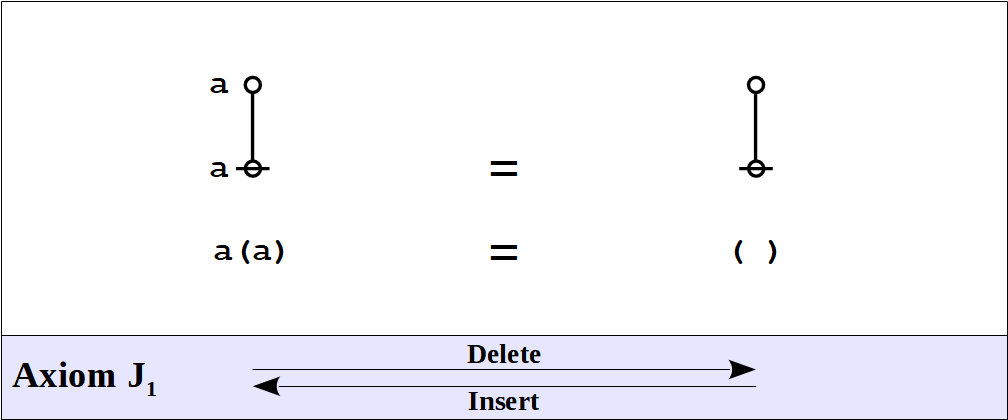
Here’s an excerpt from the above discussions, giving the four axioms or “initials” which serve as graphical transformation rules, in effect, the equational inference rules used to generate proofs and establish theorems or “consequences”.

Axioms

The formal system of logical graphs is defined by a foursome of formal equations, called initials when regarded purely formally, in abstraction from potential interpretations, and called axioms when interpreted as logical equivalences.  There are two arithmetic initials and two algebraic initials, as shown below.

Arithmetic Initials

I₁

I₂

Algebraic Initials

J₁

J₂

The statement of the Double Negation Theorem is shown below.

C1.  Double Negation Theorem

The first theorem goes under the names of Consequence 1 (C1), the double negation theorem (DNT), or Reflection.

Double Negation Theorem

The following proof is adapted from the one given by George Spencer Brown in his book Laws of Form (LOF) and credited to two of his students, John Dawes and D.A. Utting.

Double Negation Theorem • Proof

That should fill in enough background to get started on your questions …

Resources

cc: Conceptual GraphsCyberneticsLaws of FormOntolog Forum
cc: FB | Theme One ProgramStructural ModelingSystems Science

Posted in Algorithms, Animata, Artificial Intelligence, Boolean Functions, C.S. Peirce, Cactus Graphs, Cognition, Computation, Constraint Satisfaction Problems, Data Structures, Differential Logic, Equational Inference, Formal Languages, Graph Theory, Inquiry Driven Systems, Laws of Form, Learning Theory, Logic, Logical Graphs, Mathematics, Minimal Negation Operators, Painted Cacti, Peirce, Propositional Calculus, Semiotics, Spencer Brown, Visualization | Tagged , , , , , , , , , , , , , , , , , , , , , , , , , , | 6 Comments

Survey of Semiotics, Semiosis, Sign Relations • 3

This is a Survey of blog and wiki resources on the theory of signs, variously known as semeiotic or semiotics, and the actions referred to as semiosis which transform signs among themselves in relation to their objects, all as based on C.S. Peirce’s concept of triadic sign relations.

Elements

Sources

Blog Series

  • Semiositis • (1)
  • C.S. Peirce • Algebra of Logic ∫ Philosophy of Notation • (1)(2)

Blog Dialogs

References

  • Awbrey, J.L., and Awbrey, S.M. (1992), “Interpretation as Action : The Risk of Inquiry”, The Eleventh International Human Science Research Conference, Oakland University, Rochester, Michigan.
  • Awbrey, J.L., and Awbrey, S.M. (1995), “Interpretation as Action : The Risk of Inquiry”, Inquiry : Critical Thinking Across the Disciplines 15(1), pp. 40–52.  ArchiveJournal.  Online (doc) (pdf).

cc: Conceptual GraphsCyberneticsLaws of FormOntolog
cc: FB | SemeioticsStructural ModelingSystems Science

Posted in C.S. Peirce, Inquiry, Logic, Mathematics, Relation Theory, Semiosis, Semiotics, Sign Relations, Triadicity | Tagged , , , , , , , , | 1 Comment

Theme One Program • Discussion 7

Re: Theme One Program • Exposition (1) (2) (3) (4)
Re: Ontolog ForumAlex Shkotin

AS:
As we both like digraphs and looking at your way of rendering, let me share my lazy way of using Graphviz on one of the last pictures produced.

This is a picture of a derivation tree (aka AST) for the text of four statements of context-free grammar of some kind.  It is important that this is a digraph with ordered children, and nodes have some attributes.  In your case attributes are \texttt{sign}, \texttt{code}.  In my case attributes are:

  • node id,
  • nonterminal,
    • for syntactic nonterminal:  rule id used for derivation,
    • for lexical nonterminal:  value taken from text.

Dear Alex,

Many thanks, the Graphviz suite looks very nice and I will spend some time looking through the docs.  I kept a few samples of my old ASCII graphics, mostly out of a sense of nostalgia, but I’ve reached a point in reworking my Theme One Exposition where I need to upgrade the graphics.  My original aim was to have the program display its own visuals, but it doesn’t look like I’ll be the one doing that.  Visualizing proof requires animation — I used to have an app for that bundled with CorelDraw but it quit working in a previous platform change and I haven’t gotten around to hunting up a new one.  At any rate, there’s a sampler of animated proofs in logical graphs on the following page.

Resources

cc: Conceptual GraphsCyberneticsLaws of FormOntolog Forum
cc: FB | Theme One ProgramStructural ModelingSystems Science

Posted in Algorithms, Animata, Artificial Intelligence, Boolean Functions, C.S. Peirce, Cactus Graphs, Cognition, Computation, Constraint Satisfaction Problems, Data Structures, Differential Logic, Equational Inference, Formal Languages, Graph Theory, Inquiry Driven Systems, Laws of Form, Learning Theory, Logic, Logical Graphs, Mathematics, Minimal Negation Operators, Painted Cacti, Peirce, Propositional Calculus, Semiotics, Spencer Brown, Visualization | Tagged , , , , , , , , , , , , , , , , , , , , , , , , , , | 7 Comments

Theme One Program • Exposition 5

Lexical, Literal, Logical

Theme One puts cactus graphs to work in three distinct but related ways, called lexical, literal, and logical applications.  The three modes of operation employ three distinct but overlapping subsets of the broader species of cacti.  Accordingly we find ourselves working with graphs, expressions, and files of lexical, literal, and logical types, depending on the task at hand.

The logical class of cacti is the broadest, encompassing the whole species described above, of which we have already seen a typical example in its several avatars as abstract graph, pointer data structure, and string of characters suitable for storage in a text file.

Being a logical cactus is not just a matter of syntactic form — it means being subject to meaningful interpretations as a sign of a logical proposition.  To enter the logical arena cactus expressions must express something, a proposition true or false of something.

Fully addressing the logical, interpretive, semantic aspect of cactus graphs normally requires a mind-boggling mass of preliminary work on the details of their syntactic structure.  Practical, pragmatic, and especially computational considerations will eventually make that unavoidable.  For the sake of the present discussion, however, let’s put that on hold and fast forward to the logical substance.

Resources

cc: Conceptual GraphsCyberneticsLaws of FormOntolog Forum
cc: FB | Theme One ProgramStructural ModelingSystems Science

Posted in Algorithms, Animata, Artificial Intelligence, Boolean Functions, C.S. Peirce, Cactus Graphs, Cognition, Computation, Constraint Satisfaction Problems, Data Structures, Differential Logic, Equational Inference, Formal Languages, Graph Theory, Inquiry Driven Systems, Laws of Form, Learning Theory, Logic, Logical Graphs, Mathematics, Minimal Negation Operators, Painted Cacti, Peirce, Propositional Calculus, Semiotics, Spencer Brown, Visualization | Tagged , , , , , , , , , , , , , , , , , , , , , , , , , , | 6 Comments

Theme One Program • Exposition 4

Parsing Logical Graphs

It is possible to write a program that parses cactus expressions into reasonable facsimiles of cactus graphs as pointer structures in computer memory, making edges correspond to addresses and nodes correspond to records.  I did just that in the early forerunners of the present program, but it turned out to be a more robust strategy in the long run, despite the need for additional nodes at the outset, to implement a more articulate but more indirect parsing algorithm, one in which the punctuation marks are not just tacitly converted to addresses in passing, but instead recorded as nodes in roughly the same way as the ordinary identifiers, or paints.

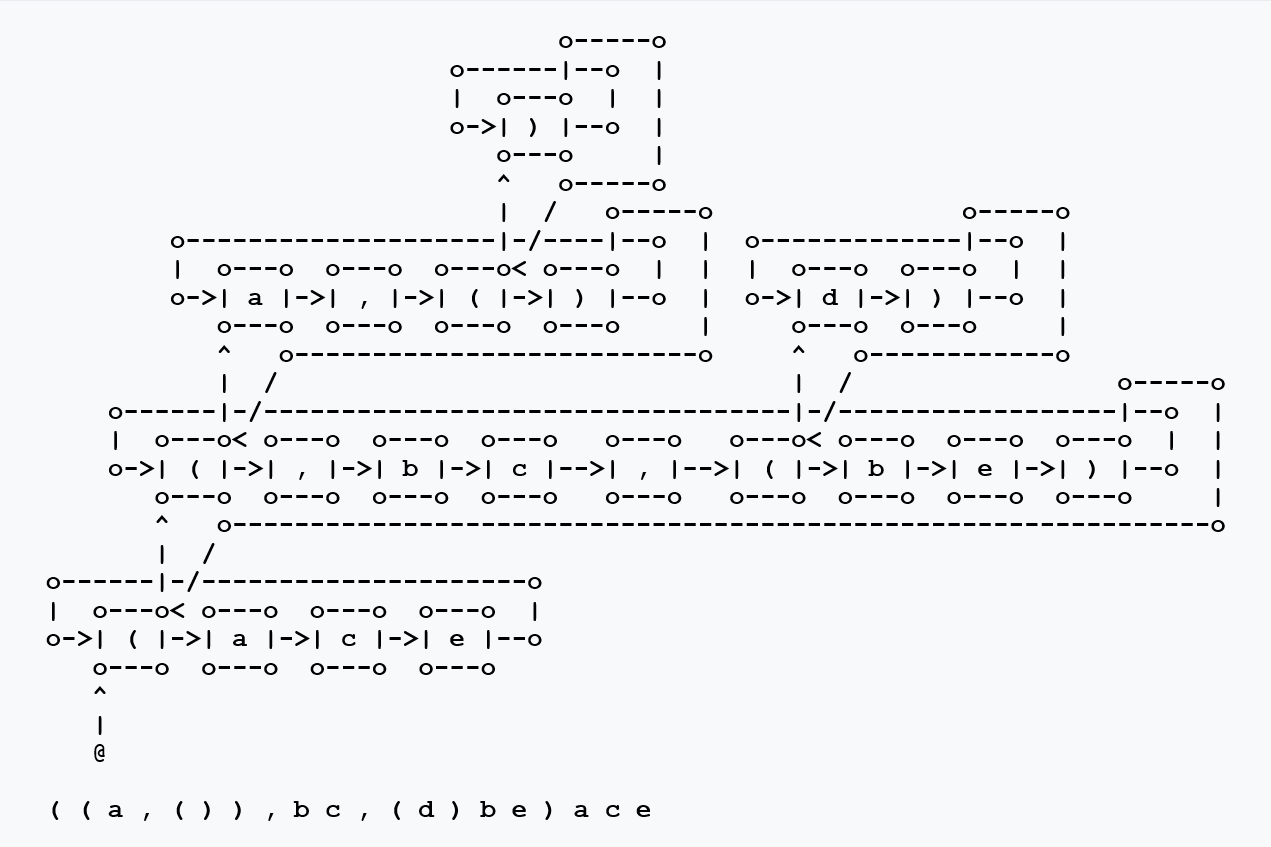
Figure 3 illustrates the type of parsing paradigm used by the program, showing the pointer graph structure obtained by parsing the cactus expression in Figure 2.  A traversal of this graph naturally reconstructs the cactus string that parses into it.

Parse Graph and Traverse String
\text{Figure 3. Parse Graph and Traverse String}

The pointer graph in Figure 3, namely, the parse graph of a cactus expression, is the sort of thing we’ll probably not be able to resist calling a cactus graph, for all the looseness of that manner of speaking, but we should keep in mind its level of abstraction lies a step further in the direction of a concrete implementation than the last thing we called by that name.  While we have them before our mind’s eyes, there are several other distinctive features of cactus parse graphs we ought to notice before moving on.

In terms of idea-form structures, a cactus parse graph begins with a root idea pointing into a by‑cycle of forms, each of whose sign fields bears either a paint, in other words, a direct or indirect identifier reference, or an opening left parenthesis indicating a link to a subtended lobe of the cactus.

A lobe springs from a form whose sign field bears a left parenthesis.  That stem form has an on idea pointing into a by‑cycle of forms, exactly one of which has a sign field bearing a right parenthesis.  That last form has an on idea pointing back to the form bearing the initial left parenthesis.

In the case of a lobe, aside from the single form bearing the closing right parenthesis, the by‑cycle of a lobe may list any number of forms, each of whose sign fields bears either a comma, a paint, or an opening left parenthesis signifying a link to a more deeply subtended lobe.

Just to draw out one of the implications of this characterization and to stress the point of it, the root node can be painted and bear many lobes, but it cannot be segmented, that is, the by‑cycle corresponding to the root node can bear no commas.

Resources

cc: Conceptual GraphsCyberneticsLaws of FormOntolog Forum
cc: FB | Theme One ProgramStructural ModelingSystems Science

Posted in Algorithms, Animata, Artificial Intelligence, Boolean Functions, C.S. Peirce, Cactus Graphs, Cognition, Computation, Constraint Satisfaction Problems, Data Structures, Differential Logic, Equational Inference, Formal Languages, Graph Theory, Inquiry Driven Systems, Laws of Form, Learning Theory, Logic, Logical Graphs, Mathematics, Minimal Negation Operators, Painted Cacti, Peirce, Propositional Calculus, Semiotics, Spencer Brown, Visualization | Tagged , , , , , , , , , , , , , , , , , , , , , , , , , , | 7 Comments

Theme One Program • Exposition 3

Coding Logical Graphs

My earliest experiments coding logical graphs as dynamic “pointer” data structures taught me that conceptual and computational efficiencies of a critical sort could be achieved by generalizing their abstract graphs from trees to the variety graph theorists know as cacti.  The genesis of that generalization is a tale worth telling another time, but for now it’s best to jump right in and proceed by way of generic examples.

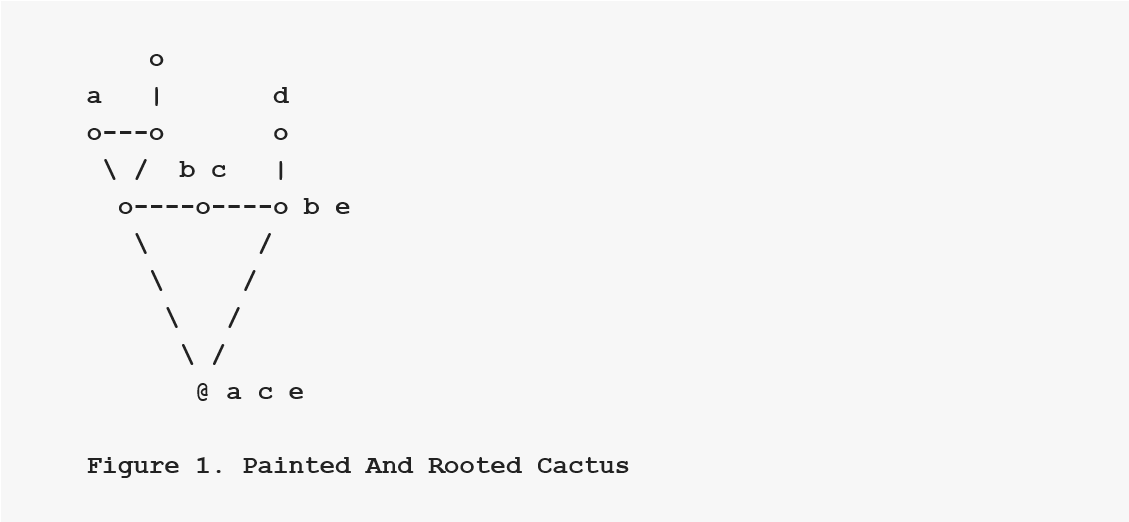
Figure 1 shows a typical example of a painted and rooted cactus.

Painted And Rooted Cactus

Figure 2 shows a way to visualize the correspondence between cactus graphs and cactus strings, demonstrated on the cactus from Figure 1.  By way of convenient terminology, the polygons of a cactus graph are called its lobes.  An edge not part of a larger polygon is called a 2‑gon or a bi‑gon.  A terminal bi‑gon is called a spike.

Cactus Graph and Cactus Expression

The correspondence between a cactus graph and a cactus string is obtained by an operation called traversing the graph in question.

  • One traverses a cactus graph by beginning at the left hand side of the root node, reading off the list of paints one encounters at that point.  Since the order of elements at any node is not significant, one may start the cactus string with that list of paints or save them for the end.  We have done the latter in this case.
  • One continues by climbing up the left hand side of the leftmost lobe, marking the ascent by means of a left parenthesis, traversing whatever cactus one happens to reach at the first node above the root, that done, proceeding from left to right along the top side of the lobe, marking each interlobal span by means of a comma, traversing each cactus in turn one meets along the way, on completing the last of them climbing down the right hand side of the lobe, marking the descent by means of a right parenthesis, and then traversing each cactus in turn, in left to right order, that is incident with the root node.

The string of letters, parentheses, and commas one obtains by this procedure is called the traversal string of the graph, in this case, a cactus string.

Resources

cc: Conceptual GraphsCyberneticsLaws of FormOntolog Forum
cc: FB | Theme One ProgramStructural ModelingSystems Science

Posted in Algorithms, Animata, Artificial Intelligence, Boolean Functions, C.S. Peirce, Cactus Graphs, Cognition, Computation, Constraint Satisfaction Problems, Data Structures, Differential Logic, Equational Inference, Formal Languages, Graph Theory, Inquiry Driven Systems, Laws of Form, Learning Theory, Logic, Logical Graphs, Mathematics, Minimal Negation Operators, Painted Cacti, Peirce, Propositional Calculus, Semiotics, Spencer Brown, Visualization | Tagged , , , , , , , , , , , , , , , , , , , , , , , , , , | 7 Comments

Theme One Program • Exposition 2

The previous post described the elementary data structure used to represent nodes of graphs in the Theme One program.  This post describes the specific family of graphs employed by the program.

Painted And Rooted Cacti

Figure 1 shows a typical example of a painted and rooted cactus.

Painted And Rooted Cactus

The graph itself is a mathematical object and does not inhabit the page or other medium before our eyes, and it must not be confused with any picture or other representation of it, anymore than we’d want someone to confuse us with a picture of ourselves, but it’s a fair enough picture, once we understand the conventions of representation involved.

Let V(G) be the set of nodes in a graph G and let L be a set of identifiers.  We often find ourselves in situations where we have to consider many different ways of associating the nodes of G with the identifiers in L.  Various manners of associating nodes with identifiers have been given conventional names by different schools of graph theorists.  I will give one way of describing a few of the most common patterns of association.

  • A graph is painted if there is a relation between its node set and a set of identifiers, in which case the relation is called a painting and the identifiers are called paints.
  • A graph is colored if there is a function from its node set to a set of identifiers, in which case the function is called a coloring and the identifiers are called colors.
  • A graph is labeled if there is a one-to-one mapping between its node set and a set of identifiers, in which case the mapping is called a labeling and the identifiers are called labels.
  • A graph is said to be rooted if it has a unique distinguished node, in which case the distinguished node is called the root of the graph.  The graph in Figure 1 has a root node marked by the “at” sign or amphora symbol “\texttt{@}”.

The graph in Figure 1 has eight nodes plus the five paints in the set \{ a, b, c, d, e \}.  The painting of nodes is indicated by drawing the paints of each node next to the node they paint.  Observe that some nodes may be painted with an empty set of paints.

The structure of a painted and rooted cactus can be encoded in the form of a character string called a painted and rooted cactus expression.  For the remainder of this discussion the terms cactus and cactus expression will be used to mean the painted and rooted varieties.  A cactus expression is formed on an alphabet consisting of the relevant set of identifiers, the paints, together with three punctuation marks:  the left parenthesis, the comma, and the right parenthesis.

Resources

cc: Conceptual GraphsCyberneticsLaws of FormOntolog Forum
cc: FB | Theme One ProgramStructural ModelingSystems Science

Posted in Algorithms, Animata, Artificial Intelligence, Boolean Functions, C.S. Peirce, Cactus Graphs, Cognition, Computation, Constraint Satisfaction Problems, Data Structures, Differential Logic, Equational Inference, Formal Languages, Graph Theory, Inquiry Driven Systems, Laws of Form, Learning Theory, Logic, Logical Graphs, Mathematics, Minimal Negation Operators, Painted Cacti, Peirce, Propositional Calculus, Semiotics, Spencer Brown, Visualization | Tagged , , , , , , , , , , , , , , , , , , , , , , , , , , | 8 Comments