
Re: Cybernetics • Cliff Joslyn
- CJ:
- For a given arbitrary triadic relation
(let’s say that
and
are all finite, non‑empty sets), I’m interested to understand what additional axioms you’re saying are necessary and sufficient to make
a sign relation. I checked Sign Relations • Definition, but it wasn’t obvious, or at least, not formalized.

Dear Cliff,
Peirce claims a definition of logic as formal semiotic and goes on to define a sign in terms of its relation to its interpretant sign and its object.
For ease of reference, here’s the cited paragraph again.
Logic will here be defined as formal semiotic. A definition of a sign will be given which no more refers to human thought than does the definition of a line as the place which a particle occupies, part by part, during a lapse of time. Namely, a sign is something, A, which brings something, B, its interpretant sign determined or created by it, into the same sort of correspondence with something, C, its object, as that in which itself stands to C. It is from this definition, together with a definition of “formal”, that I deduce mathematically the principles of logic. I also make a historical review of all the definitions and conceptions of logic, and show, not merely that my definition is no novelty, but that my non‑psychological conception of logic has virtually been quite generally held, though not generally recognized. (C.S. Peirce, NEM 4, 20–21).
Let me cut to the chase and say what I see in that passage. Peirce draws our attention to a category of mathematical structures of use in understanding various domains of complex phenomena by capturing aspects of objective structure immanent in those domains.
The domains of complex phenomena of interest to logic in its broadest sense encompass all that appears on the discourse side of any universe of discourse we happen to discuss. That’s a big enough sky for anyone to live under, but for the moment I am focusing on the ways we transform signs in activities like communication, computation, inquiry, learning, proof, and reasoning in general. I’m especially focused on the ways we do now and may yet use computation to advance the other pursuits on that list.
To be continued …
Reference
- Charles S. Peirce (1902), “Parts of Carnegie Application” (L 75), in Carolyn Eisele (ed., 1976), The New Elements of Mathematics by Charles S. Peirce, vol. 4, 13–73. Online.
Sources
- C.S. Peirce • On the Definition of Logic
- C.S. Peirce • Logic as Semiotic
- C.S. Peirce • Objective Logic
cc: Conceptual Graphs • Cybernetics • Laws of Form • Ontolog Forum
cc: FB | Semeiotics • Structural Modeling • Systems Science
 is an equivalence relation on a set
  then every element
  of
of ![[x]_E](https://s0.wp.com/latex.php?latex=%5Bx%5D_E&bg=ffffff&fg=000000&s=0&c=20201002) or the simpler form
or the simpler form ![[x]](https://s0.wp.com/latex.php?latex=%5Bx%5D&bg=ffffff&fg=000000&s=0&c=20201002) when the subscript
when the subscript  are equivalent under
 ![\begin{array}{clc} (x, y) & \in & E \\[4pt] x & \in & [y]_E \\[4pt] y & \in & [x]_E \\[4pt] [x]_E & = & [y]_E \\[4pt] x & =_E & y \end{array}](https://s0.wp.com/latex.php?latex=%5Cbegin%7Barray%7D%7Bclc%7D++%28x%2C+y%29+%26+%5Cin+%26+E++%5C%5C%5B4pt%5D++x+%26+%5Cin+%26+%5By%5D_E++%5C%5C%5B4pt%5D++y+%26+%5Cin+%26+%5Bx%5D_E++%5C%5C%5B4pt%5D++%5Bx%5D_E+%26+%3D+%26+%5By%5D_E++%5C%5C%5B4pt%5D++x+%26+%3D_E+%26+y++%5Cend%7Barray%7D&bg=ffffff&fg=000000&s=0&c=20201002)
![\begin{array}{ccc} [x]_E & = & \{ y \in X : (x, y) \in E \} \\[6pt] x =_E y & \Leftrightarrow & (x, y) \in E \end{array}](https://s0.wp.com/latex.php?latex=%5Cbegin%7Barray%7D%7Bccc%7D++%5Bx%5D_E+%26+%3D+%26+%5C%7B+y+%5Cin+X+%3A+%28x%2C+y%29+%5Cin+E+%5C%7D++%5C%5C%5B6pt%5D++x+%3D_E+y+%26+%5CLeftrightarrow+%26+%28x%2C+y%29+%5Cin+E++%5Cend%7Barray%7D&bg=ffffff&fg=000000&s=0&c=20201002)
 is an equivalence relation on
  let
let ![[s]_L](https://s0.wp.com/latex.php?latex=%5Bs%5D_L&bg=ffffff&fg=000000&s=0&c=20201002) be the equivalence class of
be the equivalence class of  under
under  In short,
 ![[s]_L = [s]_{L_{SI}}.](https://s0.wp.com/latex.php?latex=%5Bs%5D_L+%3D+%5Bs%5D_%7BL_%7BSI%7D%7D.&bg=ffffff&fg=000000&s=0&c=20201002) A statement that the signs
A statement that the signs ![\begin{array}{clc} [x]_L & = & [y]_L \\[6pt] x & =_L & y \end{array}](https://s0.wp.com/latex.php?latex=%5Cbegin%7Barray%7D%7Bclc%7D++%5Bx%5D_L+%26+%3D+%26+%5By%5D_L++%5C%5C%5B6pt%5D++x+%26+%3D_L+%26+y++%5Cend%7Barray%7D&bg=ffffff&fg=000000&s=0&c=20201002)
 in a sign relation
  it is permissible to let
 ![[o]_L](https://s0.wp.com/latex.php?latex=%5Bo%5D_L&bg=ffffff&fg=000000&s=0&c=20201002) be defined as
be defined as ![[s]_L.](https://s0.wp.com/latex.php?latex=%5Bs%5D_L.&bg=ffffff&fg=000000&s=0&c=20201002) This lets the notation for semiotic equivalence classes harmonize more smoothly with the frequent use of similar devices for the denotations of signs and expressions.
This lets the notation for semiotic equivalence classes harmonize more smoothly with the frequent use of similar devices for the denotations of signs and expressions. and
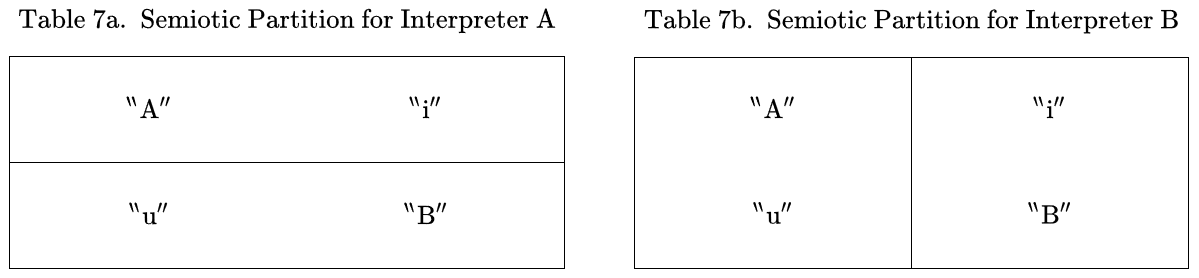
and  will serve to illustrate their use and utility.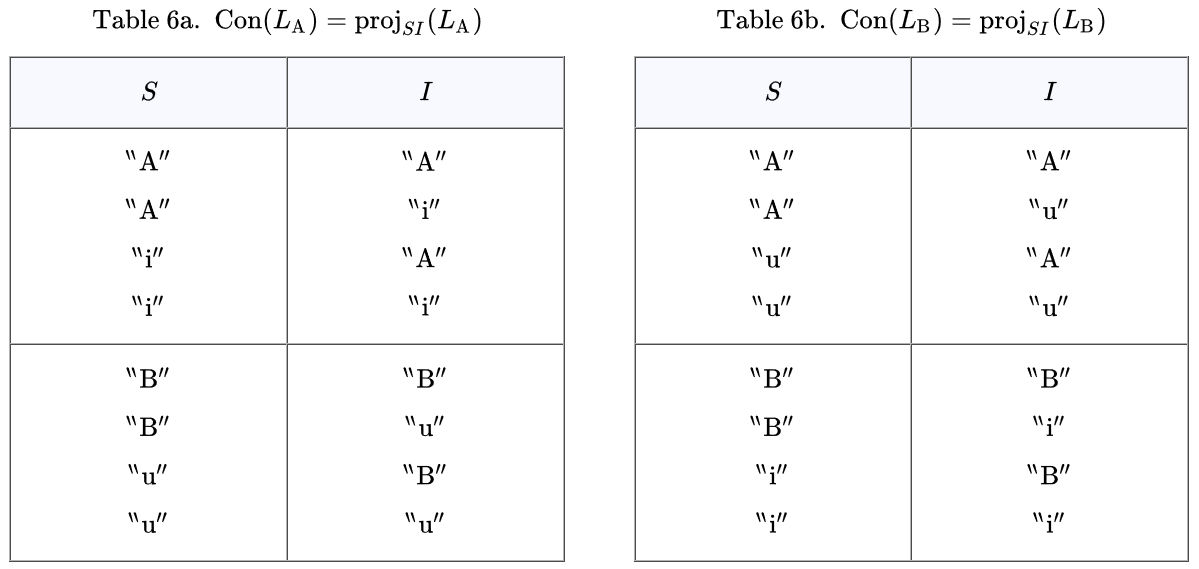
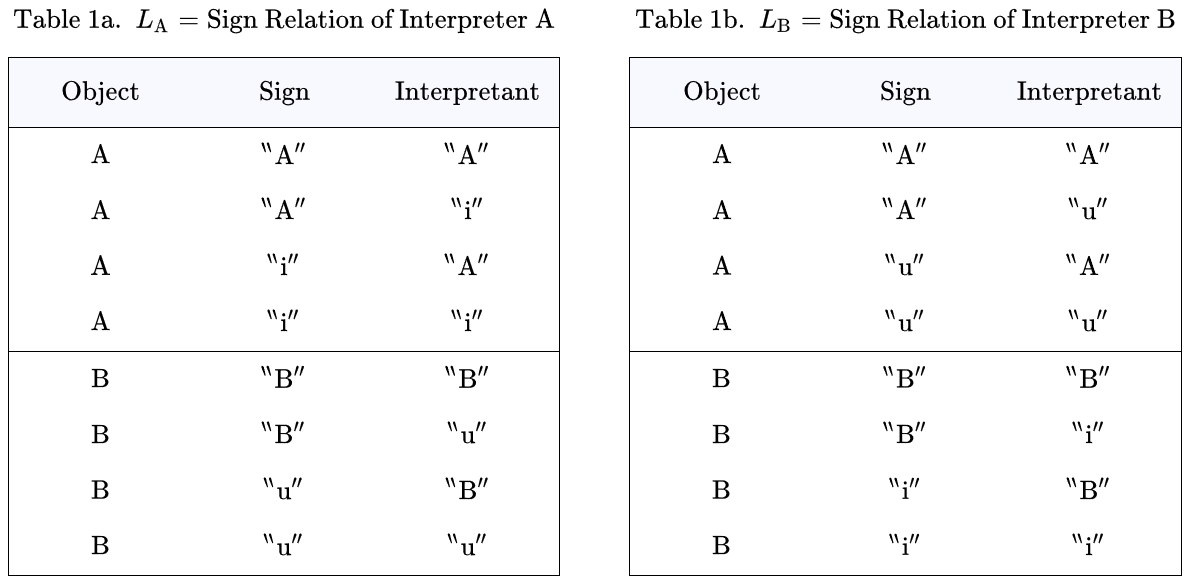
 yields the following semiotic equations.
![\begin{matrix} [ {}^{\backprime\backprime} \mathrm{A} {}^{\prime\prime} ]_{L_\mathrm{A}} & = & [ {}^{\backprime\backprime} \mathrm{i} {}^{\prime\prime} ]_{L_\mathrm{A}} \\[6pt] [ {}^{\backprime\backprime} \mathrm{B} {}^{\prime\prime} ]_{L_\mathrm{A}} & = & [ {}^{\backprime\backprime} \mathrm{u} {}^{\prime\prime} ]_{L_\mathrm{A}} \end{matrix}](https://s0.wp.com/latex.php?latex=%5Cbegin%7Bmatrix%7D++%5B+%7B%7D%5E%7B%5Cbackprime%5Cbackprime%7D+%5Cmathrm%7BA%7D+%7B%7D%5E%7B%5Cprime%5Cprime%7D+%5D_%7BL_%5Cmathrm%7BA%7D%7D++%26+%3D+%26++%5B+%7B%7D%5E%7B%5Cbackprime%5Cbackprime%7D+%5Cmathrm%7Bi%7D+%7B%7D%5E%7B%5Cprime%5Cprime%7D+%5D_%7BL_%5Cmathrm%7BA%7D%7D++%5C%5C%5B6pt%5D++%5B+%7B%7D%5E%7B%5Cbackprime%5Cbackprime%7D+%5Cmathrm%7BB%7D+%7B%7D%5E%7B%5Cprime%5Cprime%7D+%5D_%7BL_%5Cmathrm%7BA%7D%7D++%26+%3D+%26++%5B+%7B%7D%5E%7B%5Cbackprime%5Cbackprime%7D+%5Cmathrm%7Bu%7D+%7B%7D%5E%7B%5Cprime%5Cprime%7D+%5D_%7BL_%5Cmathrm%7BA%7D%7D++%5Cend%7Bmatrix%7D&bg=ffffff&fg=000000&s=0&c=20201002)
![\begin{matrix} {}^{\backprime\backprime} \mathrm{A} {}^{\prime\prime} & =_{L_\mathrm{A}} & {}^{\backprime\backprime} \mathrm{i} {}^{\prime\prime} \\[6pt] {}^{\backprime\backprime} \mathrm{B} {}^{\prime\prime} & =_{L_\mathrm{A}} & {}^{\backprime\backprime} \mathrm{u} {}^{\prime\prime} \end{matrix}](https://s0.wp.com/latex.php?latex=%5Cbegin%7Bmatrix%7D++%7B%7D%5E%7B%5Cbackprime%5Cbackprime%7D+%5Cmathrm%7BA%7D+%7B%7D%5E%7B%5Cprime%5Cprime%7D++%26+%3D_%7BL_%5Cmathrm%7BA%7D%7D+%26++%7B%7D%5E%7B%5Cbackprime%5Cbackprime%7D+%5Cmathrm%7Bi%7D+%7B%7D%5E%7B%5Cprime%5Cprime%7D++%5C%5C%5B6pt%5D++%7B%7D%5E%7B%5Cbackprime%5Cbackprime%7D+%5Cmathrm%7BB%7D+%7B%7D%5E%7B%5Cprime%5Cprime%7D++%26+%3D_%7BL_%5Cmathrm%7BA%7D%7D+%26++%7B%7D%5E%7B%5Cbackprime%5Cbackprime%7D+%5Cmathrm%7Bu%7D+%7B%7D%5E%7B%5Cprime%5Cprime%7D++%5Cend%7Bmatrix%7D&bg=ffffff&fg=000000&s=0&c=20201002)

 yields the following semiotic equations.
![\begin{matrix} [ {}^{\backprime\backprime} \mathrm{A} {}^{\prime\prime} ]_{L_\mathrm{B}} & = & [ {}^{\backprime\backprime} \mathrm{u} {}^{\prime\prime} ]_{L_\mathrm{B}} \\[6pt] [ {}^{\backprime\backprime} \mathrm{B} {}^{\prime\prime} ]_{L_\mathrm{B}} & = & [ {}^{\backprime\backprime} \mathrm{i} {}^{\prime\prime} ]_{L_\mathrm{B}} \end{matrix}](https://s0.wp.com/latex.php?latex=%5Cbegin%7Bmatrix%7D++%5B+%7B%7D%5E%7B%5Cbackprime%5Cbackprime%7D+%5Cmathrm%7BA%7D+%7B%7D%5E%7B%5Cprime%5Cprime%7D+%5D_%7BL_%5Cmathrm%7BB%7D%7D++%26+%3D+%26++%5B+%7B%7D%5E%7B%5Cbackprime%5Cbackprime%7D+%5Cmathrm%7Bu%7D+%7B%7D%5E%7B%5Cprime%5Cprime%7D+%5D_%7BL_%5Cmathrm%7BB%7D%7D++%5C%5C%5B6pt%5D++%5B+%7B%7D%5E%7B%5Cbackprime%5Cbackprime%7D+%5Cmathrm%7BB%7D+%7B%7D%5E%7B%5Cprime%5Cprime%7D+%5D_%7BL_%5Cmathrm%7BB%7D%7D++%26+%3D+%26++%5B+%7B%7D%5E%7B%5Cbackprime%5Cbackprime%7D+%5Cmathrm%7Bi%7D+%7B%7D%5E%7B%5Cprime%5Cprime%7D+%5D_%7BL_%5Cmathrm%7BB%7D%7D++%5Cend%7Bmatrix%7D&bg=ffffff&fg=000000&s=0&c=20201002)
![\begin{matrix} {}^{\backprime\backprime} \mathrm{A} {}^{\prime\prime} & =_{L_\mathrm{B}} & {}^{\backprime\backprime} \mathrm{u} {}^{\prime\prime} \\[6pt] {}^{\backprime\backprime} \mathrm{B} {}^{\prime\prime} & =_{L_\mathrm{B}} & {}^{\backprime\backprime} \mathrm{i} {}^{\prime\prime} \end{matrix}](https://s0.wp.com/latex.php?latex=%5Cbegin%7Bmatrix%7D++%7B%7D%5E%7B%5Cbackprime%5Cbackprime%7D+%5Cmathrm%7BA%7D+%7B%7D%5E%7B%5Cprime%5Cprime%7D++%26+%3D_%7BL_%5Cmathrm%7BB%7D%7D+%26++%7B%7D%5E%7B%5Cbackprime%5Cbackprime%7D+%5Cmathrm%7Bu%7D+%7B%7D%5E%7B%5Cprime%5Cprime%7D++%5C%5C%5B6pt%5D++%7B%7D%5E%7B%5Cbackprime%5Cbackprime%7D+%5Cmathrm%7BB%7D+%7B%7D%5E%7B%5Cprime%5Cprime%7D++%26+%3D_%7BL_%5Cmathrm%7BB%7D%7D+%26++%7B%7D%5E%7B%5Cbackprime%5Cbackprime%7D+%5Cmathrm%7Bi%7D+%7B%7D%5E%7B%5Cprime%5Cprime%7D++%5Cend%7Bmatrix%7D&bg=ffffff&fg=000000&s=0&c=20201002)

 and
and  have many interesting properties over and above those possessed by sign relations in general. Some of those properties have to do with the relation between signs and their interpretant signs, as reflected in the projections of
  ‑plane, notated as
  and
and  respectively. The dyadic relations on
  induced by those projections are also referred to as the connotative components of the corresponding sign relations, notated as
  and
and  respectively. Tables 6a and 6b show the corresponding connotative components.
 form a pair of equivalence relations on their common syntactic domain
  This type of equivalence relation is called a semiotic equivalence relation (SER) because it equates signs having the same meaning to some interpreter.
 partitions the collection of signs into semiotic equivalence classes. This constitutes a strong form of representation in that the structure of the interpreters’ common object domain
  is reflected or reconstructed, part for part, in the structure of each one’s semiotic partition of the syntactic domain
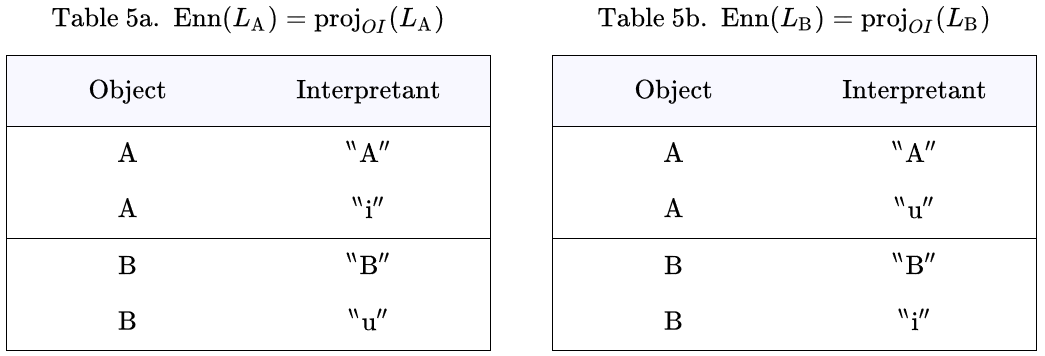
 Information about the ennotative aspect of meaning is obtained from
  and the interpretant domain
  The ennotative component of a sign relation

 and
and  is defined as follows.
 is echoed unchanged in
  and all the data of
  is echoed unchanged in
 respectively. The rows of each Table list the ordered pairs
  in the corresponding projections,
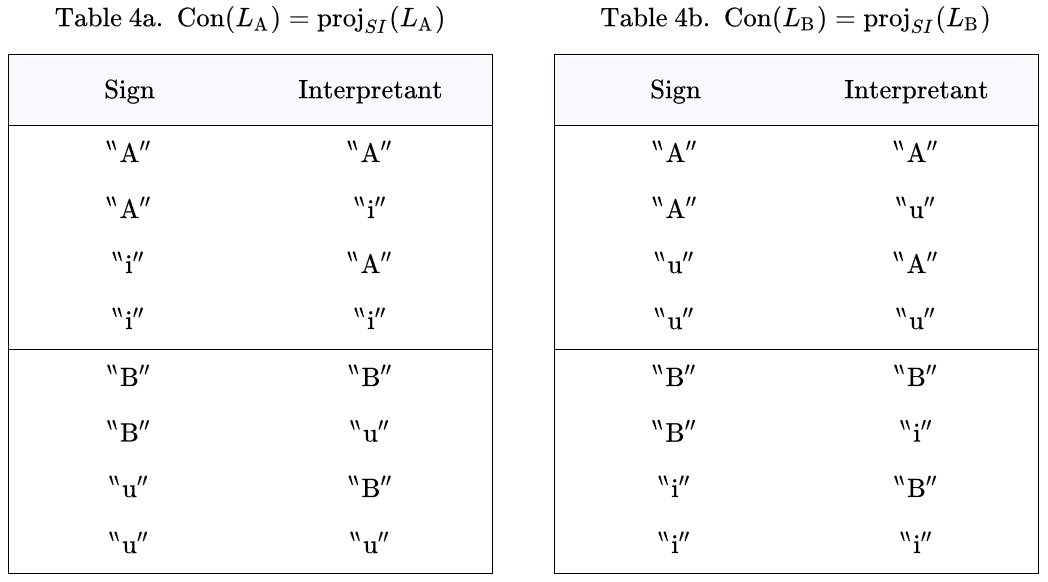
 Information about the connotative aspect of meaning is obtained from
  and the interpretant domain

 and
and  is defined as follows.
 in the corresponding projections,
 Information about the denotative aspect of meaning is obtained from
  The denotative component of a sign relation

 and
and  is defined as follows.
 in the corresponding projections,
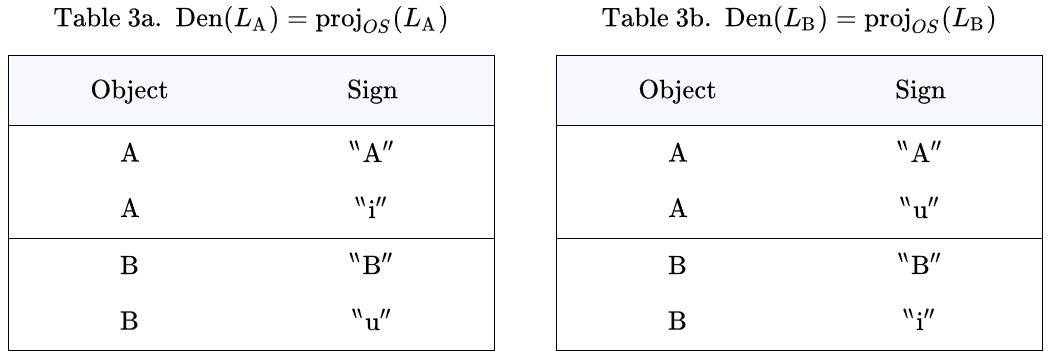
 various rows of the Tables specify, for example, that
  to denote
  to denote
 whether it happens to be a sign relation or not, there are six dyadic relations obtained by projecting
  -space
  The six dyadic projections of a triadic relation
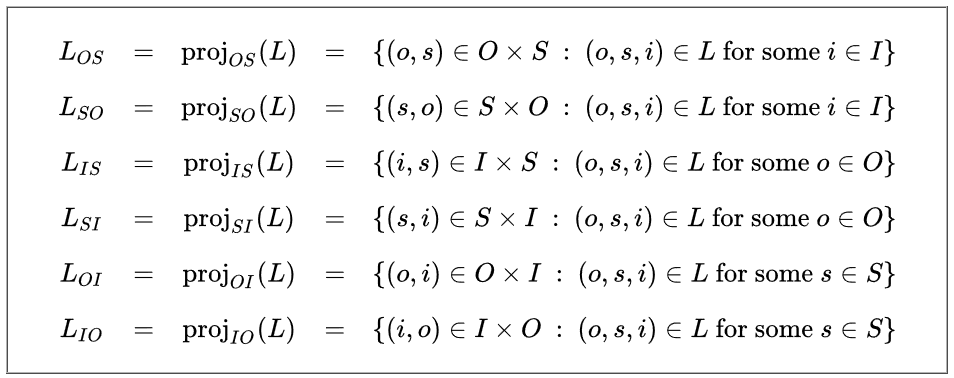
 -plane
  is written briefly as
  or written more fully as
  and is defined as the set of all ordered pairs
  in the set

 are known as the object domain, the sign domain, and the interpretant domain, respectively, of the sign relation
 In those situations it becomes convenient to lump signs and interpretants together in a single class called the sign system or the syntactic domain. In the forthcoming examples
![\begin{array}{ccl} O & = & \text{Object Domain} \\[6pt] S & = & \text{Sign Domain} \\[6pt] I & = & \text{Interpretant Domain} \end{array}](https://s0.wp.com/latex.php?latex=%5Cbegin%7Barray%7D%7Bccl%7D++O+%26+%3D+%26+%5Ctext%7BObject+Domain%7D++%5C%5C%5B6pt%5D++S+%26+%3D+%26+%5Ctext%7BSign+Domain%7D++%5C%5C%5B6pt%5D++I+%26+%3D+%26+%5Ctext%7BInterpretant+Domain%7D++%5Cend%7Barray%7D&bg=ffffff&fg=000000&s=0&c=20201002)
![\begin{array}{cclcl} O & = & \{ \text{Ann}, \text{Bob} \} & = & \{ \mathrm{A}, \mathrm{B} \} \\[6pt] S & = & \{ {}^{\backprime\backprime} \text{Ann} {}^{\prime\prime}, {}^{\backprime\backprime} \text{Bob} {}^{\prime\prime}, {}^{\backprime\backprime} \text{I} {}^{\prime\prime}, {}^{\backprime\backprime} \text{you} {}^{\prime\prime} \} & = & \{ {}^{\backprime\backprime} \mathrm{A} {}^{\prime\prime}, {}^{\backprime\backprime} \mathrm{B} {}^{\prime\prime}, {}^{\backprime\backprime} \mathrm{i} {}^{\prime\prime}, {}^{\backprime\backprime} \mathrm{u} {}^{\prime\prime} \} \\[6pt] I & = & \{ {}^{\backprime\backprime} \text{Ann} {}^{\prime\prime}, {}^{\backprime\backprime} \text{Bob} {}^{\prime\prime}, {}^{\backprime\backprime} \text{I} {}^{\prime\prime}, {}^{\backprime\backprime} \text{you} {}^{\prime\prime} \} & = & \{ {}^{\backprime\backprime} \mathrm{A} {}^{\prime\prime}, {}^{\backprime\backprime} \mathrm{B} {}^{\prime\prime}, {}^{\backprime\backprime} \mathrm{i} {}^{\prime\prime}, {}^{\backprime\backprime} \mathrm{u} {}^{\prime\prime} \} \end{array}](https://s0.wp.com/latex.php?latex=%5Cbegin%7Barray%7D%7Bcclcl%7D++O++%26+%3D+%26++%5C%7B+%5Ctext%7BAnn%7D%2C+%5Ctext%7BBob%7D+%5C%7D+%26+%3D+%26+%5C%7B+%5Cmathrm%7BA%7D%2C+%5Cmathrm%7BB%7D+%5C%7D++%5C%5C%5B6pt%5D++S++%26+%3D+%26++%5C%7B+%7B%7D%5E%7B%5Cbackprime%5Cbackprime%7D+%5Ctext%7BAnn%7D+%7B%7D%5E%7B%5Cprime%5Cprime%7D%2C+%7B%7D%5E%7B%5Cbackprime%5Cbackprime%7D+%5Ctext%7BBob%7D+%7B%7D%5E%7B%5Cprime%5Cprime%7D%2C+%7B%7D%5E%7B%5Cbackprime%5Cbackprime%7D+%5Ctext%7BI%7D+%7B%7D%5E%7B%5Cprime%5Cprime%7D%2C+%7B%7D%5E%7B%5Cbackprime%5Cbackprime%7D+%5Ctext%7Byou%7D+%7B%7D%5E%7B%5Cprime%5Cprime%7D+%5C%7D++%26+%3D+%26++%5C%7B+%7B%7D%5E%7B%5Cbackprime%5Cbackprime%7D+%5Cmathrm%7BA%7D+%7B%7D%5E%7B%5Cprime%5Cprime%7D%2C+%7B%7D%5E%7B%5Cbackprime%5Cbackprime%7D+%5Cmathrm%7BB%7D+%7B%7D%5E%7B%5Cprime%5Cprime%7D%2C+%7B%7D%5E%7B%5Cbackprime%5Cbackprime%7D+%5Cmathrm%7Bi%7D+%7B%7D%5E%7B%5Cprime%5Cprime%7D%2C+%7B%7D%5E%7B%5Cbackprime%5Cbackprime%7D+%5Cmathrm%7Bu%7D+%7B%7D%5E%7B%5Cprime%5Cprime%7D+%5C%7D++%5C%5C%5B6pt%5D++I++%26+%3D+%26++%5C%7B+%7B%7D%5E%7B%5Cbackprime%5Cbackprime%7D+%5Ctext%7BAnn%7D+%7B%7D%5E%7B%5Cprime%5Cprime%7D%2C+%7B%7D%5E%7B%5Cbackprime%5Cbackprime%7D+%5Ctext%7BBob%7D+%7B%7D%5E%7B%5Cprime%5Cprime%7D%2C+%7B%7D%5E%7B%5Cbackprime%5Cbackprime%7D+%5Ctext%7BI%7D+%7B%7D%5E%7B%5Cprime%5Cprime%7D%2C+%7B%7D%5E%7B%5Cbackprime%5Cbackprime%7D+%5Ctext%7Byou%7D+%7B%7D%5E%7B%5Cprime%5Cprime%7D+%5C%7D++%26+%3D+%26++%5C%7B+%7B%7D%5E%7B%5Cbackprime%5Cbackprime%7D+%5Cmathrm%7BA%7D+%7B%7D%5E%7B%5Cprime%5Cprime%7D%2C+%7B%7D%5E%7B%5Cbackprime%5Cbackprime%7D+%5Cmathrm%7BB%7D+%7B%7D%5E%7B%5Cprime%5Cprime%7D%2C+%7B%7D%5E%7B%5Cbackprime%5Cbackprime%7D+%5Cmathrm%7Bi%7D+%7B%7D%5E%7B%5Cprime%5Cprime%7D%2C+%7B%7D%5E%7B%5Cbackprime%5Cbackprime%7D+%5Cmathrm%7Bu%7D+%7B%7D%5E%7B%5Cprime%5Cprime%7D+%5C%7D++%5Cend%7Barray%7D&bg=ffffff&fg=000000&s=0&c=20201002)



 Inquiry Into Inquiry