Theme One Program • Exposition 1

Theme One is a program for constructing and transforming a particular species of graph‑theoretic data structures, forms designed to support a variety of fundamental learning and reasoning tasks.

The program evolved over the course of an exploration into the integration of contrasting types of activities involved in learning and reasoning, especially the types of algorithms and data structures capable of supporting all sorts of inquiry processes, from everyday problem solving to scientific investigation.  In its current state, Theme One integrates over a common data structure fundamental algorithms for one type of inductive learning and one type of deductive reasoning.

We begin by describing the class of graph-theoretic data structures used by the program, as determined by their local and global features.  It will be the usual practice to shift around and view these graphs at many different levels of detail, from their abstract definition to their concrete implementation, and many points in between.

The main work of the Theme One program is achieved by building and transforming a single species of graph-theoretic data structures.  In their abstract form these structures are closely related to the graphs called cacti and conifers in graph theory, so we’ll generally refer to them under those names.

The Idea↑Form Flag

The graph-theoretic data structures used by the program are built up from a basic data structure called an idea-form flag.  That structure is defined as a pair of Pascal data types by means of the following specifications.
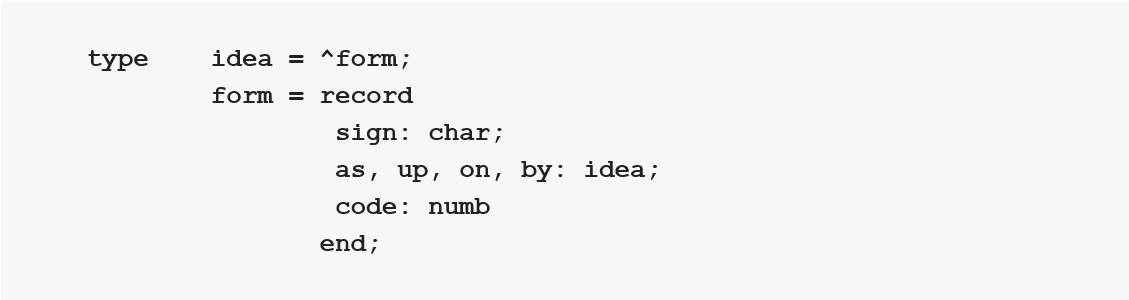
Type Idea = ^Form

  • An idea is a pointer to a form.
  • A form is a record consisting of:
    • A sign of type char;
    • Four pointers, as, up, on, by, of type idea;
    • A code of type numb, that is, an integer in [0, max integer].

Represented in terms of digraphs, or directed graphs, the combination of an idea pointer and a form record is most easily pictured as an arc, or directed edge, leading to a node labeled with the other data, in this case, a letter and a number.

At the roughest but quickest level of detail, an idea of a form can be drawn as follows.

Idea^Form Node

When it is necessary to fill in more detail, the following schematic pattern can be used.
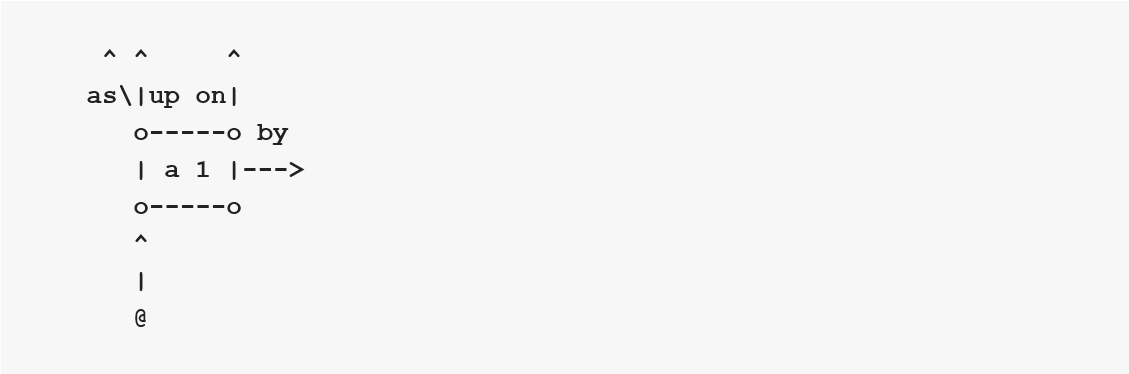
Idea^Form Flag

The idea-form type definition determines the local structure of the whole host of graphs used by the program, including a motley array of ephemeral buffers, temporary scratch lists, and other graph-theoretic data structures used for their transient utilities at specific points in the program.

I will put off discussing the more incidental graph structures until the points where they actually arise, focusing here on the particular varieties of cactoid graphs which constitute the main formal media of the program’s operation.

Resources

cc: Conceptual GraphsCyberneticsLaws of FormOntolog Forum
cc: FB | Theme One ProgramStructural ModelingSystems Science

Posted in Algorithms, Animata, Artificial Intelligence, Boolean Functions, C.S. Peirce, Cactus Graphs, Cognition, Computation, Constraint Satisfaction Problems, Data Structures, Differential Logic, Equational Inference, Formal Languages, Graph Theory, Inquiry Driven Systems, Laws of Form, Learning Theory, Logic, Logical Graphs, Mathematics, Minimal Negation Operators, Painted Cacti, Peirce, Propositional Calculus, Semiotics, Spencer Brown, Visualization | Tagged , , , , , , , , , , , , , , , , , , , , , , , , , , | 8 Comments

Survey of Theme One Program • 4

This is a Survey of blog and wiki posts relating to the Theme One Program I worked on all through the 1980s.  The aim was to develop fundamental algorithms and data structures for integrating empirical learning with logical reasoning.  I had earlier developed separate programs for basic components of those tasks, namely, 2-level formal language learning and propositional constraint satisfaction, the latter using an extension of C.S. Peirce’s logical graphs as a syntax for propositional logic.  Thus arose the question of how well it might be possible to get “empiricist” and “rationalist” modes of operation to cooperate.  The long-term vision is the design and implementation of an Automated Research Tool able to double as a platform for Inquiry Driven Education.

Wiki Hub

Documentation

Blog Series

Blog Dialogs

Applications

References

  • Awbrey, S.M., and Awbrey, J.L. (May 1991), “An Architecture for Inquiry • Building Computer Platforms for Discovery”, Proceedings of the Eighth International Conference on Technology and Education, Toronto, Canada, pp. 874–875.  Online.
  • Awbrey, J.L., and Awbrey, S.M. (January 1991), “Exploring Research Data Interactively • Developing a Computer Architecture for Inquiry”, Poster presented at the Annual Sigma Xi Research Forum, University of Texas Medical Branch, Galveston, TX.
  • Awbrey, J.L., and Awbrey, S.M. (August 1990), “Exploring Research Data Interactively • Theme One : A Program of Inquiry”, Proceedings of the Sixth Annual Conference on Applications of Artificial Intelligence and CD-ROM in Education and Training, Society for Applied Learning Technology, Washington, DC, pp. 9–15.  Online.

cc: Conceptual Graphs • Cybernetics (1) (2) • Laws of Form (1) (2) (3)
cc: Ontolog Forum (1) (2) (3) • Structural Modeling (1) (2) • Systems Science (1) (2) (3)
cc: Peirce List (Dec 2012) (Feb 2018) (Mar 2018) (Sep 2020) (Oct 2020) (Oct 2021)
cc: FB | Theme One Program

Posted in Algorithms, Animata, Artificial Intelligence, Boolean Functions, C.S. Peirce, Cactus Graphs, Cognition, Computation, Constraint Satisfaction Problems, Data Structures, Differential Logic, Equational Inference, Formal Languages, Graph Theory, Inquiry Driven Systems, Laws of Form, Learning Theory, Logic, Logical Graphs, Mathematics, Minimal Negation Operators, Painted Cacti, Peirce, Propositional Calculus, Semiotics, Spencer Brown, Visualization | Tagged , , , , , , , , , , , , , , , , , , , , , , , , , , | 22 Comments

Functional Logic • Inquiry and Analogy • 21

Inquiry and AnalogyGeneralized Umpire Operators

To get a better handle on the space of higher order propositions and continue developing our functional approach to quantification theory, we’ll need a number of specialized tools.  To begin, we define a higher order operator \Upsilon, called the umpire operator, which takes 1, 2, or 3 propositions as arguments and returns a single truth value as the result.  Operators with optional numbers of arguments are called multigrade operators, typically defined as unions over function types.  Expressing \Upsilon in that form gives the following formula.

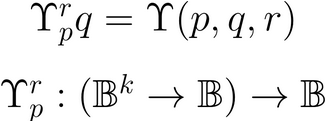
UMP 1

In contexts of application, that is, where a multigrade operator is actually being applied to arguments, the number of arguments in the argument list tells which of the optional types is “operative”.  In the case of \Upsilon, the first and last arguments appear as indices, the one in the middle serving as the main argument while the other two arguments serve to modify the sense of the operation in question.  Thus, we have the following forms.

UMP 2

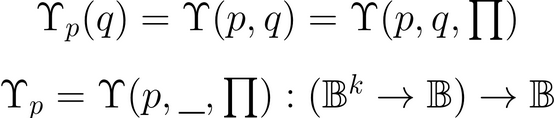
The operation \Upsilon_p^r q evaluates the proposition q on each model of the proposition p and combines the results according to the method indicated by the connective parameter r.  In principle, the index r may specify any logical connective on as many as 2^k arguments but in practice we usually have a much simpler form of combination in mind, typically either products or sums.  By convention, each of the accessory indices p, r is assigned a default value understood to be in force when the corresponding argument place is left blank, specifically, the constant proposition 1 : \mathbb{B}^k \to \mathbb{B} for the lower index p and the continued conjunction or continued product operation \textstyle\prod for the upper index r.  Taking the upper default value gives license to the following readings.

UMP 3

This means \Upsilon_p (q) = 1 if and only if q holds for all models of p.  In propositional terms, this is tantamount to the assertion that p \Rightarrow q, or that \texttt{(} p \texttt{(} q \texttt{))} = 1.

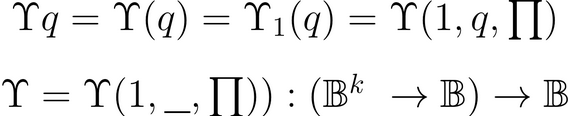
Throwing in the lower default value permits the following abbreviations.

UMP 4

This means \Upsilon q = 1 if and only if q holds for the whole universe of discourse in question, that is, if and only q is the constantly true proposition 1 : \mathbb{B}^k \to \mathbb{B}.  The ambiguities of this usage are not a problem so long as we distinguish the context of definition from the context of application and restrict all shorthand notations to the latter.

Resources

cc: FB | Peirce MattersLaws of FormMathstodonOntologAcademia.edu
cc: Conceptual GraphsCyberneticsStructural ModelingSystems Science

Posted in Abduction, Analogy, Argument, Aristotle, C.S. Peirce, Constraint, Deduction, Determination, Diagrammatic Reasoning, Diagrams, Differential Logic, Functional Logic, Hypothesis, Indication, Induction, Inference, Information, Inquiry, Logic, Logic of Science, Mathematics, Pragmatic Semiotic Information, Probable Reasoning, Propositional Calculus, Propositions, Reasoning, Retroduction, Semiotics, Sign Relations, Syllogism, Triadic Relations, Visualization | Tagged , , , , , , , , , , , , , , , , , , , , , , , , , , , , , , , | 2 Comments

Functional Logic • Inquiry and Analogy • 20

Inquiry and AnalogyApplication of Higher Order Propositions to Quantification Theory

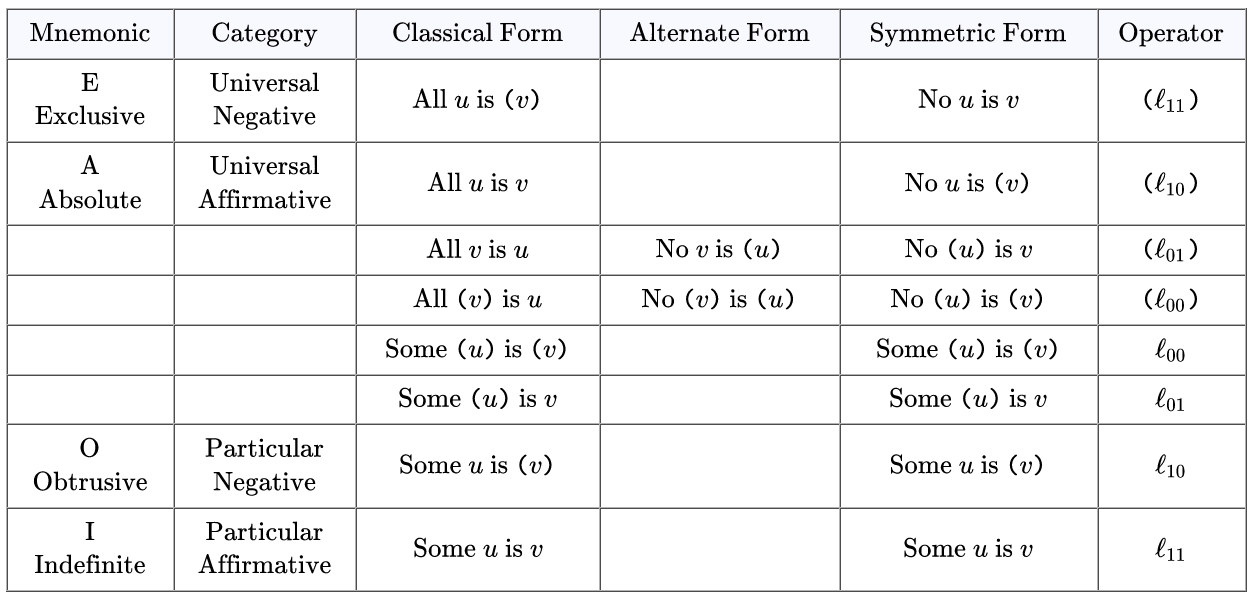
Table 21 provides a thumbnail sketch of the relationships discussed in this section.

\text{Table 21. Relation of Quantifiers to Higher Order Propositions}
Relation of Quantifiers to Higher Order Propositions

Resources

cc: FB | Peirce MattersLaws of FormMathstodonOntologAcademia.edu
cc: Conceptual GraphsCyberneticsStructural ModelingSystems Science

Posted in Abduction, Analogy, Argument, Aristotle, C.S. Peirce, Constraint, Deduction, Determination, Diagrammatic Reasoning, Diagrams, Differential Logic, Functional Logic, Hypothesis, Indication, Induction, Inference, Information, Inquiry, Logic, Logic of Science, Mathematics, Pragmatic Semiotic Information, Probable Reasoning, Propositional Calculus, Propositions, Reasoning, Retroduction, Semiotics, Sign Relations, Syllogism, Triadic Relations, Visualization | Tagged , , , , , , , , , , , , , , , , , , , , , , , , , , , , , , , | 2 Comments

Functional Logic • Inquiry and Analogy • 19

Inquiry and AnalogyApplication of Higher Order Propositions to Quantification Theory

Reflection is turning a topic over in various aspects and in various lights so that nothing significant about it shall be overlooked — almost as one might turn a stone over to see what its hidden side is like or what is covered by it.

John Dewey • How We Think

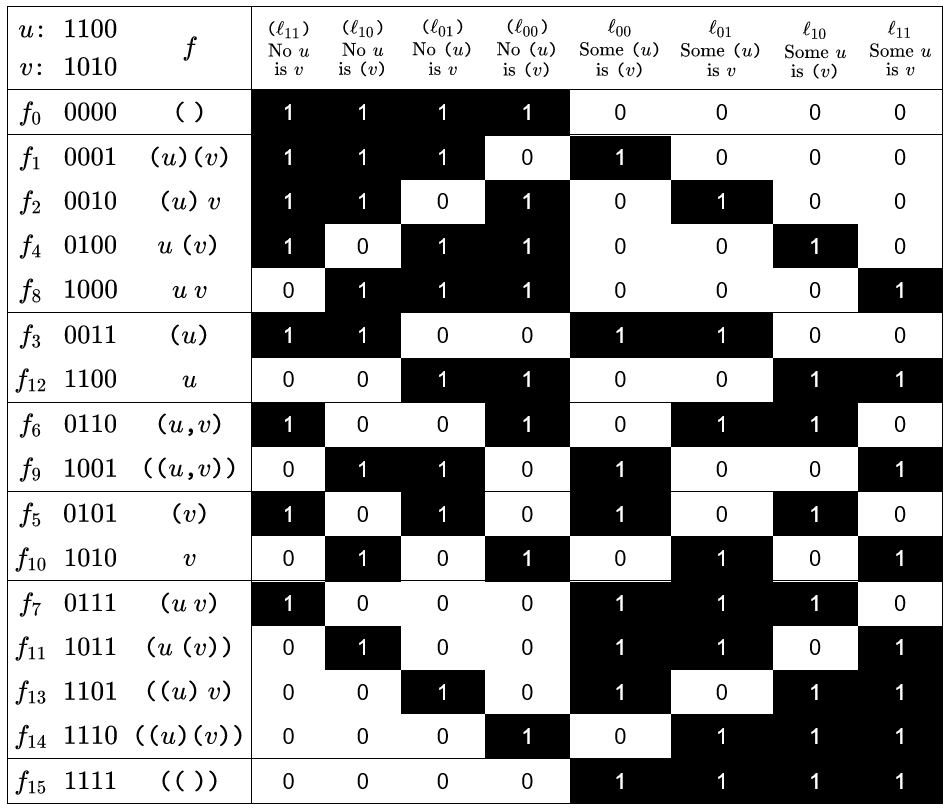
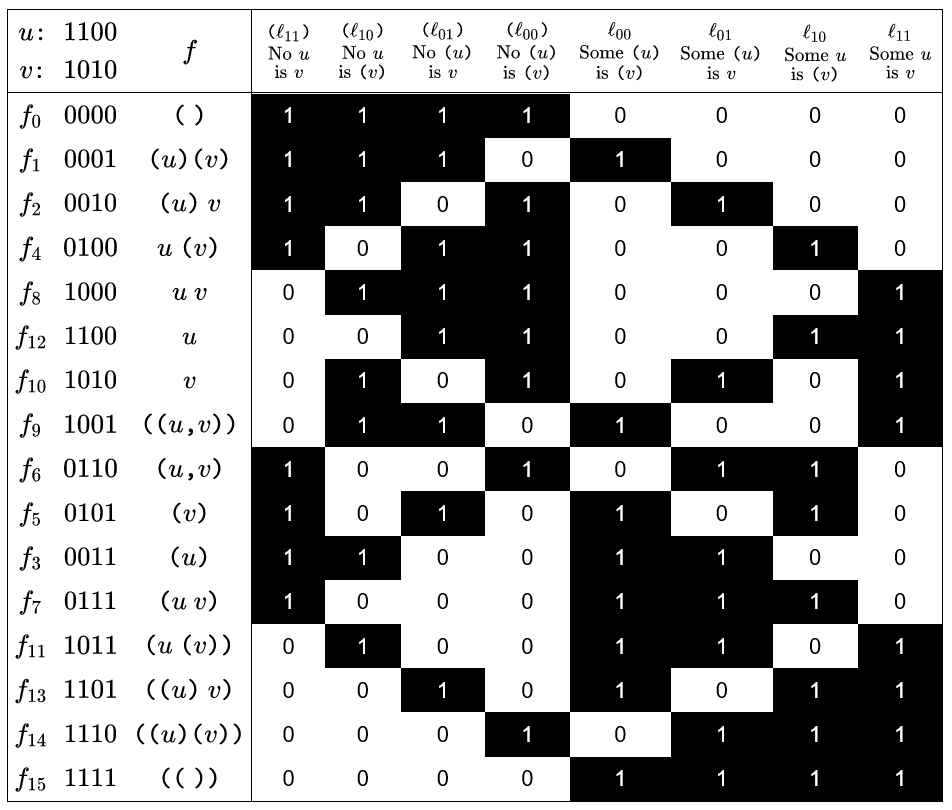
Tables 19 and 20 present the same information as Table 18, sorting the rows in different orders to reveal other symmetries in the arrays.

\text{Table 19. Simple Qualifiers of Propositions (Version 2)}
Simple Qualifiers of Propositions (Version 2)

\text{Table 20. Simple Qualifiers of Propositions (Version 3)}
Simple Qualifiers of Propositions (Version 3)

Resources

cc: FB | Peirce MattersLaws of FormMathstodonOntologAcademia.edu
cc: Conceptual GraphsCyberneticsStructural ModelingSystems Science

Posted in Abduction, Analogy, Argument, Aristotle, C.S. Peirce, Constraint, Deduction, Determination, Diagrammatic Reasoning, Diagrams, Differential Logic, Functional Logic, Hypothesis, Indication, Induction, Inference, Information, Inquiry, Logic, Logic of Science, Mathematics, Pragmatic Semiotic Information, Probable Reasoning, Propositional Calculus, Propositions, Reasoning, Retroduction, Semiotics, Sign Relations, Syllogism, Triadic Relations, Visualization | Tagged , , , , , , , , , , , , , , , , , , , , , , , , , , , , , , , | 2 Comments

Functional Logic • Inquiry and Analogy • 18

Inquiry and AnalogyApplication of Higher Order Propositions to Quantification Theory

Last time we took up a fourfold scheme of quantified propositional forms traditionally known as a “Square of Opposition”, relating it to a quartet of higher order propositions which, depending on context, are also known as measures, qualifiers, or higher order indicator functions.

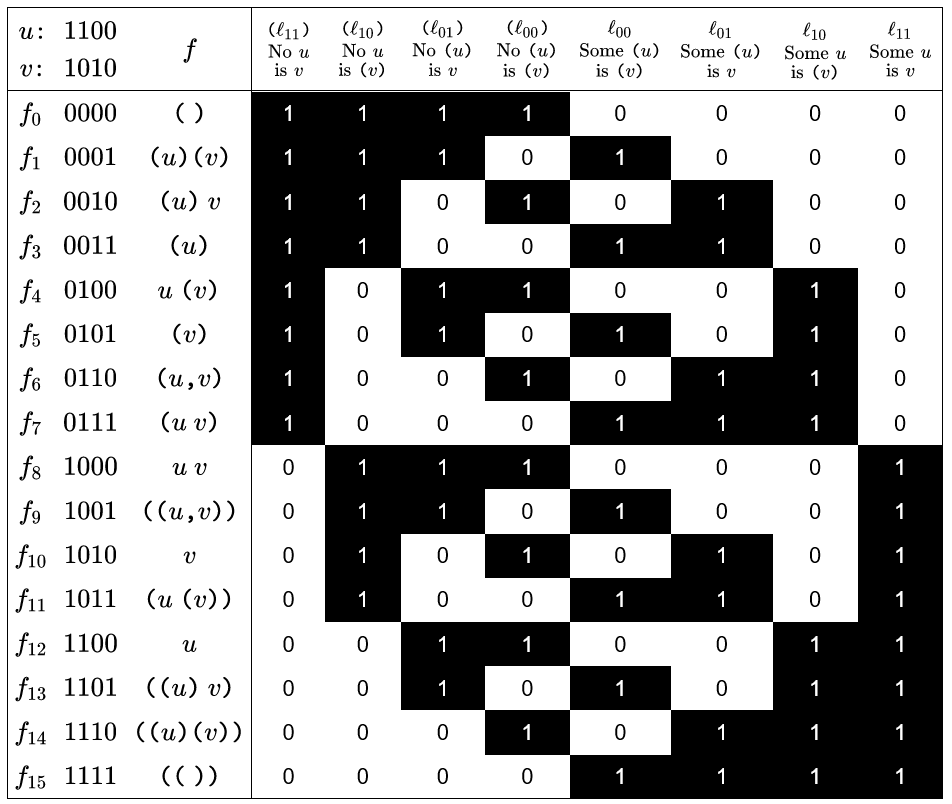
Table 18 develops the above ideas in further detail, expressing a larger set of quantified propositional forms by means of propositions about propositions.

\text{Table 18. Simple Qualifiers of Propositions (Version 1)}
Simple Qualifiers of Propositions (Version 1)

Resources

cc: FB | Peirce MattersLaws of FormMathstodonOntologAcademia.edu
cc: Conceptual GraphsCyberneticsStructural ModelingSystems Science

Posted in Abduction, Analogy, Argument, Aristotle, C.S. Peirce, Constraint, Deduction, Determination, Diagrammatic Reasoning, Diagrams, Differential Logic, Functional Logic, Hypothesis, Indication, Induction, Inference, Information, Inquiry, Logic, Logic of Science, Mathematics, Pragmatic Semiotic Information, Probable Reasoning, Propositional Calculus, Propositions, Reasoning, Retroduction, Semiotics, Sign Relations, Syllogism, Triadic Relations, Visualization | Tagged , , , , , , , , , , , , , , , , , , , , , , , , , , , , , , , | 2 Comments

Functional Logic • Inquiry and Analogy • 17

Inquiry and AnalogyApplication of Higher Order Propositions to Quantification Theory

Our excursion into the expanding landscape of higher order propositions has come round to the point where we can begin to open up new perspectives on quantificational logic.

Though it may be all the same from a purely formal point of view, it does serve intuition to adopt a slightly different interpretation for the two‑valued space we take as the target of our basic indicator functions.  In that spirit we declare a novel type of existence-valued functions f : \mathbb{B}^k \to \mathbb{E} where \mathbb{E} = \{ -e, +e \} = \{ \mathrm{empty}, \mathrm{existent} \} is a pair of values indicating whether anything exists in the cells of the underlying universe of discourse.  As usual, we won’t be too picky about the coding of those functions, reverting to binary codes whenever the intended interpretation is clear enough.

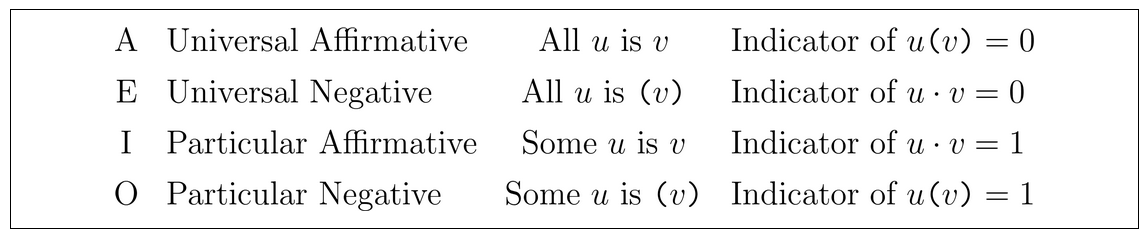
With that interpretation in mind we observe the following correspondence between classical quantifications and higher order indicator functions.

\text{Table 17. Syllogistic Premisses as Higher Order Indicator Functions}
Syllogistic Premisses as Higher Order Indicator Functions

Resources

cc: FB | Peirce MattersLaws of FormMathstodonOntologAcademia.edu
cc: Conceptual GraphsCyberneticsStructural ModelingSystems Science

Posted in Abduction, Analogy, Argument, Aristotle, C.S. Peirce, Constraint, Deduction, Determination, Diagrammatic Reasoning, Diagrams, Differential Logic, Functional Logic, Hypothesis, Indication, Induction, Inference, Information, Inquiry, Logic, Logic of Science, Mathematics, Pragmatic Semiotic Information, Probable Reasoning, Propositional Calculus, Propositions, Reasoning, Retroduction, Semiotics, Sign Relations, Syllogism, Triadic Relations, Visualization | Tagged , , , , , , , , , , , , , , , , , , , , , , , , , , , , , , , | 2 Comments

Functional Logic • Inquiry and Analogy • 16

Inquiry and AnalogyExtending the Existential Interpretation to Quantificational Logic

One of the resources we have for this work is a formal calculus based on C.S. Peirce’s logical graphs.  For now we’ll adopt the existential interpretation of that calculus, fixing the meanings of logical constants and connectives at the core level of propositional logic.  To build on that core we’ll need to extend the existential interpretation to encompass the analysis of quantified propositions, or quantifications.  That in turn will take developing two further capacities of our calculus.  On the formal side we’ll need to consider higher order functional types, continuing our earlier venture above.  In terms of content we’ll need to consider new species of elemental or singular propositions.

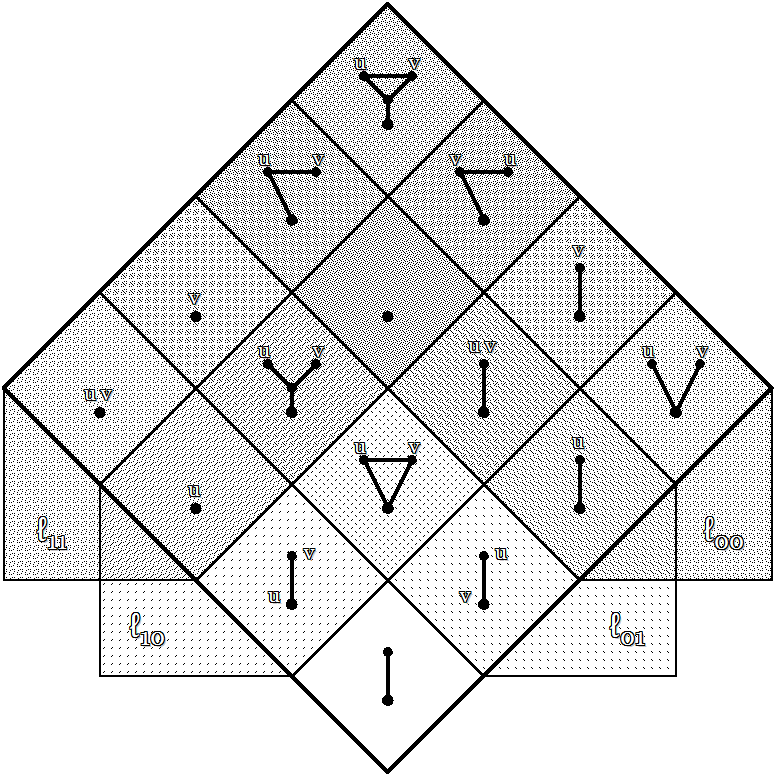
Let us return to the 2‑dimensional universe X^\bullet = [u, v].  A bridge between propositions and quantifications is afforded by a set of measures or qualifiers \ell_{ij} : (\mathbb{B} \times \mathbb{B} \to \mathbb{B}) \to \mathbb{B} defined by the following equations.

\begin{array}{*{11}{l}}  \ell_{00} f  & = & \ell_{\texttt{(} u \texttt{)(} v \texttt{)}} f  & = & \alpha_1 f  & = & \Upsilon_{\texttt{(} u \texttt{)(} v \texttt{)}} f  & = & \Upsilon_{\texttt{(} u \texttt{)(} v \texttt{)} \,\Rightarrow\, f}  & = & f ~\text{likes}~ \texttt{(} u \texttt{)(} v \texttt{)}  \\  \ell_{01} f  & = & \ell_{\texttt{(} u \texttt{)} v} f  & = & \alpha_2 f  & = & \Upsilon_{\texttt{(} u \texttt{)} v} f  & = & \Upsilon_{\texttt{(} u \texttt{)} v \,\Rightarrow\, f}  & = & f ~\text{likes}~ \texttt{(} u \texttt{)}  v  \\  \ell_{10} f  & = & \ell_{u  \texttt{(} v \texttt{)}} f  & = & \alpha_4 f  & = & \Upsilon_{u \texttt{(} v \texttt{)}} f  & = & \Upsilon_{u \texttt{(} v \texttt{)} \,\Rightarrow\, f}  & = & f ~\text{likes}~ u  \texttt{(} v \texttt{)}  \\  \ell_{11} f  & = & \ell_{u \, v} f  & = & \alpha_8 f  & = & \Upsilon_{u \, v} f  & = & \Upsilon_{u \, v \,\Rightarrow\, f}  & = & f ~\text{likes}~ u \, v  \end{array}

A higher order proposition \ell_{ij} : (\mathbb{B} \times \mathbb{B} \to \mathbb{B}) \to \mathbb{B} tells us something about the proposition f :\mathbb{B} \times \mathbb{B} \to \mathbb{B}, namely, which elements in the space of type \mathbb{B} \times \mathbb{B} are assigned a positive value by f.  Taken together, the \ell_{ij} operators give us a way to express many useful observations about the propositions in X^\bullet = [u, v].  Figure 16 summarizes the action of the \ell_{ij} operators on the propositions of type f :\mathbb{B} \times \mathbb{B} \to \mathbb{B}.

Higher Order Universe of Discourse
\text{Figure 16. Higher Order Universe of Discourse}~ [ \ell_{00}, \ell_{01}, \ell_{10}, \ell_{11} ] \subseteq [[ u, v ]]

Resources

cc: FB | Peirce MattersLaws of FormMathstodonOntologAcademia.edu
cc: Conceptual GraphsCyberneticsStructural ModelingSystems Science

Posted in Abduction, Analogy, Argument, Aristotle, C.S. Peirce, Constraint, Deduction, Determination, Diagrammatic Reasoning, Diagrams, Differential Logic, Functional Logic, Hypothesis, Indication, Induction, Inference, Information, Inquiry, Logic, Logic of Science, Mathematics, Pragmatic Semiotic Information, Probable Reasoning, Propositional Calculus, Propositions, Reasoning, Retroduction, Semiotics, Sign Relations, Syllogism, Triadic Relations, Visualization | Tagged , , , , , , , , , , , , , , , , , , , , , , , , , , , , , , , | 2 Comments

Functional Logic • Inquiry and Analogy • 15

Inquiry and AnalogyMeasure for Measure

Let us define two families of measures,

\alpha_i, \beta_i : (\mathbb{B} \times \mathbb{B} \to \mathbb{B}) \to \mathbb{B} ~\text{for}~ i = 0 ~\text{to}~ 15,

by means of the following equations:

\begin{matrix}  \alpha_i f & = & \Upsilon (f_i, f) & = & \Upsilon (f_i \Rightarrow f),  \\[6pt]  \beta_i f & = & \Upsilon (f, f_i) & = & \Upsilon (f \Rightarrow f_i).  \end{matrix}

Table 14 shows the value of each \alpha_i on each of the 16 boolean functions f: \mathbb{B} \times \mathbb{B} \to \mathbb{B}.  In terms of the implication ordering on the 16 functions, \alpha_i f = 1 says that f is above or identical to f_i in the implication lattice, that is, f \ge f_i in the implication ordering.

\text{Table 14. Qualifiers of the Implication Ordering}~ \alpha_i f = \Upsilon (f_i, f)
Qualifiers of the Implication Ordering α

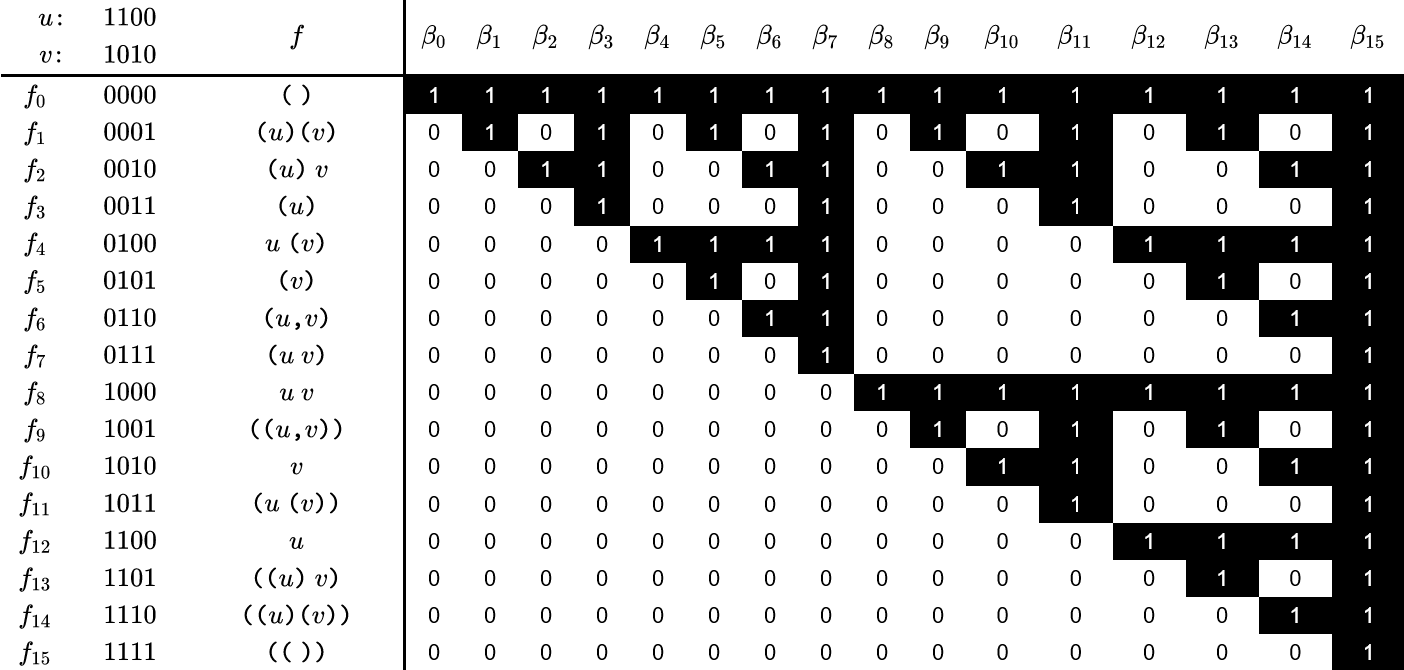
Table 15 shows the value of each \beta_i on each of the 16 boolean functions f: \mathbb{B} \times \mathbb{B} \to \mathbb{B}.  In terms of the implication ordering on the 16 functions, \beta_i f = 1 says that f is below or identical to f_i in the implication lattice, that is, f \le f_i in the implication ordering.

\text{Table 15. Qualifiers of the Implication Ordering}~ \beta_i f = \Upsilon (f, f_i)
Qualifiers of the Implication Ordering β

Applied to a given proposition f, the qualifiers \alpha_i and \beta_i tell whether f is above f_i or below f_i, respectively, in the implication ordering.  By way of example, let us trace the effects of several such measures, namely, those which occupy the limiting positions in the Tables.

\begin{array}{*{8}{r}}  \alpha_{0} f = 1  & \mathrm{iff}  & f_{0} \Rightarrow f  & \mathrm{iff}  & 0 \Rightarrow f,  & \mathrm{hence}  & \alpha_{0} f = 1  & \mathrm{for~all} ~ f.  \\[4pt]  \alpha_{15} f = 1  & \mathrm{iff}  & f_{15} \Rightarrow f  & \mathrm{iff}  & 1 \Rightarrow f,  & \mathrm{hence}  & \alpha_{15} f = 1  & \mathrm{iff} ~ f = 1.  \\[4pt]  \beta_{0} f = 1  & \mathrm{iff}  & f \Rightarrow f_{0}  & \mathrm{iff}  & f \Rightarrow 0,  & \mathrm{hence}  & \beta_{0} f = 1  & \mathrm{iff} ~ f = 0.  \\[4pt]  \beta_{15} f = 1  & \mathrm{iff}  & f \Rightarrow f_{15}  & \mathrm{iff}  & f \Rightarrow 1,  & \mathrm{hence}  & \beta_{15} f = 1  & \mathrm{for~all} ~ f.  \end{array}

Expressed in terms of the propositional forms they value positively, \alpha_{0} = \beta_{15} is a wholly indifferent or indiscriminate measure, accepting every proposition f : \mathbb{B} \times \mathbb{B} \to \mathbb{B}, whereas the measures \alpha_{15} and \beta_{0} value the constant propositions 1 : \mathbb{B} \times \mathbb{B} \to \mathbb{B} and 0 : \mathbb{B} \times \mathbb{B} \to \mathbb{B}, respectively, above all others.

Finally, in conformity with the use of fiber notation to indicate sets of models, it is natural to use notations like the following to denote sets of propositions satisfying the umpires in question.

\begin{matrix}  [| \alpha_i |] & = & \alpha_i^{-1}(1),  \\[6pt]  [| \beta_i |] & = & \beta_i^{-1}(1),  \\[6pt]  [| \Upsilon_p |] & = & \Upsilon_p^{-1}(1).  \end{matrix}

Resources

cc: FB | Peirce MattersLaws of FormMathstodonOntologAcademia.edu
cc: Conceptual GraphsCyberneticsStructural ModelingSystems Science

Posted in Abduction, Analogy, Argument, Aristotle, C.S. Peirce, Constraint, Deduction, Determination, Diagrammatic Reasoning, Diagrams, Differential Logic, Functional Logic, Hypothesis, Indication, Induction, Inference, Information, Inquiry, Logic, Logic of Science, Mathematics, Pragmatic Semiotic Information, Probable Reasoning, Propositional Calculus, Propositions, Reasoning, Retroduction, Semiotics, Sign Relations, Syllogism, Triadic Relations, Visualization | Tagged , , , , , , , , , , , , , , , , , , , , , , , , , , , , , , , | 2 Comments

Functional Logic • Inquiry and Analogy • 14

Inquiry and AnalogyUmpire Operators

The 2^{16} measures of type (\mathbb{B} \times \mathbb{B} \to \mathbb{B}) \to \mathbb{B} present a formidable array of propositions about propositions about 2‑dimensional universes of discourse.  The early entries in their standard ordering define universes too amorphous to detain us for long on a first pass but as we turn toward the high end of the ordering we begin to recognize familiar structures worth examining from new angles.

Instrumental to our study we define a couple of higher order operators,

\begin{matrix}  \Upsilon : (\mathbb{B} \times \mathbb{B} \to \mathbb{B})^2 \to \mathbb{B}  && \text{and} &&  \Upsilon_1 : (\mathbb{B} \times \mathbb{B} \to \mathbb{B}) \to \mathbb{B},  \end{matrix}

referred to as the relative and absolute umpire operators, respectively.  If either operator is defined in terms of more primitive notions then the remaining operator can be defined in terms of the one first established.

Let X = \langle u, v \rangle be a two‑dimensional boolean space, X \cong \mathbb{B} \times \mathbb{B}, generated by two boolean variables or logical features u and v.

Given an ordered pair of propositions e, f : \langle u, v \rangle \to \mathbb{B} as arguments, the relative umpire operator reports the value 1 if the first implies the second, otherwise it reports the value 0.

\begin{matrix}  \Upsilon (e, f) = 1 && \text{if and only if} && e \Rightarrow f  \end{matrix}

Expressing it another way:

\begin{matrix}  \Upsilon (e, f) = 1 && \iff && \texttt{(} e \texttt{(} f \texttt{))} = 1  \end{matrix}

In writing this, however, it is important to observe that the 1 appearing on the left side and the 1 appearing on the right side of the logical equivalence have different meanings.  Filling in the details, we have the following.

\begin{matrix}   \Upsilon (e, f) = 1 \in \mathbb{B}  && \iff &&  \texttt{(} e \texttt{(} f \texttt{))} = 1 : \langle u, v \rangle \to \mathbb{B}  \end{matrix}

Writing types as subscripts and using the fact that X = \langle u, v \rangle, it is possible to express this more succinctly as follows.


\begin{matrix}  \Upsilon (e, f) = 1_\mathbb{B}  && \iff &&  \texttt{(} e \texttt{(} f \texttt{))} = 1_{X \to \mathbb{B}}  \end{matrix}

Finally, it is often convenient to write the first argument as a subscript.  Thus we have the following equation.

\begin{matrix}  \Upsilon_e (f) & = & \Upsilon (e, f).  \end{matrix}

The absolute umpire operator, also known as the umpire measure, is a higher order proposition \Upsilon_1 : (\mathbb{B} \times \mathbb{B} \to \mathbb{B}) \to \mathbb{B} defined by the equation \Upsilon_1 (f) = \Upsilon (1, f).  In this case the subscript 1 on the left and the argument 1 on the right both refer to the constant proposition 1 : \mathbb{B} \times \mathbb{B} \to \mathbb{B}.  In most settings where \Upsilon_1 is applied to arguments it is safe to omit the subscript 1 since the number of arguments indicates which type of operator is meant.  Thus, we have the following identities and equivalents.

\begin{matrix}   \Upsilon f = \Upsilon_1 (f) = 1_\mathbb{B}  & \iff &  \texttt{(} 1 \texttt{(} f \texttt{))} = \mathbf{1}  & \iff &  f = 1_{\mathbb{B} \times \mathbb{B} \to \mathbb{B}}  \end{matrix}

The umpire measure \Upsilon_1 is defined on boolean functions regarded as mathematical objects but can also be understood in terms of the judgments it induces on the syntactic level.  In that interpretation \Upsilon_1 recognizes theorems of the propositional calculus over [u, v], giving a score of 1 to tautologies and a score of 0 to everything else, counting all contingent statements as no better than falsehoods.

One remark in passing for those who might prefer an alternative definition.  If we had originally taken \Upsilon to mean the absolute measure then the relative measure could have been defined as \Upsilon_e f = \Upsilon \texttt{(} e \texttt{(} f \texttt{))}.

Resources

cc: FB | Peirce MattersLaws of FormMathstodonOntologAcademia.edu
cc: Conceptual GraphsCyberneticsStructural ModelingSystems Science

Posted in Abduction, Analogy, Argument, Aristotle, C.S. Peirce, Constraint, Deduction, Determination, Diagrammatic Reasoning, Diagrams, Differential Logic, Functional Logic, Hypothesis, Indication, Induction, Inference, Information, Inquiry, Logic, Logic of Science, Mathematics, Pragmatic Semiotic Information, Probable Reasoning, Propositional Calculus, Propositions, Reasoning, Retroduction, Semiotics, Sign Relations, Syllogism, Triadic Relations, Visualization | Tagged , , , , , , , , , , , , , , , , , , , , , , , , , , , , , , , | 2 Comments