
Logical Graphs, Truth Tables, Venn Diagrams • 3

Re: Laws of FormJohn MingersLyle Anderson

Dear John, Lyle,

There is nothing simple about the interpretation of If-Then-Else constructions in ordinary language as they combine the equivocation between formal and material implication at the outset with the vacillation between exclusive and inclusive disjunction at the final Or-Else.

Nor is there anything straightforward about the implementation of If-Then-Else clauses in half-functional half-procedural programming languages like Pascal.  In settings like that they do not render as pure boolean expressions but as boolean tests determining a choice between procedural branches.  Multiply that by the diversity of evaluation strategies for boolean expressions, (complete | partial), (eager | greedy | lazy), etc., and the possibilities are legion.  That is all well and good, those are just the choices that are out there, and we can work with anyone’s understanding of If-Then-Else as a boolean function so long as they give us their intended truth table so we don’t have to guess what they have in mind.

I’ll touch on If-Then-Else again when we turn to what I regard as the proper handling of Case Analysis in the systems of logical graphs evolving from the work of C.S. Peirce and Spencer Brown.

As it happens, I did once write out all 256 boolean functions on three variables in cactus syntax several years ago — pursuant to discussions in Stephen Wolfram’s New Kind of Science (NKS) Forum regarding Elementary Cellular Automaton Rules (ECARs), which are in effect just that set of boolean functions.  I’ll have to dig up a passel of ancient links from the WayBack Machine, but see the following archive page for a hint of how it went.

To be continued …

Jon

References

cc: CyberneticsOntolog • Peirce List (1) (2)Structural ModelingSystems Science
cc: FB | Logical GraphsLaws of Form

Posted in Amphecks, Boolean Algebra, Boolean Functions, C.S. Peirce, Graph Theory, Laws of Form, Logic, Logical Graphs, Mathematics, Peirce, Propositional Calculus, Spencer Brown, Truth Tables, Venn Diagrams, Visualization | Tagged , , , , , , , , , , , , , , | 7 Comments

Logical Graphs, Truth Tables, Venn Diagrams • 2

Re: Laws of FormJohn Mingers

JM:
Most of the recent discussion is about two-variable logic forms where there is a logical relation between two logical variables.  I want to bring up the subject of three-variable logic which I think is very rich but not much discussed.

In two-variable logic, as we know, there are 16 possible relations.  With three variables, there are 8 rows in the truth table and so 28 = 256 possibilities.  Many of these are the same at 2-variable, eg. AND(a,b,c) or OR(a,b,c) but some are different, eg. IF a THEN b ELSE c.  This latter one is really at the heart of all computer programming.

I haven’t seen much written about this although William Bricken has done some (see for example “Symmetry in Boolean Functions with Examples for Two and Three Variables”).  Here he shows that when you take into account reflections and rotations there are actually 14 distinct forms within the 256.

Dear John,

One of the biggest advantages of the systems of graphical forms derived from C.S. Peirce’s logical graphs and Spencer Brown’s calculus of indications is precisely the conceptual and computational efficiencies they afford us in dealing with propositional forms and boolean functions of many variables.  This has been one of my main motivations in pursuing their development for the last half century and I think we have hopes of enjoying those benefits once we’ve had our dose of minimum logical requirements and cross the threshold of first principles.

That said, I still have work to do on the logical graphs for two-variable boolean functions since I’ve been using those as logical man-in-the-moon marigolds to study the effects of the \mathrm{En} \leftrightarrow \mathrm{Ex} duality.  That duality is associated with a transformation group of order two which partitions the set of sixteen functions into ten orbits.  The groups William Bricken considers have much higher orders at each number of variables and thus partition their spaces of functions into many fewer orbits in each case.  See the first reference below.

Have to break here …

Jon

References

cc: CyberneticsOntolog • Peirce List (1) (2)Structural ModelingSystems Science
cc: FB | Logical GraphsLaws of Form

Posted in Amphecks, Boolean Algebra, Boolean Functions, C.S. Peirce, Graph Theory, Laws of Form, Logic, Logical Graphs, Mathematics, Peirce, Propositional Calculus, Spencer Brown, Truth Tables, Venn Diagrams, Visualization | Tagged , , , , , , , , , , , , , , | 7 Comments

Differential Logic and Dynamic Systems • Discussion 4

Re: Differential Propositional Calculus • Discussions • (1)(2)(3)
Re: Laws of FormLyle Anderson (1) (2)

Dear Lyle,

I’ve been meaning to get back to your comments linked above — the connections you observed to finite difference calculus, ordinary and partial differential equations, and differential geometry are very apt — but preparing the ground for a smooth transition to differential logic takes time, plus I needed to deal with the details of the \mathrm{En} \leftrightarrow \mathrm{Ex} logical graph duality I’ve been wanting to give their due for decades.

The flat out fastest key to the highway of differential logic is still the Casual Introduction I wrote for Part One of Differential Propositional Calculus.  It affords direct access to the basic intuitions and motivations of the subject but stops short of the syntactic mechanics needed to really take off.  The jump from that point to the more aggressive approaches of Differential Logic and Differential Logic and Dynamic Systems has long been a challenge.  I went looking for materials to bridge the gap and was pleased to find a few old writings I had almost forgotten but wrote when I myself was passing through a similar transition.  Perhaps one of those will help the intrepid reader hit the ground running in this field.

I’ll take up one of those pieces next time.

Resources

cc: CyberneticsOntolog • Peirce List (1) (2)Structural ModelingSystems Science
cc: FB | Differential LogicLaws of Form

Posted in Amphecks, Boolean Functions, C.S. Peirce, Cactus Graphs, Category Theory, Change, Computational Complexity, Cybernetics, Differential Analytic Turing Automata, Differential Calculus, Differential Logic, Discrete Dynamics, Dynamical Systems, Equational Inference, Functional Logic, Gradient Descent, Graph Theory, Group Theory, Hologrammautomaton, Indicator Functions, Logic, Logical Graphs, Mathematical Models, Mathematics, Minimal Negation Operators, Painted Cacti, Peirce, Propositional Calculus, Propositional Equation Reasoning Systems, Time, Visualization | Tagged , , , , , , , , , , , , , , , , , , , , , , , , , , , , , , | 10 Comments

De In Esse Predication • Preliminaries

Questions have arisen in several places about classical logic and its vicissitudes, what used to be called “deviant logics” in some circles, all of which I recall being hot topics and much-mooted questions when I was a young wffer-snapper and Novice In Logic (NIL) back in the day.

That whole ball of wax still preserves a number of my oldest research questions and I have a rough sense of where the edges of my knowledge wedge into it, bit by bit, here and there.  Part of it had to do with the conflict and confluence between extensional and intensional logic, while other parts arose from difficulties with “intentional contexts”.  The persons of the play on this stage ranged from Leibniz on one side to Russell and Quine on the other, with Peirce as the “Magister Ludi”, the Grand Integrator.  Now, I’ve actually been doing my best to avoid getting into this particular kettle of fish, but I ran across a bunch of old notes on it while looking for earlier thoughts on differential logic and dynamic systems so I’ll post a bare link by way of reminder to come back later, clean up the old texts, and share them to my blog.

This is all stuff that would have been posted to the old Ontology List and the Peirce List or one of its avatars.  I don’t quite remember why I used the title “De In Esse Predication” but it had to do with a link I saw between Leibniz and Peirce, and it’s possible I got it all wrong.

cc: CyberneticsOntolog ForumPeirce ListStructural ModelingSystems Science
cc: FB | Peirce MattersLaws of Form

Posted in C.S. Peirce, Comprehension, Connotation, Denotation, Extension, Indication, Information, Information = Comprehension × Extension, Intension, Intention, Intentionality, Logic, Peirce, Semiotics, Sign Relations, Triadic Relations | Tagged , , , , , , , , , , , , , , , | 1 Comment

Differential Logic and Dynamic Systems • Discussion 3

Re: FB | Differential LogicRajib Hossain Pavel

RHP:
How can Differential Logic find Optimal Condition in a Game setting for an Individual Player (Individual Choice) and Overall System (Social Welfare)?

Dear Rajib,

Differential logic is a general framework for analyzing aspects of change and difference in systems amenable to qualitative description, for example, processes taking place in a universe of discourse or transformations mapping a source universe to a target universe.  To apply its concepts and methods to a concrete case one has to define the state space and the objective function one desires to optimize.  This may indeed be the hardest part of the problem.  It helps to break ground if one can think up a simple example from the class of systems one has in mind.

References

  • Awbrey, S.M., and Awbrey, J.L. (May 2001), “Conceptual Barriers to Creating Integrative Universities”, Organization : The Interdisciplinary Journal of Organization, Theory, and Society 8(2), Sage Publications, London, UK, 269–284.  AbstractOnline.
  • Awbrey, S.M., and Awbrey, J.L. (September 1999), “Organizations of Learning or Learning Organizations : The Challenge of Creating Integrative Universities for the Next Century”, Second International Conference of the Journal ‘Organization’, Re‑Organizing Knowledge, Trans‑Forming Institutions : Knowing, Knowledge, and the University in the 21st Century, University of Massachusetts, Amherst, MA.  Online.

Resources

cc: CyberneticsOntolog • Peirce List (1) (2)Structural ModelingSystems Science
cc: FB | Differential LogicLaws of Form

Posted in Amphecks, Boolean Functions, C.S. Peirce, Cactus Graphs, Category Theory, Change, Computational Complexity, Cybernetics, Differential Analytic Turing Automata, Differential Calculus, Differential Logic, Discrete Dynamics, Dynamical Systems, Equational Inference, Functional Logic, Gradient Descent, Graph Theory, Group Theory, Hologrammautomaton, Indicator Functions, Logic, Logical Graphs, Mathematical Models, Mathematics, Minimal Negation Operators, Painted Cacti, Peirce, Propositional Calculus, Propositional Equation Reasoning Systems, Time, Visualization | Tagged , , , , , , , , , , , , , , , , , , , , , , , , , , , , , , | 7 Comments

Differential Logic and Dynamic Systems • Discussion 2

Re: Michael HarrisDoes Mathematics “Progress”?Comment

In several places I can’t find right now I described formalization as an arrow.  A related idea occurs in a paper by Susan Awbrey and myself where we discussed “a dimension of increasing formalization in our mental models of the world” as an obstacle to integrating knowledge across various styles of inquiry.  An excerpt follows.

Conceptual Barriers to Creating Integrative Universities

The Trivializing of Integration

From reviewing its philosophical sources, we can see that the trivialization of integration hypothesis presents barriers to creating an integrated learning environment.  Below we focus on three closely interrelated problematics and the bearing that the triviality of integration hypothesis has on them.

Problematic 1 is the tension that arises along a dimension of increasing formalization in our mental models of the world, between what we may call the ‘informal context’ of real-world practice and the ‘formal context’ of specialized study.

Problematic 2 is the difficulty in communication that is created by differing mental models of the world, in other words, by the tendency among groups of specialists to form internally coherent but externally disparate systems of mental images.

Problematic 3 is a special type of communication difficulty that commonly arises between the ‘Two Cultures’ of the scientific and the humanistic disciplines.  A significant part of the problem derives from the differential emphasis that each group places on its use of symbolic and conceptual systems, limiting itself to either the denotative or the connotative planes of variation, but seldom integrating the two.

References

  • Awbrey, S.M., and Awbrey, J.L. (May 2001), “Conceptual Barriers to Creating Integrative Universities”, Organization : The Interdisciplinary Journal of Organization, Theory, and Society 8(2), Sage Publications, London, UK, 269–284.  AbstractOnline.
  • Awbrey, S.M., and Awbrey, J.L. (September 1999), “Organizations of Learning or Learning Organizations : The Challenge of Creating Integrative Universities for the Next Century”, Second International Conference of the Journal ‘Organization’, Re‑Organizing Knowledge, Trans‑Forming Institutions : Knowing, Knowledge, and the University in the 21st Century, University of Massachusetts, Amherst, MA.  Online.

Resources

cc: CyberneticsOntolog • Peirce List (1) (2)Structural ModelingSystems Science
cc: FB | Differential LogicLaws of Form

Posted in Amphecks, Boolean Functions, C.S. Peirce, Cactus Graphs, Category Theory, Change, Computational Complexity, Cybernetics, Differential Analytic Turing Automata, Differential Calculus, Differential Logic, Discrete Dynamics, Dynamical Systems, Equational Inference, Functional Logic, Gradient Descent, Graph Theory, Group Theory, Hologrammautomaton, Indicator Functions, Logic, Logical Graphs, Mathematical Models, Mathematics, Minimal Negation Operators, Painted Cacti, Peirce, Propositional Calculus, Propositional Equation Reasoning Systems, Time, Visualization | Tagged , , , , , , , , , , , , , , , , , , , , , , , , , , , , , , | 7 Comments

Differential Logic and Dynamic Systems • Discussion 1

It is understandable that an engineer should be completely absorbed in his speciality, instead of pouring himself out into the freedom and vastness of the world of thought, even though his machines are being sent off to the ends of the earth;  for he no more needs to be capable of applying to his own personal soul what is daring and new in the soul of his subject than a machine is in fact capable of applying to itself the differential calculus on which it is based.  The same thing cannot, however, be said about mathematics;  for here we have the new method of thought, pure intellect, the very well-spring of the times, the fons et origo of an unfathomable transformation.

Robert Musil • The Man Without Qualities

Re: Michael HarrisDoes Mathematics “Progress”?

Just off-hand, by way of getting grounded and oriented, there are a few questions I’d have to ask first.

  • Is mathematics a science, or a form of scientific inquiry?
  • If so, what is the place of mathematics within the sciences?
  • Does science progress?
    • (I mean progress in the sense of progress toward a goal, not necessarily progressive jazz or progressions in music generally.)
  • If so, what is the goal of science?
  • If science has a goal, does mathematics serve it?
  • If so, how?

By science or scientific inquiry I meant to focus on species of goal-directed activity with the specific goal of “knowledge” and to ask whether mathematical arts and crafts and rites fall within that ballpark.  We come back to the antic Socratic question of whether we put another quarter in the machine for the sake of an external gain or simply to continue the play for its own sake.

MH:
In this post I was less concerned with philosophy than with philology — which, by the way, is another example of a term that was once seen as hopelessly antiquated and musty but that has been revived recently.
But when you introduce “knowledge” you have to grapple with “truth” and “objective reality”.  Philosophy has been so unsuccessful at pinning those down that some would prefer to give up on them altogether.  We can choose to call what mathematics generates “knowledge” but that just leads to the (philological) question of what this has to do with what other practices call “knowledge”.

Not that I don’t love wisdom and words, however often their stars may cross, but I invoked Musil rather for the way he syzygied the way of the engineer, the way of the mathematician, and the recursive point where their ways diverge.  It’s in this frame I think of the word entelechy, which I got from readings in Aristotle, Goethe, and Peirce and promptly gave a personal gloss as end in itself, partly on the influence of Conway’s game theory.

And that’s where I remember all those two-bit pieces I gave up to pinball machines in the early 70s and the critical point in my own trajectory when I realized I would never beat those machines, not that way, not ever, and I turned to the more collaboratory ends of teaching machines how to learn and reason.

♩ On A Related Note ♪ The Music Of The Primes ♫

Now there’s a progression of progressions I could enjoy, musically speaking, ad infinitum, and yet this pilgrim would consider it progress, mathematically speaking, if he could understand why the sequentiae should be sequenced as they are.  Would that understanding add to my enjoyment?  On jugera …

Resources

cc: CyberneticsOntolog • Peirce List (1) (2)Structural ModelingSystems Science
cc: FB | Differential LogicLaws of Form

Posted in Amphecks, Boolean Functions, C.S. Peirce, Cactus Graphs, Category Theory, Change, Computational Complexity, Cybernetics, Differential Analytic Turing Automata, Differential Calculus, Differential Logic, Discrete Dynamics, Dynamical Systems, Equational Inference, Functional Logic, Gradient Descent, Graph Theory, Group Theory, Hologrammautomaton, Indicator Functions, Logic, Logical Graphs, Mathematical Models, Mathematics, Minimal Negation Operators, Painted Cacti, Peirce, Propositional Calculus, Propositional Equation Reasoning Systems, Time, Visualization | Tagged , , , , , , , , , , , , , , , , , , , , , , , , , , , , , , | 7 Comments

Survey of Differential Logic • 3

This is a Survey of blog and wiki posts on Differential Logic, material I plan to develop toward a more compact and systematic account.

Note.  One effect of the pandemic has been been to blot out my memory of much work I blogged over the year and many group discussions I have in mind as “recent” and “I’ll get back to it” actually occurred several months ago.  Thinking it will serve memory to recycle the more eddifying currents of water under the bridge, here’s an update of my Survey page on Differential Logic.

Elements

Blog Series

Architectonics

Applications

Blog Dialogs

Explorations

cc: Conceptual GraphsCyberneticsOntologStructural ModelingSystems Science
cc: FB | Differential Logic • Laws of Form (1) (2)

Posted in Amphecks, Animata, Boolean Algebra, Boolean Functions, C.S. Peirce, Cactus Graphs, Category Theory, Change, Cybernetics, Differential Analytic Turing Automata, Differential Calculus, Differential Logic, Discrete Dynamics, Equational Inference, Frankl Conjecture, Functional Logic, Gradient Descent, Graph Theory, Hologrammautomaton, Indicator Functions, Inquiry Driven Systems, Leibniz, Logic, Logical Graphs, Mathematics, Minimal Negation Operators, Painted Cacti, Peirce, Propositional Calculus, Surveys, Time, Topology, Visualization, Zeroth Order Logic | Tagged , , , , , , , , , , , , , , , , , , , , , , , , , , , , , , , , , | 16 Comments

Differential Logic • Comment 5

Re: Peirce ListJohn Sowa : “Modal Logic Is An Immense Swamp”

Dear John,

Best title I’ve read in a long time!  But the really immense swamp critter here is the Naturally Evolved Organon known as ornery natural language which resists any augmentation by mathematics and keeps trying to get by with a motley assortment of evolution’s legacy software.

The way physics adapted to quantitative change was not by adding “tense operators” to Descartes’ analytic geometry but by Leibniz and Newton developing the differential calculus.  The way logic will handle qualitative change is by finding the appropriate logical analogue of differential calculus.  I took a few steps in that direction with the work linked on the following page.

cc: CyberneticsOntolog ForumPeirce ListStructural ModelingSystems Science
cc: FB | Differential LogicLaws of Form

Posted in Adaptive Systems, Amphecks, Belief Systems, Boole, Boolean Algebra, Boolean Functions, C.S. Peirce, Cactus Graphs, Cybernetics, Differential Logic, Discrete Dynamics, Fixation of Belief, Gradient Descent, Graph Theory, Hill Climbing, Hologrammautomaton, Inquiry, Inquiry Driven Systems, Laws of Form, Leibniz, Logic, Logical Graphs, Mathematics, Minimal Negation Operators, Optimization, Painted Cacti, Peirce, Propositional Calculus, Spencer Brown | Tagged , , , , , , , , , , , , , , , , , , , , , , , , , , , , | Comments Off on Differential Logic • Comment 5

Animated Logical Graphs • 75

Re: Richard J. LiptonThe Art Of Math
Re: Animated Logical Graphs • (30)(45)(57)(58)(59)(60)(61)(62)(63)(64)(65)(66)(69)(70)(71)(72)(73)(74)

Continuing our scan of the Table in Episode 72, the next two orbits contain the logical graphs for the boolean functions f_{2}, f_{11}, f_{4}, f_{13}, in that order.  A first glance shows these two orbits have surprisingly intricate structures and relationships to each other — let’s isolate that section for a closer look.
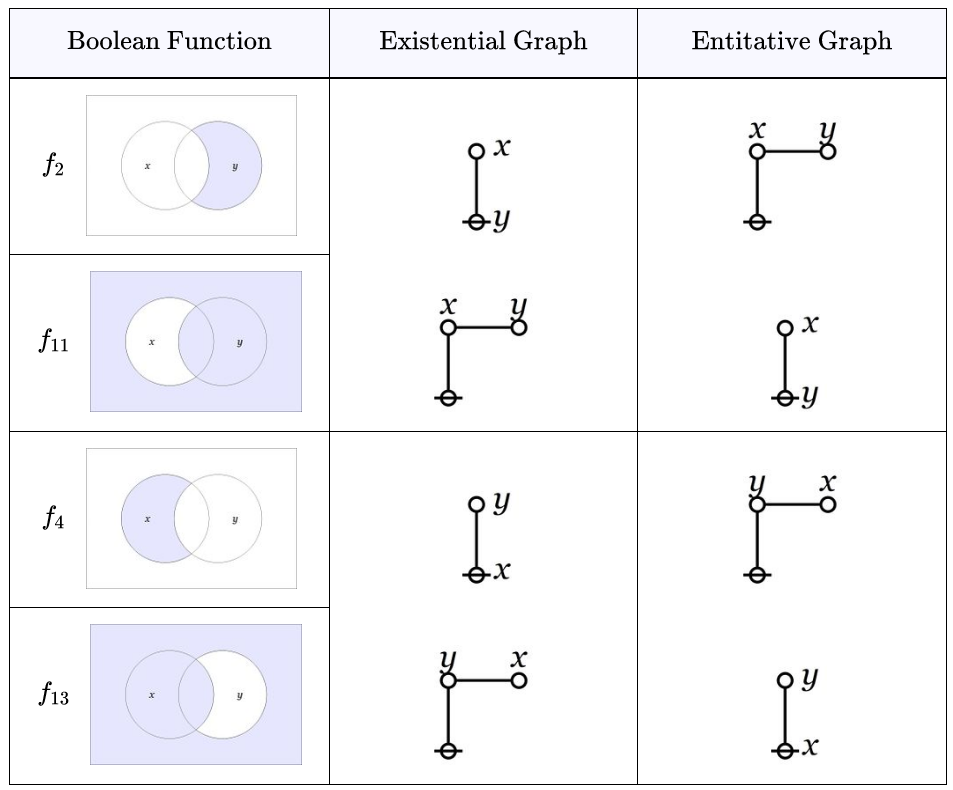
\text{Peirce Duality} \stackrel{_\bullet}{} \text{Subtractions and Implications}

Peirce Duality • Subtractions and Implications

  • The boolean functions f_{2} and f_{4} are called subtraction functions.
  • The boolean functions f_{11} and f_{13} are called implication functions.
  • The logical graphs for f_{2} and f_{11} are dual to each other.
  • The logical graphs for f_{4} and f_{13} are dual to each other.

The values of the subtraction and implication functions for each (x, y) \in \mathbb{B} \times \mathbb{B} and the text expressions for their logical graphs are given in the following Table.
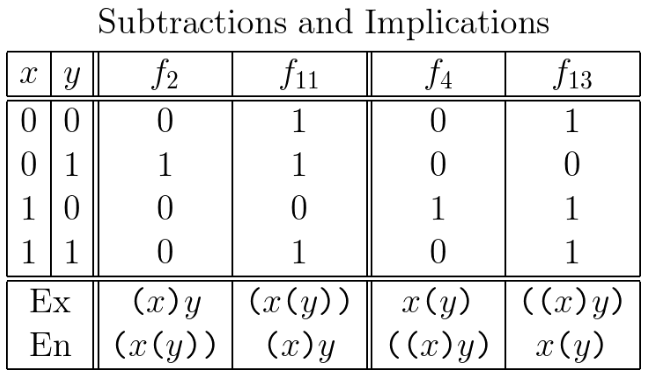
Subtractions and Implications

Resources

cc: Peirce List (1) (2) (3) (4) (5) (6) (7) (8) (9) (10) (11) (12) (13) (14) (15) (16)
cc: Structural Modeling (1) (2) • Systems Science (1) (2)
cc: Cybernetics (1) (2) • Ontolog Forum (1) (2)
cc: FB | Logical GraphsLaws of Form

Posted in Amphecks, Animata, Boolean Algebra, Boolean Functions, C.S. Peirce, Cactus Graphs, Constraint Satisfaction Problems, Deduction, Diagrammatic Reasoning, Duality, Equational Inference, Graph Theory, Laws of Form, Logic, Logical Graphs, Mathematics, Minimal Negation Operators, Model Theory, Painted Cacti, Peirce, Proof Theory, Propositional Calculus, Propositional Equation Reasoning Systems, Spencer Brown, Theorem Proving, Visualization | Tagged , , , , , , , , , , , , , , , , , , , , , , , , , | 7 Comments