Differential Propositional Calculus • 8

Formal Development (cont.)

Before moving on, let’s unpack some of the assumptions, conventions, and implications involved in the array of concepts and notations introduced above.

A universe of discourse A^\bullet = [a_1, \ldots, a_n] qualified by the logical features a_1, \ldots, a_n is a set A plus the set of all functions from the space A to the boolean domain \mathbb{B} = \{ 0, 1 \}.  There are 2^n elements in A, often pictured as the cells of a venn diagram or the nodes of a hypercube.  There are 2^{2^n} possible functions from A to \mathbb{B}, accordingly pictured as all the ways of painting the cells of a venn diagram or the nodes of a hypercube with a palette of two colors.

A logical proposition about the elements of A is either true or false of each element in A, while a function f : A \to \mathbb{B} evaluates to 1 or 0 on each element of A.  The analogy between logical propositions and boolean-valued functions is close enough to adopt the latter as models of the former and simply refer to the functions f : A \to \mathbb{B} as propositions about the elements of A.

Resources

cc: FB | Differential LogicLaws of FormMathstodonAcademia.edu
cc: Conceptual GraphsCyberneticsStructural ModelingSystems Science

Posted in Amphecks, Boolean Functions, C.S. Peirce, Cactus Graphs, Category Theory, Change, Computational Complexity, Cybernetics, Differential Analytic Turing Automata, Differential Calculus, Differential Logic, Discrete Dynamics, Dynamical Systems, Equational Inference, Functional Logic, Gradient Descent, Graph Theory, Group Theory, Hologrammautomaton, Indicator Functions, Logic, Logical Graphs, Mathematical Models, Mathematics, Minimal Negation Operators, Painted Cacti, Peirce, Propositional Calculus, Propositional Equation Reasoning Systems, Time, Visualization | Tagged , , , , , , , , , , , , , , , , , , , , , , , , , , , , , , | 2 Comments

Differential Propositional Calculus • 7

Formal Development

The preceding discussion outlined the ideas leading to the differential extension of propositional logic.  The next task is to lay out the concepts and terminology needed to describe various orders of differential propositional calculi.

Elementary Notions

Logical description of a universe of discourse begins with a collection of logical signs.  For simplicity in a first approach we assume the signs are collected in the form of a finite alphabet, \mathfrak{A} = \{``a_1", \ldots, ``a_n"\}.  The signs are interpreted as denoting logical features, for example, properties of objects in the universe of discourse or simple propositions about those objects.  Corresponding to the alphabet \mathfrak{A} there is then a set of logical features, \mathcal{A} = \{ a_1, \ldots, a_n \}.

A set of logical features \mathcal{A} = \{ a_1, \ldots, a_n \} affords a basis for generating an n-dimensional universe of discourse, written A^\bullet = [ \mathcal{A} ] = [ a_1, \ldots, a_n ].  It is useful to consider a universe of discourse as a categorical object incorporating both the set of points A = \langle a_1, \ldots, a_n \rangle and the set of propositions A^\uparrow = \{ f : A \to \mathbb{B} \} implicit with the ordinary picture of a venn diagram on n features.  Accordingly, the universe of discourse A^\bullet may be regarded as an ordered pair (A, A^\uparrow) having the type (\mathbb{B}^n, (\mathbb{B}^n \to \mathbb{B})) and this last type designation may be abbreviated as \mathbb{B}^n\ +\!\!\to \mathbb{B}, or even more succinctly as [ \mathbb{B}^n ].  For convenience, the data type of a finite set on n elements may be indicated by either one of the equivalent notations, [n] or \mathbf{n}.

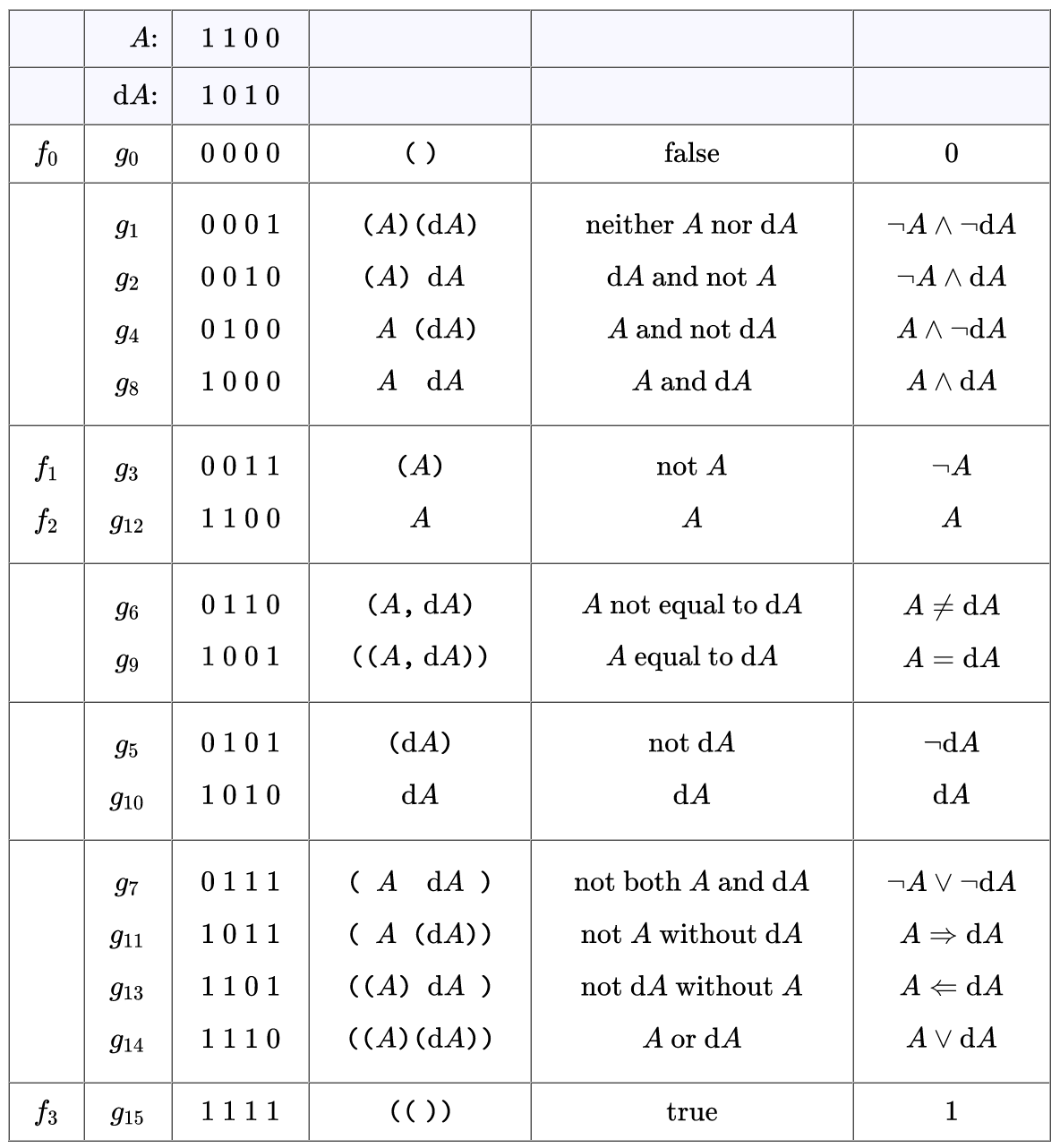
Table 7 summarizes the notations needed to describe ordinary propositional calculi in a systematic fashion.

\text{Table 7. Propositional Calculus} \stackrel{_\bullet}{} \text{Basic Notation}
Propositional Calculus • Basic Notation

Resources

cc: FB | Differential LogicLaws of FormMathstodonAcademia.edu
cc: Conceptual GraphsCyberneticsStructural ModelingSystems Science

Posted in Amphecks, Boolean Functions, C.S. Peirce, Cactus Graphs, Category Theory, Change, Computational Complexity, Cybernetics, Differential Analytic Turing Automata, Differential Calculus, Differential Logic, Discrete Dynamics, Dynamical Systems, Equational Inference, Functional Logic, Gradient Descent, Graph Theory, Group Theory, Hologrammautomaton, Indicator Functions, Logic, Logical Graphs, Mathematical Models, Mathematics, Minimal Negation Operators, Painted Cacti, Peirce, Propositional Calculus, Propositional Equation Reasoning Systems, Time, Visualization | Tagged , , , , , , , , , , , , , , , , , , , , , , , , , , , , , , | 2 Comments

Differential Propositional Calculus • 6

Cactus Calculus

Table 6 outlines a syntax for propositional calculus based on two types of logical connectives, both of variable k-ary scope.

  • A bracketed sequence of propositional expressions \texttt{(} e_1 \texttt{,} e_2 \texttt{,} \ldots \texttt{,} e_{k-1} \texttt{,} e_k \texttt{)} is taken to mean exactly one of the propositions e_1, e_2, \ldots, e_{k-1}, e_k is false, in other words, their minimal negation is true.
  • A concatenated sequence of propositional expressions e_1 ~ e_2 ~ \ldots ~ e_{k-1} ~ e_k is taken to mean every one of the propositions e_1, e_2, \ldots, e_{k-1}, e_k is true, in other words, their logical conjunction is true.

\text{Table 6. Syntax and Semantics of a Calculus for Propositional Logic}
Syntax and Semantics of a Calculus for Propositional Logic

All other propositional connectives can be obtained through combinations of the above two forms.  Strictly speaking, the concatenation form is dispensable in light of the bracket form, but it is convenient to maintain it as an abbreviation for more complicated bracket expressions.  While working with expressions solely in propositional calculus, it is easiest to use plain parentheses for logical connectives.  In contexts where parentheses are needed for other purposes “teletype” parentheses \texttt{(} \ldots \texttt{)} or barred parentheses (\!| \ldots |\!) may be used for logical operators.

The briefest expression for logical truth is the empty word, abstractly denoted \boldsymbol\varepsilon or \boldsymbol\lambda in formal languages, where it forms the identity element for concatenation.  It may be given visible expression in this context by means of the logically equivalent form \texttt{((} ~ \texttt{))}, or, especially if operating in an algebraic context, by a simple 1.  Also when working in an algebraic mode, the plus sign {+} may be used for exclusive disjunction.  For example, we have the following paraphrases of algebraic expressions:

\begin{matrix}  x + y ~=~ \texttt{(} x \texttt{,} y \texttt{)}  \\[6pt]  x + y + z ~=~ \texttt{((} x \texttt{,} y \texttt{),} z \texttt{)} ~=~ \texttt{(} x \texttt{,(} y \texttt{,} z \texttt{))}  \end{matrix}

It is important to note the last expressions are not equivalent to the triple bracket \texttt{(} x \texttt{,} y \texttt{,} z \texttt{)}.

More information about this syntax for propositional calculus can be found at the following locations.

Resources

cc: FB | Differential LogicLaws of FormMathstodonAcademia.edu
cc: Conceptual GraphsCyberneticsStructural ModelingSystems Science

Posted in Amphecks, Boolean Functions, C.S. Peirce, Cactus Graphs, Category Theory, Change, Computational Complexity, Cybernetics, Differential Analytic Turing Automata, Differential Calculus, Differential Logic, Discrete Dynamics, Dynamical Systems, Equational Inference, Functional Logic, Gradient Descent, Graph Theory, Group Theory, Hologrammautomaton, Indicator Functions, Logic, Logical Graphs, Mathematical Models, Mathematics, Minimal Negation Operators, Painted Cacti, Peirce, Propositional Calculus, Propositional Equation Reasoning Systems, Time, Visualization | Tagged , , , , , , , , , , , , , , , , , , , , , , , , , , , , , , | 2 Comments

Differential Propositional Calculus • 5

Casual Introduction (concl.)

Table 5 shows the rules of inference responsible for giving the differential quality \mathrm{d}q its meaning in practice.

\text{Table 5. Differential Inference Rules}
Differential Inference Rules

cc: FB | Differential LogicLaws of FormMathstodonAcademia.edu
cc: Conceptual GraphsCyberneticsStructural ModelingSystems Science

Posted in Amphecks, Boolean Functions, C.S. Peirce, Cactus Graphs, Category Theory, Change, Computational Complexity, Cybernetics, Differential Analytic Turing Automata, Differential Calculus, Differential Logic, Discrete Dynamics, Dynamical Systems, Equational Inference, Functional Logic, Gradient Descent, Graph Theory, Group Theory, Hologrammautomaton, Indicator Functions, Logic, Logical Graphs, Mathematical Models, Mathematics, Minimal Negation Operators, Painted Cacti, Peirce, Propositional Calculus, Propositional Equation Reasoning Systems, Time, Visualization | Tagged , , , , , , , , , , , , , , , , , , , , , , , , , , , , , , | 2 Comments

Differential Propositional Calculus • 4

Casual Introduction (cont.)

Figure 3 extends the basis of description for the space X to a set of two qualities \{q, \mathrm{d}q\} and the corresponding terms of description to an alphabet of two symbols \{``q", ``\mathrm{d}q"\}.

Any propositional calculus over two basic propositions allows for the expression of sixteen propositions all together.  Salient among those propositions in the present setting are the four which single out the individual sample points at the initial moment of observation.  Table 4 lists the initial state descriptions, using overlines to express logical negations.

\text{Table 4. Initial State Descriptions}
Initial State Descriptions

cc: FB | Differential LogicLaws of FormMathstodonAcademia.edu
cc: Conceptual GraphsCyberneticsStructural ModelingSystems Science

Posted in Amphecks, Boolean Functions, C.S. Peirce, Cactus Graphs, Category Theory, Change, Computational Complexity, Cybernetics, Differential Analytic Turing Automata, Differential Calculus, Differential Logic, Discrete Dynamics, Dynamical Systems, Equational Inference, Functional Logic, Gradient Descent, Graph Theory, Group Theory, Hologrammautomaton, Indicator Functions, Logic, Logical Graphs, Mathematical Models, Mathematics, Minimal Negation Operators, Painted Cacti, Peirce, Propositional Calculus, Propositional Equation Reasoning Systems, Time, Visualization | Tagged , , , , , , , , , , , , , , , , , , , , , , , , , , , , , , | 2 Comments

Differential Propositional Calculus • 3

Casual Introduction (cont.)

Figure 3 returns to the situation in Figure 1, but this time interpolates a new quality specifically tailored to account for the relation between Figure 1 and Figure 2.

Figure 3. Back, To The Future
\text{Figure 3. Back, To The Future}

This new quality, \mathrm{d}q, is an example of a differential quality, since its absence or presence qualifies the absence or presence of change occurring in another quality.  As with any other quality, it is represented in the venn diagram by means of a “circle” distinguishing two halves of the universe of discourse, in this case, the portions of X outside and inside the region \mathrm{d}Q.

Figure 1 represents a universe of discourse, X, together with a basis of discussion, \{ q \}, for expressing propositions about the contents of that universe.  Once the quality q is given a name, say, the symbol ``q", we have the basis for a formal language specifically cut out for discussing X in terms of q.  This language is more formally known as the propositional calculus with alphabet \{ ``q" \}.

In the context marked by X and \{ q \} there are just four distinct pieces of information which can be expressed in the corresponding propositional calculus, namely, the constant proposition \text{false}, the negative proposition \lnot q, the positive proposition q, and the constant proposition \text{true}.

For example, referring to the points in Figure 1, the constant proposition \text{false} holds of no points, the negative proposition \lnot q holds of a and d, the positive proposition q holds of b and c, and the constant proposition \text{true} holds of all points in the sample.

Figure 3 preserves the same universe of discourse and extends the basis of discussion to a set of two qualities, \{ q, \mathrm{d}q \}.  In corresponding fashion, the initial propositional calculus is extended by means of the enlarged alphabet, \{ ``q", ``\mathrm{d}q" \}.

cc: FB | Differential LogicLaws of FormMathstodonAcademia.edu
cc: Conceptual GraphsCyberneticsStructural ModelingSystems Science

Posted in Amphecks, Boolean Functions, C.S. Peirce, Cactus Graphs, Category Theory, Change, Computational Complexity, Cybernetics, Differential Analytic Turing Automata, Differential Calculus, Differential Logic, Discrete Dynamics, Dynamical Systems, Equational Inference, Functional Logic, Gradient Descent, Graph Theory, Group Theory, Hologrammautomaton, Indicator Functions, Logic, Logical Graphs, Mathematical Models, Mathematics, Minimal Negation Operators, Painted Cacti, Peirce, Propositional Calculus, Propositional Equation Reasoning Systems, Time, Visualization | Tagged , , , , , , , , , , , , , , , , , , , , , , , , , , , , , , | 2 Comments

Differential Propositional Calculus • 2

Casual Introduction (cont.)

Now consider the situation represented by the venn diagram in Figure 2.

Figure 2. Same Names, Different Habitations
\text{Figure 2. Same Names, Different Habitations}

Figure 2 differs from Figure 1 solely in the circumstance that the object c is outside the region Q while the object d is inside the region Q.  So far, nothing says our encountering these Figures in this order is other than purely accidental but if we interpret this sequence of frames as a “moving picture” representation of their natural order in a temporal process then it would be natural to suppose a and b have remained as they were with regard to the quality q while c and d have changed their standings in that respect.  In particular, c has moved from the region where q is true to the region where q is false while d has moved from the region where q is false to the region where q is true.

cc: FB | Differential LogicLaws of FormMathstodonAcademia.edu
cc: Conceptual GraphsCyberneticsStructural ModelingSystems Science

Posted in Amphecks, Boolean Functions, C.S. Peirce, Cactus Graphs, Category Theory, Change, Computational Complexity, Cybernetics, Differential Analytic Turing Automata, Differential Calculus, Differential Logic, Discrete Dynamics, Dynamical Systems, Equational Inference, Functional Logic, Gradient Descent, Graph Theory, Group Theory, Hologrammautomaton, Indicator Functions, Logic, Logical Graphs, Mathematical Models, Mathematics, Minimal Negation Operators, Painted Cacti, Peirce, Propositional Calculus, Propositional Equation Reasoning Systems, Time, Visualization | Tagged , , , , , , , , , , , , , , , , , , , , , , , , , , , , , , | 2 Comments

Differential Propositional Calculus • 1

A differential propositional calculus is a propositional calculus extended by a set of terms for describing aspects of change and difference, for example, processes taking place in a universe of discourse or transformations mapping a source universe to a target universe.

Casual Introduction

Consider the situation represented by the venn diagram in Figure 1.

Figure 1. Local Habitations, And Names
\text{Figure 1. Local Habitations, And Names}

The area of the rectangle represents a universe of discourse, X.  The universe under discussion may be a population of individuals having various additional properties or it may be a collection of locations occupied by various individuals.  The area of the “circle” represents the individuals having the property q or the locations in the corresponding region Q.  Four individuals, a, b, c, d, are singled out by name.  It happens that b and c currently reside in region Q while a and d do not.

cc: FB | Differential LogicLaws of FormMathstodonAcademia.edu
cc: Conceptual GraphsCyberneticsStructural ModelingSystems Science

Posted in Amphecks, Boolean Functions, C.S. Peirce, Cactus Graphs, Category Theory, Change, Computational Complexity, Cybernetics, Differential Analytic Turing Automata, Differential Calculus, Differential Logic, Discrete Dynamics, Dynamical Systems, Equational Inference, Functional Logic, Gradient Descent, Graph Theory, Group Theory, Hologrammautomaton, Indicator Functions, Logic, Logical Graphs, Mathematical Models, Mathematics, Minimal Negation Operators, Painted Cacti, Peirce, Propositional Calculus, Propositional Equation Reasoning Systems, Time, Visualization | Tagged , , , , , , , , , , , , , , , , , , , , , , , , , , , , , , | 2 Comments

Differential Propositional Calculus • Overview

The most fundamental concept in cybernetics is that of “difference”, either that two things are recognisably different or that one thing has changed with time.

W. Ross Ashby • An Introduction to Cybernetics

Here’s the outline of a sketch I wrote on differential propositional calculi, which extend propositional calculi by adding terms for describing aspects of change and difference, for example, processes taking place in a universe of discourse or transformations mapping a source universe to a target universe.  I wrote this as an intuitive introduction to differential logic, which is my best effort so far at dealing with the ancient and persistent problems of treating diversity and mutability in logical terms.  I’ll be looking at ways to improve this draft as I serialize it to my blog.

Part 1

Casual Introduction

Cactus Calculus

Part 2

Formal_Development

Elementary Notions

Special Classes of Propositions

Linear Propositions

Positive Propositions

Singular Propositions

Differential Extensions

Appendices

Appendices

Appendix 1. Propositional Forms and Differential Expansions

Table A1. Propositional Forms on Two Variables

Table A2. Propositional Forms on Two Variables

Table A3. Ef Expanded Over Differential Features

Table A4. Df Expanded Over Differential Features

Table A5. Ef Expanded Over Ordinary Features

Table A6. Df Expanded Over Ordinary Features

Appendix 2. Differential Forms

Table A7. Differential Forms Expanded on a Logical Basis

Table A8. Differential Forms Expanded on an Algebraic Basis

Table A9. Tangent Proposition as Pointwise Linear Approximation

Table A10. Taylor Series Expansion Df = df + d²f

Table A11. Partial Differentials and Relative Differentials

Table A12. Detail of Calculation for the Difference Map

Appendix 3. Computational Details

Operator Maps for the Logical Conjunction f8(u, v)

Computation of εf8
Computation of Ef8
Computation of Df8
Computation of df8
Computation of rf8
Computation Summary for Conjunction

Operator Maps for the Logical Equality f9(u, v)

Computation of εf9
Computation of Ef9
Computation of Df9
Computation of df9
Computation of rf9
Computation Summary for Equality

Operator Maps for the Logical Implication f11(u, v)

Computation of εf11
Computation of Ef11
Computation of Df11
Computation of df11
Computation of rf11
Computation Summary for Implication

Operator Maps for the Logical Disjunction f14(u, v)

Computation of εf14
Computation of Ef14
Computation of Df14
Computation of df14
Computation of rf14
Computation Summary for Disjunction

Appendix 4. Source Materials

Appendix 5. Various Definitions of the Tangent Vector

References

References

cc: FB | Differential LogicLaws of FormMathstodonAcademia.edu
cc: Conceptual GraphsCyberneticsStructural ModelingSystems Science

Posted in Amphecks, Boolean Functions, C.S. Peirce, Cactus Graphs, Category Theory, Change, Computational Complexity, Cybernetics, Differential Analytic Turing Automata, Differential Calculus, Differential Logic, Discrete Dynamics, Dynamical Systems, Equational Inference, Functional Logic, Gradient Descent, Graph Theory, Group Theory, Hologrammautomaton, Indicator Functions, Logic, Logical Graphs, Mathematical Models, Mathematics, Minimal Negation Operators, Painted Cacti, Peirce, Propositional Calculus, Propositional Equation Reasoning Systems, Time, Visualization | Tagged , , , , , , , , , , , , , , , , , , , , , , , , , , , , , , | 3 Comments

Survey of Differential Logic • 6

This is a Survey of work in progress on Differential Logic, resources under development toward a more systematic treatment.

Differential logic is the component of logic whose object is the description of variation — the aspects of change, difference, distribution, and diversity — in universes of discourse subject to logical description.  A definition as broad as that naturally incorporates any study of variation by way of mathematical models, but differential logic is especially charged with the qualitative aspects of variation pervading or preceding quantitative models.  To the extent a logical inquiry makes use of a formal system, its differential component treats the use of a differential logical calculus — a formal system with the expressive capacity to describe change and diversity in logical universes of discourse.

Elements

Blog Series

Architectonics

Applications

Blog Dialogs

Explorations

cc: FB | Differential LogicLaws of FormMathstodonOntologAcademia.edu
cc: Conceptual GraphsCyberneticsStructural ModelingSystems Science

Posted in Amphecks, Animata, Boolean Algebra, Boolean Functions, C.S. Peirce, Cactus Graphs, Category Theory, Change, Cybernetics, Differential Analytic Turing Automata, Differential Calculus, Differential Logic, Discrete Dynamics, Equational Inference, Frankl Conjecture, Functional Logic, Gradient Descent, Graph Theory, Hologrammautomaton, Indicator Functions, Inquiry Driven Systems, Leibniz, Logic, Logical Graphs, Mathematics, Minimal Negation Operators, Painted Cacti, Peirce, Propositional Calculus, Surveys, Time, Topology, Visualization, Zeroth Order Logic | Tagged , , , , , , , , , , , , , , , , , , , , , , , , , , , , , , , , , | Leave a comment