The Difference That Makes A Difference That Peirce Makes • 25

I’ve been detecting something approaching a mini-zeitgeist lately.  Ideas and issues popping up in recent discussions and readings keep reminding me of themes I first encountered in Peirce’s early work, especially the Lectures on the Logic of Science (1865–1866) and the Logic of Relatives (1870).  A number of Peirce’s potentially ground-breaking, paradigm-shifting ideas first saw the light of day in those early ventures.  I say “potentially” because what I regard as his most revolutionary ideas never saw their full development in Peirce’s lifetime, only to arise again in the press of mathematical and scientific advances later in the 20th Century.

cc: CyberneticsOntolog ForumStructural ModelingSystems Science

Posted in C.S. Peirce, Fixation of Belief, Formal Systems, Information, Inquiry, Logic, Logic of Relatives, Logic of Science, Logical Graphs, Mathematics, Paradigms, Pragmatic Maxim, Pragmatism, Relation Theory, Semiosis, Semiotics, Sign Relations, Triadic Relations, Triadicity, Visualization | Tagged , , , , , , , , , , , , , , , , , , , | Leave a comment

Peirce’s Categories • 12

Re: Peirce ListJFSJBD

Different minds are drawn to Peirce for different reasons and they tend to discover different stores of value there.  I was attracted to his work largely for his insights into logic, math, and science and because his articulations of their springs and catches ring true to the ways their own practitioners understand them in practice.

One consequence is my tendency to approach the question of categories from a particular angle, more through the logic and mathematics of relations than by way of phenomenology.

What follows from that approach gives me sufficient reason to pursue it, but I’ll have to save further motivation until I develop more material from the 1870 Logic of Relatives.

Resources

cc: Systems ScienceStructural ModelingOntolog ForumLaws of FormCybernetics

Posted in Abstraction, Aristotle, C.S. Peirce, Category Theory, Logic, Logic of Relatives, Mathematics, Peirce, Peirce's Categories, Phenomenology, Pragmatic Maxim, Relation Theory, Semiotics, Triadic Relations, Triadicity, Type Theory | Tagged , , , , , , , , , , , , , , , | 7 Comments

Peirce’s Categories • 11

Re: Peirce ListHelmut Raulien

There is a kind of “second cousin” kinship between category markers and grammatical aspects, moods, or tenses.  In several drafts of an earlier comment I experimented with grammatical terms like conjugation, declension, diacritic, inflection, etc.  to explain the function of category markers.  But I eventually decided this laid too much stress on their grammatical aspect and distracted from their main function, which is to focus the relation between formal expressions and formal objects.

Resources

cc: Systems ScienceStructural ModelingOntolog ForumLaws of FormCybernetics

Posted in Abstraction, Aristotle, C.S. Peirce, Category Theory, Logic, Logic of Relatives, Mathematics, Peirce, Peirce's Categories, Phenomenology, Pragmatic Maxim, Relation Theory, Semiotics, Triadic Relations, Triadicity, Type Theory | Tagged , , , , , , , , , , , , , , , | 8 Comments

Peirce’s Categories • 10

Re: CyberneticsBernard Cohen

I began that note on the Precursors of Category Theory as a purely exploratory sketch, plotting a few points on a single theme with no plans of making an exhaustive survey.  Even at that I never got time to get back to it.  I put in a pin for Kant but haven’t had a chance to map out any passages.  There are even “incitements” going back to my earliest days reading Russell and wrestling with his take on type theory but those inklings are too hazy in my memory to make clear at present.

Resources

cc: Systems ScienceStructural ModelingOntolog ForumLaws of FormCybernetics

Posted in Abstraction, Aristotle, C.S. Peirce, Category Theory, Logic, Logic of Relatives, Mathematics, Peirce, Peirce's Categories, Phenomenology, Pragmatic Maxim, Relation Theory, Semiotics, Triadic Relations, Triadicity, Type Theory | Tagged , , , , , , , , , , , , , , , | 8 Comments

Peirce’s Categories • 9

Re: FB | Systems SciencesKenneth Lloyd

Scanning the spectrum of sources I sampled in my Precursors of Category Theory, there are many differences in the categorical paradigms different observers developed over the centuries.  Just for starters, the numbers of categories vary widely from system to system.  But there is a conceptual continuity in the function category markers perform in every system.  If we look to the role a category marker plays in the relation between formal expressions and their formal objects, in effect, if we look at the matter from a semiotic perspective, as Aristotle already did, then we see the job of a category marker is to reduce (“drive down”) the ambiguity of equivocal linguistic expressions to the point where they obey the laws of logic.

Resources

cc: CyberneticsOntolog ForumStructural ModelingSystems Science

Posted in Abstraction, Aristotle, C.S. Peirce, Category Theory, Logic, Logic of Relatives, Mathematics, Peirce, Peirce's Categories, Phenomenology, Pragmatic Maxim, Relation Theory, Semiotics, Triadic Relations, Triadicity, Type Theory | Tagged , , , , , , , , , , , , , , , | 9 Comments

Peirce’s Categories • 8

Re: Peirce Society Facebook PageRicardo Bibi Tamtam Durski

The best way to get clear about Peirce’s categories is to look to their origin in Aristotle’s concept of a category, in effect nothing more mysterious than a grammatical device for reducing the ambiguities of equivocal terms.  We find Peirce starting out this way in his classification of logical terms, for instance, here —

Resources

cc: Systems ScienceStructural ModelingOntolog ForumLaws of FormCybernetics

Posted in Abstraction, Aristotle, C.S. Peirce, Category Theory, Logic, Logic of Relatives, Mathematics, Peirce, Peirce's Categories, Phenomenology, Pragmatic Maxim, Relation Theory, Semiotics, Triadic Relations, Triadicity, Type Theory | Tagged , , , , , , , , , , , , , , , | 8 Comments

Ontologies As Systems • Comment 1

Re: Ontolog ForumJoseph Simpson

The reason I’ve been maintaining an interdisciplinary perspective in my postings to the Ontolog Forum, Structural Modeling, and Systems Science groups is because each one stresses a distinct but necessary aspect of a systems approach to scientific inquiry.  I see much potential to be had in integrating these views of the inquiry process, but it will take a lot more thought and work to fully develop that potential.

The feature that jumps out at me as I scan the discussions on this thread — and I’ve said this before about most of the discussions of systems I’ve seen in these groups — is the static nature of the pictures of systems people are laying out.  Whereas, for me, my whole reason for taking up a systems approach to inference, information, inquiry, along with the symbol systems we use to conduct their transactions, is to tease out the shape and flow and dynamics of their transformations.

cc: Systems ScienceStructural ModelingOntolog Forum

Posted in C.S. Peirce, Cybernetics, Inquiry, Inquiry Driven Systems, Inquiry Into Inquiry, Intelligent Systems, Knowledge Bases, Knowledge Representation, Learning, Logic, Peirce, Reasoning, Semiotics, Sign Relations, Systems Theory | Tagged , , , , , , , , , , , , , , | Leave a comment

Pragmatic Semiotic Information • Discussion 18

Re: FB | Peirce SocietyJohn Corcoran

To address Was ist und was soll Information sein? in a Peircean context we need to grasp or at least try to grapple with Peirce’s inklings about information.  As it happens, I’ve been engaged in that quest for a number of years.  Pilgrims moved by a similar spirit may find my travel logs of use on their way —

cc: Ontolog ForumStructural ModelingSystems Science

Posted in Abduction, Aristotle, C.S. Peirce, Comprehension, Deduction, Definition, Determination, Extension, Hypothesis, Induction, Inference, Information, Information = Comprehension × Extension, Inquiry, Intension, Intention, Logic, Logic of Science, Mathematics, Measurement, Observation, Peirce, Perception, Phenomenology, Physics, Pragmatic Semiotic Information, Pragmatism, Probability, Quantum Mechanics, Scientific Method, Semiotics, Sign Relations | Tagged , , , , , , , , , , , , , , , , , , , , , , , , , , , , , , , | 8 Comments

Peirce’s 1870 “Logic Of Relatives” • Discussion 1

Re: Ontolog ForumJohn Bottoms
Re: History View BlogA Yukaghir Girl Writes A Love Letter
Re: Peirce’s 1870 “Logic Of Relatives” • Proto-Graphical Syntax

John Bottoms, writing in the Ontolog Forum, compared the graphic I drew for one of Peirce’s relational formulas to a pictographic image he had been studying.

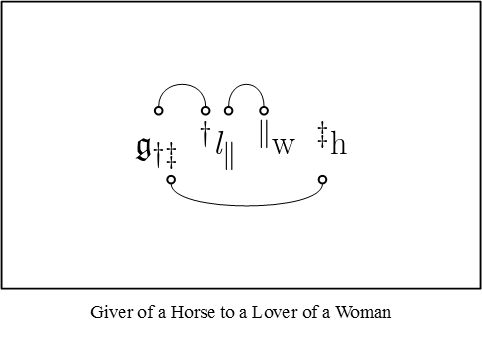
Peirce introduced the compound term “giver of a horse to a lover of a woman” in Selection 7 to illustrate his use of marks of reference to identify the corresponding correlates of component terms.  The symbolic form of this compound term is shown below.

\mathfrak{g}_{\dagger\ddagger} {}^\dagger\mathit{l}_\parallel {}^\parallel\mathrm{w} {}^\ddagger\mathrm{h}

In my comment on Proto-Graphical Syntax I drew lines of identity to connect the corresponding marks of reference, as shown in the following Figure.
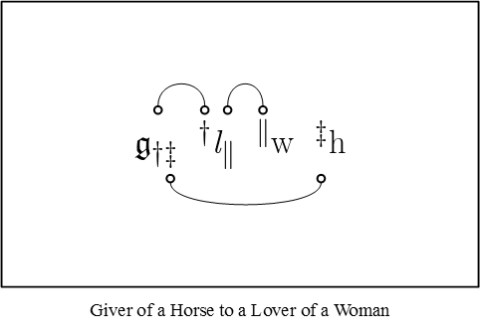
Giver of a Horse to a Lover of a Woman

John tells us what he sees in this Figure in the following words:

One of my interests is in the intersection between images and prose.  The note [on Proto-Graphical Syntax] is prescient.  It echoes a semasiographic image that has been discussed recently on the web.  The image below shows two houses, and the tree shapes represent people.

In the image a girl complains to her ex-lover that his new relationship is not useful, and he is missing an opportunity to have children with her.  This image was created by a Yukaghir girl for a local game similar to Pictionary.
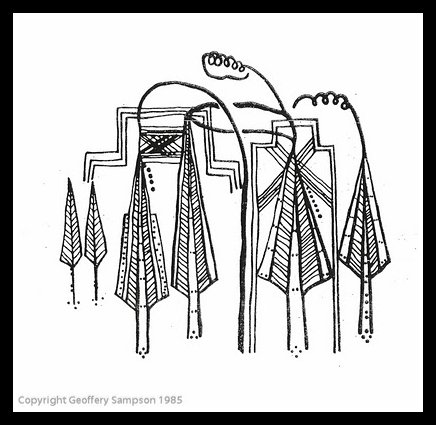
Geoffery Sampson • A Yukaghir Girl Writes A Love Letter

I started a draft in the middle of the night to draw out the analogies and disanalogies of these two Figures but the clear light of day showed me I would need to deal with a host of preliminary issues before moving on.  So I will turn to that task next.

cc: Systems ScienceStructural ModelingOntolog ForumLaws of FormCybernetics

Posted in C.S. Peirce, Category Theory, Differential Logic, Duality, Dyadic Relations, Graph Theory, Group Theory, Logic, Logic of Relatives, Logical Graphs, Logical Matrices, Mathematics, Peirce, Peirce's Categories, Predicate Calculus, Propositional Calculus, Relation Theory, Semiotics, Sign Relations, Teridentity, Triadic Relations, Visualization | Tagged , , , , , , , , , , , , , , , , , , , , , | 5 Comments

Peirce’s 1870 “Logic of Relatives” • Overview

My long ago encounter with Peirce’s 1870 paper, “Description of a Notation for the Logic of Relatives, Resulting from an Amplification of the Conceptions of Boole’s Calculus of Logic”, was one of the events precipitating my return from the hazier heights of philosophy to the solid plains of mathematics below.  Over the years I copied out various drafts of my study notes to the web, consisting of selections from Peirce’s paper along with my running commentary.  A few years back I serialized what progress I had made so far to this blog and this Overview consists of links to those installments.

Peirce’s 1870 “Logic of Relatives”

References

  • Peirce, C.S. (1870), “Description of a Notation for the Logic of Relatives, Resulting from an Amplification of the Conceptions of Boole’s Calculus of Logic”, Memoirs of the American Academy of Arts and Sciences 9, 317–378, 26 January 1870.  Reprinted, Collected Papers (CP 3.45–149), Chronological Edition (CE 2, 359–429).  Online (1) (2) (3).
  • Peirce, C.S., Collected Papers of Charles Sanders Peirce, vols. 1–6, Charles Hartshorne and Paul Weiss (eds.), vols. 7–8, Arthur W. Burks (ed.), Harvard University Press, Cambridge, MA, 1931–1935, 1958.  Cited as (CP volume.paragraph).
  • Peirce, C.S., Writings of Charles S. Peirce : A Chronological Edition, Peirce Edition Project (eds.), Indiana University Press, Bloomington and Indianapolis, IN, 1981–.  Cited as (CE volume, page).

Resources

Posted in C.S. Peirce, Category Theory, Differential Logic, Duality, Dyadic Relations, Graph Theory, Group Theory, Logic, Logic of Relatives, Logical Graphs, Logical Matrices, Mathematics, Peirce, Peirce's Categories, Predicate Calculus, Propositional Calculus, Relation Theory, Semiotics, Sign Relations, Teridentity, Triadic Relations, Visualization | Tagged , , , , , , , , , , , , , , , , , , , , , | 19 Comments