The Difference That Makes A Difference That Peirce Makes • 24

Re: Laws of FormJames Bowery

The concepts of closure and idempotence are closely related.

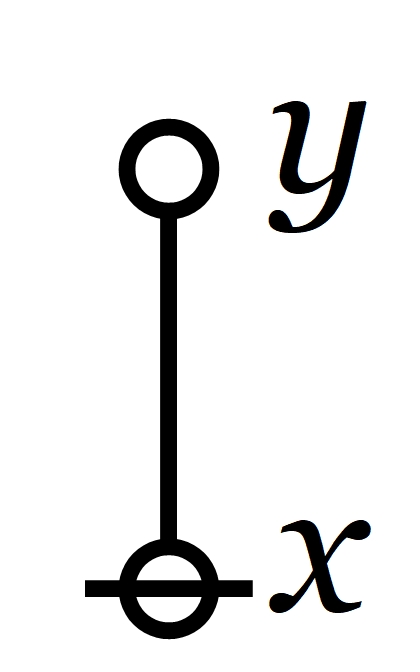
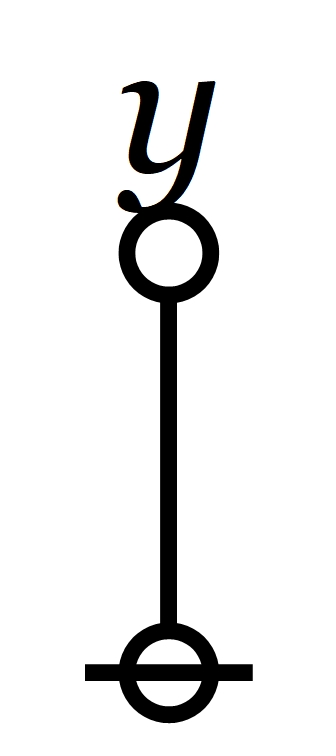
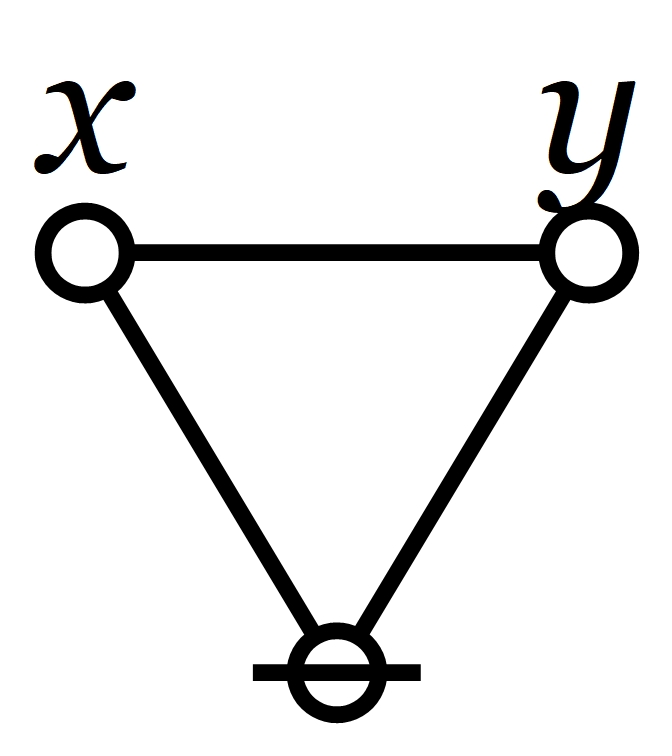
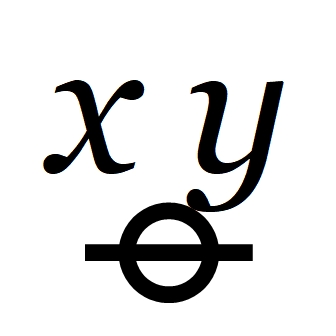
We usually speak of a closure operator in contexts where the objects acted on are the primary interest, as in topology, where the objects of interest are open sets, boundaries, closed sets, etc.  In contexts where we abstract away from the operand space, as in algebra, we tend to say idempotence for the detached application \mathrm{CC} = \mathrm{C}.  (If I recall right, it was actually Charles Peirce’s father Benjamin who coined the term idempotence.)

At any rate, I’ll have to mutate the principle a bit to cover the uses Peirce makes of it.

cc: Systems ScienceStructural ModelingOntolog ForumLaws of FormCybernetics

Posted in Analogy, C.S. Peirce, Communication, Descriptive Science, Fixation of Belief, Formal Systems, Information, Inquiry, Logic, Logic of Relatives, Logic of Science, Logical Graphs, Mathematics, Normative Science, Paradigms, Peirce, Pragmatic Maxim, Pragmatism, Relation Theory, Semiotics, Sign Relations, Triadic Relations, Triadicity | Tagged , , , , , , , , , , , , , , , , , , , , , , | 1 Comment

The Difference That Makes A Difference That Peirce Makes • 23

Re: Structural ModelingJoseph Simpson
Re: Peirce’s 1870 Logic Of RelativesSelection 1

A critical question in mathematical logic and its applications concerns the threshold of complexity between dyadic (binary) and triadic (ternary) relations, in essence, whether 2-place relations are universally adequate or whether 3-place relations are irreducible, minimally adequate, and even sufficient as a basis for all higher dimensions.

One of Peirce’s earliest arguments for the sufficiency of triadic relative terms occurs at the top of his 1870 “Logic of Relatives”.

The conjugative term involves the conception of third, the relative that of second or other, the absolute term simply considers an object.  No fourth class of terms exists involving the conception of fourth, because when that of third is introduced, since it involves the conception of bringing objects into relation, all higher numbers are given at once, inasmuch as the conception of bringing objects into relation is independent of the number of members of the relationship.  Whether this reason for the fact that there is no fourth class of terms fundamentally different from the third is satisfactory or not, the fact itself is made perfectly evident by the study of the logic of relatives.  (Peirce, CP 3.63).

Peirce’s argument invokes what is known as a closure principle, as I remarked in the following comment:

What strikes me about the initial installment this time around is its use of a certain pattern of argument I can recognize as invoking a closure principle, and this is a figure of reasoning Peirce uses in three other places:  his discussion of continuous predicates, his definition of sign relations, and in the formulation of the pragmatic maxim itself.

In mathematics, a closure operator is one whose repeated application yields the same result as its first application.

If we consider an arbitrary operator \mathrm{A}, the result of applying \mathrm{A} to an operand x is \mathrm{A}x, the result of applying \mathrm{A} again is \mathrm{AA}x, the result of applying \mathrm{A} again is \mathrm{AAA}x, and so on.  In general, it is perfectly possible each application yields a novel result, distinct from all previous results.

But a closure operator \mathrm{C} is defined by the property \mathrm{CC} = \mathrm{C}, so nothing new results beyond the first application.

cc: Systems ScienceStructural ModelingOntolog ForumLaws of FormCybernetics

Posted in Analogy, C.S. Peirce, Communication, Descriptive Science, Fixation of Belief, Formal Systems, Information, Inquiry, Logic, Logic of Relatives, Logic of Science, Logical Graphs, Mathematics, Normative Science, Paradigms, Peirce, Pragmatic Maxim, Pragmatism, Relation Theory, Semiotics, Sign Relations, Triadic Relations, Triadicity | Tagged , , , , , , , , , , , , , , , , , , , , , , | 1 Comment

The Difference That Makes A Difference That Peirce Makes • 22

Peirce Society Facebook PageJCJAJAJAJC

A discussion — well, more like a series of posts and counterposts — arose last week on the Facebook Page of the Charles S. Peirce Society, and I’ve been going back over it this week because it seemed to invite a useful re-examination of some old but important issues.  There appears to be some sort of disagreement, or maybe just failure to communicate, but I’m still having trouble putting my finger on what the source of the issue might be.

One factor seems to be different understandings about the relationship between Peirce’s brand of semiotics and standard first order logic.  One thing I’ve noticed before is that people who view Peirce’s work through the filter of first order logic are not likely to see what many of us appreciate in his semiotic approach to logic.  There are commentators on Peirce’s logical systems who treat them as nothing more than first order logics in other syntaxes, but I am not one of those.  There is something more general and powerful going on with Peirce’s conception of “logic as formal semiotic”, in other words, a normative science of signs.

I still see that factor playing a role in the background of the animadversion but I’m beginning to think there’s probably a much simpler explanation.

cc: Systems ScienceStructural ModelingOntolog ForumLaws of FormCybernetics

Posted in Analogy, C.S. Peirce, Communication, Descriptive Science, Fixation of Belief, Formal Systems, Information, Inquiry, Logic, Logic of Relatives, Logic of Science, Logical Graphs, Mathematics, Normative Science, Paradigms, Peirce, Pragmatic Maxim, Pragmatism, Relation Theory, Semiotics, Sign Relations, Triadic Relations, Triadicity | Tagged , , , , , , , , , , , , , , , , , , , , , , | Leave a comment

The Difference That Makes A Difference That Peirce Makes • 21

Re: Ontolog ForumJohn Bottoms
Re: The Difference That Makes A Difference That Peirce Makes : 20

The reflections in my previous blog post developed over several weeks observing various discussions around the web where people seemed to be spending most of their effort talking past each other and hardly ever getting any ideas or information out of one skull and into another.  It’s not the first time I’ve noticed belief systems, comfort zones, conceptual silos, paradigms, whatever we call them, acting like immune systems, insulating our mental metabolisms from intellectual antigens.

Anyhow, it’s a working hypothesis to prime future inquiry …

As far as Peirce references go, the choices are legion, so I’ll just link to one place I have in mind at the moment where Peirce sets out a number of truly radical ideas, ones I view as missed opportunities — so far as I know he never fully followed up on them.

cc: Systems ScienceStructural ModelingOntolog ForumLaws of FormCybernetics

Posted in Analogy, C.S. Peirce, Communication, Descriptive Science, Fixation of Belief, Formal Systems, Information, Inquiry, Logic, Logic of Relatives, Logic of Science, Logical Graphs, Mathematics, Normative Science, Paradigms, Peirce, Pragmatic Maxim, Pragmatism, Relation Theory, Semiotics, Sign Relations, Triadic Relations, Triadicity | Tagged , , , , , , , , , , , , , , , , , , , , , , | Leave a comment

The Difference That Makes A Difference That Peirce Makes • 20

Cross-paradigm communication, like cross-disciplinary and cross-cultural communication, can be difficult.  Sometimes people do not even recognize the existence of other paradigms, disciplines, cultures, long before it comes to the question of their value.  Readers of Peirce know he often uses important words in more primordial senses than later came into fashion.  Other times his usage embodies a distinct analysis of the concept in question.  More than once I’ve found myself remarking how Peirce “anticipates” some strikingly “modern” idea in logic, mathematics, or science, only to find its roots lay deep in the history of thought.  Whether he anticipates a future sense or preserves an ancient sense is not always easy to answer.

cc: Systems ScienceStructural ModelingOntolog ForumLaws of FormCybernetics

Posted in Analogy, C.S. Peirce, Communication, Descriptive Science, Fixation of Belief, Formal Systems, Information, Inquiry, Logic, Logic of Relatives, Logic of Science, Logical Graphs, Mathematics, Normative Science, Paradigms, Peirce, Pragmatic Maxim, Pragmatism, Relation Theory, Semiotics, Sign Relations, Triadic Relations, Triadicity | Tagged , , , , , , , , , , , , , , , , , , , , , , | 2 Comments

Riffs and Rotes • 4

Riff 123456789

Prompted by a recent discussion of prime numbers and complex dynamics on one of the Santa Fe Institute’s FaceBook pages, I posted a link to an old project of mine, going back to a time when I was first learning programming in college and working as an orderly in a hospital x-ray department.  Something about the collision of those influences in the medium of my gray matter led me to see curious connections among self-documenting programs, self-indexing data structures, and molecular tagging.  Shortly afterwards a couple of Mathematical Games columns by Martin Gardner started me thinking about Gödel numbers and links among graph theory, logic, and number theory.

At any rate, here’s a report on what came of that —

Posted in Algebra, Combinatorics, Graph Theory, Group Theory, Logic, Mathematics, Number Theory, Riffs and Rotes | Tagged , , , , , , , | Leave a comment

Differential Logic and Dynamic Systems • Overview

In modeling intelligent systems, whether we are trying to understand a natural system or engineer an artificial system, there has long been a tension or trade‑off between dynamic paradigms and symbolic paradigms.  Dynamic models take their cue from physics, using quantitative measures and differential equations to model the evolution of a system’s state through time.  Symbolic models use logical methods to describe systems and their agents in qualitative terms, deriving logical consequences of a system’s description or an agent’s state of information.  Logic‑based systems have tended to be static in character, largely because we have lacked a proper logical analogue of differential calculus.  The work laid out in this report is intended to address that lack.

This article develops a differential extension of propositional calculus and applies it to the analysis of dynamic systems whose states are described in qualitative logical terms.  The work pursued here is coordinated with a parallel application focusing on neural network systems but the dependencies are arranged to make the present article the main and the more self‑contained work, to serve as a conceptual frame and a technical background for the network project.

Part 1

Review and Transition

A Functional Conception of Propositional Calculus

Qualitative Logic and Quantitative Analogy

Philosophy of Notation : Formal Terms and Flexible Types

Special Classes of Propositions

Basis Relativity and Type Ambiguity

The Analogy Between Real and Boolean Types

Theory of Control and Control of Theory

Propositions as Types and Higher Order Types

Reality at the Threshold of Logic

Tables of Propositional Forms

A Differential Extension of Propositional Calculus

Differential Propositions : Qualitative Analogues of Differential Equations

An Interlude on the Path

The Extended Universe of Discourse

Intentional Propositions

Life on Easy Street

Part 2

Back to the Beginning : Exemplary Universes

A One-Dimensional Universe

Example 1. A Square Rigging

Back to the Feature

Tacit Extensions

Example 2. Drives and Their Vicissitudes

Part 3

Transformations of Discourse

Foreshadowing Transformations : Extensions and Projections of Discourse

Extension from 1 to 2 Dimensions

Extension from 2 to 4 Dimensions

Thematization of Functions : And a Declaration of Independence for Variables

Thematization : Venn Diagrams

Thematization : Truth Tables

Propositional Transformations

Alias and Alibi Transformations

Transformations of General Type

Analytic Expansions : Operators and Functors

Operators on Propositions and Transformations

Differential Analysis of Propositions and Transformations

The Secant Operator : E
The Radius Operator : e
The Phantom of the Operators : η
The Chord Operator : D
The Tangent Operator : T

Part 4

Transformations of Discourse (cont.)

Transformations of Type B² → B¹

Analytic Expansion of Conjunction

Tacit Extension of Conjunction
Enlargement Map of Conjunction
Digression : Reflection on Use and Mention
Difference Map of Conjunction
Differential of Conjunction
Remainder of Conjunction
Summary of Conjunction

Analytic Series : Coordinate Method

Analytic Series : Recap

Terminological Interlude

End of Perfunctory Chatter : Time to Roll the Clip!

Operator Maps : Areal Views
Operator Maps : Box Views
Operator Diagrams for the Conjunction J = uv

Part 5

Transformations of Discourse (concl.)

Taking Aim at Higher Dimensional Targets

Transformations of Type B² → B²

Logical Transformations

Local Transformations

Difference Operators and Tangent Functors

Epilogue, Enchoiry, Exodus

Appendices

Appendices

Appendix 1. Propositional Forms and Differential Expansions

Table A1. Propositional Forms on Two Variables

Table A2. Propositional Forms on Two Variables

Table A3. Ef Expanded Over Differential Features

Table A4. Df Expanded Over Differential Features

Table A5. Ef Expanded Over Ordinary Features

Table A6. Df Expanded Over Ordinary Features

Appendix 2. Differential Forms

Table A7. Differential Forms Expanded on a Logical Basis

Table A8. Differential Forms Expanded on an Algebraic Basis

Table A9. Tangent Proposition as Pointwise Linear Approximation

Table A10. Taylor Series Expansion Df = df + d²f

Table A11. Partial Differentials and Relative Differentials

Table A12. Detail of Calculation for the Difference Map

Appendix 3. Computational Details

Operator Maps for the Logical Conjunction f8(u, v)

Computation of εf8
Computation of Ef8
Computation of Df8
Computation of df8
Computation of rf8
Computation Summary for Conjunction

Operator Maps for the Logical Equality f9(u, v)

Computation of εf9
Computation of Ef9
Computation of Df9
Computation of df9
Computation of rf9
Computation Summary for Equality

Operator Maps for the Logical Implication f11(u, v)

Computation of εf11
Computation of Ef11
Computation of Df11
Computation of df11
Computation of rf11
Computation Summary for Implication

Operator Maps for the Logical Disjunction f14(u, v)

Computation of εf14
Computation of Ef14
Computation of Df14
Computation of df14
Computation of rf14
Computation Summary for Disjunction

Appendix 4. Source Materials

Appendix 5. Various Definitions of the Tangent Vector

References

References

Works Cited

Works Consulted

Incidental Works

Document History

Document History

cc: Conceptual GraphsCyberneticsStructural ModelingSystems Science
cc: Differential Logic | Facebook | MathstodonLaws of FormOntolog Forum

Posted in Amphecks, Boolean Functions, C.S. Peirce, Cactus Graphs, Category Theory, Change, Computational Complexity, Cybernetics, Differential Analytic Turing Automata, Differential Calculus, Differential Logic, Discrete Dynamics, Dynamical Systems, Equational Inference, Functional Logic, Gradient Descent, Graph Theory, Group Theory, Hologrammautomaton, Indicator Functions, Logic, Logical Graphs, Mathematical Models, Mathematics, Minimal Negation Operators, Painted Cacti, Peirce, Propositional Calculus, Propositional Equation Reasoning Systems, Time, Visualization | Tagged , , , , , , , , , , , , , , , , , , , , , , , , , , , , , , | 10 Comments

Animated Logical Graphs • 31

Re: Systems ScienceAleksandar Malečić
Re: Animated Logical Graphs • 21

AM:
Each step on its own, as far as I can follow them, makes sense.  You are, if I understand it correctly, trying to figure out something fundamental, the rock bottom reality.  When can we expect that results of such a research to become “applicable to more than one of the traditional departments of knowledge”?  What kinds of tragedy, disaster, misunderstanding, mismanagement, or failure would/will be preventable by your approach?

The larger questions asked above — interdisciplinary inquiry, the interest in integration, the synthesis of ideas across isolated silos of specialization, and what it might mean for the future — are issues Susan Awbrey and I addressed from a pragmatic semiotic perspective:

  • Awbrey, S.M., and Awbrey, J.L. (2001), “Conceptual Barriers to Creating Integrative Universities”, Organization : The Interdisciplinary Journal of Organization, Theory, and Society 8(2), Sage Publications, London, UK, 269–284.  AbstractOnline.
  • Awbrey, S.M., and Awbrey, J.L. (1999), “Organizations of Learning or Learning Organizations : The Challenge of Creating Integrative Universities for the Next Century”, Second International Conference of the Journal ‘Organization’, Re-Organizing Knowledge, Trans-Forming Institutions : Knowing, Knowledge, and the University in the 21st Century, University of Massachusetts, Amherst, MA.  Online.

From that vantage point, what I’m about here is just a subgoal of a subgoal, panning what bits of elemental substrate can be found ever nearer that elusive “rock bottom reality”.

cc: Structural ModelingOntolog ForumLaws of FormCybernetics

Posted in Amphecks, Animata, Boolean Algebra, Boolean Functions, C.S. Peirce, Cactus Graphs, Constraint Satisfaction Problems, Deduction, Diagrammatic Reasoning, Duality, Equational Inference, Graph Theory, Laws of Form, Logic, Logical Graphs, Mathematics, Minimal Negation Operators, Model Theory, Painted Cacti, Peirce, Proof Theory, Propositional Calculus, Propositional Equation Reasoning Systems, Spencer Brown, Theorem Proving, Visualization | Tagged , , , , , , , , , , , , , , , , , , , , , , , , , | 9 Comments

Animated Logical Graphs • 30

The duality between Entitative and Existential interpretations of logical graphs is a good example of a mathematical symmetry, in this case a symmetry of order two.  Symmetries of this and higher orders give us conceptual handles on excess complexity in the manifold of sensuous impressions, making it well worth the effort to seek them out and grasp them where we find them.

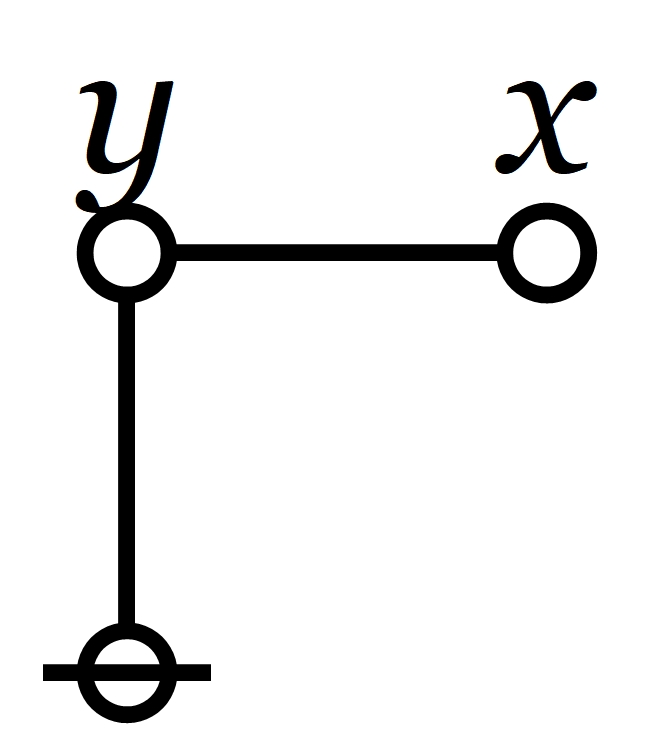
In that vein, here’s a Rosetta Stone to give us a grounding in the relationship between boolean functions and our two readings of logical graphs.

\text{Boolean Functions on Two Variables}
\text{Boolean Function} \text{Entitative Graph} \text{Existential Graph}
f_{0} Cactus Root Cactus Stem
\text{false} \text{false} \text{false}
f_{1} Cactus (xy) Cactus (x)(y)
\text{neither}~ x ~\text{nor}~ y \lnot (x \lor y) \lnot x \land \lnot y
f_{2} Cactus (x(y)) Cactus (x)y
y ~\text{and not}~ x \lnot x \land y \lnot x \land y
f_{3} Cactus (x) Cactus (x)
\text{not}~ x \lnot x \lnot x
f_{4} Cactus ((x)y) Cactus x(y)
x ~\text{and not}~ y x \land \lnot y x \land \lnot y
f_{5} Cactus (y) Cactus (y)
\text{not}~ y \lnot y \lnot y
f_{6} Cactus ((x,y)) Cactus (x,y)
x ~\text{not equal to}~ y x \ne y x \ne y
f_{7} Cactus (x)(y) Cactus (xy)
\text{not both}~ x ~\text{and}~ y \lnot x \lor \lnot y \lnot (x \land y)
f_{8} Cactus ((x)(y)) Cactus xy
x ~\text{and}~ y x \land y x \land y
f_{9} Cactus (x,y) Cactus ((x,y))
x ~\text{equal to}~ y x = y x = y
f_{10} Cactus y Cactus y
y y y
f_{11} Cactus (x)y Cactus (x(y))
\text{if}~ x ~\text{then}~ y x \Rightarrow y x \Rightarrow y
f_{12} Cactus x Cactus x
x x x
f_{13} Cactus x(y) Cactus ((x)y)
\text{if}~ y ~\text{then}~ x x \Leftarrow y x \Leftarrow y
f_{14} Cactus xy Cactus ((x)(y))
x ~\text{or}~ y x \lor y x \lor y
f_{15} Cactus Stem Cactus Root
\text{true} \text{true} \text{true}

cc: Cybernetics (1) (2)Laws of FormFB | Logical Graphs • Ontolog Forum (1) (2)
cc: Peirce List (1) (2) (3) (4) (5) (6) (7) (8) • Structural Modeling (1) (2) • Systems (1) (2)

Posted in Amphecks, Animata, Boolean Algebra, Boolean Functions, C.S. Peirce, Cactus Graphs, Constraint Satisfaction Problems, Deduction, Diagrammatic Reasoning, Duality, Equational Inference, Graph Theory, Laws of Form, Logic, Logical Graphs, Mathematics, Minimal Negation Operators, Model Theory, Painted Cacti, Peirce, Proof Theory, Propositional Calculus, Propositional Equation Reasoning Systems, Spencer Brown, Theorem Proving, Visualization | Tagged , , , , , , , , , , , , , , , , , , , , , , , , , | 22 Comments

Abduction, Deduction, Induction, Analogy, Inquiry • 27

Re: Gil KalaiAvi Wigderson : Integrating Computational Modeling, Algorithms, and Complexity into Theories of Nature Marks a New Scientific Revolution!

I took a look at Avi’s paper “On the Nature of the Theory of Computation” (OtNotToC).  There is naturally a good dose of TOC but little on the type of World-Objective Contact (WOC) it takes to connect with empirical science.  Just on that sample it reminds me of projects like Wolfram’s “New Kind Of Science”.  They all do a good job of convincing us to use computational media as virtual laboratories for conducting experimental mathematics, but they leave us hanging when it comes to analyzing the relation between what goes on inside the box of computation and the natural world outside the box.

cc: CyberneticsLaws of FormOntolog ForumStructural ModelingSystems Science

Posted in Abduction, Analogy, Aristotle, Artificial Intelligence, C.S. Peirce, Deduction, Induction, Inquiry, Inquiry Driven Systems, Intelligent Systems Engineering, Logic, Mental Models, Peirce, Scientific Method, Semiotics, Systems | Tagged , , , , , , , , , , , , , , , | 6 Comments