Animated Logical Graphs • 8

Re: Ken ReganThe Shapes of Computations

The most striking example of a “Primitive Insight Proof” (PIP❢) known to me is the Dawes–Utting proof of the Double Negation Theorem from the CSP–GSB axioms for propositional logic.  There is a graphically illustrated discussion at the following location:

I cannot hazard a guess what order of insight it took to find that proof — for me it would have involved a whole lot of random search through the space of possible proofs, and that’s even if I got the notion to look for one in the first place.

There is of course a much deeper order of insight into the mathematical form of logical reasoning that it took C.S. Peirce to arrive at his maximally elegant 4-axiom set.

Posted in Amphecks, Animata, Boolean Algebra, Boolean Functions, C.S. Peirce, Cactus Graphs, Constraint Satisfaction Problems, Deduction, Diagrammatic Reasoning, Duality, Equational Inference, Graph Theory, Laws of Form, Logic, Logical Graphs, Mathematics, Minimal Negation Operators, Model Theory, Painted Cacti, Peirce, Proof Theory, Propositional Calculus, Propositional Equation Reasoning Systems, Spencer Brown, Theorem Proving, Visualization | Tagged , , , , , , , , , , , , , , , , , , , , , , , , , | 12 Comments

Animated Logical Graphs • 7

Re: Ken ReganThe Shapes of Computations

There are several issues of computation shape and proof style that raise their heads already at the logical ground level of boolean functions and propositional calculus.  From what I’ve seen, there are three dimensions of variation that appear most prominent at this stage:

  • Insight Proofs vs. Routine Proofs
  • Model-Theoretic Methods vs. Proof-Theoretic Methods
  • Equational (Information-Preserving) Proofs vs.
    Implicational (Information-Reducing) Proofs

More later, after I dig up some basic examples …

Posted in Amphecks, Animata, Boolean Algebra, Boolean Functions, C.S. Peirce, Cactus Graphs, Constraint Satisfaction Problems, Deduction, Diagrammatic Reasoning, Duality, Equational Inference, Graph Theory, Laws of Form, Logic, Logical Graphs, Mathematics, Minimal Negation Operators, Model Theory, Painted Cacti, Peirce, Proof Theory, Propositional Calculus, Propositional Equation Reasoning Systems, Spencer Brown, Theorem Proving, Visualization | Tagged , , , , , , , , , , , , , , , , , , , , , , , , , | 12 Comments

Survey of Theme One Program • 1

This is a Survey of blog and wiki posts relating to the Theme One Program I worked on all through the 1980s.  The aim was to develop fundamental algorithms and data structures to support an integrated learning and reasoning interface, looking toward the design of an Automated Research Tool able to double as a medium for Inquiry Driven Education.  I wrote up a pilot version of the program well enough to get a Master’s degree out of it but I’m still getting around to writing up the complete documentation.

Wiki Hub

Documentation in Progress

Applications

References

  • Awbrey, S.M., and Awbrey, J.L. (May 1991), “An Architecture for Inquiry : Building Computer Platforms for Discovery”, Proceedings of the Eighth International Conference on Technology and Education, Toronto, Canada, pp. 874–875.  Online.
  • Awbrey, J.L., and Awbrey, S.M. (January 1991), “Exploring Research Data Interactively : Developing a Computer Architecture for Inquiry”, Poster presented at the Annual Sigma Xi Research Forum, University of Texas Medical Branch, Galveston, TX.
  • Awbrey, J.L., and Awbrey, S.M. (August 1990), “Exploring Research Data Interactively • Theme One : A Program of Inquiry”, Proceedings of the Sixth Annual Conference on Applications of Artificial Intelligence and CD-ROM in Education and Training, Society for Applied Learning Technology, Washington, DC, pp. 9–15.  Online.
Posted in Algorithms, Animata, Artificial Intelligence, Boolean Functions, C.S. Peirce, Cactus Graphs, Cognition, Computation, Constraint Satisfaction Problems, Data Structures, Differential Logic, Equational Inference, Formal Languages, Graph Theory, Inquiry Driven Systems, Laws of Form, Learning Theory, Logic, Logical Graphs, Mathematics, Minimal Negation Operators, Painted Cacti, Peirce, Propositional Calculus, Semiotics, Spencer Brown, Visualization | Tagged , , , , , , , , , , , , , , , , , , , , , , , , , , | Leave a comment

Survey of Semiotic Theory Of Information • 1

This is a Survey of previous blog and wiki posts on the Semiotic Theory Of Information.  All my projects are exploratory in essence but this line of inquiry is more open-ended than most.  The question is:

What is information and how does it impact the spectrum of activities that answer to the name of inquiry?

Setting out on what would become his lifelong quest to explore and explain the “Logic of Science”, C.S. Peirce pierced the veil of historical confusions obscuring the issue and fixed on what he called the “laws of information” as the key to solving the puzzle.  This was in 1865 and 1866, detailed in his lectures at Harvard University and the Lowell Institute.

Fast forward to the present and I see the Big Question as follows.  Having gone through the exercise of comparing and contrasting Peirce’s theory of information, however much it yet remains in a rough-hewn state, with Shannon’s paradigm so pervasively informing the ongoing revolution in our understanding and use of information, I have reason to believe Peirce’s idea is root and branch more general and has the potential, with due development, to resolve many mysteries still bedeviling our grasp of inference, information, and inquiry.

C.S. Peirce on the Laws of Information and the Logic of Science

Excursions

Blog Dialogs

Reference

Posted in Abduction, C.S. Peirce, Communication, Control, Cybernetics, Deduction, Determination, Discovery, Doubt, Epistemology, Fixation of Belief, Induction, Information, Information = Comprehension × Extension, Information Theory, Inquiry, Inquiry Driven Systems, Inquiry Into Inquiry, Interpretation, Invention, Knowledge, Learning Theory, Logic, Logic of Relatives, Logic of Science, Mathematics, Peirce, Philosophy, Philosophy of Science, Pragmatic Information, Probable Reasoning, Process Thinking, Relation Theory, Scientific Inquiry, Scientific Method, Semeiosis, Semiosis, Semiotic Information, Semiotics, Sign Relational Manifolds, Sign Relations, Surveys, Triadic Relations, Uncertainty | Tagged , , , , , , , , , , , , , , , , , , , , , , , , , , , , , , , , , , , , , , , , , , , | Leave a comment

Survey of Relation Theory • 1

In this Survey of blog and wiki posts on Relation Theory, relations are viewed from the perspective of combinatorics, in other words, as a topic in discrete mathematics, with special attention to finite structures and concrete set-theoretic constructions, many of which arise quite naturally in applications.  This approach to relation theory is distinct from, though closely related to, its study from the perspectives of abstract algebra on the one hand and formal logic on the other.

Elements

Relational Concepts

Relation Construction Relation Composition Relation Reduction
Relative Term Sign Relation Triadic Relation
Logic of Relatives Hypostatic Abstraction Continuous Predicate

Illustrations

Blog Series

Resources

Posted in Algebra, Algebra of Logic, C.S. Peirce, Category Theory, Combinatorics, Discrete Mathematics, Duality, Dyadic Relations, Foundations of Mathematics, Graph Theory, Logic, Logic of Relatives, Mathematics, Peirce, Relation Theory, Semiotics, Set Theory, Sign Relational Manifolds, Sign Relations, Surveys, Triadic Relations, Triadicity, Type Theory | Tagged , , , , , , , , , , , , , , , , , , , , , , | 1 Comment

Survey of Precursors Of Category Theory • 1

A few years ago I began a sketch on the “Precursors of Category Theory”, aiming to trace the continuities of the category concept from Aristotle, to Kant and Peirce, through Hilbert and Ackermann, to contemporary mathematical practice.  A Survey of blog and wiki notes on the subject is given below, still very rough and incomplete, but perhaps a few will find it of use.

Wiki Notes

Blog Posts

  • Notes On Categories • (1)
  • Precursors Of Category Theory • (1)(2)(3)

Categories à la Peirce

Posted in Abstraction, Ackermann, Analogy, Aristotle, C.S. Peirce, Carnap, Category Theory, Diagrams, Dyadic Relations, Equational Inference, Form, Foundations of Mathematics, Functional Logic, Hilbert, History of Mathematics, Hypostatic Abstraction, Kant, Logic, Logic of Relatives, Mathematics, Peirce, Propositions As Types Analogy, Relation Theory, Saunders Mac Lane, Semiotics, Sign Relations, Surveys, Triadic Relations, Type Theory, Universals | Tagged , , , , , , , , , , , , , , , , , , , , , , , , , , , , , | 18 Comments

Survey of Inquiry Driven Systems • 1

This is a Survey of blog and wiki posts on Inquiry Driven Systems, material I plan to refine toward a more compact and systematic treatment of the subject.

An inquiry driven system is a system having among its state variables some representing its state of information with respect to various topics of interest, for example, its own state and the states of any potential object systems.  Thus it has a component of state tracing a trajectory though an information state space.

Elements

Developments

Applications

Posted in Abduction, Action, Adaptive Systems, Aristotle, Artificial Intelligence, Automated Research Tools, Change, Cognitive Science, Communication, Cybernetics, Deduction, Descartes, Dewey, Discovery, Doubt, Education, Educational Systems Design, Educational Technology, Fixation of Belief, Induction, Information, Information Theory, Inquiry, Inquiry Driven Systems, Inquiry Into Inquiry, Intelligent Systems, Interpretation, Invention, Kant, Knowledge, Learning, Learning Theory, Logic, Logic of Science, Mathematics, Mental Models, Peirce, Pragmatic Maxim, Pragmatism, Process Thinking, Scientific Inquiry, Semiotics, Sign Relations, Surveys, Teaching, Triadic Relations, Visualization | Tagged , , , , , , , , , , , , , , , , , , , , , , , , , , , , , , , , , , , , , , , , , , , , , , | Leave a comment

Survey of Differential Logic • 1

This is a Survey of blog and wiki posts on Differential Logic, material I plan to develop toward a more compact and systematic account.

Elements

Architectonics

Applications

Explorations

Posted in Amphecks, Animata, Boolean Algebra, Boolean Functions, C.S. Peirce, Cactus Graphs, Category Theory, Change, Cybernetics, Differential Analytic Turing Automata, Differential Calculus, Differential Logic, Discrete Dynamics, Equational Inference, Frankl Conjecture, Functional Logic, Gradient Descent, Graph Theory, Hologrammautomaton, Indicator Functions, Inquiry Driven Systems, Leibniz, Logic, Logical Graphs, Mathematics, Minimal Negation Operators, Painted Cacti, Peirce, Propositional Calculus, Surveys, Time, Topology, Visualization, Zeroth Order Logic | Tagged , , , , , , , , , , , , , , , , , , , , , , , , , , , , , , , , , | 1 Comment

Survey of Animated Logical Graphs • 1

This is one of several Survey posts I’ll be drafting from time to time, starting with minimal stubs and collecting links to the better variations on persistent themes I’ve worked on over the years.  After that I’ll look to organizing and revising the assembled material with an eye toward developing more polished articles.

Elements

Excursions

Applications

Blog Dialogs

Posted in Abstraction, Amphecks, Animata, Boole, Boolean Algebra, Boolean Functions, C.S. Peirce, Cactus Graphs, Computational Complexity, Constraint Satisfaction Problems, Equational Inference, Graph Theory, Laws of Form, Logic, Logical Graphs, Mathematics, Minimal Negation Operators, Painted Cacti, Peirce, Propositional Calculus, Propositional Equation Reasoning Systems, Spencer Brown, Surveys, Theorem Proving, Visualization, Zeroth Order Logic | Tagged , , , , , , , , , , , , , , , , , , , , , , , , , | 2 Comments

Peirce’s 1880 “Algebra Of Logic” Chapter 3 • Comment 7.5

Suppose we add another individual to our initial universe of discourse, arriving at a three-point universe \{ \mathrm{I}, \mathrm{J}, \mathrm{K} \}.

It might be thought that adding one more element to the universe of discourse would allow slightly more complicated relations to be compounded from its basic ingredients, but the truth is that crossing the threshold from a two-point universe to a three-point universe occasions a steep ascent in the complexity of relations generated.

Looking back from the ascent we see that the two-point universe \{ \mathrm{I}, \mathrm{J} \} manifests a type of formal degeneracy (loss of generality) compared with the three-point universe \{ \mathrm{I}, \mathrm{J}, \mathrm{K} \}.  This is due to the circumstance that the number of “diagonal” pairs, those of the form \mathrm{A\!:\!A}, equals the number of “off-diagonal” pairs, those of the form \mathrm{A\!:\!B}, so the two-point case exhibits symmetries that will be broken as soon as one adds another element to the universe.

A universe of three individuals \mathrm{I, J, K} yields exactly nine individual dual relatives or ordered pairs of universe elements:

\begin{matrix}  \mathrm{I\!:\!I}, & \mathrm{I\!:\!J}, & \mathrm{I\!:\!K}, & \mathrm{J\!:\!I}, & \mathrm{J\!:\!J}, & \mathrm{J\!:\!K}, & \mathrm{K\!:\!I}, & \mathrm{K\!:\!J}, & \mathrm{K\!:\!K}.  \end{matrix}

It is convenient arrange the pairs in a square array:

\left( \begin{matrix}  \mathrm{I\!:\!I} & \mathrm{I\!:\!J} & \mathrm{I\!:\!K}  \\[4pt]  \mathrm{J\!:\!I} & \mathrm{J\!:\!J} & \mathrm{J\!:\!K}  \\[4pt]  \mathrm{K\!:\!I} & \mathrm{K\!:\!J} & \mathrm{K\!:\!K}  \end{matrix} \right)

There are 2^9 = 512 dual relatives over this universe of discourse, since each one is formed by choosing a subset of the nine ordered pairs and then “aggregating” them, forming their logical sum, or simply regarding them as a subset.  Taking the square array of ordered pairs as a backdrop, any one of the 512 dual relatives may be represented by a square matrix of binary values, a value of 1 occupying the place of each ordered pair that belongs to the subset and a value of 0 occupying the place of each ordered pair that does not belong to the subset in question.

The matrix representations of the 512 dual relatives or dyadic relations over the universe \{ \mathrm{I}, \mathrm{J}, \mathrm{K} \} are tabulated below according to the following plan:

  • Since the diagonal and off-diagonal components of the matrices vary independently of each other, the whole set of matrices factors as a product of two smaller sets, making the break along the lines of the corresponding cardinalities, 2^9 = 2^3 \times 2^6.
  • The eight diagonal matrices are shown in the first row of the display, omitting the off-diagonal zeroes for ease of reading and pattern recognition.
  • The 64 off-diagonal matrices are shown in the rest of the display, arranged in rank order by increasing numbers of \text{1's} and decreasing numbers of \text{0's}, suppressing the fixed zeroes along the diagonals to make the changing patterns of \text{0's} and \text{1's} easier to follow.
  • The number of off-diagonal matrices of rank k is equal to the binomial coefficient \tbinom{6}{k} or \mathrm{C}(6, k).  The values of \mathrm{C}(6, k)  are given by the row of Pascal’s Triangle that contains the sequence {1, 6, 15, 20, 15, 6, 1}.

\begin{pmatrix}  0 & ~ & ~ \\  ~ & 0 & ~ \\  ~ & ~ & 0  \end{pmatrix}  \,  \begin{pmatrix}  1 & ~ & ~ \\  ~ & 0 & ~ \\  ~ & ~ & 0  \end{pmatrix}  \,  \begin{pmatrix}  0 & ~ & ~ \\  ~ & 1 & ~ \\  ~ & ~ & 0  \end{pmatrix}  \,  \begin{pmatrix}  0 & ~ & ~ \\  ~ & 0 & ~ \\  ~ & ~ & 1  \end{pmatrix}  \,  \begin{pmatrix}  1 & ~ & ~ \\  ~ & 1 & ~ \\  ~ & ~ & 0  \end{pmatrix}  \,  \begin{pmatrix}  1 & ~ & ~ \\  ~ & 0 & ~ \\  ~ & ~ & 1  \end{pmatrix}  \,  \begin{pmatrix}  0 & ~ & ~ \\  ~ & 1 & ~ \\  ~ & ~ & 1  \end{pmatrix}  \,  \begin{pmatrix}  1 & ~ & ~ \\  ~ & 1 & ~ \\  ~ & ~ & 1  \end{pmatrix}

\times

\begin{pmatrix}  ~ & 0 & 0 \\  0 & ~ & 0 \\  0 & 0 & ~  \end{pmatrix}

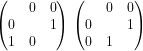
\begin{pmatrix}  ~ & 1 & 0 \\  0 & ~ & 0 \\  0 & 0 & ~  \end{pmatrix}  \,  \begin{pmatrix}  ~ & 0 & 1 \\  0 & ~ & 0 \\  0 & 0 & ~  \end{pmatrix}  \,  \begin{pmatrix}  ~ & 0 & 0 \\  1 & ~ & 0 \\  0 & 0 & ~  \end{pmatrix}  \,  \begin{pmatrix}  ~ & 0 & 0 \\  0 & ~ & 1 \\  0 & 0 & ~  \end{pmatrix}  \,  \begin{pmatrix}  ~ & 0 & 0 \\  0 & ~ & 0 \\  1 & 0 & ~  \end{pmatrix}  \,  \begin{pmatrix}  ~ & 0 & 0 \\  0 & ~ & 0 \\  0 & 1 & ~  \end{pmatrix}

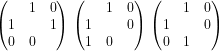
\begin{pmatrix}  ~ & 1 & 1 \\  0 & ~ & 0 \\  0 & 0 & ~  \end{pmatrix}  \,  \begin{pmatrix}  ~ & 1 & 0 \\  1 & ~ & 0 \\  0 & 0 & ~  \end{pmatrix}  \,  \begin{pmatrix}  ~ & 1 & 0 \\  0 & ~ & 1 \\  0 & 0 & ~  \end{pmatrix}  \,  \begin{pmatrix}  ~ & 1 & 0 \\  0 & ~ & 0 \\  1 & 0 & ~  \end{pmatrix}  \,  \begin{pmatrix}  ~ & 1 & 0 \\  0 & ~ & 0 \\  0 & 1 & ~  \end{pmatrix}

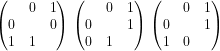
\begin{pmatrix}  ~ & 0 & 1 \\  1 & ~ & 0 \\  0 & 0 & ~  \end{pmatrix}  \,  \begin{pmatrix}  ~ & 0 & 1 \\  0 & ~ & 1 \\  0 & 0 & ~  \end{pmatrix}  \,  \begin{pmatrix}  ~ & 0 & 1 \\  0 & ~ & 0 \\  1 & 0 & ~  \end{pmatrix}  \,  \begin{pmatrix}  ~ & 0 & 1 \\  0 & ~ & 0 \\  0 & 1 & ~  \end{pmatrix}

\begin{pmatrix}  ~ & 0 & 0 \\  1 & ~ & 1 \\  0 & 0 & ~  \end{pmatrix}  \,  \begin{pmatrix}  ~ & 0 & 0 \\  1 & ~ & 0 \\  1 & 0 & ~  \end{pmatrix}  \,  \begin{pmatrix}  ~ & 0 & 0 \\  1 & ~ & 0 \\  0 & 1 & ~  \end{pmatrix}

\begin{pmatrix}  ~ & 0 & 0 \\  0 & ~ & 1 \\  1 & 0 & ~  \end{pmatrix}  \,  \begin{pmatrix}  ~ & 0 & 0 \\  0 & ~ & 1 \\  0 & 1 & ~  \end{pmatrix}

\begin{pmatrix}  ~ & 0 & 0 \\  0 & ~ & 0 \\  1 & 1 & ~  \end{pmatrix}

\begin{pmatrix}  ~ & 1 & 1 \\  1 & ~ & 0 \\  0 & 0 & ~  \end{pmatrix}  \,  \begin{pmatrix}  ~ & 1 & 1 \\  0 & ~ & 1 \\  0 & 0 & ~  \end{pmatrix}  \,  \begin{pmatrix}  ~ & 1 & 1 \\  0 & ~ & 0 \\  1 & 0 & ~  \end{pmatrix}  \,  \begin{pmatrix}  ~ & 1 & 1 \\  0 & ~ & 0 \\  0 & 1 & ~  \end{pmatrix}

\begin{pmatrix}  ~ & 1 & 0 \\  1 & ~ & 1 \\  0 & 0 & ~  \end{pmatrix}  \,  \begin{pmatrix}  ~ & 1 & 0 \\  1 & ~ & 0 \\  1 & 0 & ~  \end{pmatrix}  \,  \begin{pmatrix}  ~ & 1 & 0 \\  1 & ~ & 0 \\  0 & 1 & ~  \end{pmatrix}

\begin{pmatrix}  ~ & 1 & 0 \\  0 & ~ & 1 \\  1 & 0 & ~  \end{pmatrix}  \,  \begin{pmatrix}  ~ & 1 & 0 \\  0 & ~ & 1 \\  0 & 1 & ~  \end{pmatrix}

\begin{pmatrix}  ~ & 1 & 0 \\  0 & ~ & 0 \\  1 & 1 & ~  \end{pmatrix}

\begin{pmatrix}  ~ & 0 & 1 \\  1 & ~ & 1 \\  0 & 0 & ~  \end{pmatrix}

\begin{pmatrix}  ~ & 0 & 1 \\  1 & ~ & 0 \\  0 & 1 & ~  \end{pmatrix}  \,  \begin{pmatrix}  ~ & 0 & 1 \\  1 & ~ & 0 \\  1 & 0 & ~  \end{pmatrix}

\begin{pmatrix}  ~ & 0 & 1 \\  0 & ~ & 0 \\  1 & 1 & ~  \end{pmatrix}  \,  \begin{pmatrix}  ~ & 0 & 1 \\  0 & ~ & 1 \\  0 & 1 & ~  \end{pmatrix}  \,  \begin{pmatrix}  ~ & 0 & 1 \\  0 & ~ & 1 \\  1 & 0 & ~  \end{pmatrix}

\begin{pmatrix}  ~ & 0 & 0 \\  0 & ~ & 1 \\  1 & 1 & ~  \end{pmatrix}  \,  \begin{pmatrix}  ~ & 0 & 0 \\  1 & ~ & 0 \\  1 & 1 & ~  \end{pmatrix}  \,  \begin{pmatrix}  ~ & 0 & 0 \\  1 & ~ & 1 \\  0 & 1 & ~  \end{pmatrix}  \,  \begin{pmatrix}  ~ & 0 & 0 \\  1 & ~ & 1 \\  1 & 0 & ~  \end{pmatrix}

\begin{pmatrix}  ~ & 1 & 1 \\  1 & ~ & 1 \\  0 & 0 & ~  \end{pmatrix}

\begin{pmatrix}  ~ & 1 & 1 \\  1 & ~ & 0 \\  0 & 1 & ~  \end{pmatrix}  \,  \begin{pmatrix}  ~ & 1 & 1 \\  1 & ~ & 0 \\  1 & 0 & ~  \end{pmatrix}

\begin{pmatrix}  ~ & 1 & 1 \\  0 & ~ & 0 \\  1 & 1 & ~  \end{pmatrix}  \,  \begin{pmatrix}  ~ & 1 & 1 \\  0 & ~ & 1 \\  0 & 1 & ~  \end{pmatrix}  \,  \begin{pmatrix}  ~ & 1 & 1 \\  0 & ~ & 1 \\  1 & 0 & ~  \end{pmatrix}

\begin{pmatrix}  ~ & 1 & 0 \\  0 & ~ & 1 \\  1 & 1 & ~  \end{pmatrix}  \,  \begin{pmatrix}  ~ & 1 & 0 \\  1 & ~ & 0 \\  1 & 1 & ~  \end{pmatrix}  \,  \begin{pmatrix}  ~ & 1 & 0 \\  1 & ~ & 1 \\  0 & 1 & ~  \end{pmatrix}  \,  \begin{pmatrix}  ~ & 1 & 0 \\  1 & ~ & 1 \\  1 & 0 & ~  \end{pmatrix}

\begin{pmatrix}  ~ & 0 & 0 \\  1 & ~ & 1 \\  1 & 1 & ~  \end{pmatrix}  \,  \begin{pmatrix}  ~ & 0 & 1 \\  0 & ~ & 1 \\  1 & 1 & ~  \end{pmatrix}  \,  \begin{pmatrix}  ~ & 0 & 1 \\  1 & ~ & 0 \\  1 & 1 & ~  \end{pmatrix}  \,  \begin{pmatrix}  ~ & 0 & 1 \\  1 & ~ & 1 \\  0 & 1 & ~  \end{pmatrix}  \,  \begin{pmatrix}  ~ & 0 & 1 \\  1 & ~ & 1 \\  1 & 0 & ~  \end{pmatrix}

\begin{pmatrix}  ~ & 0 & 1 \\  1 & ~ & 1 \\  1 & 1 & ~  \end{pmatrix}  \,  \begin{pmatrix}  ~ & 1 & 0 \\  1 & ~ & 1 \\  1 & 1 & ~  \end{pmatrix}  \,  \begin{pmatrix}  ~ & 1 & 1 \\  0 & ~ & 1 \\  1 & 1 & ~  \end{pmatrix}  \,  \begin{pmatrix}  ~ & 1 & 1 \\  1 & ~ & 0 \\  1 & 1 & ~  \end{pmatrix}  \,  \begin{pmatrix}  ~ & 1 & 1 \\  1 & ~ & 1 \\  0 & 1 & ~  \end{pmatrix}  \,  \begin{pmatrix}  ~ & 1 & 1 \\  1 & ~ & 1 \\  1 & 0 & ~  \end{pmatrix}

\begin{pmatrix}  ~ & 1 & 1 \\  1 & ~ & 1 \\  1 & 1 & ~  \end{pmatrix}

References

  • Peirce, C.S. (1880), “On the Algebra of Logic”, American Journal of Mathematics 3, 15–57.  Collected Papers (CP 3.154–251), Chronological Edition (CE 4, 163–209).
  • Peirce, C.S., Collected Papers of Charles Sanders Peirce, vols. 1–6, Charles Hartshorne and Paul Weiss (eds.), vols. 7–8, Arthur W. Burks (ed.), Harvard University Press, Cambridge, MA, 1931–1935, 1958.  Volume 3 : Exact Logic, 1933.
  • Peirce, C.S., Writings of Charles S. Peirce : A Chronological Edition, Peirce Edition Project (eds.), Indiana University Press, Bloomington and Indianapolis, IN, 1981–.  Volume 4 (1879–1884), 1986.

Resources
Posted in Dyadic Relations, Graph Theory, Logic, Logic of Relatives, Mathematics, Matrix Theory, Peirce, Relation Theory, Semiotics, Sign Relations, Triadic Relations | Tagged , , , , , , , , , , | 10 Comments