Survey of Differential Logic • 2

This is a Survey of blog and wiki posts on Differential Logic, material I plan to develop toward a more compact and systematic account.

Elements

Blog Series

Architectonics

Applications

Blog Dialogs

Explorations

Posted in Amphecks, Animata, Boolean Algebra, Boolean Functions, C.S. Peirce, Cactus Graphs, Category Theory, Change, Cybernetics, Differential Analytic Turing Automata, Differential Calculus, Differential Logic, Discrete Dynamics, Equational Inference, Frankl Conjecture, Functional Logic, Gradient Descent, Graph Theory, Hologrammautomaton, Indicator Functions, Inquiry Driven Systems, Leibniz, Logic, Logical Graphs, Mathematics, Minimal Negation Operators, Painted Cacti, Peirce, Propositional Calculus, Surveys, Time, Topology, Visualization, Zeroth Order Logic | Tagged , , , , , , , , , , , , , , , , , , , , , , , , , , , , , , , , , | 5 Comments

Pragmatic Semiotic Information • Discussion 19

Re: Differential Logic and Dynamic Systems
Re: FB | Systems SciencesKenneth Lloyd

An exchange on Facebook took me back to recent discussions of pragmatic truth and long-running discussions of pragmatic semiotic information.  Just by way of a note to myself and anyone who’s interested, I’ll copy my comment here and add a few links to keep the relevant gray cells warm.

Concepts of belief, fact, knowledge, opinion, etc. look rather different from a Peircean pragmatic perspective, in other words, when analyzed in terms of the pragmatic maxim.  In time the traditional conceptions begin to strike us as increasingly clumsy tools, better supplanted by Peirce’s concept of information.

Resources

cc: CyberneticsOntolog ForumStructural ModelingSystems Science

Posted in Abduction, Aristotle, C.S. Peirce, Comprehension, Deduction, Definition, Determination, Extension, Hypothesis, Induction, Inference, Information, Information = Comprehension × Extension, Inquiry, Intension, Intention, Logic, Logic of Science, Mathematics, Measurement, Observation, Peirce, Perception, Phenomenology, Physics, Pragmatic Semiotic Information, Pragmatism, Probability, Quantum Mechanics, Scientific Method, Semiotics, Sign Relations | Tagged , , , , , , , , , , , , , , , , , , , , , , , , , , , , , , , | 7 Comments

Cybernetics • Requisite Variety • Selection 13

Our venture into cybernetics, the study of systems whose time evolution signifies an object, brings us to the point of seeing how pragmatic, semiotic, and systems thinking all have triadic relations at their core.

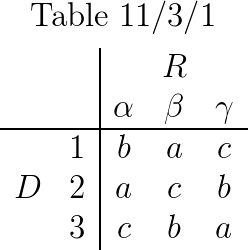
Recall the game between R and D determined by the following data:

Ashby Cybernetics Table 11.3.1

We continue with Ashby’s analysis of how the game plays out.

Requisite Variety

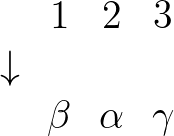
11/3.[cont.]   Examination of the table soon shows that with this particular table R can win always.  Whatever value D selects first, R can always select a Greek letter that will give the desired outcome.  Thus if D selects 1, R selects \beta;  if D selects 2, R selects \alpha;  and so on.  In fact, if R acts according to the transformation

Ashby Cybernetics Figure 11.3.2

then he can always force the outcome to be a.

R\text{'s} position, with this particular table, is peculiarly favourable, for not only can R always force a as the outcome, but he can as readily force, if desired, b or c as the outcome.  R has, in fact, complete control of the outcome.

Reference

  • Ashby, W.R. (1956), An Introduction to Cybernetics, Chapman and Hall, London, UK.  Republished by Methuen and Company, London, UK, 1964.  Online.

cc: CyberneticsOntolog ForumStructural ModelingSystems Science

Posted in Adaptive Systems, Ashby, C.S. Peirce, Communication, Control, Cybernetics, Evolution, Information, Inquiry Driven Systems, Learning, Logic, Mathematics, Peirce, Purpose, Regulation, Survival, Truth Theory, W. Ross Ashby | Tagged , , , , , , , , , , , , , , , , , | 9 Comments

Cybernetics • Requisite Variety • Selection 12

Ashby now invites us to consider a series of games, beginning as follows.

Requisite Variety

11/3.   Play and outcome.  Let us therefore forget all about regulation and simply suppose that we are watching two players, R and D, who are engaged in a game.  We shall follow the fortunes of R, who is attempting to score an a.  The rules are as follows.  They have before them Table 11/3/1, which can be seen by both:

Ashby Cybernetics Table 11.3.1

D must play first, by selecting a number, and thus a particular row.  R, knowing this number, then selects a Greek letter, and thus a particular column.  The italic letter specified by the intersection of the row and column is the outcome.  If it is an a, R wins;  if not, R loses.

I’ll pause the play here and give readers a chance to contemplate strategies.

Reference

  • Ashby, W.R. (1956), An Introduction to Cybernetics, Chapman and Hall, London, UK.  Republished by Methuen and Company, London, UK, 1964.  Online.

cc: CyberneticsOntolog ForumStructural ModelingSystems Science

Posted in Adaptive Systems, Ashby, C.S. Peirce, Communication, Control, Cybernetics, Evolution, Information, Inquiry Driven Systems, Learning, Logic, Mathematics, Peirce, Purpose, Regulation, Survival, Truth Theory, W. Ross Ashby | Tagged , , , , , , , , , , , , , , , , , | 6 Comments

Pragmatic Truth • Discussion 21

Re: Cybernetic CommunicationsKlaus Krippendorff

I appreciate the way Klaus Krippendorff immediately extracted one of the overarching themes of Peirce’s whole paper, indeed of his whole work.  That allows us to tread lightly past a lot of verbal nit-picking about the differences among traditional concepts like belief, fact, knowledge, opinion, etc. and get right down to systems-theoretic ideas about states of information and inquiry as a process that revises those states.

Here’s a bit I wrote a few years back rubricizing Peirce’s four ways of moving from doubt to belief — from a state of information so unsettled it puzzles the will to one secure enough on which to act, should the need for action arise.

My favorite polymathematician, Charles Sanders Peirce, gave a fourfold classification of what he called “methods of fixing belief”, or “settling opinion”, most notably and seminally in his paper, “The Fixation of Belief” (1877).  Adjusting his nomenclature very slightly, if only for the sake of preserving a mnemonic rhyme scheme, we may refer to his four types as Tenacity, Authority, Plausibility (à priori pleasing praiseworthiness), and full-fledged Scientific Inquiry.

Reference

Resources

cc: CyberneticsOntolog • Peirce List (1) (2)Structural ModelingSystems Science

Posted in Aristotle, C.S. Peirce, Coherence, Concordance, Congruence, Consensus, Convergence, Correspondence, Dewey, Fixation of Belief, Information, Inquiry, John Dewey, Kant, Logic, Logic of Science, Method, Peirce, Philosophy, Pragmatic Maxim, Pragmatism, Semiotics, Sign Relations, Triadic Relations, Truth, Truth Theory, William James | Tagged , , , , , , , , , , , , , , , , , , , , , , , , , , | 8 Comments

Pragmatic Truth • Discussion 20

Re: Renaissance MathematicusThony Christie
Re: Cybernetic CommunicationsLouis Kauffman
Re: FB | Charles S. Peirce SocietyJohn Corcoran

Various conceptions of belief in relation to pragmatic theories of inquiry, signs, and truth have come up recently in several discussion groups.  Some of the variations are too far off my present track but if I stay the pragmatic course I’d naturally recommend the novel fork taken by Peirce’s 1877 paper, “The Fixation of Belief”.

Resources

cc: CyberneticsOntolog • Peirce List (1) (2)Structural ModelingSystems Science

Posted in Aristotle, C.S. Peirce, Coherence, Concordance, Congruence, Consensus, Convergence, Correspondence, Dewey, Fixation of Belief, Information, Inquiry, John Dewey, Kant, Logic, Logic of Science, Method, Peirce, Philosophy, Pragmatic Maxim, Pragmatism, Semiotics, Sign Relations, Triadic Relations, Truth, Truth Theory, William James | Tagged , , , , , , , , , , , , , , , , , , , , , , , , , , | 5 Comments

Differential Logic • Comment 4

Re: Cybernetic CommunicationsStephen Paul King

SPK:
Is it possible that beliefs can propagate almost completely contrary to facts, seen by those that are not infected with those beliefs?
Can we have complex waves in the domains of binary truth tables?

Dear Stephen,

Patterns of change in multi-dimensional Boolean spaces is what Differential Logic is all about.  I’ll say more on that as I get time but here’s a collection of resource links for now.

Resources

cc: Cybernetics • Laws of Form • Ontolog Forum • Peirce List
cc: FB | Differential LogicStructural ModelingSystems Science

Posted in Adaptive Systems, Amphecks, Belief Systems, Boole, Boolean Algebra, Boolean Functions, C.S. Peirce, Cactus Graphs, Cybernetics, Differential Logic, Discrete Dynamics, Fixation of Belief, Gradient Descent, Graph Theory, Hill Climbing, Hologrammautomaton, Inquiry, Inquiry Driven Systems, Laws of Form, Leibniz, Logic, Logical Graphs, Mathematics, Minimal Negation Operators, Optimization, Painted Cacti, Peirce, Propositional Calculus, Spencer Brown | Tagged , , , , , , , , , , , , , , , , , , , , , , , , , , , , | Comments Off on Differential Logic • Comment 4

Cybernetics • Requisite Variety • Selection 11

Ashby now takes a few steps back from the picture of regulation in biological systems, setting out the framework he needs for a broader perspective on regulation in general.

Requisite Variety

11/1.   In the previous chapter we considered regulation from the biological point of view, taking it as something sufficiently well understood.  In this chapter we shall examine the process of regulation itself, with the aim of finding out exactly what is involved and implied.  In particular we shall develop ways of measuring the amount or degree of regulation achieved, and we shall show that this amount has an upper limit.

11/2.   The subject of regulation is very wide in its applications, covering as it does most of the activities in physiology, sociology, ecology, economics, and much of the activities in almost every branch of science and life.  Further, the types of regulator that exist are almost bewildering in their variety.  One way of treating the subject would be to deal seriatim with the various types;  and chapter 12 will, in fact, indicate them.  In this chapter, however, we shall be attempting to get at the core of the subject — to find what is common to all.

What is common to all regulators, however, is not, at first sight, much like any particular form.  We will therefore start anew in the next section, making no explicit reference to what has gone before.  Only after the new subject has been sufficiently developed will we begin to consider any relation it may have to regulation.

Reference

  • Ashby, W.R. (1956), An Introduction to Cybernetics, Chapman and Hall, London, UK.  Republished by Methuen and Company, London, UK, 1964.  Online.

cc: CyberneticsOntolog ForumStructural ModelingSystems Science

Posted in Adaptive Systems, Ashby, C.S. Peirce, Communication, Control, Cybernetics, Evolution, Information, Inquiry Driven Systems, Learning, Logic, Mathematics, Peirce, Purpose, Regulation, Survival, Truth Theory, W. Ross Ashby | Tagged , , , , , , , , , , , , , , , , , | 6 Comments

Cybernetics • Regulation In Biological Systems • Selection 10

Regulation In Biological Systems

Survival

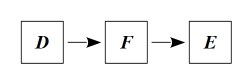
Ashby Cybernetics Figure 10.5.2

10/7.[concl.]   When considering this second form [of defence] we should be careful to notice the part played by information and variety in the process.  The fencer must watch his opponent closely, and he must gain information in all ways possible if he is to survive.  For this purpose he is born with eyes, and for this purpose he learns how to use them.  Nevertheless, the end result of this skill, if successful, is shown by his essential variables, such as his blood-volume, remaining within normal limits, much as if the duel had not occurred.  Information flows freely to the non-essential variables, but the variety in the distinction “duel or no-duel” has been prevented from reaching the essential variables.

Through the remaining chapters we shall be considering this type of active defence, asking such questions as:  what principles must govern it?  What mechanisms can achieve it?  And, what is to be done when the regulation is very difficult?

Reference

  • Ashby, W.R. (1956), An Introduction to Cybernetics, Chapman and Hall, London, UK.  Republished by Methuen and Company, London, UK, 1964.  Online.

cc: Cybernetics • Ontolog (1) (2) • Structural Modeling (1) (2) • Systems Science (1) (2)

Posted in Adaptive Systems, Ashby, C.S. Peirce, Communication, Control, Cybernetics, Evolution, Information, Inquiry Driven Systems, Learning, Logic, Mathematics, Peirce, Purpose, Regulation, Survival, Truth Theory, W. Ross Ashby | Tagged , , , , , , , , , , , , , , , , , | 6 Comments

Cybernetics • Regulation In Biological Systems • Selection 9

Studies of intelligent systems, natural or artificial, tend to focus on dynamic models or symbolic models, rarely both, finding it difficult to integrate the two.  But here we are asking the synthetic question — How does a cybernetic system come to develop semiotic systems, mediated both internally and externally, capable of bearing the information it needs to survive and achieve its other objectives?

With that in mind, let’s return to Ashby’s text, picking up the argument where he underscores his thesis up to this point and continuing from there.

Regulation In Biological Systems

Survival
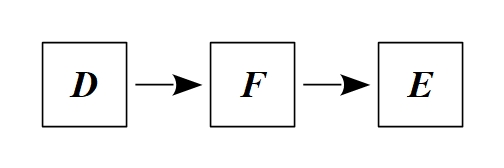
Ashby Cybernetics Figure 10.5.2

10/6.[concl.]   In general, then, an essential feature of the good regulator is that it blocks the flow of variety from disturbances to essential variables.

10/7.   The blocking may take place in a variety of ways, which prove, however, on closer examination to be fundamentally the same.  Two extreme forms will illustrate the range.

One way of blocking the flow (from the source of disturbance D to the essential variable E\,) is to interpose something that acts as a simple passive block to the disturbances.  Such is the tortoise’s shell, which reduces a variety of impacts, blows, bites, etc. to a negligible disturbance of the sensitive tissues within.  In the same class are the tree’s bark, the seal’s coat of blubber, and the human skull.

At the other extreme from this static defence is the defence by skilled counter-action — the defence that gets information about the disturbance to come, prepares for its arrival, and then meets the disturbance, which may be complex and mobile, with a defence that is equally complex and mobile.  This is the defence of the fencer, in some deadly duel, who wears no armour and who trusts to his skill in parrying.  This is the defence used mostly by the higher organisms, who have developed a nervous system precisely for the carrying out of this method.

Reference

  • Ashby, W.R. (1956), An Introduction to Cybernetics, Chapman and Hall, London, UK.  Republished by Methuen and Company, London, UK, 1964.  Online.

cc: Cybernetics • Ontolog (1) (2) • Structural Modeling (1) (2) • Systems Science (1) (2)

Posted in Adaptive Systems, Ashby, C.S. Peirce, Communication, Control, Cybernetics, Evolution, Information, Inquiry Driven Systems, Learning, Logic, Mathematics, Peirce, Purpose, Regulation, Survival, Truth Theory, W. Ross Ashby | Tagged , , , , , , , , , , , , , , , , , | 6 Comments