Sign Relations • Semiotic Equivalence Relations 1

A semiotic equivalence relation (SER) is a special type of equivalence relation arising in the analysis of sign relations.  Generally speaking, any equivalence relation induces a partition of the underlying set of elements, known as the domain or space of the relation, into a family of equivalence classes.  In the case of a SER the equivalence classes are called semiotic equivalence classes (SECs) and the partition is called a semiotic partition (SEP).

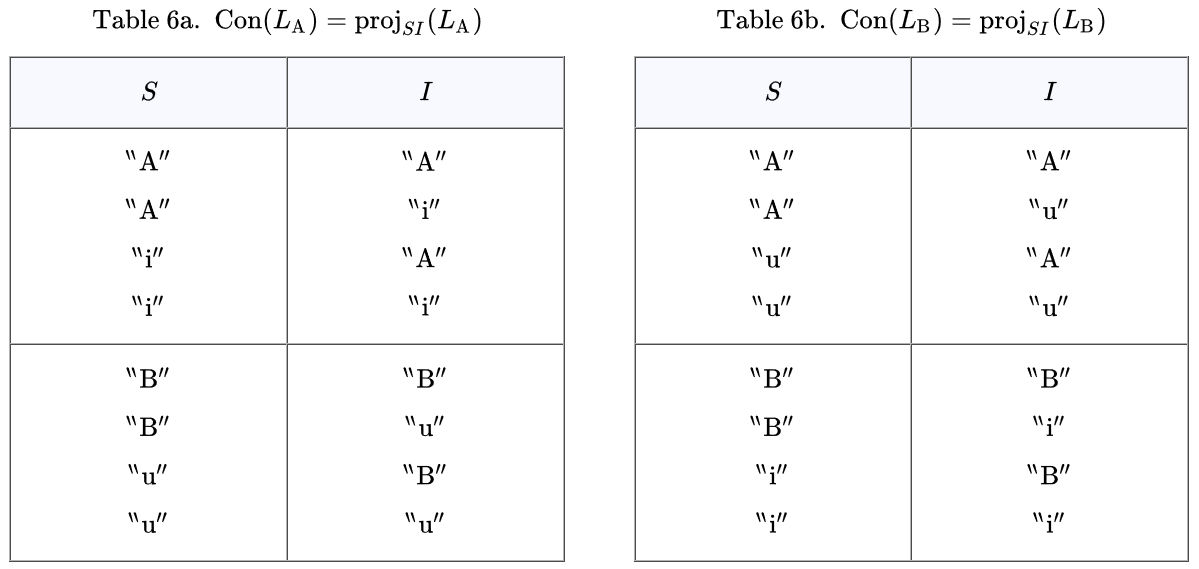
The sign relations L_\mathrm{A} and L_\mathrm{B} have many interesting properties over and above those possessed by sign relations in general.  Some of these properties have to do with the relation between signs and their interpretant signs, as reflected in the projections of L_\mathrm{A} and L_\mathrm{B} on the SI-plane, notated as \mathrm{proj}_{SI} L_\mathrm{A} and \mathrm{proj}_{SI} L_\mathrm{B}, respectively.  The dyadic relations on S \times I induced by these projections are also referred to as the connotative components of the corresponding sign relations, notated as \mathrm{Con}(L_\mathrm{A}) and \mathrm{Con}(L_\mathrm{B}), respectively.  Tables 6a and 6b show the corresponding connotative components.

Connotative Components Con(L_A) and Con(L_B)

A nice property of the sign relations L_\mathrm{A} and L_\mathrm{B} is that their connotative components \mathrm{Con}(L_\mathrm{A}) and \mathrm{Con}(L_\mathrm{B}) form a pair of equivalence relations on their common syntactic domain S = I.  This type of equivalence relation is called a semiotic equivalence relation (SER) because it equates signs having the same meaning to some interpreter.

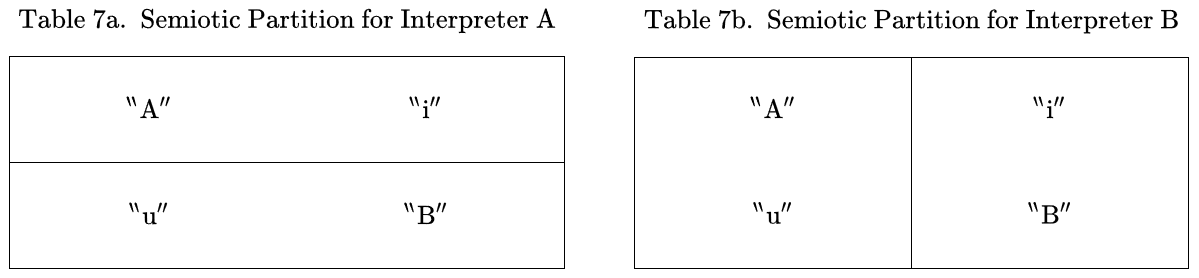
Each of the semiotic equivalence relations, \mathrm{Con}(L_\mathrm{A}), \mathrm{Con}(L_\mathrm{B}) \subseteq S \times I \cong S \times S partitions the collection of signs into semiotic equivalence classes.  This makes for a strong form of representation in that the structure of the interpreters’ common object domain \{ \mathrm{A}, \mathrm{B} \} is reflected or reconstructed, part for part, in the structure of each one’s semiotic partition of the syntactic domain \{ {}^{\backprime\backprime} \mathrm{A} {}^{\prime\prime}, {}^{\backprime\backprime} \mathrm{B} {}^{\prime\prime}, {}^{\backprime\backprime} \mathrm{i} {}^{\prime\prime}, {}^{\backprime\backprime} \mathrm{u} {}^{\prime\prime} \}.  But it needs to be observed that the semiotic partitions for interpreters \mathrm{A} and \mathrm{B} are not identical, indeed, they are orthogonal to each other.  This allows us to regard the form of these partitions as corresponding to an objective structure or invariant reality, but not the literal sets of signs themselves, independent of the individual interpreter’s point of view.

Information about the contrasting patterns of semiotic equivalence corresponding to the interpreters \mathrm{A} and \mathrm{B} is summarized in Tables 7a and 7b.  The form of these Tables serves to explain what is meant by saying the SEPs for \mathrm{A} and \mathrm{B} are orthogonal to each other.
Semiotic Partitions for Interpreters A and B

References

  • Peirce, C.S. (1902), “Parts of Carnegie Application” (L 75), in Carolyn Eisele (ed., 1976), The New Elements of Mathematics by Charles S. Peirce, vol. 4, 13–73.  Online.
  • Awbrey, J.L., and Awbrey, S.M. (1995), “Interpretation as Action : The Risk of Inquiry”, Inquiry : Critical Thinking Across the Disciplines 15(1), pp. 40–52.  ArchiveJournalOnline.

Resources

Document History

Portions of the above article were adapted from the following sources under the GNU Free Documentation License, under other applicable licenses, or by permission of the copyright holders.

cc: CyberneticsOntolog • Peirce List (1) (2)Structural ModelingSystems Science

Posted in C.S. Peirce, Logic, Logic of Relatives, Mathematics, Peirce, Peirce's Categories, Philosophy, Pragmatic Semiotic Information, Pragmatism, Relation Theory, Semiotics, Sign Relations, Thirdness, Triadic Relations, Triadicity | Tagged , , , , , , , , , , , , , , | 3 Comments

Sign Relations • Ennotation

A third aspect of a sign’s complete meaning concerns the reference its objects have to its interpretants, which has no standard name in semiotics.  It would be called an induced relation in graph theory or the result of relational composition in relation theory.  If an interpretant is recognized as a sign in its own right then its independent reference to an object can be taken as belonging to another moment of denotation, but this neglects the mediational character of the whole transaction in which this occurs.  Denotation and connotation have to do with dyadic relations in which the sign plays an active role but here we are dealing with a dyadic relation between objects and interpretants mediated by the sign from an off-stage position, as it were.

As a relation between objects and interpretants mediated by a sign, this third aspect of meaning may be referred to as the ennotation of a sign and the dyadic relation making up the ennotative aspect of a sign relation L may be notated as \mathrm{Enn}(L).  Information about the ennotative aspect of meaning is obtained from L by taking its projection on the object-interpretant plane.  We may visualize this as the “shadow” L casts on the 2-dimensional space whose axes are the object domain O and the interpretant domain I.  The ennotative component of a sign relation L, alternatively written in any of forms, \mathrm{proj}_{OI} L,  L_{OI},  \mathrm{proj}_{13} L,  and L_{13}, is defined as follows.

\begin{matrix}  \mathrm{Enn}(L) & = & \mathrm{proj}_{OI} L & = &  \{ (o, i) \in O \times I ~:~ (o, s, i) \in L ~\text{for some}~ s \in S \}.  \end{matrix}

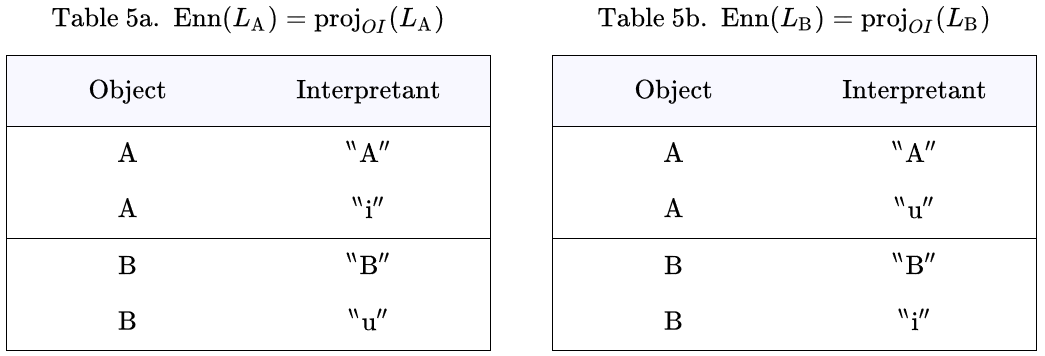
As it happens, the sign relations L_\mathrm{A} and L_\mathrm{B} are fully symmetric with respect to exchanging signs and interpretants, so all the data of \mathrm{proj}_{OS} L_\mathrm{A} is echoed unchanged in \mathrm{proj}_{OI} L_\mathrm{A} and all the data of \mathrm{proj}_{OS} L_\mathrm{B} is echoed unchanged in \mathrm{proj}_{OI} L_\mathrm{B}.

Tables 5a and 5b show the ennotative components of the sign relations associated with the interpreters \mathrm{A} and \mathrm{B}, respectively.  The rows of each Table list the ordered pairs (o, i) in the corresponding projections, \mathrm{Enn}(L_\mathrm{A}), \mathrm{Enn}(L_\mathrm{B}) \subseteq O \times I.

Ennotative Components Enn(L_A) and Enn(L_B)

References

  • Peirce, C.S. (1902), “Parts of Carnegie Application” (L 75), in Carolyn Eisele (ed., 1976), The New Elements of Mathematics by Charles S. Peirce, vol. 4, 13–73.  Online.
  • Awbrey, J.L., and Awbrey, S.M. (1995), “Interpretation as Action : The Risk of Inquiry”, Inquiry : Critical Thinking Across the Disciplines 15(1), pp. 40–52.  ArchiveJournalOnline.

Resources

Document History

Portions of the above article were adapted from the following sources under the GNU Free Documentation License, under other applicable licenses, or by permission of the copyright holders.

cc: CyberneticsOntolog • Peirce List (1) (2)Structural ModelingSystems Science

Posted in C.S. Peirce, Logic, Logic of Relatives, Mathematics, Peirce, Peirce's Categories, Philosophy, Pragmatic Semiotic Information, Pragmatism, Relation Theory, Semiotics, Sign Relations, Thirdness, Triadic Relations, Triadicity | Tagged , , , , , , , , , , , , , , | 5 Comments

Sign Relations • Discussion 7

Re: Sign Relations • Definition
Re: Ontolog ForumAlex Shkotin

Dear Alex,

Please forgive the long and winding dissertation.  I’ve been through many discussions of Peirce’s definition of “logic as formal semiotic” but I keep discovering new ways of reading what I once regarded as a straightforward proposition.  That’s all useful information but it makes me anxious to avoid any missteps of interpretation I might have made in the past.  At any rate, I think I’ve set enough background and context to begin addressing your comments now.

For ease of reference here is Peirce’s twofold definition again.

Logic will here be defined as formal semiotic.  A definition of a sign will be given which no more refers to human thought than does the definition of a line as the place which a particle occupies, part by part, during a lapse of time.  Namely, a sign is something, A, which brings something, B, its interpretant sign determined or created by it, into the same sort of correspondence with something, C, its object, as that in which itself stands to C.  It is from this definition, together with a definition of “formal”, that I deduce mathematically the principles of logic.  I also make a historical review of all the definitions and conceptions of logic, and show, not merely that my definition is no novelty, but that my non-psychological conception of logic has virtually been quite generally held, though not generally recognized.  (C.S. Peirce, NEM 4, 20–21).

Turning to your first comment

A Sign is unusually active in Peirce’s definition:

A (a sign) brings B (interpretant sign) into correspondence with C (object of sign).

Moreover, A determines B or even creates B.

It would be nice to get an example of such an active sign, its interpretant sign, and an object.  My point is to make the Peirce definition as clear as to be formalized.

Several issues stand out.  There are questions about paraphrases, the active character of signs, and the nature of what is being defined.

  • The problem of paraphrases arises at this point because it affects how literally we ought to take the words in a natural language proxy for a logical or mathematical formula.

    For example, a conventional idiom in describing a mathematical function f : X \to Y is to say f “maps” or “sends” an element of X to an element of Y.  A concrete verb may quicken the intuition but the downside is its power to evoke excess meanings beyond the abstract intention.  It is only as we become more familiar with the formal subject matter of sign relations that we can decide what kind of “bringing” and “creating” and “determining” is really going on in all that sign, object, interpretant relating, whether at the abstract level or in a given application.

  • There is the question of a sign’s active character.  Where’s the dynamic function in all that static structure?  Klaus Krippendorff raised the same question in regard to the Parable of the Sunflower back at the beginning of this discussion.

    [Peirce’s] triadic explanations do not cover the dynamics of the sunflower’s behavior.  It favors static descriptions which cybernetics is fundamentally opposed to, moreover including the cybernetician as enactor of his or her conceptual system.

    I have not forgotten this question.  Indeed, it’s the question at the heart of my work on Inquiry Driven Systems, which led me back to grad school in Systems Engineering “to develop mutual applications of systems theory and artificial intelligence to each other”.

    Anything approaching an adequate answer to that question is going to be one of those things requiring more background and context, all in good time, but there are a few hints we can take from Peirce’s text about the way forward.

    A definition of a sign will be given which no more refers to human thought than does the definition of a line as the place which a particle occupies, part by part, during a lapse of time.

    My reading of that tells me about a division of labor across three levels of abstraction.  There is a level of psychological experience and social activity, a level of dynamic process and temporal pattern, and a level of mathematical form.

To be continued …

References

  • Peirce, C.S. (1902), “Parts of Carnegie Application” (L 75), in Carolyn Eisele (ed., 1976), The New Elements of Mathematics by Charles S. Peirce, vol. 4, 13–73.  Online.
  • Awbrey, J.L., and Awbrey, S.M. (1995), “Interpretation as Action : The Risk of Inquiry”, Inquiry : Critical Thinking Across the Disciplines 15(1), pp. 40–52.  ArchiveJournalOnline.

Resources

cc: CyberneticsOntolog • Peirce List (1) (2)Structural ModelingSystems Science

Posted in C.S. Peirce, Logic, Logic of Relatives, Mathematics, Peirce, Peirce's Categories, Philosophy, Pragmatic Semiotic Information, Pragmatism, Relation Theory, Semiotics, Sign Relations, Thirdness, Triadic Relations, Triadicity | Tagged , , , , , , , , , , , , , , | 6 Comments

Survey of Inquiry Driven Systems • 2

This is a Survey of blog and wiki posts on Inquiry Driven Systems, material I plan to refine toward a more compact and systematic treatment of the subject.

An inquiry driven system is a system having among its state variables some representing its state of information with respect to various topics of interest, for example, its own state and the states of any potential object systems.  Thus it has a component of state tracing a trajectory though an information state space.

Elements

Blog Dialogs

Developments

Applications

Posted in Abduction, Action, Adaptive Systems, Aristotle, Artificial Intelligence, Automated Research Tools, Change, Cognitive Science, Communication, Cybernetics, Deduction, Descartes, Dewey, Discovery, Doubt, Education, Educational Systems Design, Educational Technology, Fixation of Belief, Induction, Information, Information Theory, Inquiry, Inquiry Driven Systems, Inquiry Into Inquiry, Intelligent Systems, Interpretation, Invention, Kant, Knowledge, Learning, Learning Theory, Logic, Logic of Science, Mathematics, Mental Models, Peirce, Pragmatic Maxim, Pragmatism, Process Thinking, Scientific Inquiry, Semiotics, Sign Relations, Surveys, Teaching, Triadic Relations, Visualization | Tagged , , , , , , , , , , , , , , , , , , , , , , , , , , , , , , , , , , , , , , , , , , , , , , | 1 Comment

Peirce’s Categories • 21

Re: Peirce ListRobert Marty

Dear Robert,

Let’s go back to a point where paths diverged in the yarrow wood and a lot of synchronicity was lost …

Variant understandings of words like axiom, definition, predicate, proposition, proof, relation, theory, and the like make mutual understanding difficult.  For example, when I mention Peirce’s definition of a sign, many people will bring to mind a long list of short statements Peirce made in describing the properties of signs, and when I refer to Peirce’s theory of signs, many people will bring to mind the entire corpus of Peirce’s writings on signs, so far as they know it, augmented perhaps with reliable reports of statements he may have made about signs.

There are fields of study where such expansive understandings of definitions and theories are the prevailing ones, perhaps the only feasible ones.  One example would be scriptural hermeneutics, where the full sense of a word’s meaning is determined by its use in every context where it occurs.  Thus the use of concordances to bring the diversity of contextual meanings into harmony.  We plow this field in a hermeneutic circle, according each bit of authoritative text equal priority, none privileged above the other, as if equidistant from a central point radiating a pervasive message.  It’s all you can do when there’s nothing but the text in view.

Curiously enough, the branch of mathematical logic known as model theory sets out with an equally expansive view, taking a maximally inclusive definition of theory as its initial point of departure and defining a theory as an arbitrary set of sentences from a formal language.  Naturally, logical and mathematical attention almost immediately shifts to more focused spheres of theory.

A set \Gamma of sentences is called a theory.  A theory is said to be closed iff every consequence of \Gamma belongs to \Gamma.  A set \Delta of sentences is said to be a set of axioms for a theory \Gamma iff \Gamma and \Delta have the same consequences.  A theory is called finitely axiomatizable iff it has a finite set of axioms.  Since we may form the conjunction of a finite set of axioms, a finitely axiomatizable theory actually always has a single axiom.  The set \bar\Gamma of all consequences of \Gamma is the unique closed theory which has \Gamma as a set of axioms.  (Chang and Keisler, p. 12).

That’s all well and good as far as esoteric technical usage goes but outside those cloisters I would recommend using the word corpus when we want to talk about an arbitrary set of sentences or texts and reserving the word theory for those corpora possessing more differentiated and substantial anatomies than a mere hermeneutic blastula.

Reference

  • Chang, C.C., and Keisler, H.J. (1973), Model Theory, North-Holland, Amsterdam.

Resources

cc: CyberneticsOntolog • Peirce List (1) (2) (3)Structural ModelingSystems Science

Posted in Abstraction, Aristotle, C.S. Peirce, Category Theory, Logic, Logic of Relatives, Mathematics, Peirce, Peirce's Categories, Phenomenology, Pragmatic Maxim, Relation Theory, Semiotics, Triadic Relations, Triadicity, Type Theory | Tagged , , , , , , , , , , , , , , , | 6 Comments

Sign Relations • Connotation

Another aspect of a sign’s complete meaning concerns the reference a sign has to its interpretants, which interpretants are collectively known as the connotation of the sign.  In the pragmatic theory of sign relations, connotative references fall within the projection of the sign relation on the plane spanned by its sign domain and its interpretant domain.

In the full theory of sign relations the connotative aspect of meaning includes the links a sign has to affects, concepts, ideas, impressions, intentions, and the whole realm of an interpretive agent’s mental states and allied activities, broadly encompassing intellectual associations, emotional impressions, motivational impulses, and real conduct.  Taken at the full, in the natural setting of semiotic phenomena, this complex system of references is unlikely ever to find itself mapped in much detail, much less completely formalized, but the tangible warp of its accumulated mass is commonly alluded to as the connotative import of language.

Formally speaking, however, the connotative aspect of meaning presents no additional difficulty.  The dyadic relation making up the connotative aspect of a sign relation L is notated as \mathrm{Con}(L).  Information about the connotative aspect of meaning is obtained from L by taking its projection on the sign-interpretant plane.  We may visualize this as the “shadow” L casts on the 2-dimensional space whose axes are the sign domain S and the interpretant domain I.  The connotative component of a sign relation L, alternatively written in any of forms, \mathrm{proj}_{SI} L,  L_{SI},  \mathrm{proj}_{23} L,  and L_{23}, is defined as follows.

\begin{matrix}  \mathrm{Con}(L) & = & \mathrm{proj}_{SI} L & = &  \{ (s, i) \in S \times I ~:~ (o, s, i) \in L ~\text{for some}~ o \in O \}.  \end{matrix}

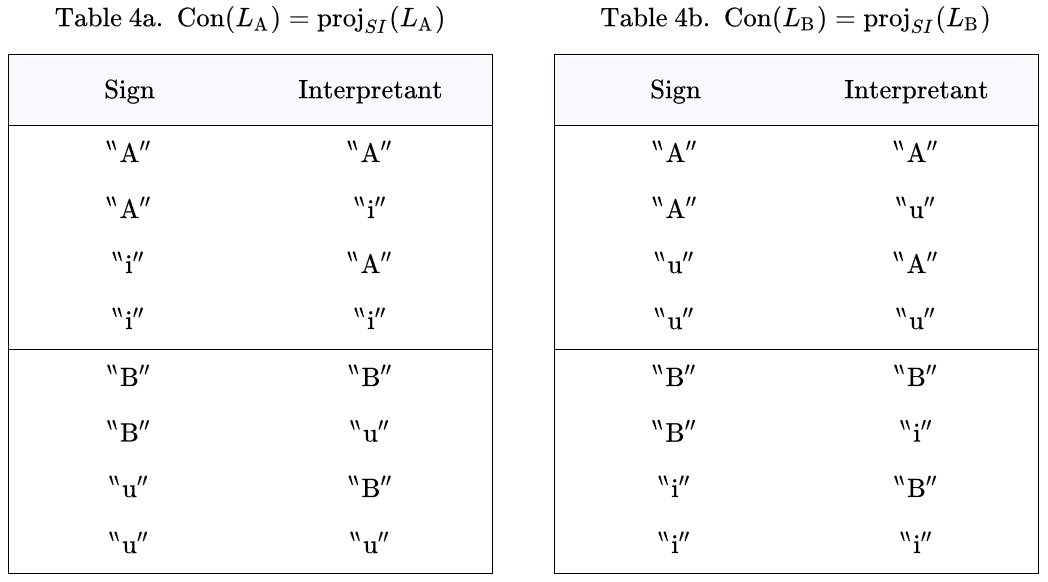
Tables 4a and 4b show the connotative components of the sign relations associated with the interpreters \mathrm{A} and \mathrm{B}, respectively.  The rows of each Table list the ordered pairs (s, i) in the corresponding projections, \mathrm{Con}(L_\mathrm{A}), \mathrm{Con}(L_\mathrm{B}) \subseteq S \times I.

Connotative Components Con(L_A) and Con(L_B)

References

  • Peirce, C.S. (1902), “Parts of Carnegie Application” (L 75), in Carolyn Eisele (ed., 1976), The New Elements of Mathematics by Charles S. Peirce, vol. 4, 13–73.  Online.
  • Awbrey, J.L., and Awbrey, S.M. (1995), “Interpretation as Action : The Risk of Inquiry”, Inquiry : Critical Thinking Across the Disciplines 15(1), pp. 40–52.  ArchiveJournalOnline.

Resources

Document History

Portions of the above article were adapted from the following sources under the GNU Free Documentation License, under other applicable licenses, or by permission of the copyright holders.

cc: CyberneticsOntolog • Peirce List (1) (2)Structural ModelingSystems Science

Posted in C.S. Peirce, Logic, Logic of Relatives, Mathematics, Peirce, Peirce's Categories, Philosophy, Pragmatic Semiotic Information, Pragmatism, Relation Theory, Semiotics, Sign Relations, Thirdness, Triadic Relations, Triadicity | Tagged , , , , , , , , , , , , , , | 3 Comments

Sign Relations • Denotation

One aspect of a sign’s complete meaning concerns the reference a sign has to its objects, which objects are collectively known as the denotation of the sign.  In the pragmatic theory of sign relations, denotative references fall within the projection of the sign relation on the plane spanned by its object domain and its sign domain.

The dyadic relation making up the denotative, referent, or semantic aspect of a sign relation L is notated as \mathrm{Den}(L).  Information about the denotative aspect of meaning is obtained from L by taking its projection on the object-sign plane.  We may visualize this as the “shadow” L casts on the 2-dimensional space whose axes are the object domain O and the sign domain S.  The denotative component of a sign relation L, alternatively written in any of forms, \mathrm{proj}_{OS} L,  L_{OS},  \mathrm{proj}_{12} L,  and L_{12}, is defined as follows.

\begin{matrix}  \mathrm{Den}(L) & = & \mathrm{proj}_{OS} L & = &  \{ (o, s) \in O \times S ~:~ (o, s, i) \in L ~\text{for some}~ i \in I \}.  \end{matrix}

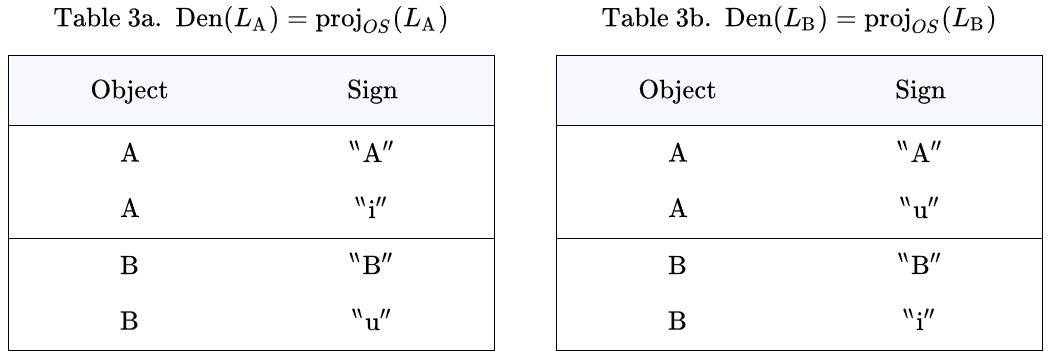
Tables 3a and 3b show the denotative components of the sign relations associated with the interpreters \mathrm{A} and \mathrm{B}, respectively.  The rows of each Table list the ordered pairs (o, s) in the corresponding projections, \mathrm{Den}(L_\mathrm{A}), \mathrm{Den}(L_\mathrm{B}) \subseteq O \times S.

Denotative Components Den(L_A) and Den(L_B)

Looking to the denotative aspects of L_\mathrm{A} and L_\mathrm{B}, various rows of the Tables specify, for example, that \mathrm{A} uses {}^{\backprime\backprime} \mathrm{i} {}^{\prime\prime} to denote \mathrm{A} and {}^{\backprime\backprime} \mathrm{u} {}^{\prime\prime} to denote \mathrm{B}, while \mathrm{B} uses {}^{\backprime\backprime} \mathrm{i} {}^{\prime\prime} to denote \mathrm{B} and {}^{\backprime\backprime} \mathrm{u} {}^{\prime\prime} to denote \mathrm{A}.

References

  • Peirce, C.S. (1902), “Parts of Carnegie Application” (L 75), in Carolyn Eisele (ed., 1976), The New Elements of Mathematics by Charles S. Peirce, vol. 4, 13–73.  Online.
  • Awbrey, J.L., and Awbrey, S.M. (1995), “Interpretation as Action : The Risk of Inquiry”, Inquiry : Critical Thinking Across the Disciplines 15(1), pp. 40–52.  ArchiveJournalOnline.

Resources

Document History

Portions of the above article were adapted from the following sources under the GNU Free Documentation License, under other applicable licenses, or by permission of the copyright holders.

cc: CyberneticsOntolog • Peirce List (1) (2)Structural ModelingSystems Science

Posted in C.S. Peirce, Logic, Logic of Relatives, Mathematics, Peirce, Peirce's Categories, Philosophy, Pragmatic Semiotic Information, Pragmatism, Relation Theory, Semiotics, Sign Relations, Thirdness, Triadic Relations, Triadicity | Tagged , , , , , , , , , , , , , , | 3 Comments

Sign Relations • Discussion 6

Re: Sign RelationsDefinitionExamples
Re: Ontolog Forum • Alex Shkotin (1) (2) (3)

Dear Alex,

We all love natural languages, our native tongues, but each one has a mind of its own and a habit of saying both more and less and something other than the meanings we intend at the moment of utterance.  So maybe it’s a love‑hate relationship, or at least a Liebeskampf.

Whether we are endowed with an inborn faculty for language, even a genetic blueprint for selected species of languages on a par with our naturally evolved motor and sense organs, or whether we acquire our initial languages from scratch, every natural language worth its salt preserves a rich heritage of biological and cultural meanings its users will assimilate, consciously or otherwise.  I would not say “resistance is futile” but habits of thought built into our first and second natures demand persistent habits of critical reflection to break.

We do use natural language paraphrases to “express the meaning of [a logical formula] using different words, especially to achieve greater clarity” and up to a point they serve that end.  But there’s a catch.  If a natural language paraphrase could express the precise meaning of a logical formula with greater clarity, what would be the use of the formula?

Well, that’s the beginning of a post I started on the spectrum of formality from form to formal object to formula to paraphrase.  But I decided to let it simmer for another day.  Now that we have a workbench stocked with concrete examples of triadic relations and sign relations we might as well use them to illustrate the abstractions while keeping our feet on more solid ground.

I’ll turn to that task next.

References

  • Awbrey, S.M., and Awbrey, J.L. (2001), “Conceptual Barriers to Creating Integrative Universities”, Organization : The Interdisciplinary Journal of Organization, Theory, and Society 8(2), Sage Publications, London, UK, pp. 269–284.  AbstractOnline.
  • Peirce, C.S. (1902), “Parts of Carnegie Application” (L 75), in Carolyn Eisele (ed., 1976), The New Elements of Mathematics by Charles S. Peirce, vol. 4, 13–73.  Online.

Resources

cc: CyberneticsOntolog • Peirce List (1) (2)Structural ModelingSystems Science

Posted in C.S. Peirce, Logic, Logic of Relatives, Mathematics, Peirce, Peirce's Categories, Philosophy, Pragmatic Semiotic Information, Pragmatism, Relation Theory, Semiotics, Sign Relations, Thirdness, Triadic Relations, Triadicity | Tagged , , , , , , , , , , , , , , | 6 Comments

Sign Relations • Dyadic Aspects

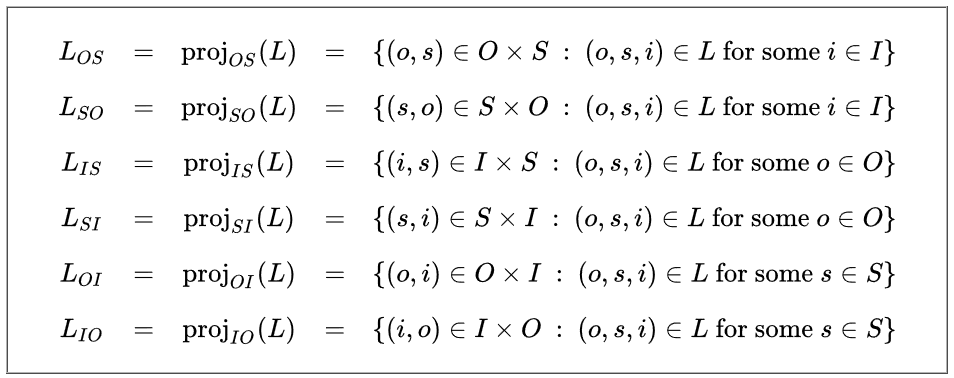
For an arbitrary triadic relation L \subseteq O \times S \times I, whether it is a sign relation or not, there are six dyadic relations obtained by projecting L on one of the planes of the OSI-space O \times S \times I.  The six dyadic projections of a triadic relation L are defined and notated as shown in Table 2.

\text{Table 2.} ~~ \text{Dyadic Aspects of Triadic Relations}

Dyadic Aspects of Triadic Relations

By way of unpacking the set-theoretic notation, here is what the first definition says in ordinary language.

The dyadic relation resulting from the projection of L on the OS-plane O \times S is written briefly as L_{OS} or written more fully as \mathrm{proj}_{OS}(L) and is defined as the set of all ordered pairs (o, s) in the cartesian product O \times S for which there exists an ordered triple (o, s, i) in L for some interpretant i in the interpretant domain I.

In the case where L is a sign relation, which it becomes by satisfying one of the definitions of a sign relation, some of the dyadic aspects of L can be recognized as formalizing aspects of sign meaning which have received their share of attention from students of signs over the centuries, and thus they can be associated with traditional concepts and terminology.  Of course, traditions may vary as to the precise formation and usage of such concepts and terms.  Other aspects of meaning have not received their fair share of attention, and thus remain anonymous on the contemporary scene of sign studies.

References

  • Peirce, C.S. (1902), “Parts of Carnegie Application” (L 75), in Carolyn Eisele (ed., 1976), The New Elements of Mathematics by Charles S. Peirce, vol. 4, 13–73.  Online.
  • Awbrey, J.L., and Awbrey, S.M. (1995), “Interpretation as Action : The Risk of Inquiry”, Inquiry : Critical Thinking Across the Disciplines 15(1), pp. 40–52.  ArchiveJournalOnline.

Resources

Document History

Portions of the above article were adapted from the following sources under the GNU Free Documentation License, under other applicable licenses, or by permission of the copyright holders.

cc: CyberneticsOntolog • Peirce List (1) (2)Structural ModelingSystems Science

Posted in C.S. Peirce, Logic, Logic of Relatives, Mathematics, Peirce, Peirce's Categories, Philosophy, Pragmatic Semiotic Information, Pragmatism, Relation Theory, Semiotics, Sign Relations, Thirdness, Triadic Relations, Triadicity | Tagged , , , , , , , , , , , , , , | 3 Comments

Animated Logical Graphs • 33

A reader’s request for more examples of animated logical graphs prompted me to look again at the User Guide for my Theme One Program, whose exposition develops a series of logical graphs increasing in complexity from extremely simple to more substantial than any I’ve posted so far.

I’m thinking now it may be worthwhile to look at those examples again and see if they’re suitable for recycling as a series of blog posts.

Resources

cc: CyberneticsOntolog • Peirce List (1) (2) (3)Structural ModelingSystems Science

Posted in Amphecks, Animata, Boolean Algebra, Boolean Functions, C.S. Peirce, Cactus Graphs, Constraint Satisfaction Problems, Deduction, Diagrammatic Reasoning, Duality, Equational Inference, Graph Theory, Laws of Form, Logic, Logical Graphs, Mathematics, Minimal Negation Operators, Model Theory, Painted Cacti, Peirce, Proof Theory, Propositional Calculus, Propositional Equation Reasoning Systems, Spencer Brown, Theorem Proving, Visualization | Tagged , , , , , , , , , , , , , , , , , , , , , , , , , | 8 Comments