Mathematical Method • Discussion 1

Re: Peirce ListJohn Sowa

Dear John,

Thanks for the notice of Carolyn Eisele’s article — it’s always worth reading what she has to say.  We’ve had discussions of Peirce’s distinction between theorematic and corollarial reasoning before and I know there’s a respectable amount of literature out there about it.

The subject has curiously enough come up just recently in discussions on Facebook and Academia.edu, mostly on account of points brought up by John Corcoran.  It’s also related to a number of discussions I’ve had over the years about the difference between “insight” proofs and “routine” proofs, partly in connection with theorem proving apps and Peirce’s logical graphs.

Usually these discussions take off into the stratosphere of high‑sounding blue‑skying about Gödel incompleteness and all that — but I want to keep my focus on more nuts and bolts issues at the moment and I’ll try to avoid going off on those planes.

Reference

  • Eisele, C. (1982), “Mathematical Methodology in the Thought of Charles S. Peirce”, Historia Mathematica 9, pp. 333–341.  OnlinePDF.

cc: CyberneticsOntolog • Peirce List (1) (2) (3)Structural ModelingSystems Science

Posted in Abstraction, C.S. Peirce, Essentialism, Hypostatic Abstraction, Logic, Mathematics, Metaphysics, Method, Nominalism, Ockham, Ockham's Razor, Peirce, Pragmatic Maxim, Pragmatism, Realism, Semiotics, Theory | Tagged , , , , , , , , , , , , , , , , | Leave a comment

Differential Analytic Turing Automata • Discussion 2

Re: Scott AaronsonThe Busy Beaver Frontier

Dear Scott,

This discussion inspired me to go back and look at some of the work I did in the late 80s when I was trying to understand Cook’s Theorem.  One of the programs I wrote to explore the integration of sequential learning and propositional reasoning had a propositional calculus module based on an extension of C.S. Peirce’s logical graphs, so I used that syntax to write out the clauses for finite approximations to Turing machines, taking the 4-state parity machine from Herbert S. Wilf’s Algorithms and Complexity as an object example.  It was 1989 and all I had was a 289 PC with 600K heap, but I did manage to emulate a parity machine capable of 1 bit of computation.  Here’s a link to an exposition of that.

It may be quicker to skip to Part 2 and refer to Part 1 only as needed.

I’ll work up the case of a 2-state Busy Beaver when I get a chance.
I always learned a lot just from looking at the propositional form.

cc: CyberneticsOntolog ForumPeirce ListStructural ModelingSystems Science

Posted in Algorithms, Boolean Functions, C.S. Peirce, Cactus Graphs, Computational Complexity, Differential Analytic Turing Automata, Differential Logic, Logic, Logical Graphs, Peirce, Propositional Calculus, Turing Machines | Tagged , , , , , , , , , , , | Leave a comment

Riffs and Rotes • 5

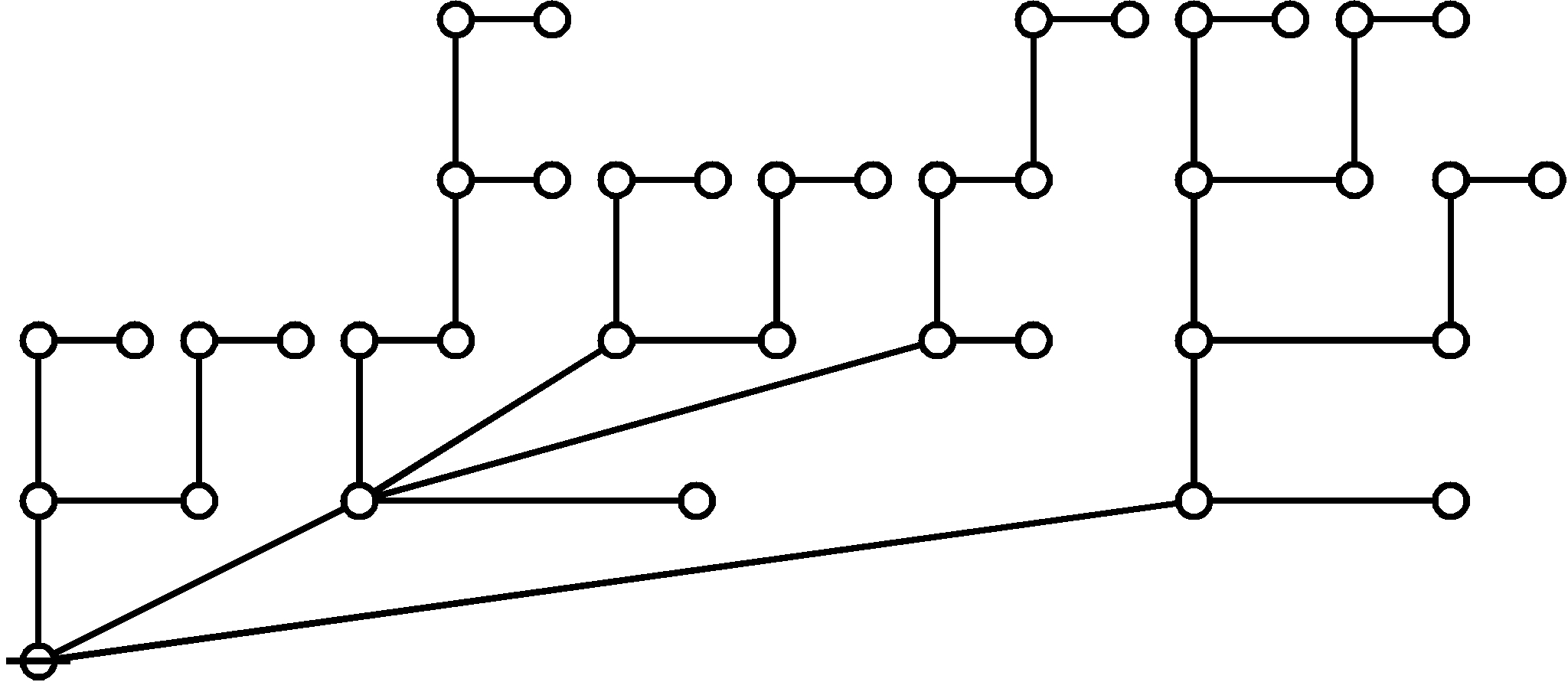
Rote 123456789

Re: Scott AaronsonThe Busy Beaver Frontier

All my favorite integer sequences, some very fast growing, spring from the “lambda point” where graph theory, logic, and number theory meet.  My fascination with them goes back to a time when I was playing around with Gödel numbers of graph-theoretic structures and thinking about computational complexity.  I’m busy as a beaver with other business at the moment so I’ll leave it now with just a few links to chew on till whenever.

Resources

Posted in Algebra, Combinatorics, Graph Theory, Group Theory, Logic, Mathematics, Number Theory, Riffs and Rotes | Tagged , , , , , , , | 2 Comments

Differential Logic, Dynamic Systems, Tangent Functors • Discussion 9

Re: FB | Systems SciencesKenneth Lloyd

Dear Kenneth,

Mulling over recent discussions put me in a pensive frame of mind and my thoughts led me back to my first encounter with category theory.  I came across the term while reading and I didn’t fully understand it.  But I distinctly remember a short time later catching up with my math TA — it was on the path by the tennis courts behind Spartan Stadium — and asking him about it.

The instruction I received that day was roughly along the following lines.

“Actually . . . we’re already doing a little category theory, without quite calling it that.  Think about the different types of spaces we’ve been discussing in class, the real line \mathbb{R}, the various dimensions of real-value spaces, \mathbb{R}^n, \mathbb{R}^m, and so on, along with the various types of mappings between those spaces.  There are mappings from the real line \mathbb{R} into an n-dimensional space \mathbb{R}^n — we think of those as curves, paths, or trajectories.  There are mappings from the plane \mathbb{R}^2 to values in \mathbb{R} — we picture those as potential surfaces over the plane.  More generally, there are mappings from an n-dimensional space \mathbb{R}^n to values in \mathbb{R} — we think of those as scalar fields over \mathbb{R}^n — say, the temperature at each point of an n-dimensional volume.  There are mappings from \mathbb{R}^n to \mathbb{R}^n and mappings from \mathbb{R}^n to \mathbb{R}^m where n and m are different, all of which we call transformations or vector fields, depending on the use we have in mind.”

All that was pretty familiar to me, though I had to admire the panoramic sweep of his survey, so my mind’s eye naturally supplied all the arrows for the maps he rolled out.  A curve \gamma through an n-dimensional space would be typed as a function \gamma : \mathbb{R} \to \mathbb{R}^n, where the functional domain \mathbb{R} would ordinarily be regarded as a time dimension.  A mapping \alpha from the plane to a real value would be typed as a function \alpha : \mathbb{R}^2 \to \mathbb{R}, where we might be thinking of \alpha(x, y) as the altitude of a topographic map above each point (x, y) of the plane.  A scalar field \beta defined on an n-dimensional space would be typed as a function \beta : \mathbb{R}^n \to \mathbb{R}, where \beta(x_1, \ldots, x_n) is something like the pressure, the temperature, or the value of some other dependent variable at each point (x_1, \ldots, x_n) of the n-dimensional volume.  And rounding out the story, if only the basement and ground floor of a towering abstraction still under construction, we come to the general case of a mapping f from an n-dimensional space to an m-dimensional space, typed as a function f : \mathbb{R}^n \to \mathbb{R}^m.

To be continued …

Resources

cc: CyberneticsOntolog ForumPeirce ListStructural ModelingSystems Science

Posted in Amphecks, Boolean Functions, C.S. Peirce, Cactus Graphs, Category Theory, Cybernetics, Differential Analytic Turing Automata, Differential Calculus, Differential Logic, Discrete Dynamical Systems, Dynamical Systems, Graph Theory, Hill Climbing, Hologrammautomaton, Information Theory, Inquiry Driven Systems, Intelligent Systems, Knowledge Representation, Laws of Form, Logic, Logical Graphs, Mathematics, Minimal Negation Operators, Painted Cacti, Peirce, Propositional Calculus, Propositional Equation Reasoning Systems, Spencer Brown, Systems, Visualization | Tagged , , , , , , , , , , , , , , , , , , , , , , , , , , , , , | 8 Comments

Differential Logic, Dynamic Systems, Tangent Functors • Comment 1

Re: Differential Logic, Dynamic Systems, Tangent Functors • 1

Seeing as how quasi-neural models and the recurring issues of symbolic vs. connectionist paradigms have come round again, I thought I might revisit work I began initially in that context, investigating logical, qualitative, and symbolic analogues of systems studied by McClelland, Rumelhart, and the Parallel Distributed Processing Group, and especially Stephen Grossberg’s competition-cooperation models.

People interested in category theory as applied to systems may wish to check out the following article, reporting work I carried out while engaged in a systems engineering program at Oakland University.

The problem addressed is a longstanding one, namely, building bridges to negotiate the gap between qualitative and quantitative descriptions of complex phenomena, like those we meet in analyzing and engineering systems, especially intelligent systems endowed with a capacity for processing information and acquiring knowledge of objective reality.

One way the problem arises has to do with describing change in logical, qualitative, and symbolic terms, long before we grasp the reality beneath the appearances firmly enough to cast it in measured, quantitative, real-number form.

Development on the quantitative shore got no further than a Sisyphean beachhead until the invention of differential calculus by Leibniz and Newton, after which things advanced by leaps and bounds.  And there’s our clue what we need to do on the qualitative shore, namely, develop the missing logical analogue of differential calculus.

With that preamble …

Differential Logic and Dynamic Systems

This article develops a differential extension of propositional calculus and applies it to a context of problems arising in dynamic systems.  The work pursued here is coordinated with a parallel application that focuses on neural network systems, but the dependencies are arranged to make the present article the main and the more self-contained work, to serve as a conceptual frame and a technical background for the network project.

The reading continues at Differential Logic and Dynamic Systems

Resources

cc: Category Theory • Cybernetics (1) (2) (3) • Ontolog Forum (1) (2)
cc: Structural Modeling (1) (2) • Systems Science (1) (2)
cc: FB | Differential LogicLaws of FormPeirce List

Posted in Amphecks, Animata, Boolean Functions, C.S. Peirce, Cactus Graphs, Category Theory, Cybernetics, Differential Calculus, Differential Logic, Discrete Dynamical Systems, Dynamical Systems, Graph Theory, Information & Control, Inquiry Driven Systems, Intelligent Systems, Laws of Form, Logic, Logical Graphs, Mathematics, Minimal Negation Operators, Propositional Calculus, Propositional Equation Reasoning Systems, Spencer Brown, Visualization | Tagged , , , , , , , , , , , , , , , , , , , , , , , | 7 Comments

Category Theory • Comment 1

I’m deep in the middle of upgrading my intro to sign relations and I am determined to stick to it this time but there will be a phase when it’s critical to bring category theory to bear on the development.  I had a nagging sense we had been discussing category theory in a related connection just recently but when I went back through my records it turned out this was way back in late 2018.  (I was a bit occupied with moving our household and lost track of many loose threads.)  At any rate, I’ll just post a few links here as reminders of topics to pick up later.

cc: CyberneticsOntolog ForumPeirce ListStructural ModelingSystems Science

Posted in Abstraction, C.S. Peirce, Category Theory, Differential Logic, Graph Theory, Group Theory, Inquiry Driven Systems, Intelligent Systems, Knowledge Representation, Logic, Logical Graphs, Mathematics, Peirce, Peirce's Categories, Research Technology, Scientific Method, Semiotics, Set Theory, Sign Relations, Systems Theory, Triadic Relations | Tagged , , , , , , , , , , , , , , , , , , , , | Leave a comment

Sign Relations • Discussion 10

Re: CyberneticsKlaus KrippendorffBernard Scott
Re: OntologMihai NadinJohn SowaAlex Shkotin
Re: Peirce ListHelmut RaulienEdwina Taborsky

While engaged in a number of real and imaginary dialogues with people I continue to owe full replies, I thought it might be a good time to stand back and take in the view from this vantage point.  I summed up the desired outlook a few days ago in the following way.

The important thing now is to extend our perspective beyond one sign at a time and one object, sign, interpretant at a time to comprehending a sign relation as a specified set of object, sign, interpretant triples embedded in the set of all possible triples in a specified context.

If we now comprehend each sign relation L as an extended collection of triples (o, s, i), where each object o belongs to a set O of objects, each sign s belongs to a set S of signs, each interpretant i belongs to a set I of interpretants, and the whole sign relation L is embedded as a subset in the product space O \times S \times I, then our level of description ascends to the point where we take whole sign relations of this sort as the principal subjects of classification and structural analysis.

Once we adopt a whole systems perspective on sign relations we begin to see many commonplace topics in a fresh light.

Agency

That Peirce remodels his theory of semiosis from speaking of interpretive agents to speaking of interpretant signs is a familiar theme by now.  By way of reminder, we discussed this transformation recently in Discussion 4 and Discussion 5 of this series.

But we have to wonder:  Why does Peirce make this shift, this change of basis from interpreters to interpretants?  He does this because the idea of an interpreter stands in need of clarification and his method for clarifying ideas is to apply the pragmatic maxim.  The result is an operational definition of an interpreter in terms of its effects on signs in relation to their objects.

It would seem we have replaced an interpreter with a sign relation.  To be more precise, we are taking a sign relation as our effective model for the interpreter in question.  But we must not take this the wrong way.  There is no suggestion of reducing the hypostatic agent to a sign relation.  It falls within our capacity merely to clarify our concept of the agent to a moderate degree, to construct a model or a representation capturing aspects of the agent’s activity bearing on a particular application.

With that I’ve run out of time for today.  The topic for next time will be Context …

References

  • Peirce, C.S. (1902), “Parts of Carnegie Application” (L 75), in Carolyn Eisele (ed., 1976), The New Elements of Mathematics by Charles S. Peirce, vol. 4, 13–73.  Online.
  • Awbrey, J.L., and Awbrey, S.M. (1995), “Interpretation as Action : The Risk of Inquiry”, Inquiry : Critical Thinking Across the Disciplines 15(1), pp. 40–52.  ArchiveJournalOnline.

Resources

cc: CyberneticsOntolog • Peirce List (1) (2)Structural ModelingSystems Science

Posted in C.S. Peirce, Logic, Logic of Relatives, Mathematics, Peirce, Peirce's Categories, Philosophy, Pragmatic Semiotic Information, Pragmatism, Relation Theory, Semiotics, Sign Relations, Thirdness, Triadic Relations, Triadicity | Tagged , , , , , , , , , , , , , , | 8 Comments

Sign Relations • Discussion 9

Re: Sign Relations • Ennotation
Re: Peirce ListHelmut Raulien

Dear Helmut,

Thanks for your comments.  They prompt me to say a little more about the mathematical character of the sign relational models I’m using.

Peirce without mathematics is like science without mathematics.  In every direction of research he pioneered or prospected — information, inquiry, logic, semiotics — we trace his advances only so far, barely scratch the surface before we need to bring in mathematical models adequate to the complexity of the phenomena under investigation.

In recent years there has been a tendency in certain quarters to ignore the mathematical substrate of Peirce’s pragmatic thought, even a refusal to use the mathematical tools he crafted to the task of sharpening our understanding.  I do not recall that attitude being prevalent when I began my studies of Peirce’s work some fifty years ago.  The issue in the “reception of Peirce” over most of that time has largely been the tendency of people imbued in the traditions of “analytic philosophy” to dismiss Peirce out of hand.  But that school of thought had no problem with using mathematics, aside from the short-sighted attempts to reduce mathematics to logic and all relations to dyadic ones.

Maybe this late resistance to Peirce’s mathematical groundwork has come about through an overly selective viewing of his entire spectrum of work or maybe it’s just a matter of taste.  Whatever the case, it’s critical for people who are looking for adequate models of the complex phenomena involved in belief systems, communication, intelligent systems, knowledge representation, scientific inquiry, and so on to recognize that all the resources we need for working with relations in general as sets of ordered tuples and sign relations in particular as sets of ordered triples are already available in Peirce’s technical works from 1870 on.

Okay, it looks like I’ve used up my morning again with more preliminary matters but it seemed important to clear up a few things about the overall mathematical approach.

References

  • Peirce, C.S. (1902), “Parts of Carnegie Application” (L 75), in Carolyn Eisele (ed., 1976), The New Elements of Mathematics by Charles S. Peirce, vol. 4, 13–73.  Online.
  • Awbrey, J.L., and Awbrey, S.M. (1995), “Interpretation as Action : The Risk of Inquiry”, Inquiry : Critical Thinking Across the Disciplines 15(1), 40–52.  ArchiveJournal.  Online (doc) (pdf).

Resources

cc: CyberneticsOntolog • Peirce List (1) (2)Structural ModelingSystems Science

Posted in C.S. Peirce, Logic, Logic of Relatives, Mathematics, Peirce, Peirce's Categories, Philosophy, Pragmatic Semiotic Information, Pragmatism, Relation Theory, Semiotics, Sign Relations, Thirdness, Triadic Relations, Triadicity | Tagged , , , , , , , , , , , , , , | 7 Comments

Sign Relations • Semiotic Equivalence Relations 2

A few items of notation are useful in discussing equivalence relations in general and semiotic equivalence relations in particular.

In general, if E is an equivalence relation on a set X then every element x of X belongs to a unique equivalence class under E called the equivalence class of x under E.  Convention provides the square bracket notation for denoting such equivalence classes, in either the form [x]_E or the simpler form [x] when the subscript E is understood.  A statement that the elements x and y are equivalent under E is called an equation or an equivalence and may be expressed in any of the following ways.

\begin{array}{clc}  (x, y) & \in & E  \\[4pt]  x & \in & [y]_E  \\[4pt]  y & \in & [x]_E  \\[4pt]  [x]_E & = & [y]_E  \\[4pt]  x & =_E & y  \end{array}

Thus we have the following definitions.

\begin{array}{ccc}  [x]_E & = & \{ y \in X : (x, y) \in E \}  \\[6pt]  x =_E y & \Leftrightarrow & (x, y) \in E  \end{array}

In the application to sign relations it is useful to extend the square bracket notation in the following ways.  If L is a sign relation whose connotative component L_{SI} is an equivalence relation on S = I, let [s]_L be the equivalence class of s under L_{SI}.  That is, let [s]_L = [s]_{L_{SI}}.  A statement that the signs x and y belong to the same equivalence class under a semiotic equivalence relation L_{SI} is called a semiotic equation (SEQ) and may be written in either of the following forms.

\begin{array}{clc}  [x]_L & = & [y]_L  \\[6pt]  x & =_L & y  \end{array}

In many situations there is one further adaptation of the square bracket notation for semiotic equivalence classes that can be useful.  Namely, when there is known to exist a particular triple (o, s, i) in a sign relation L, it is permissible to let [o]_L be defined as [s]_L.  These modifications are designed to make the notation for semiotic equivalence classes harmonize as well as possible with the frequent use of similar devices for the denotations of signs and expressions.

Applying the array of equivalence notations to the sign relations for A and B will serve to illustrate their use and utility.
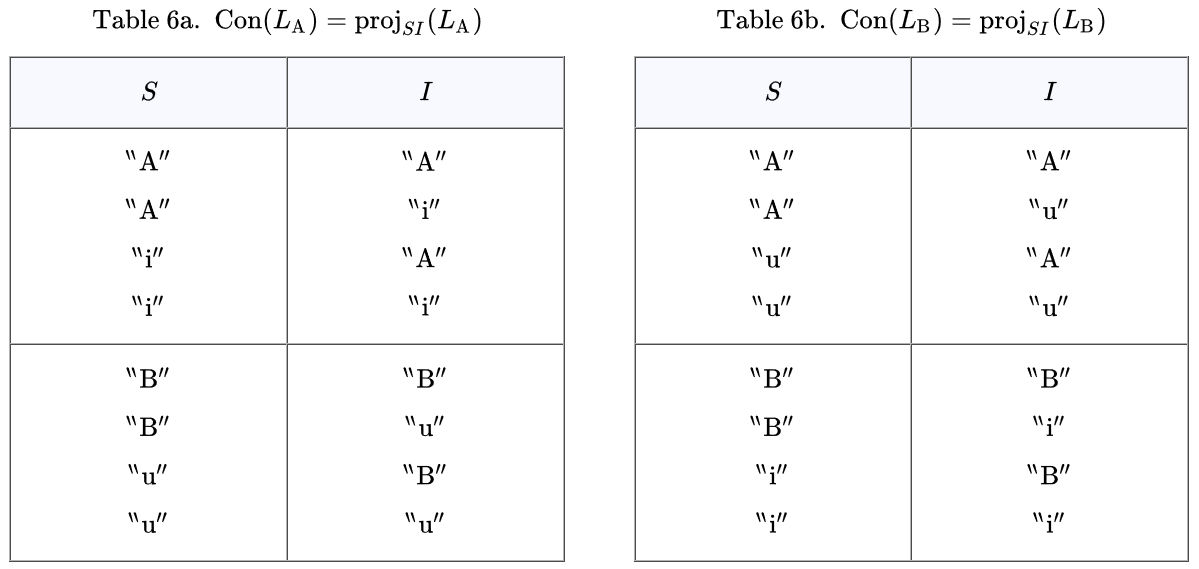
Connotative Components Con(L_A) and Con(L_B)

The semiotic equivalence relation for interpreter \mathrm{A} yields the following semiotic equations.

\begin{matrix}  [ {}^{\backprime\backprime} \mathrm{A} {}^{\prime\prime} ]_{L_\mathrm{A}}  & = &  [ {}^{\backprime\backprime} \mathrm{i} {}^{\prime\prime} ]_{L_\mathrm{A}}  \\[6pt]  [ {}^{\backprime\backprime} \mathrm{B} {}^{\prime\prime} ]_{L_\mathrm{A}}  & = &  [ {}^{\backprime\backprime} \mathrm{u} {}^{\prime\prime} ]_{L_\mathrm{A}}  \end{matrix}

or

\begin{matrix}  {}^{\backprime\backprime} \mathrm{A} {}^{\prime\prime}  & =_{L_\mathrm{A}} &  {}^{\backprime\backprime} \mathrm{i} {}^{\prime\prime}  \\[6pt]  {}^{\backprime\backprime} \mathrm{B} {}^{\prime\prime}  & =_{L_\mathrm{A}} &  {}^{\backprime\backprime} \mathrm{u} {}^{\prime\prime}  \end{matrix}

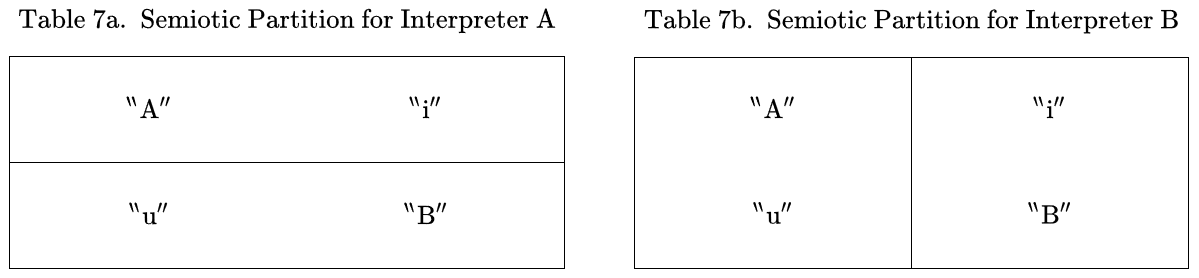
Thus it induces the semiotic partition:

\{ \{ {}^{\backprime\backprime} \mathrm{A} {}^{\prime\prime}, {}^{\backprime\backprime} \mathrm{i} {}^{\prime\prime} \}, \{ {}^{\backprime\backprime} \mathrm{B} {}^{\prime\prime}, {}^{\backprime\backprime} \mathrm{u} {}^{\prime\prime} \} \}.

The semiotic equivalence relation for interpreter \mathrm{B} yields the following semiotic equations.

\begin{matrix}  [ {}^{\backprime\backprime} \mathrm{A} {}^{\prime\prime} ]_{L_\mathrm{B}}  & = &  [ {}^{\backprime\backprime} \mathrm{u} {}^{\prime\prime} ]_{L_\mathrm{B}}  \\[6pt]  [ {}^{\backprime\backprime} \mathrm{B} {}^{\prime\prime} ]_{L_\mathrm{B}}  & = &  [ {}^{\backprime\backprime} \mathrm{i} {}^{\prime\prime} ]_{L_\mathrm{B}}  \end{matrix}

or

\begin{matrix}  {}^{\backprime\backprime} \mathrm{A} {}^{\prime\prime}  & =_{L_\mathrm{B}} &  {}^{\backprime\backprime} \mathrm{u} {}^{\prime\prime}  \\[6pt]  {}^{\backprime\backprime} \mathrm{B} {}^{\prime\prime}  & =_{L_\mathrm{B}} &  {}^{\backprime\backprime} \mathrm{i} {}^{\prime\prime}  \end{matrix}

Thus it induces the semiotic partition:

\{ \{ {}^{\backprime\backprime} \mathrm{A} {}^{\prime\prime}, {}^{\backprime\backprime} \mathrm{u} {}^{\prime\prime} \}, \{ {}^{\backprime\backprime} \mathrm{B} {}^{\prime\prime}, {}^{\backprime\backprime} \mathrm{i} {}^{\prime\prime} \} \}.

Semiotic Partitions for Interpreters A and B

References

  • Peirce, C.S. (1902), “Parts of Carnegie Application” (L 75), in Carolyn Eisele (ed., 1976), The New Elements of Mathematics by Charles S. Peirce, vol. 4, 13–73.  Online.
  • Awbrey, J.L., and Awbrey, S.M. (1995), “Interpretation as Action : The Risk of Inquiry”, Inquiry : Critical Thinking Across the Disciplines 15(1), pp. 40–52.  ArchiveJournalOnline.

Resources

Document History

Portions of the above article were adapted from the following sources under the GNU Free Documentation License, under other applicable licenses, or by permission of the copyright holders.

cc: CyberneticsOntolog • Peirce List (1) (2)Structural ModelingSystems Science

Posted in C.S. Peirce, Logic, Logic of Relatives, Mathematics, Peirce, Peirce's Categories, Philosophy, Pragmatic Semiotic Information, Pragmatism, Relation Theory, Semiotics, Sign Relations, Thirdness, Triadic Relations, Triadicity | Tagged , , , , , , , , , , , , , , | 3 Comments

Sign Relations • Discussion 8

Re: Sign Relations • Ennotation
Re: Peirce ListHelmut Raulien

Dear Helmut,

The important thing now is to extend our perspective beyond one sign at a time and one object, sign, interpretant at a time to comprehending a sign relation as a specified set of object, sign, interpretant triples embedded in the set of all possible triples in a specified context.

In my mind’s eye, no doubt influenced by my early interest in Gestalt Psychology, I always picture a sign relation as a gestalt composed of figure and ground.  The triples in the sign relation form a figure set in relief against the background of all possible triples and the triples left over form the ground of the gestalt.

From a mathematical point of view, the set of possible triples is a cartesian product of the following form.

O \times S \times I = \{ (o, s, i) : o \in O \land s \in S \land i \in I \}.

Here, O is the object domain, the set of objects under discussion, S is the sign domain, the specified set of signs, and I is the interpretant domain, the specified set of interpretants.

On this canvass, in this frame, any number of sign relations might be set as figures and each of them would be delimited as a salient subset of the cartesian product in view.  Letting L be any such sign relation, mathematical convention provides the following description of its relation to the set of possible triples.

L \subseteq O \times S \times I.

It’s important to note at this point that the specified cartesian product and the specified subset of it are equally critical parts of the sign relation’s definition.

Well, it took a lot longer to set the scene than I thought it would when I got up this morning, so I’ll break here and get back to your specific comments when I next get a chance.

References

  • Peirce, C.S. (1902), “Parts of Carnegie Application” (L 75), in Carolyn Eisele (ed., 1976), The New Elements of Mathematics by Charles S. Peirce, vol. 4, 13–73.  Online.
  • Awbrey, J.L., and Awbrey, S.M. (1995), “Interpretation as Action : The Risk of Inquiry”, Inquiry : Critical Thinking Across the Disciplines 15(1), pp. 40–52.  ArchiveJournalOnline.

Resources

cc: CyberneticsOntolog • Peirce List (1) (2)Structural ModelingSystems Science

Posted in C.S. Peirce, Logic, Logic of Relatives, Mathematics, Peirce, Peirce's Categories, Philosophy, Pragmatic Semiotic Information, Pragmatism, Relation Theory, Semiotics, Sign Relations, Thirdness, Triadic Relations, Triadicity | Tagged , , , , , , , , , , , , , , | 8 Comments