Differential Logic • Discussion 3

Re: R.J. LiptonP<NP

Instead of boolean circuit complexity I would look at logical graph complexity, where those logical graphs are constructed from minimal negation operators.

Physics once had a frame problem (complexity of dynamic updating) long before AI did but physics learned to reduce complexity through the use of differential equations and group symmetries (combined in Lie groups).  One of the promising features of minimal negation operators is their relationship to differential operators.  So I’ve been looking into that.  Here’s a link, a bit in medias res, but what I’ve got for now.

Resources

cc: CyberneticsOntolog • Peirce List (1) (2) (3)Structural ModelingSystems Science

Posted in Amphecks, Animata, Boolean Algebra, Boolean Functions, C.S. Peirce, Cactus Graphs, Category Theory, Change, Cybernetics, Differential Analytic Turing Automata, Differential Calculus, Differential Logic, Discrete Dynamics, Equational Inference, Frankl Conjecture, Functional Logic, Gradient Descent, Graph Theory, Hologrammautomaton, Indicator Functions, Inquiry Driven Systems, Leibniz, Logic, Logical Graphs, Mathematics, Minimal Negation Operators, Painted Cacti, Peirce, Propositional Calculus, Surveys, Time, Topology, Visualization, Zeroth Order Logic | Tagged , , , , , , , , , , , , , , , , , , , , , , , , , , , , , , , , , | 8 Comments

Sign Relations • Examples

Because the examples to follow have been artificially constructed to be as simple as possible, their detailed elaboration can run the risk of trivializing the whole theory of sign relations.  Despite their simplicity, however, these examples have subtleties of their own, and their careful treatment will serve to illustrate many important issues in the general theory of signs.

Imagine a discussion between two people, Ann and Bob, and attend only to the aspects of their interpretive practice involving the use of the following nouns and pronouns:

“Ann”,   “Bob”,   “I”,   “you”.

  • The object domain of their discussion is the set of two people \{ \text{Ann}, \text{Bob} \}.
  • The sign domain of their discussion is the set of four signs \{ {}^{\backprime\backprime} \text{Ann} {}^{\prime\prime}, {}^{\backprime\backprime} \text{Bob} {}^{\prime\prime}, {}^{\backprime\backprime} \text{I} {}^{\prime\prime}, {}^{\backprime\backprime} \text{you} {}^{\prime\prime} \}.

Ann and Bob are not only the passive objects of linguistic references but also the active interpreters of the language they use.  The system of interpretation (SOI) associated with each language user can be represented in the form of an individual three-place relation known as the sign relation of that interpreter.

In terms of its set-theoretic extension, a sign relation L is a subset of a cartesian product O \times S \times I.  The three sets O, S, I are known as the object domain, the sign domain, and the interpretant domain, respectively, of the sign relation L \subseteq O \times S \times I.

Broadly speaking, the three domains of a sign relation may be any sets at all but the types of sign relations contemplated in formal settings are usually constrained to having I \subseteq S.  In those situations it becomes convenient to lump signs and interpretants together in a single class called the sign system or the syntactic domain.  In the forthcoming examples S and I are identical as sets, so the same elements manifest themselves in two different roles of the sign relations in question.

When it becomes necessary to refer to the whole set of objects and signs in the union of the domains O, S, I for a given sign relation L, we will call this set the World of L and write W = W_L = O \cup S \cup I.

To facilitate an interest in the formal structures of sign relations and to keep notations as simple as possible as the examples become more complicated, it serves to introduce the following general notations:

\begin{array}{ccl}  O & = & \text{Object Domain}  \\[6pt]  S & = & \text{Sign Domain}  \\[6pt]  I & = & \text{Interpretant Domain}  \end{array}

Introducing a few abbreviations for use in this Example, we have the following data:

\begin{array}{cclcl}  O  & = &  \{ \text{Ann}, \text{Bob} \} & = & \{ \mathrm{A}, \mathrm{B} \}  \\[6pt]  S  & = &  \{ {}^{\backprime\backprime} \text{Ann} {}^{\prime\prime}, {}^{\backprime\backprime} \text{Bob} {}^{\prime\prime}, {}^{\backprime\backprime} \text{I} {}^{\prime\prime}, {}^{\backprime\backprime} \text{you} {}^{\prime\prime} \}  & = &  \{ {}^{\backprime\backprime} \mathrm{A} {}^{\prime\prime}, {}^{\backprime\backprime} \mathrm{B} {}^{\prime\prime}, {}^{\backprime\backprime} \mathrm{i} {}^{\prime\prime}, {}^{\backprime\backprime} \mathrm{u} {}^{\prime\prime} \}  \\[6pt]  I  & = &  \{ {}^{\backprime\backprime} \text{Ann} {}^{\prime\prime}, {}^{\backprime\backprime} \text{Bob} {}^{\prime\prime}, {}^{\backprime\backprime} \text{I} {}^{\prime\prime}, {}^{\backprime\backprime} \text{you} {}^{\prime\prime} \}  & = &  \{ {}^{\backprime\backprime} \mathrm{A} {}^{\prime\prime}, {}^{\backprime\backprime} \mathrm{B} {}^{\prime\prime}, {}^{\backprime\backprime} \mathrm{i} {}^{\prime\prime}, {}^{\backprime\backprime} \mathrm{u} {}^{\prime\prime} \}  \end{array}

In the present example, S = I = \text{Syntactic Domain}.

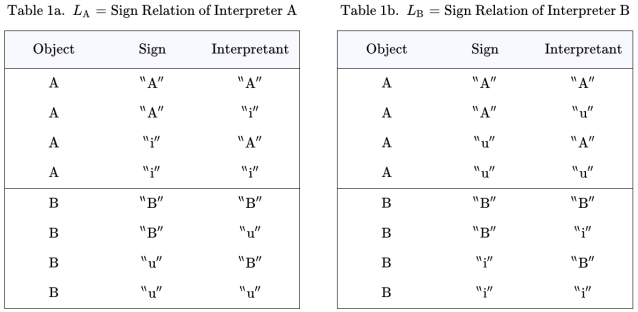
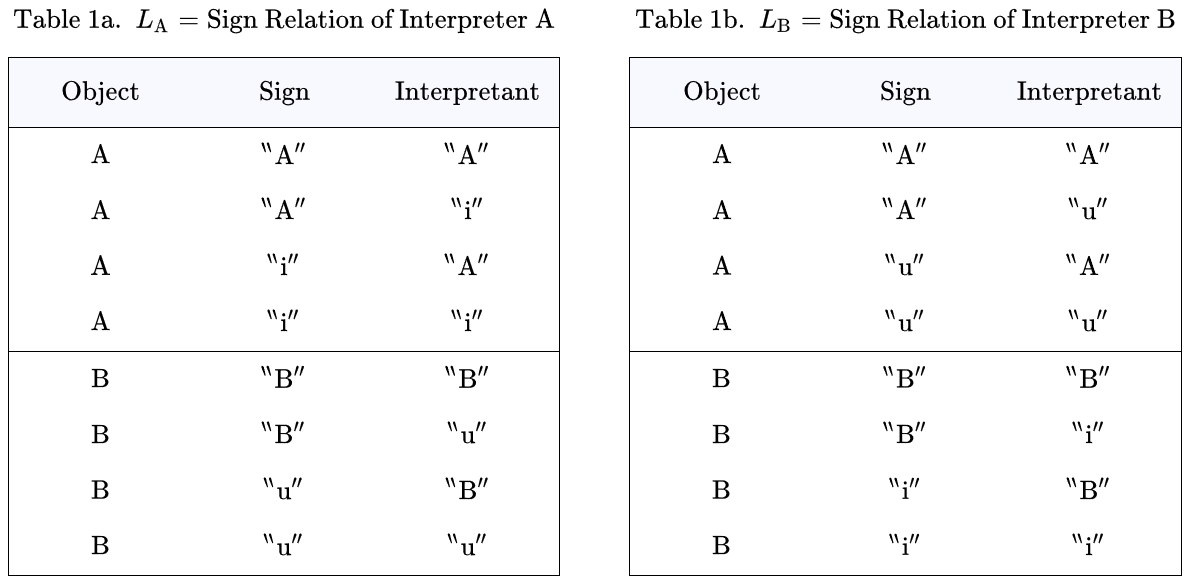
Tables 1a and 1b show the sign relations associated with the interpreters \mathrm{A} and \mathrm{B}, respectively.  In this arrangement the rows of each Table list the ordered triples of the form (o, s, i) belonging to the corresponding sign relations, L_\mathrm{A}, L_\mathrm{B} \subseteq O \times S \times I.

Sign Relation Twin Tables LA & LB

These Tables codify a rudimentary level of interpretive practice for the agents \mathrm{A} and \mathrm{B} and provide a basis for formalizing the initial semantics appropriate to their common syntactic domain.  Each row of a Table lists an object and two co-referent signs, making up an ordered triple of the form (o, s, i) called an elementary relation, that is, one element of the relation’s set-theoretic extension.

Already in this elementary context, there are several different meanings that might attach to the project of a formal semiotics, or a formal theory of meaning for signs.  In the process of discussing these alternatives, it is useful to introduce a few terms occasionally used in the philosophy of language to point out the needed distinctions.  That is the task we’ll turn to next.

References

  • Peirce, C.S. (1902), “Parts of Carnegie Application” (L 75), in Carolyn Eisele (ed., 1976), The New Elements of Mathematics by Charles S. Peirce, vol. 4, 13–73.  Online.
  • Awbrey, J.L., and Awbrey, S.M. (1995), “Interpretation as Action : The Risk of Inquiry”, Inquiry : Critical Thinking Across the Disciplines 15(1), pp. 40–52.  ArchiveJournalOnline.

Resources

Document History

Portions of the above article were adapted from the following sources under the GNU Free Documentation License, under other applicable licenses, or by permission of the copyright holders.

cc: CyberneticsOntolog • Peirce List (1) (2)Structural ModelingSystems Science

Posted in C.S. Peirce, Logic, Logic of Relatives, Mathematics, Peirce, Peirce's Categories, Philosophy, Pragmatic Semiotic Information, Pragmatism, Relation Theory, Semiotics, Sign Relations, Thirdness, Triadic Relations, Triadicity | Tagged , , , , , , , , , , , , , , | 4 Comments

Sign Relations • Discussion 5

Re: Sign Relations • Discussion 4
Re: Peirce ListJon AwbreyGary FuhrmanJon Alan SchmidtJon Awbrey

The transformative idea in Peirce’s case of the French interpreter is not the convertibility of term logic, propositional logic, and monadic predicate logic — a commonplace of logic from the time of Aristotle, if not in those words, obscured only by the false subtleties of the Frege-Russell tradition, though even Quine was woke enough in time to write a nice essay on it — but rather the transformation from interpreter models to interpretant models of semiosis.  The latter models are what Peirce and all in his train require for constructing abstract formal theories neutral on psychologism, materialism, biologism, and various other all too stolid -isms.

There’s more discussion of Peirce’s passage to the interpretant at the following locations.

References

  • Peirce, C.S. (1902), “Parts of Carnegie Application” (L 75), in Carolyn Eisele (ed., 1976), The New Elements of Mathematics by Charles S. Peirce, vol. 4, 13–73.  Online.
  • Peirce, C.S., Writings of Charles S. Peirce : A Chronological Edition, Peirce Edition Project (eds.), Indiana University Press, Bloomington and Indianapolis, IN, 1981–.  Cited as (CE volume, page).

Resources

cc: CyberneticsOntolog • Peirce List (1) (2)Structural ModelingSystems Science

Posted in C.S. Peirce, Logic, Logic of Relatives, Mathematics, Peirce, Peirce's Categories, Philosophy, Pragmatic Semiotic Information, Pragmatism, Relation Theory, Semiotics, Sign Relations, Thirdness, Triadic Relations, Triadicity | Tagged , , , , , , , , , , , , , , | 9 Comments

Sign Relations • Discussion 4

Re: Peirce ListEdwina Taborsky

A note on a couple of recurring themes may be useful at this point.

  1. Peirce’s “metaphorical argument” for transforming discussion of interpretive agents, whether individuals or communities, to discussion of interpretant signs is as follows.

I think we need to reflect upon the circumstance that every word implies some proposition or, what is the same thing, every word, concept, symbol has an equivalent term — or one which has become identified with it, — in short, has an interpretant.

Consider, what a word or symbol is;  it is a sort of representation.  Now a representation is something which stands for something.  …   A thing cannot stand for something without standing to something for that something.  Now, what is this that a word stands to?  Is it a person?

We usually say that the word homme stands to a Frenchman for man.  It would be a little more precise to say that it stands to the Frenchman’s mind — to his memory.  It is still more accurate to say that it addresses a particular remembrance or image in that memory.  And what image, what remembrance?  Plainly, the one which is the mental equivalent of the word homme — in short, its interpretant.  Whatever a word addresses then or stands to, is its interpretant or identified symbol.  …

The interpretant of a term, then, and that which it stands to are identical.  Hence, since it is of the very essence of a symbol that it should stand to something, every symbol — every word and every conception — must have an interpretant — or what is the same thing, must have information or implication.  (Peirce, CE 1, 466–467).

There’s additional discussion of this passage at the following locations.

  1. When we employ mathematical models to describe any domain of phenomena, we are always proceeding hypothetically and tentatively, and the modality of all mathematics, in its own right, is the possible.  That is because mathematical existence is existence in the modest sense of “whatever’s not inconsistent”.  In the idiom, “It’s would-be’s all the way down.”  In effect the ordinary scales of modality are flattened down to one mode, to wit, Be ♭.  It is not until we take the risk of acting on our abduced model that we encounter genuine brute force Secondness.

References

  • Peirce, C.S. (1902), “Parts of Carnegie Application” (L 75), in Carolyn Eisele (ed., 1976), The New Elements of Mathematics by Charles S. Peirce, vol. 4, 13–73.  Online.
  • Peirce, C.S., Writings of Charles S. Peirce : A Chronological Edition, Peirce Edition Project (eds.), Indiana University Press, Bloomington and Indianapolis, IN, 1981–.  Cited as (CE volume, page).

Resources

cc: CyberneticsOntolog • Peirce List (1) (2)Structural ModelingSystems Science

Posted in C.S. Peirce, Logic, Logic of Relatives, Mathematics, Peirce, Peirce's Categories, Philosophy, Pragmatic Semiotic Information, Pragmatism, Relation Theory, Semiotics, Sign Relations, Thirdness, Triadic Relations, Triadicity | Tagged , , , , , , , , , , , , , , | 11 Comments

Animated Logical Graphs • 32

Re: R.J. Lipton and K.W. ReganProof Checking

Dear Dick/Ken,

Here’s a place where I explore different shapes of proofs in a propositional calculus deriving from the graphical systems of Charles S. Peirce and G. Spencer Brown.

I don’t know whether that helps any with \mathrm{P} \overset{\underset{?}{}}{=} \mathrm{NP} but it does supply a lot of nice pictures to contemplate.

Resources

cc: CyberneticsOntolog • Peirce List (1) (2) (3)Structural ModelingSystems Science

Posted in Amphecks, Animata, Boolean Algebra, Boolean Functions, C.S. Peirce, Cactus Graphs, Constraint Satisfaction Problems, Deduction, Diagrammatic Reasoning, Duality, Equational Inference, Graph Theory, Laws of Form, Logic, Logical Graphs, Mathematics, Minimal Negation Operators, Model Theory, Painted Cacti, Peirce, Proof Theory, Propositional Calculus, Propositional Equation Reasoning Systems, Spencer Brown, Theorem Proving, Visualization | Tagged , , , , , , , , , , , , , , , , , , , , , , , , , | 8 Comments

Sign Relations • Discussion 3

Re: Sign Relations • Definition
Re: Ontolog Forum • Alex Shkotin (1) (2)

Regarding Peirce’s definition of a sign linked above, Alex Shkotin writes:

A Sign is unusually active in Peirce’s definition:

A (a sign) brings B (interpretant sign) into correspondence with C (object of sign).

Moreover, A determines B or even creates B.

It would be nice to get an example of such an active sign, its interpretant sign, and an object.  My point is to make the Peirce definition as clear as to be formalized.

Dear Alex,

Thanks for your comment.  It points to a problem lurking in the wings through all these discussions, so let’s nudge it on stage and throw a better light on it.

I remember my first formal logic prof in college being rather adamant about the difference between a logical formula, which supposedly bore its “logical form” on its sleeve — I recall the very figure he used — and any of its diverse and sundry natural language paraphrases.  As time wore on I would reconfigure many of the lessons impressed on me in those days, but that one has stuck, I’m guessing because it goes without saying in mathematical and scientific practice.

This treble clef, to vary the figure — forms as objects, formulas as signs, and paraphrases as interpretant signs — is the key to a fundamental theme.

A very wide field of discussion opens up at this point.  To begin we have the logical jump from forms to formulas and the semiotic drift from formulas to paraphrases.  Further on we’ll encounter a range of tensions between formal and informal contexts of inquiry.

Susan Awbrey and I discussed a related set of issues in our “Conceptual Barriers” paper.  Here is how we set up our treatment of three problematics.

  • Problematic 1 is the tension that arises along a dimension of increasing formalization in our mental models of the world, between what we may call the ‘informal context’ of real-world practice and the ‘formal context’ of specialized study.
  • Problematic 2 is the difficulty in communication that is created by differing mental models of the world, in other words, by the tendency among groups of specialists to form internally coherent but externally disparate systems of mental images.
  • Problematic 3 is a special type of communication difficulty that commonly arises between the ‘Two Cultures’ of the scientific and the humanistic disciplines.  A significant part of the problem derives from the differential emphasis that each group places on its use of symbolic and conceptual systems, limiting itself to either the denotative or the connotative planes of variation, but seldom integrating the two.

Please excuse the sweeping preamble.  It wasn’t meant to sweep your observations under the rug — it’s just so many discussions here and there on the web in recent days are reminding me of the larger designs beyond my more mundane focus on brass tacks matters.  I’ll bring this all back to bear on the everyday life of signs the next chance I get.

References

  • Awbrey, S.M., and Awbrey, J.L. (2001), “Conceptual Barriers to Creating Integrative Universities”, Organization : The Interdisciplinary Journal of Organization, Theory, and Society 8(2), Sage Publications, London, UK, pp. 269–284.  AbstractOnline.
  • Peirce, C.S. (1902), “Parts of Carnegie Application” (L 75), in Carolyn Eisele (ed., 1976), The New Elements of Mathematics by Charles S. Peirce, vol. 4, 13–73.  Online.

Resources

cc: CyberneticsOntolog • Peirce List (1) (2)Structural ModelingSystems Science

Posted in C.S. Peirce, Logic, Logic of Relatives, Mathematics, Peirce, Peirce's Categories, Philosophy, Pragmatic Semiotic Information, Pragmatism, Relation Theory, Semiotics, Sign Relations, Thirdness, Triadic Relations, Triadicity | Tagged , , , , , , , , , , , , , , | 8 Comments

Sign Relations • Signs and Inquiry

There is a close relationship between the pragmatic theory of signs and the pragmatic theory of inquiry.  In fact, the correspondence between the two studies exhibits so many congruences and parallels it is often best to treat them as integral parts of one and the same subject.  In a very real sense, inquiry is the process by which sign relations come to be established and continue to evolve.  In other words, inquiry, “thinking” in its best sense, “is a term denoting the various ways in which things acquire significance” (John Dewey).  Thus, there is an active and intricate form of cooperation that needs to be appreciated and maintained between these converging modes of investigation.  Its proper character is best understood by realizing that the theory of inquiry is adapted to study the developmental aspects of sign relations, a subject which the theory of signs is specialized to treat from structural and comparative points of view.

References

  • Charles S. Peirce (1902), “Parts of Carnegie Application” (L 75), in Carolyn Eisele (ed., 1976), The New Elements of Mathematics by Charles S. Peirce, vol. 4, 13–73.  Online.
  • Awbrey, J.L., and Awbrey, S.M. (1995), “Interpretation as Action : The Risk of Inquiry”, Inquiry : Critical Thinking Across the Disciplines 15(1), pp. 40–52.  ArchiveJournalOnline.

Resources

Document History

Portions of the above article were adapted from the following sources under the GNU Free Documentation License, under other applicable licenses, or by permission of the copyright holders.

cc: CyberneticsOntolog • Peirce List (1) (2)Structural ModelingSystems Science

Posted in C.S. Peirce, Logic, Logic of Relatives, Mathematics, Peirce, Peirce's Categories, Philosophy, Pragmatic Semiotic Information, Pragmatism, Relation Theory, Semiotics, Sign Relations, Thirdness, Triadic Relations, Triadicity | Tagged , , , , , , , , , , , , , , | 3 Comments

Sign Relations • Discussion 2

Re: CyberneticsBernard C.E. Scott
Re: Sign Relations • Definition

Regarding Peirce’s definition of a sign given in the previous post, Bernard Scott writes:

It is very helpful [to] distinguish Peirce’s formal semiotic (his logic) from psychological, and by extension, ‘biosemiotic’ understandings of ‘sign’.

Dear Bernard,

You raise a very important point.  It is critical to distinguish the abstract theory from its concrete applications.  The power of a great theory lies in the diversity of its applications.  But that very power comes with a warning, as the diversity it generates can be the source of dispute and dissension among its appliers and interpreters.

We all know the parable of the seven sightless sages and the polymorphous pachyderm they ponder, so I don’t need to spend a lot of words on the moral of that story here.  But it may be useful to say more about the major misunderstandings occasioned by, the schisms, sects, and splinter groups spawned by Peirce’s extremely general and powerful theory of triadic sign relations.  I’ll attend to that when I next get a chance.

Reference

  • Charles S. Peirce (1902), “Parts of Carnegie Application” (L 75), in Carolyn Eisele (ed., 1976), The New Elements of Mathematics by Charles S. Peirce, vol. 4, 13–73.  Online.

Resources

cc: CyberneticsOntolog • Peirce List (1) (2)Structural ModelingSystems Science

Posted in C.S. Peirce, Logic, Logic of Relatives, Mathematics, Peirce, Peirce's Categories, Philosophy, Pragmatic Semiotic Information, Pragmatism, Relation Theory, Semiotics, Sign Relations, Thirdness, Triadic Relations, Triadicity | Tagged , , , , , , , , , , , , , , | 7 Comments

Pragmatic Truth • Discussion 24

Re: Peirce ListEdwina Taborsky

Dear Edwina,

I think I can get the drift of what you are saying.  At least, I can see there is something monadic about the Tenacity method of fixing belief or settling on what to believe, perhaps even in the sense of Leibnizian monads, windowless, hermeneutically sealed spheres of belief.  But monads would say they’ve got that pre-established harmony thing working for them, so I’m not sure how to categorize that.  At first, the Authority method appears to be dyadic, Freud would probably call it a transference effect, but we know people pick their authority to fit what they already believe, so maybe appeals to authority reduce to a monadic or monastic model after all, at least to a first approximation.  As far as the À Priori Plausibility method goes, things appear a little more complex at first because it involves a community.  Sure, people can pursue the “What Is Pleasing To Speculate” game in the privacy of their own minds, but something about that way of trying to settle belief remains unsettled and naturally drives the hermitary visionary to seek out and try to convert others to the Big Idea.  So, yes, the missing link to Scientific Inquiry is found in that Dialogue Involving Nature, the endeavor to commune not only with other minds but with that ever-insistent-persistent reality constantly thumping us in the head until we pay attention.

Reference

Resources

cc: CyberneticsOntolog • Peirce List (1) (2)Structural ModelingSystems Science

Posted in Aristotle, C.S. Peirce, Coherence, Concordance, Congruence, Consensus, Convergence, Correspondence, Dewey, Fixation of Belief, Information, Inquiry, John Dewey, Kant, Logic, Logic of Science, Method, Peirce, Philosophy, Pragmatic Maxim, Pragmatism, Semiotics, Sign Relations, Triadic Relations, Truth, Truth Theory, William James | Tagged , , , , , , , , , , , , , , , , , , , , , , , , , , | 5 Comments

Pragmatic Truth • Discussion 23

Re: Richard J. LiptonThe Truth

Just a random forkful of thoughts from a pragmatic peircepective …

Re: Cristopher MoorePlatonism and Pluralism

The “irritation of doubt”, a state of uncertainty or surprise, marks the beginning of inquiry according to pragmatic thinkers like Peirce and Dewey, so it’s critical to acknowledge and value such states when they occur.

According to John Dewey, it is because of the human quest for perfect certainty that philosophy has inherited three problematic viewpoints:

the first, that certainty, security, can be found only in the fixed and unchanging;

the second, that knowledge is the only road to that which is intrinsically stable and certain;

the third, that practical activity is an inferior sort of thing, necessary simply because of man’s animal nature and the necessity for winning subsistence from the environment.

— John Dewey • The Quest for Certainty

See Interpretation as Action : The Risk of Inquiry

Resources

cc: CyberneticsOntolog • Peirce List (1) (2)Structural ModelingSystems Science

Posted in Aristotle, C.S. Peirce, Coherence, Concordance, Congruence, Consensus, Convergence, Correspondence, Dewey, Fixation of Belief, Information, Inquiry, John Dewey, Kant, Logic, Logic of Science, Method, Peirce, Philosophy, Pragmatic Maxim, Pragmatism, Semiotics, Sign Relations, Triadic Relations, Truth, Truth Theory, William James | Tagged , , , , , , , , , , , , , , , , , , , , , , , , , , | 5 Comments