Sign Relations, Triadic Relations, Relation Theory • 1

To understand how signs work in Peirce’s theory of triadic sign relations, or “semiotics”, we have to understand, in order of increasing generality, sign relations, triadic relations, and relations in general, each as conceived in Peirce’s logic of relative terms and the corresponding mathematics of relations.

Toward that understanding, here are the current versions of articles I long ago contributed to Wikipedia and Wikiversity and continue to develop at a number of other places.

cc: CyberneticsOntolog ForumPeirce ListStructural ModelingSystems Science

Posted in C.S. Peirce, Icon Index Symbol, Information, Inquiry Driven Systems, Logic, Logic of Relatives, Mathematics, Peirce, Pragmatism, Relation Theory, Semiosis, Semiotics, Sign Relations, Triadic Relations, Triadicity, Visualization | Tagged , , , , , , , , , , , , , , , | 12 Comments

Theme One • A Program Of Inquiry 19

Re: Richard J. LiptonKnowledge Is Good

It’s the usual thing to say scientific inquiry involves a combination of deductive and inductive reasoning.  A slightly different, 3-phase model, going back to Aristotle and revived by Charles S. Peirce, analyzes the process producing knowledge into abductive, deductive, and inductive stages.  Abductive inference is used to generate a hypothesis, deduction is used to derive its logical consequences, and inductive reasoning is how we test the hypothesis against experimental observations.

Here’s a few thoughts toward the design of software platforms for integrating these three components of inquiry.  (Also research and teaching.)

Resource

cc: CyberneticsOntolog Forum • Peirce (1) (2)Structural ModelingSystems Science

Posted in Algorithms, Animata, Artificial Intelligence, Boolean Functions, C.S. Peirce, Cactus Graphs, Cognition, Computation, Constraint Satisfaction Problems, Data Structures, Differential Logic, Equational Inference, Formal Languages, Graph Theory, Inquiry Driven Systems, Laws of Form, Learning Theory, Logic, Logical Graphs, Mathematics, Minimal Negation Operators, Painted Cacti, Peirce, Propositional Calculus, Semiotics, Spencer Brown, Visualization | Tagged , , , , , , , , , , , , , , , , , , , , , , , , , , | 6 Comments

Animated Logical Graphs • 44

Re: FB | Ecology Of Systems ThinkingRichard Saunders

Praeclarum Theorema Parse Graph

RS:  DNA and proteins might be good places to look for logical graphs in nature since our tech for mapping those structures has become fairly proficient lately.  Do you think we could train some kind of neural net to find the patterns?  Might that lead to a real breakthrough in computational microbiology?

Dear Richard,

Models of neural nets are extremely various.  I don’t especially cotton to the ones based on threshold computation, as I think they’re bound to remain rather dumb.   I view all those blinking neurons as something like a night view of the earth’s cities from space.  What we see is only a measure of the raw power consumption occurring in the cities, buildings, and homes, not anything like the actual processes going on inside those sites.

Reference

  • Leibniz, Gottfried W. (1679–1686?), “Addenda to the Specimen of the Universal Calculus”, pp. 40–46 in G.H.R. Parkinson (ed., trans., 1966), Leibniz : Logical Papers, Oxford University Press, London, UK.

Praeclarum Theorema

Resources

Applications

cc: CyberneticsOntolog • Peirce (1) (2) (3) (4) (5) (6) (7)Structural ModelingSystems

Posted in Amphecks, Animata, Boolean Algebra, Boolean Functions, C.S. Peirce, Cactus Graphs, Constraint Satisfaction Problems, Deduction, Diagrammatic Reasoning, Duality, Equational Inference, Graph Theory, Laws of Form, Logic, Logical Graphs, Mathematics, Minimal Negation Operators, Model Theory, Painted Cacti, Peirce, Proof Theory, Propositional Calculus, Propositional Equation Reasoning Systems, Spencer Brown, Theorem Proving, Visualization | Tagged , , , , , , , , , , , , , , , , , , , , , , , , , | 7 Comments

Animated Logical Graphs • 43

Re: FB | Ecology Of Systems ThinkingRichard Saunders

Praeclarum Theorema Parse Graph

RS:  I wonder if we might find such graphs in the physical microstructures of brains, cells, proteins, etc.

Dear Richard,

You are reading my mind.  See the following post on the Standard Upper Ontology List, where I took a simple example of a propositional expression and proceeded by way of logical graphs to prove its equivalence to a syntactically simpler expression.

Reflecting on the form of the proof, I concluded with the following remark.

JA:  For some reason I always think of that as the way that our DNA would prove it.

There’s further discussion of that example at the following location.

Reference

  • Leibniz, Gottfried W. (1679–1686?), “Addenda to the Specimen of the Universal Calculus”, pp. 40–46 in G.H.R. Parkinson (ed., trans., 1966), Leibniz : Logical Papers, Oxford University Press, London, UK.

Praeclarum Theorema

Resources

Applications

cc: CyberneticsOntolog • Peirce (1) (2) (3) (4) (5) (6) (7)Structural ModelingSystems

Posted in Amphecks, Animata, Boolean Algebra, Boolean Functions, C.S. Peirce, Cactus Graphs, Constraint Satisfaction Problems, Deduction, Diagrammatic Reasoning, Duality, Equational Inference, Graph Theory, Laws of Form, Logic, Logical Graphs, Mathematics, Minimal Negation Operators, Model Theory, Painted Cacti, Peirce, Proof Theory, Propositional Calculus, Propositional Equation Reasoning Systems, Spencer Brown, Theorem Proving, Visualization | Tagged , , , , , , , , , , , , , , , , , , , , , , , , , | 9 Comments

Animated Logical Graphs • 42

Re: Richard J. LiptonLogical Complexity Of Proofs
Re: Animated Logical Graphs • (35) (36) (37) (38) (39) (40) (41)

Praeclarum Theorema Parse Graph

Now that our propositional formula is cast in the form of a graph its evaluation proceeds as a sequence of graphical transformations where each graph in turn belongs to the same formal equivalence class as its predecessor and thus of the first.  The sequence terminates in a canonical graph making it manifest whether the initial formula is identically true by virtue of its form or not.

To be continued …

Reference

  • Leibniz, Gottfried W. (1679–1686?), “Addenda to the Specimen of the Universal Calculus”, pp. 40–46 in G.H.R. Parkinson (ed., trans., 1966), Leibniz : Logical Papers, Oxford University Press, London, UK.

Praeclarum Theorema

Resources

Applications

cc: CyberneticsOntolog • Peirce (1) (2) (3) (4) (5) (6) (7)Structural ModelingSystems

Posted in Amphecks, Animata, Boolean Algebra, Boolean Functions, C.S. Peirce, Cactus Graphs, Constraint Satisfaction Problems, Deduction, Diagrammatic Reasoning, Duality, Equational Inference, Graph Theory, Laws of Form, Logic, Logical Graphs, Mathematics, Minimal Negation Operators, Model Theory, Painted Cacti, Peirce, Proof Theory, Propositional Calculus, Propositional Equation Reasoning Systems, Spencer Brown, Theorem Proving, Visualization | Tagged , , , , , , , , , , , , , , , , , , , , , , , , , | 9 Comments

Pragmatic Semiotic Information • Discussion 20

Re: R.J. Lipton and K.W. ReganIBM Conference on the Informational Lens

A little bit of history recoded …

It may be worth noting the Information Revolution in our understanding of science began in the mid 1860s when C.S. Peirce laid down what he called the “Laws of Information” in his lectures on the “Logic of Science” at Harvard University and the Lowell Institute.  Peirce took up “the puzzle of the validity of scientific inference” and claimed it was “entirely removed by a consideration of the laws of information”.

Here’s a collection of excerpts and commentary I assembled on the subject.

Resource

cc: CyberneticsOntolog ForumPeirce ListStructural ModelingSystems Science

Posted in Abduction, Aristotle, C.S. Peirce, Comprehension, Deduction, Definition, Determination, Extension, Hypothesis, Induction, Inference, Information, Information = Comprehension × Extension, Inquiry, Intension, Intention, Logic, Logic of Science, Mathematics, Measurement, Observation, Peirce, Perception, Phenomenology, Physics, Pragmatic Semiotic Information, Pragmatism, Probability, Quantum Mechanics, Scientific Method, Semiotics, Sign Relations | Tagged , , , , , , , , , , , , , , , , , , , , , , , , , , , , , , , | 7 Comments

Animated Logical Graphs • 41

Re: Richard J. LiptonLogical Complexity Of Proofs
Re: Animated Logical Graphs • (35) (36) (37) (38) (39) (40)

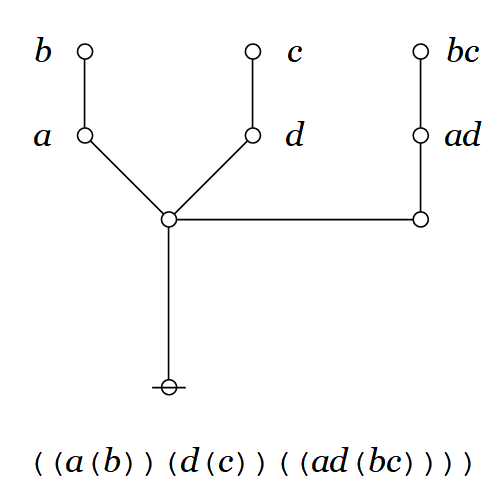
Last time we looked at a formula of propositional logic Leibniz called a Praeclarum Theorema (PT).  We don’t concur it’s a theorem, of course, until there’s a proof it’s identically true and Leibniz gave an argument to demonstrate that.  Written out in one of our more current formalisms, PT takes the following form.

((a \Rightarrow b) \land (d \Rightarrow c)) \Rightarrow ((a \land d) \Rightarrow (b \land c))

Somewhat in the spirit of Reduced Instruction Set Computing, we reformulated PT in a propositional calculus using just two primitive operations, writing the logical negation of a proposition p as \texttt{(} p \texttt{)} and the logical conjunction of two propositions p, q as pq.  That gave us a text string in teletype parentheses and proposition letters, formatted two ways below.

Praeclarum Theorema Text Strings

Our next transformation of the theorem’s expression exploits a standard correspondence in combinatorics and computer science between parenthesized symbol strings and trees with symbols attached to the nodes.

Praeclarum Theorema Parse Graph

We can see the correspondence between text and tree in the case of PT by starting at the root of the tree and reading off the characters of the text string as we traverse the edges and nodes of the tree in the following manner.  The initial ``\texttt{(}" tells us to ascend the first edge, the next ``\texttt{(}" tells us to ascend the next edge on the left, where we find the letter ``a" from the string checks with the letter ``a" attached to the node of the tree where we are.  Another ``\texttt{(}" takes us up another edge, where we find the letter ``b" from the string checks with the letter ``b" on the current tree node.  Reading the first ``\texttt{)}" on the string entitles us to descend an edge and reading another ``\texttt{)}" gives us licence to descend another.  The way of things is most likely clear by this point — at any rate, I leave the exercise to the reader.

On the scene of the general correspondence between formulas and graphs the action may be summed up as follows.  The tree, called a parse tree or parse graph, is constructed in the process of checking whether the text string is syntactically well-formed, in other words, whether it satisfies the prescriptions of the associated formal grammar and is therefore a member in good standing of the prescribed formal language.  If the text string checks out, grammatically speaking, we call it a traversal string of the corresponding parse graph, because it can be reconstructed from the graph by a process like that illustrated above called traversing the graph.

To be continued …

Reference

  • Leibniz, Gottfried W. (1679–1686?), “Addenda to the Specimen of the Universal Calculus”, pp. 40–46 in G.H.R. Parkinson (ed., trans., 1966), Leibniz : Logical Papers, Oxford University Press, London, UK.

Praeclarum Theorema

Resources

Applications

cc: CyberneticsOntolog • Peirce (1) (2) (3) (4) (5) (6)Structural ModelingSystems

Posted in Amphecks, Animata, Boolean Algebra, Boolean Functions, C.S. Peirce, Cactus Graphs, Constraint Satisfaction Problems, Deduction, Diagrammatic Reasoning, Duality, Equational Inference, Graph Theory, Laws of Form, Logic, Logical Graphs, Mathematics, Minimal Negation Operators, Model Theory, Painted Cacti, Peirce, Proof Theory, Propositional Calculus, Propositional Equation Reasoning Systems, Spencer Brown, Theorem Proving, Visualization | Tagged , , , , , , , , , , , , , , , , , , , , , , , , , | 10 Comments

Animated Logical Graphs • 40

Re: Richard J. LiptonLogical Complexity Of Proofs
Re: Animated Logical Graphs • (35) (36) (37) (38) (39)

One way to see the difference between insight proofs and routine proofs is to pick a single example of a theorem in propositional calculus and prove it two ways, one more insightful and one more routine.

The praeclarum theorema, or splendid theorem, is a theorem of propositional calculus noted and named by G.W. Leibniz, who stated and proved it in the following manner.

If a is b and d is c, then ad will be bc.
This is a fine theorem, which is proved in this way:
a is b, therefore ad is bd (by what precedes),
d is c, therefore bd is bc (again by what precedes),
ad is bd, and bd is bc, therefore ad is bc.  Q.E.D.

— Leibniz • Logical Papers, p. 41.

Expressed in contemporary logical notation, the theorem may be written as follows.

((a \Rightarrow b) \land (d \Rightarrow c)) \Rightarrow ((a \land d) \Rightarrow (b \land c))

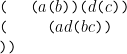
Using teletype parentheses \texttt{(} ~ \texttt{)} for the logical negation \texttt{(} p \texttt{)} of a proposition p and simple concatenation pq for the logical conjunction of propositions p and q enables writing the theorem in the following in-line and lispish ways.

Inline

\texttt{(} \quad   \texttt{(} a \texttt{(} b \texttt{))}  \texttt{(} d \texttt{(} c \texttt{))} \quad  \texttt{(} \quad   \texttt{(} ad \texttt{(} bc \texttt{))} \quad  \texttt{))}

Lispish

\begin{array}{lc}  \texttt{(} &  \texttt{(} a \texttt{(} b \texttt{))}  \texttt{(} d \texttt{(} c \texttt{))} \\  \texttt{(} &   \texttt{(} ad \texttt{(} bc \texttt{))} \\  \texttt{))}\end{array}

Reference

  • Leibniz, Gottfried W. (1679–1686?), “Addenda to the Specimen of the Universal Calculus”, pp. 40–46 in G.H.R. Parkinson (ed., trans., 1966), Leibniz : Logical Papers, Oxford University Press, London, UK.

Praeclarum Theorema

Resources

Applications

cc: CyberneticsOntolog • Peirce (1) (2) (3) (4) (5) (6)Structural ModelingSystems

Posted in Amphecks, Animata, Boolean Algebra, Boolean Functions, C.S. Peirce, Cactus Graphs, Constraint Satisfaction Problems, Deduction, Diagrammatic Reasoning, Duality, Equational Inference, Graph Theory, Laws of Form, Logic, Logical Graphs, Mathematics, Minimal Negation Operators, Model Theory, Painted Cacti, Peirce, Proof Theory, Propositional Calculus, Propositional Equation Reasoning Systems, Spencer Brown, Theorem Proving, Visualization | Tagged , , , , , , , , , , , , , , , , , , , , , , , , , | 11 Comments

Precursors Of Category Theory • Discussion 3

Take your place on The Great Mandala
As it moves through your brief moment of time.
Win or lose now you must choose now
And if you lose you’re only losing your life.

Peter Yarrow

Re: Ontolog ForumAlex Shkotin

AS:
I like Kant’s criticism of Aristotle versions of categories.

“Finding these basic concepts — such a proposal was worthy of such an astute thinker like Aristotle.  But since he did not have any principle, he picked them up as they came across to him, and first typed ten concepts, which he called categories (predicates).  Then it seemed to him that he found five more such concepts, which he added to the previous ones under the name of post-predicate.  However, his table was still insufficient.”  (Kant, Critique of Pure Reason, §10.  About Pure Rational Concepts, or Categories).

Dear Alex,

My sketch on Precursors Of Category Theory shows a big ellipsis under the heading for Kant.  I meant to get back to him, as I used to do every half-decade or so, but it’s been a long time since I kept to that schedule.  Kant is a lodestar in the Peircean constellation — Peirce’s “New List of Categories” invokes his guidance on the function of concepts just as he tries his own hand at the wheel.  I quoted that passage in my selections from Peirce.

Selection 1

§1.  This paper is based upon the theory already established, that the function of conceptions is to reduce the manifold of sensuous impressions to unity, and that the validity of a conception consists in the impossibility of reducing the content of consciousness to unity without the introduction of it.  (CP 1.545).

§2.  This theory gives rise to a conception of gradation among those conceptions which are universal.  For one such conception may unite the manifold of sense and yet another may be required to unite the conception and the manifold to which it is applied;  and so on.  (CP 1.546).

C.S. Peirce, “On a New List of Categories” (1867)

To be continued …

References

Resources

cc: CyberneticsOntolog ForumPeirce ListStructural ModelingSystems Science

Posted in Abstraction, Ackermann, Aristotle, C.S. Peirce, Carnap, Category Theory, Hilbert, Kant, Logic, Logic of Relatives, Mathematics, Peirce, Peirce's Categories, Relation Theory, Saunders Mac Lane, Sign Relations, Type Theory | Tagged , , , , , , , , , , , , , , , , | 6 Comments

Precursors Of Category Theory • Discussion 2

Re: Ontolog ForumAlex Shkotin

AS:
Looking at “categories, or types” in Precursors Of Category Theory • Hilbert and Ackermann what do you think of to say “Precursors Of Type Theory” as Category Theory is a math discipline?   […]   It seems you collect for three topics:  phil‑cat, type theory, math cat‑theory.

Dear Alex,

When it comes to math, computer science, and their applications to logic and linguistics I see categories and types as pretty much the same things.  No doubt the words are used differently in other contexts but I am concerned with the above contexts at the moment.

The diversity of categorical systems across different disciplines and theorists is obvious to all observers.  But when we examine how systems of categories operate in grammatical, logical, or more generally semiotic frameworks we can detect a common function all the more useful systems share.  The semiotic framework is already well marked in Aristotle’s founding text on interpretation and the function of category references as go-betweens from unruly language to the rule of logic is clearly delineated in his treatise on categories.  It is that order of function which is preserved from Aristotle’s categories to our current mathematical variety.

References

Resources

cc: CyberneticsOntolog ForumPeirce ListStructural ModelingSystems Science

Posted in Abstraction, Ackermann, Aristotle, C.S. Peirce, Carnap, Category Theory, Hilbert, Kant, Logic, Logic of Relatives, Mathematics, Peirce, Peirce's Categories, Relation Theory, Saunders Mac Lane, Sign Relations, Type Theory | Tagged , , , , , , , , , , , , , , , , | 6 Comments