Inquiry Driven Systems • Discussion 1

Re: Topos LabMathFoldr Project
Re: Category TheoryValeria de Paiva

Dear Brendan and Valeria,

I’ve been a participant∫observer in web-ontology knowledge projects for a couple of decades and they always give far more attention to knowledge as a product than due reflection on the dynamics of inquiry required to develop our provisional knowledge.  Many such projects have come and gone with the winds of fashion and it’s my guess the lack of balance between process and product orientation is one of the reasons why.

So I’ve been working on that … here’s a few links to the model of knowledge development sketched in my work on Inquiry Driven Systems.

cc: Category TheoryCyberneticsOntologStructural ModelingSystems Science
cc: FB | Inquiry Driven SystemsLaws of Form • Peirce List (1) (2) (3)

Posted in Animata, Artificial Intelligence, C.S. Peirce, Cybernetics, Inquiry, Inquiry Driven Systems, Inquiry Into Inquiry, Intelligent Systems, Learning Systems, Logic, Logical Graphs, Peirce, Semiotics, Sign Relations, Visualization | Tagged , , , , , , , , , , , , , , | 7 Comments

Differential Logic • Discussion 10

Re: Laws of FormLyle Anderson

Let’s say we’re observing a system at discrete intervals of time and testing whether its state satisfies or falsifies a given predicate or proposition p at each moment.  Then p and \mathrm{d}p are two state variables describing the time evolution of the system.  In logical conception p and \mathrm{d}p are independent variables, even if empirical discovery finds them bound by law.
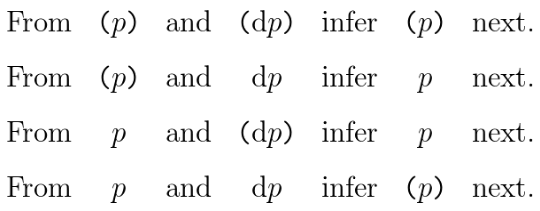
What gives the differential variable \mathrm{d}p its meaning in relation to the ordinary variable p is not the conventional notation used here but a class of temporal inference rules, in the present example, the fourfold scheme of inference shown below.

Temporal Inference Rules

cc: Category TheoryCyberneticsOntologStructural ModelingSystems Science
cc: FB | Differential LogicLaws of Form

Posted in Amphecks, Animata, Boolean Algebra, Boolean Functions, C.S. Peirce, Cactus Graphs, Category Theory, Change, Cybernetics, Differential Analytic Turing Automata, Differential Calculus, Differential Logic, Discrete Dynamics, Equational Inference, Frankl Conjecture, Functional Logic, Gradient Descent, Graph Theory, Hologrammautomaton, Indicator Functions, Inquiry Driven Systems, Leibniz, Logic, Logical Graphs, Mathematics, Minimal Negation Operators, Painted Cacti, Peirce, Propositional Calculus, Surveys, Time, Topology, Visualization, Zeroth Order Logic | Tagged , , , , , , , , , , , , , , , , , , , , , , , , , , , , , , , , , | 8 Comments

Differential Logic • Discussion 9

Re: Laws of FormLyle Anderson

LA:
All I am asking is what is your definition of \mathrm{d}p in relation to p‌.  So far I have \mathrm{d}p is what one has to do to get from p to \texttt{(} p \texttt{)} or from \texttt{(} p \texttt{)} to p‌.  Is that all there is to it?  If that is the case, then what you are really dealing with is some flavor of Lattice Theory.

Dear Lyle,

Standing back for a moment to take in the Big Picture, what we’re doing here is taking all the things we would normally do in a “calculus of many variables” setting with spaces like:

\begin{matrix}  \mathbb{R}, &   \mathbb{R}^{j}, &   \mathbb{R}^{j} \to \mathbb{R}, &   \mathbb{R}^{j} \to \mathbb{R}^{k}, &   \ldots \end{matrix}

and functoring that whole business over to \mathbb{B}, in other words, cranking the analogies as far as we can push them to spaces like:

\begin{matrix}  \mathbb{B}, &   \mathbb{B}^{j}, &   \mathbb{B}^{j} \to \mathbb{B}, &   \mathbb{B}^{j} \to \mathbb{B}^{k}, &   \ldots \end{matrix}

A few analogies are bound to break in transit through the Real-Bool barrier, once familiar constructions morph into new-fangled configurations, and other distinctions collapse or “condense” as Spencer Brown called it.  Still enough structure gets preserved overall to reckon the result a kindred subject.

To be continued …

cc: Category TheoryCyberneticsOntologStructural ModelingSystems Science
cc: FB | Differential LogicLaws of Form

Posted in Amphecks, Animata, Boolean Algebra, Boolean Functions, C.S. Peirce, Cactus Graphs, Category Theory, Change, Cybernetics, Differential Analytic Turing Automata, Differential Calculus, Differential Logic, Discrete Dynamics, Equational Inference, Frankl Conjecture, Functional Logic, Gradient Descent, Graph Theory, Hologrammautomaton, Indicator Functions, Inquiry Driven Systems, Leibniz, Logic, Logical Graphs, Mathematics, Minimal Negation Operators, Painted Cacti, Peirce, Propositional Calculus, Surveys, Time, Topology, Visualization, Zeroth Order Logic | Tagged , , , , , , , , , , , , , , , , , , , , , , , , , , , , , , , , , | 9 Comments

Differential Logic • Discussion 8

Re: Laws of FormLyle Anderson

A Reader inquired about the relationship between ordinary and differential boolean variables.  I thought it might help to explain how I first came to think about differential logic as a means of describing qualitative change.  The story goes a bit like this …

I wandered into this differential wonderland by following my nose through a budget of old readings on the calculus of finite differences.  It was a long time ago in a math library not too far away as far as space goes but no longer extant in time.  Boole himself wrote a book on the subject and corresponded with De Morgan about it.  I recall picking up the \mathrm{E} for enlargement operator somewhere in that mix.  It was a genuine epiphany.  All of which leads me to suspect the most accessible entry point may be the one I happened on first, documented in the Chapter on Linear Topics I linked at the end of the following post.

Maybe it will help to go through that …

Regards,

Jon

cc: Category TheoryCyberneticsOntologStructural ModelingSystems Science
cc: FB | Differential LogicLaws of Form

Posted in Amphecks, Animata, Boolean Algebra, Boolean Functions, C.S. Peirce, Cactus Graphs, Category Theory, Change, Cybernetics, Differential Analytic Turing Automata, Differential Calculus, Differential Logic, Discrete Dynamics, Equational Inference, Frankl Conjecture, Functional Logic, Gradient Descent, Graph Theory, Hologrammautomaton, Indicator Functions, Inquiry Driven Systems, Leibniz, Logic, Logical Graphs, Mathematics, Minimal Negation Operators, Painted Cacti, Peirce, Propositional Calculus, Surveys, Time, Topology, Visualization, Zeroth Order Logic | Tagged , , , , , , , , , , , , , , , , , , , , , , , , , , , , , , , , , | 9 Comments

Animated Logical Graphs • 80

Re: Category TheoryChad Nester

CN:
Re: Categorical Treatments of Existential Graphs
Cf: N. Haydon and P. Sobociński • Compositional Diagrammatic First-Order Logic

Thanks, Chad, for that extremely nice treatment of Peirce’s existential graphs at the β level, tantamount to predicate calculus or first order logic as we know it today.

The logic of relatives and the mathematics of relations appear in a different light from the perspective of Peirce’s own standpoint on logic, evolving as it does out of distinctive pragmatic and semiotic insights.  The reflections of Spencer Brown afford a few angles Peirce anticipated but in a glass, darkly.  And my own time tumbling recalcitrant calculi toward more ready tools for inquiry may add a few wrinkles, with luck to more than my own brow.  All that will develop as we go.

Resources

cc: Peirce List (1) (2) (3) (4) (5) (6) (7) (8) (9) (10) (11) (12) (13) (14) (15) (16) (17)
cc: Category Theory • Cybernetics (1) (2) • Ontolog Forum (1) (2)
cc: Structural Modeling (1) (2) • Systems Science (1) (2)
cc: FB | Logical GraphsLaws of Form

Posted in Amphecks, Animata, Boolean Algebra, Boolean Functions, C.S. Peirce, Cactus Graphs, Constraint Satisfaction Problems, Deduction, Diagrammatic Reasoning, Duality, Equational Inference, Graph Theory, Laws of Form, Logic, Logical Graphs, Mathematics, Minimal Negation Operators, Model Theory, Painted Cacti, Peirce, Proof Theory, Propositional Calculus, Propositional Equation Reasoning Systems, Spencer Brown, Theorem Proving, Visualization | Tagged , , , , , , , , , , , , , , , , , , , , , , , , , | 6 Comments

Differential Logic • Comment 6

Re: Category TheoryJon Awbrey

I opened a topic in the “logic” stream of “category theory zulipchat” to discuss differential logic in a category theoretic environment and began by linking to a few basic resources.

The topic on logical graphs introduced a style of graph‑theoretic syntax for propositional logic stemming from the work of Charles S. Peirce and G. Spencer Brown and touched on a generalization of Peirce’s and Spencer Brown’s tree‑like forms to what graph theorists know as cactus graphs or cacti.

Somewhat serendipitously, as it turns out, this cactus syntax is just the thing we need to develop differential propositional calculus, which augments ordinary propositional calculus in the same way the differential calculus of Leibniz and Newton augments the analytic geometry of Descartes.

Resources

cc: Category TheoryCyberneticsOntologStructural ModelingSystems Science
cc: FB | Differential LogicLaws of Form

Posted in Adaptive Systems, Amphecks, Belief Systems, Boole, Boolean Algebra, Boolean Functions, C.S. Peirce, Cactus Graphs, Cybernetics, Differential Logic, Discrete Dynamics, Fixation of Belief, Gradient Descent, Graph Theory, Hill Climbing, Hologrammautomaton, Inquiry, Inquiry Driven Systems, Laws of Form, Leibniz, Logic, Logical Graphs, Mathematics, Minimal Negation Operators, Optimization, Painted Cacti, Peirce, Propositional Calculus, Spencer Brown | Tagged , , , , , , , , , , , , , , , , , , , , , , , , , , , , | Comments Off on Differential Logic • Comment 6

Animated Logical Graphs • 79

Re: Category TheoryHenry Story

HS:
I think in this 2020 Applied Category Theory talk by Rocco Gangle, A Generic Figures Reconstruction of Peirce’s Existential Graphs (Alpha), he is looking at showing how Peirce’s work can be expressed in terms of Category Theory.

I looked at that once, I think.  I seem to recall he is still using the planar maps which I consider the mark of a novice, but I will give it another look.

Okay, I see he introduces forests about half-way through, that’s a good thing, but he’s not up to cacti yet, which is something I found necessary early on for the sake of both conceptual and computational efficiency.  So there’s a few things I will need to explain …

I started working on logical graphs early in my undergrad years, after my encounter with Peirce’s Collected Papers, quickly followed by my study of Spencer Brown’s Laws of Form, and from the outset trying everything I could hack by way of syntax handlers and theorem provers in every mix of languages and machines I got my hands on.  That combination of forces and media summed to form my current direction.

Peirce broke ground and laid the groundwork, Spencer Brown shored up the infrastructure of primary arithmetic and leveled the proving grounds to facilitate equational inference, and a host of computers supplied the real-world recalcitrance of matter, the resistance to facile simplicity, and the rebuke of all too facile reductionism.

Resources

cc: Peirce List (1) (2) (3) (4) (5) (6) (7) (8) (9) (10) (11) (12) (13) (14) (15) (16) (17)
cc: Category Theory • Cybernetics (1) (2) • Ontolog Forum (1) (2)
cc: Structural Modeling (1) (2) • Systems Science (1) (2)
cc: FB | Logical GraphsLaws of Form

Posted in Amphecks, Animata, Boolean Algebra, Boolean Functions, C.S. Peirce, Cactus Graphs, Constraint Satisfaction Problems, Deduction, Diagrammatic Reasoning, Duality, Equational Inference, Graph Theory, Laws of Form, Logic, Logical Graphs, Mathematics, Minimal Negation Operators, Model Theory, Painted Cacti, Peirce, Proof Theory, Propositional Calculus, Propositional Equation Reasoning Systems, Spencer Brown, Theorem Proving, Visualization | Tagged , , , , , , , , , , , , , , , , , , , , , , , , , | 7 Comments

Animated Logical Graphs • 78

Cf: Category TheoryJon Awbrey

As far as the “animated” part goes, I lost my klutz-friendly animation app in my last platform change and then got immersed in other things, so it may be a while before I get back to that, but here’s two examples of animated proofs in a CSP∫GSB-style propositional calculus just to give a hint of how things might develop.

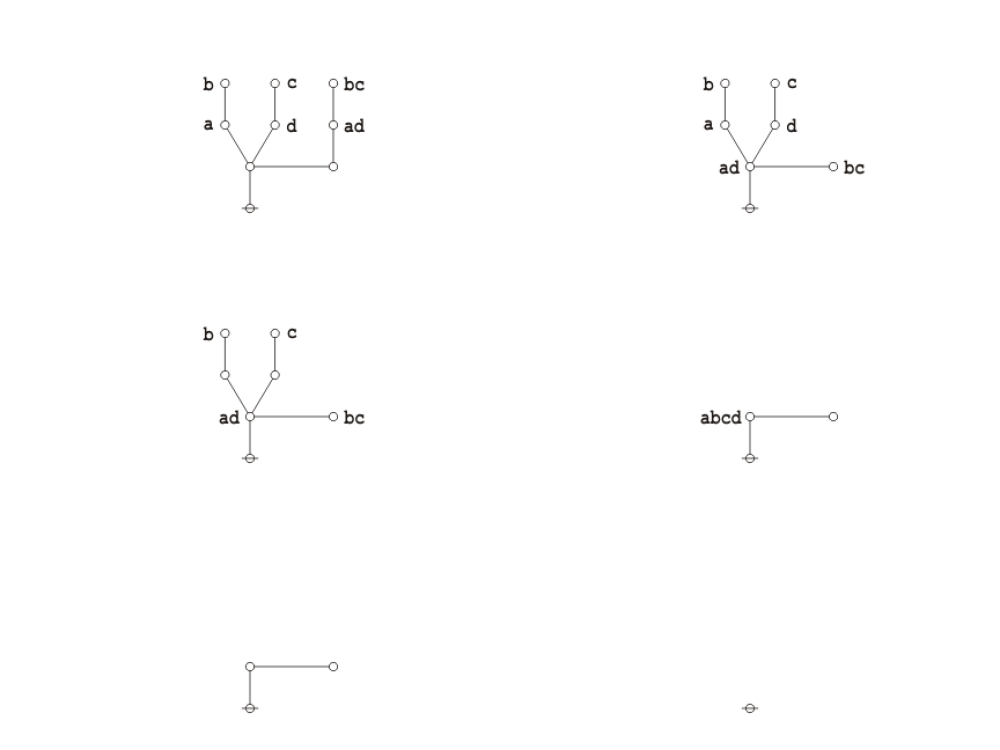
Peirce's Law • Proof Animation

Praeclarum Theorema • Proof Animation

Resources

cc: Peirce List (1) (2) (3) (4) (5) (6) (7) (8) (9) (10) (11) (12) (13) (14) (15) (16) (17)
cc: Category Theory • Cybernetics (1) (2) • Ontolog Forum (1) (2)
cc: Structural Modeling (1) (2) • Systems Science (1) (2)
cc: FB | Logical GraphsLaws of Form

Posted in Amphecks, Animata, Boolean Algebra, Boolean Functions, C.S. Peirce, Cactus Graphs, Constraint Satisfaction Problems, Deduction, Diagrammatic Reasoning, Duality, Equational Inference, Graph Theory, Laws of Form, Logic, Logical Graphs, Mathematics, Minimal Negation Operators, Model Theory, Painted Cacti, Peirce, Proof Theory, Propositional Calculus, Propositional Equation Reasoning Systems, Spencer Brown, Theorem Proving, Visualization | Tagged , , , , , , , , , , , , , , , , , , , , , , , , , | 6 Comments

Animated Logical Graphs • 77

Cf: Category TheoryJon Awbrey

A place for exploring animated forms of visual inference
inspired by the work of C.S. Peirce and Spencer Brown.

I opened a topic in the “logic” stream of “category theory.zulipchat” to discuss logical graphs in a category theoretic environment and began by linking a few basic resources.  Here goes …

Resources

cc: Peirce List (1) (2) (3) (4) (5) (6) (7) (8) (9) (10) (11) (12) (13) (14) (15) (16) (17)
cc: Category Theory • Cybernetics (1) (2) • Ontolog Forum (1) (2)
cc: Structural Modeling (1) (2) • Systems Science (1) (2)
cc: FB | Logical GraphsLaws of Form

Posted in Amphecks, Animata, Boolean Algebra, Boolean Functions, C.S. Peirce, Cactus Graphs, Constraint Satisfaction Problems, Deduction, Diagrammatic Reasoning, Duality, Equational Inference, Graph Theory, Laws of Form, Logic, Logical Graphs, Mathematics, Minimal Negation Operators, Model Theory, Painted Cacti, Peirce, Proof Theory, Propositional Calculus, Propositional Equation Reasoning Systems, Spencer Brown, Theorem Proving, Visualization | Tagged , , , , , , , , , , , , , , , , , , , , , , , , , | 7 Comments

C.S. Peirce and Category Theory • 8

Re: Category TheoryHenry Story
Re: Laws of FormLyle Anderson

LA:
As I am trying to get “frame sync” on this discussion, as the satellite communications people say, I am taking clues from the introduction
to the listing for Gangle’s Diagrammatic Immanence.

A renewal of immanent metaphysics through diagrammatic methods and the tools of category theory.  Spinoza, Peirce and Deleuze are, in different ways, philosophers of immanence.  Rocco Gangle addresses the methodological questions raised by a commitment to immanence in terms of how diagrams may be used both as tools and as objects of philosophical investigation.  He integrates insights from Spinozist metaphysics, Peircean semiotics and Deleuze’s philosophy of difference in conjunction with the formal operations of category theory.  Category theory reveals deep structural connections among logic, topology and a variety of different areas of mathematics, and it provides constructive and rigorous concepts for investigating how diagrams work.

Henry, Lyle, All,

This discussion keeps flashing me back to an unfinished syzygy from the mid ’80s when I took a course on “applications of λ-calculus” with John Gray at Illinois examining the trio of combinators, computation, and cartesian closed categories, all hot topics of the day, and followed it up with a guided study on the connections to Peirce I had glimpsed at the time.  I’ll dig up some notes and get back to that.  For the moment I’ll focus on category theory in the light of Peirce.  The lights of Spinoza and Deleuze I’ll leave to observers who see better by them.

cc: Category TheoryCyberneticsOntologStructural ModelingSystems Science
cc: FB | Peirce MattersLaws of Form

Posted in Abstraction, Aristotle, C.S. Peirce, Category Theory, Logic, Logic of Relatives, Mathematics, Peirce, Peirce's Categories, Phenomenology, Pragmatic Maxim, Relation Theory, Semiotics, Triadic Relations, Triadicity, Type Theory | Tagged , , , , , , , , , , , , , , , | 3 Comments