
Differential Propositional Calculus • Discussion 2

The most fundamental concept in cybernetics is that of “difference”, either that two things are recognisably different or that one thing has changed with time.

W. Ross Ashby • An Introduction to Cybernetics

The times are rife with distraction, so let’s pause and retrace how we got to this place.

Our last reading in Cybernetics brought us in sight of a convergence or complementarity between the triadic relations in Peirce’s semiotics and those in Ashby’s regulator games.  There’s a lot more to explore in that direction and I plan to get back to it soon.

The two threads intertwined here, Cybernetics and Differential Logic, both spun off a thread on Pragmatic Truth, asking what theories of truth are compatible with Peircean disciplines of pragmatic thinking.  That’s a topic with a tangled history but the latest local tangle is documented in the following posts and excerpts.

Pragmatic Theory Of Truth • 13

Pragmatic inquiry into a candidate concept of truth would begin by applying the pragmatic maxim to clarify the concept as far as possible and a pragmatic definition of truth, should any result, would find its place within Peirce’s theory of logic as formal semiotics, in other words, stated in terms of a formal theory of triadic sign relations.

Pragmatic Theory Of Truth • 14

There are many conceptions of truth — linguistic, model-theoretic, proof-theoretic — for the moment I’m focused on cybernetics, systems, and experimental sciences and this is where the pragmatic conception of truth fits what we naturally do in those sciences remarkably well.

The main thing in those activities is the relationship among symbol systems, the world, and our actions, whether in thought, among ourselves, or between ourselves and the world.  So the notion of truth we want here is predicated on three dimensions:  the patch of the world we are dealing with in a given application, the systems of signs we are using to describe that domain, and the transformations of signs we find of good service in bearing information about that piece of the world.

Pragmatic Theory Of Truth • 18

We do not live in axiom systems.  We do not live encased in languages, formal or natural.  There is no reason to think we will ever have exact and exhaustive theories of what’s out there, and the truth, as we know, is “out there”.  Peirce understood there are more truths in mathematics than are dreamt of in logic and Gödel’s realism should have put the last nail in the coffin of logicism, but some ways of thinking just never get a clue.

That brings us to the question —

  • What are formalisms and all their embodiments in brains and computers good for?

For that I’ll turn to cybernetics …

Survey of Cybernetics

The Survey linked above recaps the reading of Ashby’s Cybernetics up to the present date.

Meanwhile, the inquiry into Pragmatic Truth branched off at another point when a question from Stephen Paul King demanded an answer in terms of Differential Logic.  That point of departure is documented in the following post.

Differential Logic • Comment 4

This updates the state of the threads linking pragmatic truth, cybernetics, and differential logic.  Disentangling them to any large extent has always been difficult if not impossible, at least for me.

Resources

cc: CyberneticsOntolog • Peirce List (1) (2)Structural ModelingSystems Science

Posted in Amphecks, Boolean Functions, C.S. Peirce, Cactus Graphs, Category Theory, Change, Computational Complexity, Cybernetics, Differential Analytic Turing Automata, Differential Calculus, Differential Logic, Discrete Dynamics, Dynamical Systems, Equational Inference, Functional Logic, Gradient Descent, Graph Theory, Group Theory, Hologrammautomaton, Indicator Functions, Logic, Logical Graphs, Mathematical Models, Mathematics, Minimal Negation Operators, Painted Cacti, Peirce, Propositional Calculus, Propositional Equation Reasoning Systems, Time, Visualization | Tagged , , , , , , , , , , , , , , , , , , , , , , , , , , , , , , | 9 Comments

Survey of Cybernetics • 1

Again, in a ship, if a man were at liberty to do what he chose, but were devoid of mind and excellence in navigation (αρετης κυβερνητικης), do you perceive what must happen to him and his fellow sailors?

Plato • Alcibiades • 135 A

This is a Survey of blog posts relating to Cybernetics.  It includes the selections from Ashby’s Introduction and the comment on them I’ve posted so far, plus two series of reflections on the governance of social systems in light of cybernetic and semiotic principles.

Ashby’s Introduction to Cybernetics

  • Chapter 11 • Requisite Variety

Blog Series

  • Theory and Therapy of Representations • (1)(2)(3)(4)(5)

cc: Conceptual GraphsCyberneticsStructural ModelingSystems Science
cc: FB | CyberneticsMathstodonLaws of FormOntolog Forum

Posted in Abduction, C.S. Peirce, Communication, Control, Cybernetics, Deduction, Determination, Discovery, Doubt, Epistemology, Fixation of Belief, Induction, Information, Information = Comprehension × Extension, Information Theory, Inquiry, Inquiry Driven Systems, Inquiry Into Inquiry, Interpretation, Invention, Knowledge, Learning Theory, Logic, Logic of Relatives, Logic of Science, Mathematics, Peirce, Philosophy, Philosophy of Science, Pragmatic Information, Probable Reasoning, Process Thinking, Relation Theory, Scientific Inquiry, Scientific Method, Semeiosis, Semiosis, Semiotic Information, Semiotics, Sign Relational Manifolds, Sign Relations, Surveys, Triadic Relations, Uncertainty | Tagged , , , , , , , , , , , , , , , , , , , , , , , , , , , , , , , , , , , , , , , , , , , | 3 Comments

Abduction, Deduction, Induction, Analogy, Inquiry • 29

Re: Ontolog ForumMichael DeBellis

Questions about Abduction in AI and Computer Science raised in the Ontolog Forum prompted me to look up previous discussions tracing the integral relationship among information, inquiry, and the three types of inference.  Here’s a sample of links.

Inquiry Blog

OEIS Wiki

Ontolog Forum

cc: CyberneticsOntolog ForumPeirce ListStructural ModelingSystems Science

Posted in Abduction, Analogy, Aristotle, Artificial Intelligence, C.S. Peirce, Deduction, Induction, Inquiry, Inquiry Driven Systems, Intelligent Systems Engineering, Logic, Mental Models, Peirce, Scientific Method, Semiotics, Systems | Tagged , , , , , , , , , , , , , , , | 5 Comments

Differential Propositional Calculus • Discussion 1

The most fundamental concept in cybernetics is that of “difference”, either that two things are recognisably different or that one thing has changed with time.

W. Ross Ashby • An Introduction to Cybernetics

Re: Cybernetics CommunicationsKlaus Krippendorff

KK:
To me, differences are the result of drawing distinctions.  They don’t exist unless you actively draw them.  So, the act of drawing distinctions is more fundamental than the differences thereby created.

I often return to that line from Ashby.  This time I thought it made an apt segue from the scene of propositional calculus, where universes of discourse are ruled by collections of distinctive features, to the differential extension of propositional calculus, which enables us to describe trajectories within and transformations between our logical universes.

So I agree with Klaus Krippendorff about “which came first”, the distinctions drawn or the states distinguished in space or time.  The primitive character of distinctions is especially salient in this setting since our formalism for propositional calculus is built on the forms of distinction pioneered by C.S. Peirce and augmented by George Spencer Brown.

Resources

cc: CyberneticsOntolog • Peirce List (1) (2)Structural ModelingSystems Science

Posted in Amphecks, Boolean Functions, C.S. Peirce, Cactus Graphs, Category Theory, Change, Computational Complexity, Cybernetics, Differential Analytic Turing Automata, Differential Calculus, Differential Logic, Discrete Dynamics, Dynamical Systems, Equational Inference, Functional Logic, Gradient Descent, Graph Theory, Group Theory, Hologrammautomaton, Indicator Functions, Logic, Logical Graphs, Mathematical Models, Mathematics, Minimal Negation Operators, Painted Cacti, Peirce, Propositional Calculus, Propositional Equation Reasoning Systems, Time, Visualization | Tagged , , , , , , , , , , , , , , , , , , , , , , , , , , , , , , | 13 Comments

Abduction, Deduction, Induction, Analogy, Inquiry • 28

Re: Ontolog ForumMichael DeBellisAdrian Walker

MDB:
I’m currently auditing a fascinating seminar at Berkeley on Semiotics and Information Theory.  Mostly we are focusing on C.S. Peirce although we’ve also explored other theories such as Shannon’s Information Theory.  As we were discussing abduction, the history of the idea, how it compares with induction and deduction, etc. someone asked me about the uses of Abduction in AI and computer science.

Just off hand, here’s a batch of blog and wiki links relating to “Abductive Intelligence”.

My first encounters with abductive reasoning in computational contexts go back to mentions of Peirce by Warren S. McCulloch and early implementations by Pople, et al.  Here’s a few notes on those.

All through 1995 I worked on a graduate project in systems engineering at Oakland University developing my ideas about Inquiry Driven Systems.  A project report I wrote on Peirce’s treatments of analogy and inquiry includes a discussion of the logical inferences involved in the abductive and deductive steps.  There’s a copy of that at the following location:  Functional Logic • Inquiry and Analogy

AW:
Interestingly, this topic [abductive inference] overlaps with planning.

Exactly.  Resolving a surprise through an explanation and solving a problem through a plan of action are dual species of inquiry in general.

This is one of the themes at the top of my work on Inquiry Driven Systems.  See, for example, the statement of research interests I submitted with my application to grad school back in the early 90s.

This inquiry is guided by two questions that express themselves in many different guises.  In their most laconic and provocative style, self-referent but not purely so, they typically bring a person to ask:

  • Why am I asking this question?
  • How will I answer this question?

Cast in with a pool of other questions these two often act as efficient catalysts of the inquiry process, precipitating and organizing what results.  Expanded into general terms these queries become tantamount to asking:

  • What accumulated funds and immediate series of experiences lead up to the moment of surprise that causes the asking of a question?
  • What operational resources and planned sequences of actions lead on to the moment of solution that allows the ending of a problem?

Phrased in systematic terms, they ask yet again:

  • What capacity enables a system to exist in states of question?
  • What competence enables a system to exit from its problem states?

cc: CyberneticsOntolog ForumPeirce ListStructural ModelingSystems Science

Posted in Abduction, Analogy, Aristotle, Artificial Intelligence, C.S. Peirce, Deduction, Induction, Inquiry, Inquiry Driven Systems, Intelligent Systems Engineering, Logic, Mental Models, Peirce, Scientific Method, Semiotics, Systems | Tagged , , , , , , , , , , , , , , , | 5 Comments

Pragmatic Truth • Discussion 22

Re: Systems ScienceScott Jackson

Discussions of “thinking and flawed decisions” arising in the Systems Science Working Group naturally brought the topic of Pragmatic Truth and all its bedeviled vicissitudes back to this Peircean’s mind.

I have often observed how belief systems act in a way like immune systems, generating “antibodies” to combat the “antigens” of any ideas beyond their comfort zones.

Elsewhere, I described these phenomena under the heading of Information Resistance.

  • The hardest thing to understand about information is people’s resistance to it.

The locus pragmaticus for the study of belief systems and the impact of information and inquiry on them is C.S. Peirce’s “The Fixation of Belief”.  See the preceding post in this series for comment and links.

Reference

Resources

cc: CyberneticsOntolog • Peirce List (1) (2)Structural ModelingSystems Science

Posted in Aristotle, C.S. Peirce, Coherence, Concordance, Congruence, Consensus, Convergence, Correspondence, Dewey, Fixation of Belief, Information, Inquiry, John Dewey, Kant, Logic, Logic of Science, Method, Peirce, Philosophy, Pragmatic Maxim, Pragmatism, Semiotics, Sign Relations, Triadic Relations, Truth, Truth Theory, William James | Tagged , , , , , , , , , , , , , , , , , , , , , , , , , , | 5 Comments

Differential Propositional Calculus • 8

Differential Extensions

An initial universe of discourse A^\bullet supplies the groundwork for any number of further extensions, beginning with the first order differential extension \mathrm{E}A^\bullet.  The construction of \mathrm{E}A^\bullet can be described in the following stages.

  • The initial alphabet \mathfrak{A} = \{ ``a_1", \ldots, ``a_n" \} is extended by a first order differential alphabet \mathrm{d}\mathfrak{A} = \{ ``\mathrm{d}a_1", \ldots, ``\mathrm{d}a_n" \} resulting in a first order extended alphabet \mathrm{E}\mathfrak{A} defined as follows.

    \mathrm{E}\mathfrak{A} ~=~ \mathfrak{A} ~\cup~ \mathrm{d}\mathfrak{A} ~=~ \{ ``a_1", \ldots, ``a_n", ``\mathrm{d}a_1", \ldots, ``\mathrm{d}a_n" \}.

  • The initial basis \mathcal{A} = \{ a_1, \ldots, a_n \} is extended by a first order differential basis \mathrm{d}\mathcal{A} = \{ \mathrm{d}a_1, \ldots, \mathrm{d}a_n \} resulting in a first order extended basis \mathrm{E}\mathcal{A} defined as follows.

    \mathrm{E}\mathcal{A} ~=~ \mathcal{A} ~\cup~ \mathrm{d}\mathcal{A} ~=~ \{ a_1, \ldots, a_n, \mathrm{d}a_1, \ldots, \mathrm{d}a_n \}.

  • The initial space A = \langle a_1, \ldots, a_n \rangle is extended by a first order differential space or tangent space \mathrm{d}A = \langle \mathrm{d}a_1, \ldots, \mathrm{d}a_n \rangle at each point of A, resulting in a first order extended space or tangent bundle space \mathrm{E}A defined as follows.

    \mathrm{E}A ~=~ A ~\times~ \mathrm{d}A ~=~ \langle \mathrm{E}\mathcal{A} \rangle ~=~ \langle \mathcal{A} \cup \mathrm{d}\mathcal{A} \rangle ~=~ \langle a_1, \ldots, a_n, \mathrm{d}a_1, \ldots, \mathrm{d}a_n \rangle.

  • Finally, the initial universe A^\bullet = [ a_1, \ldots, a_n ] is extended by a first order differential universe or tangent universe \mathrm{d}A^\bullet = [ \mathrm{d}a_1, \ldots, \mathrm{d}a_n ] at each point of A^\bullet, resulting in a first order extended universe or tangent bundle universe \mathrm{E}A^\bullet defined as follows.

    \mathrm{E}A^\bullet ~=~ [ \mathrm{E}\mathcal{A} ] ~=~ [ \mathcal{A} ~\cup~ \mathrm{d}\mathcal{A} ] ~=~ [ a_1, \ldots, a_n, \mathrm{d}a_1, \ldots, \mathrm{d}a_n ].

    This gives \mathrm{E}A^\bullet a type defined as follows.

    [ \mathbb{B}^n \times \mathbb{D}^n ] ~=~ (\mathbb{B}^n \times \mathbb{D}^n\ +\!\!\to \mathbb{B}) ~=~ (\mathbb{B}^n \times \mathbb{D}^n, \mathbb{B}^n \times \mathbb{D}^n \to \mathbb{B}).

A proposition in a differential extension of a universe of discourse is called a differential proposition and forms the analogue of a system of differential equations in ordinary calculus.  With these constructions, the first order extended universe \mathrm{E}A^\bullet and the first order differential propositions f : \mathrm{E}A \to \mathbb{B}, we arrive at the foothills of differential logic.

Table 11 summarizes the notations needed to describe the first order differential extensions of propositional calculi in a systematic manner.

\text{Table 11. Differential Extension} \stackrel{_\bullet}{} \text{Basic Notation}
Differential Extension • Basic Notation

Resources

cc: CyberneticsOntolog ForumPeirce ListStructural ModelingSystems Science

Posted in Amphecks, Boolean Functions, C.S. Peirce, Cactus Graphs, Category Theory, Change, Computational Complexity, Cybernetics, Differential Analytic Turing Automata, Differential Calculus, Differential Logic, Discrete Dynamics, Dynamical Systems, Equational Inference, Functional Logic, Gradient Descent, Graph Theory, Group Theory, Hologrammautomaton, Indicator Functions, Logic, Logical Graphs, Mathematical Models, Mathematics, Minimal Negation Operators, Painted Cacti, Peirce, Propositional Calculus, Propositional Equation Reasoning Systems, Time, Visualization | Tagged , , , , , , , , , , , , , , , , , , , , , , , , , , , , , , | 4 Comments

Habitations

Our reach exceeds our rut and yet
We grasp but what we drag into it.

Re: Scott AaronsonA Coronavirus Poem

Posted in Anthem, Anthematics, Mantra, Maxim, Meditation, Poetry, Reflection, Reverie, Sisyphus, Verse | Tagged , , , , , , , , , | Leave a comment

Differential Propositional Calculus • 7

Special Classes of Propositions (concl.)

Last and literally least in extent, we examine the family of singular propositions in a 3-dimensional universe of discourse.

In our model of propositions as mappings of a universe of discourse to a set of two values, in other words, indicator functions of the form f : X \to \mathbb{B}, singular propositions are those singling out the minimal distinct regions of the universe, represented by single cells of the corresponding venn diagram.

Singular Propositions

Singular Propositions May Be Written As Products

In a universe of discourse based on three boolean variables, p, q, r, there are 2^3 = 8 singular propositions.  Their venn diagrams are shown in Figure 10.
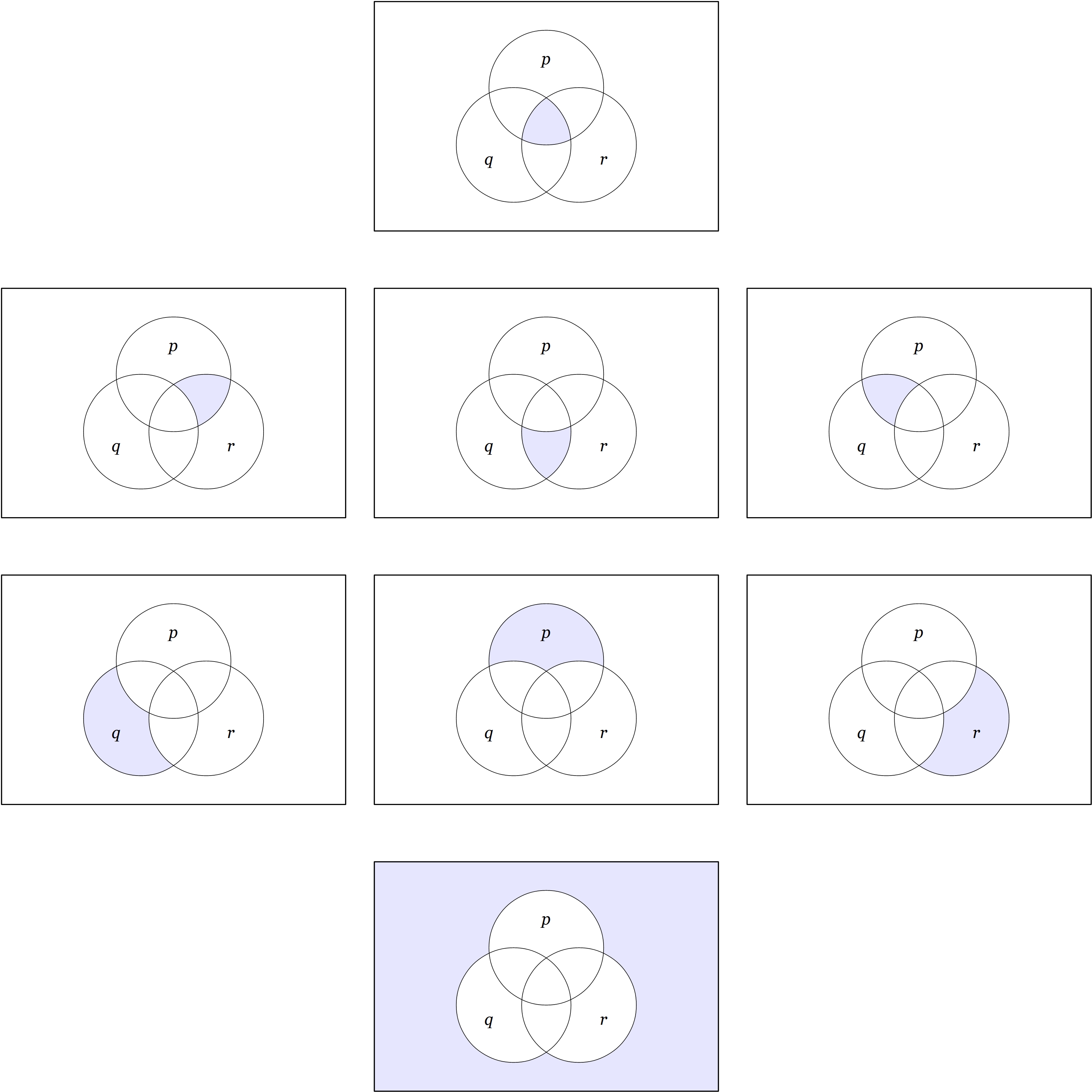

Singular Propositions on Three Variables

\text{Figure 10.} ~~ \text{Singular Propositions} : \mathbb{B}^3 \to \mathbb{B}

At the top is the venn diagram for the singular proposition of rank 3, corresponding to the boolean product pqr and identical with the positive proposition of rank 3.

Next are the venn diagrams for the three singular propositions of rank 2, which may be expressed by the following three forms, respectively:

pr \texttt{(} q \texttt{)}, \qquad  qr \texttt{(} p \texttt{)}, \qquad  pq \texttt{(} r \texttt{)}.

Next are the three singular propositions of rank 1, which may be expressed by the following three forms, respectively:

q \texttt{(} p \texttt{)(} r \texttt{)}, \qquad  p \texttt{(} q \texttt{)(} r \texttt{)}, \qquad  r \texttt{(} p \texttt{)(} q \texttt{)}.

At the bottom is the singular proposition of rank 0, which may be expressed by the following form:

\texttt{(} p \texttt{)(} q \texttt{)(} r \texttt{)}.

Resources

cc: CyberneticsOntolog ForumPeirce ListStructural ModelingSystems Science

Posted in Amphecks, Boolean Functions, C.S. Peirce, Cactus Graphs, Category Theory, Change, Computational Complexity, Cybernetics, Differential Analytic Turing Automata, Differential Calculus, Differential Logic, Discrete Dynamics, Dynamical Systems, Equational Inference, Functional Logic, Gradient Descent, Graph Theory, Group Theory, Hologrammautomaton, Indicator Functions, Logic, Logical Graphs, Mathematical Models, Mathematics, Minimal Negation Operators, Painted Cacti, Peirce, Propositional Calculus, Propositional Equation Reasoning Systems, Time, Visualization | Tagged , , , , , , , , , , , , , , , , , , , , , , , , , , , , , , | 4 Comments

Differential Propositional Calculus • 6

Special Classes of Propositions (cont.)

Next we take up the family of positive propositions and follow the same plan as before, tracing the rule of their formation in the case of a 3-dimensional universe of discourse.

Positive Propositions

Positive Propositions May Be Written As Products

In a universe of discourse based on three boolean variables, p, q, r, there are 2^3 = 8 positive propositions, taking the shapes shown in Figure 9.

Positive Propositions on Three Variables

\text{Figure 9.} ~~ \text{Positive Propositions} : \mathbb{B}^3 \to \mathbb{B}

At the top is the venn diagram for the positive proposition of rank 3, corresponding to the boolean product or logical conjunction pqr.

Next are the venn diagrams for the three positive propositions of rank 2, corresponding to the three boolean products, pr, qr, pq, respectively.

Next are the three positive propositions of rank 1, which are none other than the three basic propositions, p, q, r.

At the bottom is the positive proposition of rank 0, the everywhere true proposition or the constant 1 function, which may be expressed by the form \texttt{((}~\texttt{))} or by a simple 1.

Resources

cc: CyberneticsOntolog ForumPeirce ListStructural ModelingSystems Science

Posted in Amphecks, Boolean Functions, C.S. Peirce, Cactus Graphs, Category Theory, Change, Computational Complexity, Cybernetics, Differential Analytic Turing Automata, Differential Calculus, Differential Logic, Discrete Dynamics, Dynamical Systems, Equational Inference, Functional Logic, Gradient Descent, Graph Theory, Group Theory, Hologrammautomaton, Indicator Functions, Logic, Logical Graphs, Mathematical Models, Mathematics, Minimal Negation Operators, Painted Cacti, Peirce, Propositional Calculus, Propositional Equation Reasoning Systems, Time, Visualization | Tagged , , , , , , , , , , , , , , , , , , , , , , , , , , , , , , | 4 Comments




