Animated Logical Graphs • 79

Re: Category TheoryHenry Story

HS:
I think in this 2020 Applied Category Theory talk by Rocco Gangle, A Generic Figures Reconstruction of Peirce’s Existential Graphs (Alpha), he is looking at showing how Peirce’s work can be expressed in terms of Category Theory.

I looked at that once, I think.  I seem to recall he is still using the planar maps which I consider the mark of a novice, but I will give it another look.

Okay, I see he introduces forests about half-way through, that’s a good thing, but he’s not up to cacti yet, which is something I found necessary early on for the sake of both conceptual and computational efficiency.  So there’s a few things I will need to explain …

I started working on logical graphs early in my undergrad years, after my encounter with Peirce’s Collected Papers, quickly followed by my study of Spencer Brown’s Laws of Form, and from the outset trying everything I could hack by way of syntax handlers and theorem provers in every mix of languages and machines I got my hands on.  That combination of forces and media summed to form my current direction.

Peirce broke ground and laid the groundwork, Spencer Brown shored up the infrastructure of primary arithmetic and leveled the proving grounds to facilitate equational inference, and a host of computers supplied the real-world recalcitrance of matter, the resistance to facile simplicity, and the rebuke of all too facile reductionism.

Resources

cc: Peirce List (1) (2) (3) (4) (5) (6) (7) (8) (9) (10) (11) (12) (13) (14) (15) (16) (17)
cc: Category Theory • Cybernetics (1) (2) • Ontolog Forum (1) (2)
cc: Structural Modeling (1) (2) • Systems Science (1) (2)
cc: FB | Logical GraphsLaws of Form

Posted in Amphecks, Animata, Boolean Algebra, Boolean Functions, C.S. Peirce, Cactus Graphs, Constraint Satisfaction Problems, Deduction, Diagrammatic Reasoning, Duality, Equational Inference, Graph Theory, Laws of Form, Logic, Logical Graphs, Mathematics, Minimal Negation Operators, Model Theory, Painted Cacti, Peirce, Proof Theory, Propositional Calculus, Propositional Equation Reasoning Systems, Spencer Brown, Theorem Proving, Visualization | Tagged , , , , , , , , , , , , , , , , , , , , , , , , , | 7 Comments

Animated Logical Graphs • 78

Cf: Category TheoryJon Awbrey

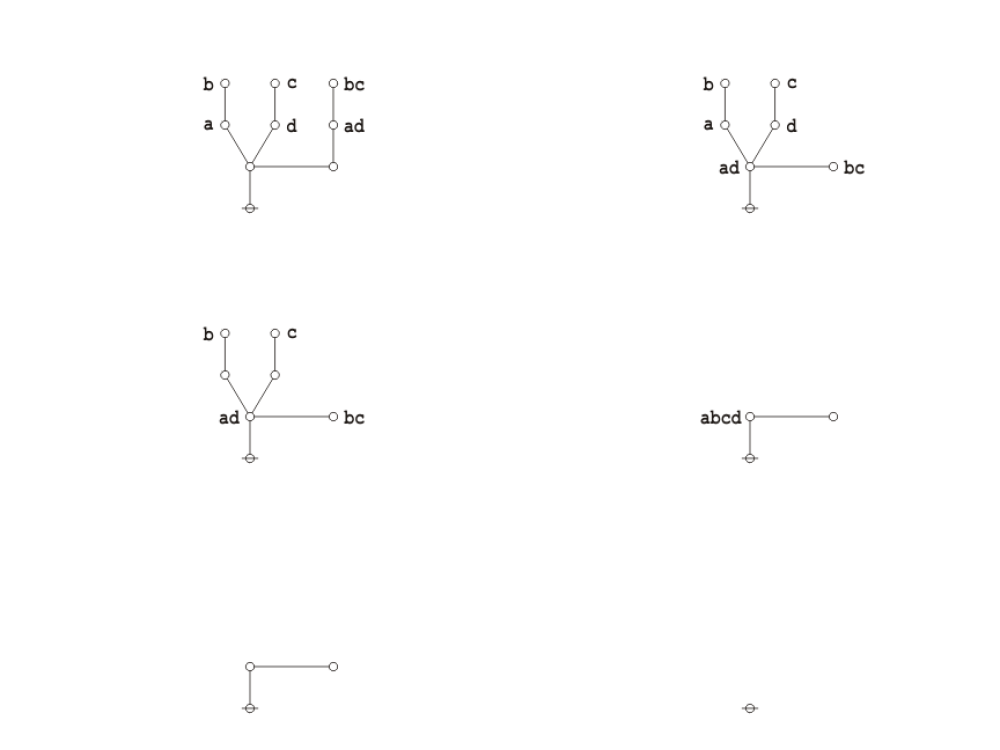
As far as the “animated” part goes, I lost my klutz-friendly animation app in my last platform change and then got immersed in other things, so it may be a while before I get back to that, but here’s two examples of animated proofs in a CSP∫GSB-style propositional calculus just to give a hint of how things might develop.

Peirce's Law • Proof Animation

Praeclarum Theorema • Proof Animation

Resources

cc: Peirce List (1) (2) (3) (4) (5) (6) (7) (8) (9) (10) (11) (12) (13) (14) (15) (16) (17)
cc: Category Theory • Cybernetics (1) (2) • Ontolog Forum (1) (2)
cc: Structural Modeling (1) (2) • Systems Science (1) (2)
cc: FB | Logical GraphsLaws of Form

Posted in Amphecks, Animata, Boolean Algebra, Boolean Functions, C.S. Peirce, Cactus Graphs, Constraint Satisfaction Problems, Deduction, Diagrammatic Reasoning, Duality, Equational Inference, Graph Theory, Laws of Form, Logic, Logical Graphs, Mathematics, Minimal Negation Operators, Model Theory, Painted Cacti, Peirce, Proof Theory, Propositional Calculus, Propositional Equation Reasoning Systems, Spencer Brown, Theorem Proving, Visualization | Tagged , , , , , , , , , , , , , , , , , , , , , , , , , | 6 Comments

Animated Logical Graphs • 77

Cf: Category TheoryJon Awbrey

A place for exploring animated forms of visual inference
inspired by the work of C.S. Peirce and Spencer Brown.

I opened a topic in the “logic” stream of “category theory.zulipchat” to discuss logical graphs in a category theoretic environment and began by linking a few basic resources.  Here goes …

Resources

cc: Peirce List (1) (2) (3) (4) (5) (6) (7) (8) (9) (10) (11) (12) (13) (14) (15) (16) (17)
cc: Category Theory • Cybernetics (1) (2) • Ontolog Forum (1) (2)
cc: Structural Modeling (1) (2) • Systems Science (1) (2)
cc: FB | Logical GraphsLaws of Form

Posted in Amphecks, Animata, Boolean Algebra, Boolean Functions, C.S. Peirce, Cactus Graphs, Constraint Satisfaction Problems, Deduction, Diagrammatic Reasoning, Duality, Equational Inference, Graph Theory, Laws of Form, Logic, Logical Graphs, Mathematics, Minimal Negation Operators, Model Theory, Painted Cacti, Peirce, Proof Theory, Propositional Calculus, Propositional Equation Reasoning Systems, Spencer Brown, Theorem Proving, Visualization | Tagged , , , , , , , , , , , , , , , , , , , , , , , , , | 7 Comments

C.S. Peirce and Category Theory • 8

Re: Category TheoryHenry Story
Re: Laws of FormLyle Anderson

LA:
As I am trying to get “frame sync” on this discussion, as the satellite communications people say, I am taking clues from the introduction
to the listing for Gangle’s Diagrammatic Immanence.

A renewal of immanent metaphysics through diagrammatic methods and the tools of category theory.  Spinoza, Peirce and Deleuze are, in different ways, philosophers of immanence.  Rocco Gangle addresses the methodological questions raised by a commitment to immanence in terms of how diagrams may be used both as tools and as objects of philosophical investigation.  He integrates insights from Spinozist metaphysics, Peircean semiotics and Deleuze’s philosophy of difference in conjunction with the formal operations of category theory.  Category theory reveals deep structural connections among logic, topology and a variety of different areas of mathematics, and it provides constructive and rigorous concepts for investigating how diagrams work.

Henry, Lyle, All,

This discussion keeps flashing me back to an unfinished syzygy from the mid ’80s when I took a course on “applications of λ-calculus” with John Gray at Illinois examining the trio of combinators, computation, and cartesian closed categories, all hot topics of the day, and followed it up with a guided study on the connections to Peirce I had glimpsed at the time.  I’ll dig up some notes and get back to that.  For the moment I’ll focus on category theory in the light of Peirce.  The lights of Spinoza and Deleuze I’ll leave to observers who see better by them.

cc: Category TheoryCyberneticsOntologStructural ModelingSystems Science
cc: FB | Peirce MattersLaws of Form

Posted in Abstraction, Aristotle, C.S. Peirce, Category Theory, Logic, Logic of Relatives, Mathematics, Peirce, Peirce's Categories, Phenomenology, Pragmatic Maxim, Relation Theory, Semiotics, Triadic Relations, Triadicity, Type Theory | Tagged , , , , , , , , , , , , , , , | 3 Comments

C.S. Peirce and Category Theory • 7

Re: Category TheoryHenry Story

HS:
I’d be very interested in the comments of people who know about Peirce on the two chapters in the book Diagrammatic Immanence I linked to above on “3. Peirce” and “4. Diagrams of Variation : Functor Categories and Presheaves”.  The chapter on Presheaves has some good intuitions on how to explain them that I recognise from studying them a year ago.  At the end of that chapter the author Rocco Gangle argues that Peirce’s diagrams can be modelled in terms of Category Theory.  I would have expected a long list of articles to follow to underwrite that claim.  Perhaps this is all well known in Peirce or CT circles …

Dear Henry,

Things are a little calmer in my neck of the woods at the moment so I’m paddling back up Peirce Bayou to clear up some of the points I missed during last week’s tempest and root canal.  An hour’s expedition through Amazon’s creeks and tributaries finally turned up a pearl of not too great a price so far as Diagrammatic Immanence goes so I tumbled for a paperback edition to arrive in a couple of weeks but the purchase lets me read it on Kindle right away.  So I’ll be perusing that …

cc: Category TheoryCyberneticsOntologStructural ModelingSystems Science
cc: FB | Peirce MattersLaws of Form

Posted in Abstraction, Aristotle, C.S. Peirce, Category Theory, Logic, Logic of Relatives, Mathematics, Peirce, Peirce's Categories, Phenomenology, Pragmatic Maxim, Relation Theory, Semiotics, Triadic Relations, Triadicity, Type Theory | Tagged , , , , , , , , , , , , , , , | 3 Comments

C.S. Peirce and Category Theory • 6

Re: Category TheoryHenry Story

HS:
I’d love it of course if all of Peirce’s graphs could be mapped to CT.  That would help me integrate that work a lot faster.  Or alternatively, if one could work out exactly where it could not be tied into CT, that would also be very helpful.
Dear Henry,

The way I see it, Peirce’s work as a whole requires us to stand back from our current picture of category theory and adopt a more general perspective on the subject as we know it.  That has not been a popular opinion in math circles and scarcely grasped in phil circles.  It’s on my big bucket list of Failures To Communicate but I haven’t really tried all that hard lately so maybe I’ll give it another go.

Regards,

Jon

cc: Category TheoryCyberneticsOntologStructural ModelingSystems Science
cc: FB | Peirce MattersLaws of Form

Posted in Abstraction, Aristotle, C.S. Peirce, Category Theory, Logic, Logic of Relatives, Mathematics, Peirce, Peirce's Categories, Phenomenology, Pragmatic Maxim, Relation Theory, Semiotics, Triadic Relations, Triadicity, Type Theory | Tagged , , , , , , , , , , , , , , , | 3 Comments

C.S. Peirce and Category Theory • 5

Re: C.S. Peirce and Category Theory • 2
Re: Category TheoryHenry StoryAvi CraimerHenry Story

Dear Avi, Henry,

Diagrams are a mixed bag, a complex and polymorphic species, in Peircean semiotics.  All diagrams in common use, especially in mathematics, involve all three types of signs — Symbols, Icons, Indices — as interpreted by their user communities.  There has been a tendency in recent years to overemphasize the iconic aspects of Peirce’s logical graphs, reading them a bit too much on the analogy of venn diagrams, but their real conceptual and computational power comes rather from their generic symbolic character.

Here’s an intro to Sign Relations from a Peircean point of view, still a bit “working on it” from my POV.

Here’s the skinny on the three main types of signs — Symbols, Icons, Indices — in Peirce’s theory of signs.

cc: Category TheoryCyberneticsOntologStructural ModelingSystems Science
cc: FB | Peirce MattersLaws of Form

Posted in Abstraction, Aristotle, C.S. Peirce, Category Theory, Logic, Logic of Relatives, Mathematics, Peirce, Peirce's Categories, Phenomenology, Pragmatic Maxim, Relation Theory, Semiotics, Triadic Relations, Triadicity, Type Theory | Tagged , , , , , , , , , , , , , , , | 3 Comments

C.S. Peirce and Category Theory • 4

Re: C.S. Peirce and Category Theory • 3
Re: Category TheoryKyle Rivelli

Dear Kyle,

My Inquiry Into Inquiry blog has a Survey page where I collect blog and wiki resources on all the longer-running topics I write and dialogue about.  The following two collections bear on the close relationship, almost a kind of noun-verb or product-process duality, between signs and inquiry.

Especially relevant to the complex of connections Peirce suggests between the main types of signs (Icons, Indices, Symbols) and the main types of inference (Abduction, Induction, Deduction) are my study notes and blog series on Peirce’s Laws of Information, the spirit of which is captured by the following formula.

\text{Information} = \text{Comprehension} \times \text{Extension}

I appear destined to revisit this subject every other summer or so.  Here’s an outline of the last time around.

Probably about due for another return …

Jon

cc: Category TheoryCyberneticsOntologStructural ModelingSystems Science
cc: FB | Peirce MattersLaws of Form

Posted in Abstraction, Aristotle, C.S. Peirce, Category Theory, Logic, Logic of Relatives, Mathematics, Peirce, Peirce's Categories, Phenomenology, Pragmatic Maxim, Relation Theory, Semiotics, Triadic Relations, Triadicity, Type Theory | Tagged , , , , , , , , , , , , , , , | 3 Comments

C.S. Peirce and Category Theory • 3

Re: Category TheoryKyle Rivelli

KR:
I really enjoyed the Diagrammatic Immanence book.
Gangle has another book that goes into more depth with Peirce:
Gianluca Caterina and Rocco Gangle (2016), Iconicity and Abduction.

Thanks, Kyle, I’ve been looking at this book for a while now, trying to decide if there’s anything in it I need to know badly enough to justify the purchase.

The connection between the types of inference (Abduction, Induction, Deduction) and the types of signs (Icons, Indices, Symbols) is a pivotal question in Peirce’s logic, occupying the interface between his theory of inquiry and his theory of signs.  It’s an issue I’ve done a lot of thinking, dialoguing, and blogging about.  I will dig up some links later but here is one for starters.

cc: Category TheoryCyberneticsOntologStructural ModelingSystems Science
cc: FB | Peirce MattersLaws of Form

Posted in Abstraction, Aristotle, C.S. Peirce, Category Theory, Logic, Logic of Relatives, Mathematics, Peirce, Peirce's Categories, Phenomenology, Pragmatic Maxim, Relation Theory, Semiotics, Triadic Relations, Triadicity, Type Theory | Tagged , , , , , , , , , , , , , , , | 4 Comments

C.S. Peirce and Category Theory • 2

Re: Category TheoryHenry Story

HS:
This book Diagrammatic Immanence [preview]
has a whole chapter on Peirce and Category Theory.

There’s a two‑culture tension in the reception of Peirce these days.  Maybe it’s always been that way but it strikes me as more bifurcated today than any time since I began my Peirce studies 50+ years ago.  Peirce for the logic-math-science researcher and Peirce for the humanities-literary-verbal stylist are almost immiscible types of thinkers.  I find this especially irksome in the case of Peirce since I have felt from the beginning Peirce more than any other thinker gave us the framework and the tools we need to integrate the two‑culture divide in society at large.

The following paper touches on a number of related issues as they affect the education and research missions of universities.

  • Awbrey, S.M., and Awbrey, J.L. (2001), “Conceptual Barriers to Creating Integrative Universities”, Organization : The Interdisciplinary Journal of Organization, Theory, and Society 8(2), Sage Publications, London, UK, pp. 269–284.  AbstractOnline.

cc: Category TheoryCyberneticsOntologStructural ModelingSystems Science
cc: FB | Peirce MattersLaws of Form

Posted in Abstraction, Aristotle, C.S. Peirce, Category Theory, Logic, Logic of Relatives, Mathematics, Peirce, Peirce's Categories, Phenomenology, Pragmatic Maxim, Relation Theory, Semiotics, Triadic Relations, Triadicity, Type Theory | Tagged , , , , , , , , , , , , , , , | 4 Comments