Abduction, Deduction, Induction, Analogy, Inquiry • 21

Figure 2. Signs and Inquiry in Dewey

Re: Peirce List • Jerry Rhee • Tom Gollier • Edwina Taborsky

Given a working hypothesis, as abduced in the previous post, the next phase of inquiry uses deductive inference to expand the implied consequences of the abductive hypothesis, with the aim of testing its truth.  For this purpose, our inquirer must think of other things following from the consequent of his precipitate explanation.  Thus, he now reflects on the Case just assumed:

  • Case : {C \Rightarrow B},   The Current situation is just Before it rains.

He looks up to scan the sky, perhaps in a random search for further information, but since the sky is a logical place to look for details of an imminent rainstorm, symbolized in our story by the letter {B}, we may suppose our reasoner has already detached the consequent of the abduced Case, {C \Rightarrow B}, and has begun to expand on its further implications.  So let us imagine our up-looker has a more deliberate purpose in mind and his search for additional data is driven by the new-found, determinate Rule:

  • Rule : {B \Rightarrow D},   Just Before it rains, Dark clouds appear.

Contemplating the assumed Case in combination with this new Rule leads him by an immediate deduction to predict an additional Fact:

  • Fact : {C \Rightarrow D},   In the Current situation Dark clouds appear.

The reconstructed picture of reasoning assembled in this second phase of inquiry is true to the pattern of deductive inference.

References

cc: Peirce List (1) (2) (3) (4) (5) (6) (7) (8)

Posted in Abduction, Analogy, Aristotle, Artificial Intelligence, C.S. Peirce, Deduction, Induction, Inquiry, Inquiry Driven Systems, Intelligent Systems Engineering, Logic, Mental Models, Peirce, Scientific Method, Semiotics, Systems | Tagged , , , , , , , , , , , , , , , | 6 Comments

Abduction, Deduction, Induction, Analogy, Inquiry • 20

Figure 2. Signs and Inquiry in Dewey

Re: Peirce List • Jerry Rhee • Tom Gollier • Edwina Taborsky

In passing from a sign-relational account to a propositional analysis of Dewey’s story there is an old mathematical trick, analogous to the method of adding fractions by expressing them over a common denominator, that comes in handy.

The general idea is that we introduce a new term {C} to denote the Current situation.  In the example at hand, letting {A} be the proposition that the Air is cool, we can express our hero’s initial observation by means of the following premiss:

  • Fact : {C \Rightarrow A},   In the Current situation the Air is cool.

Responding to an intellectual reflex of puzzlement about the situation, his resource of common knowledge about the world is impelled to seize on an approximate Rule:

  • Rule : {B \Rightarrow A},   Just Before it rains, the Air is cool.

This Rule can be recognized as having a potential relevance to the situation because it matches the surprising Fact, {C \Rightarrow A}, in its consequential feature {A}.

All of this suggests that the present Case may be one in which it is just about to rain:

  • Case : {C \Rightarrow B},   The Current situation is just Before it rains.

The whole mental performance, however automatic and semi-conscious it may be, that leads from a problematic Fact and a previously settled knowledge base of Rules to the plausible suggestion of a Case description, is what we are calling an abductive inference.

The above is the first part of a “Zeroth Order” logical analysis of Dewey’s Sign of Rain story that I’ve posted a number of times around the web.  The rest of the analysis can be found at the following location.

Reference

cc: Peirce List (1) (2) (3) (4) (5) (6) (7) (8)

Posted in Abduction, Analogy, Aristotle, Artificial Intelligence, C.S. Peirce, Deduction, Induction, Inquiry, Inquiry Driven Systems, Intelligent Systems Engineering, Logic, Mental Models, Peirce, Scientific Method, Semiotics, Systems | Tagged , , , , , , , , , , , , , , , | 7 Comments

Abduction, Deduction, Induction, Analogy, Inquiry • 19

Figure 2. Signs and Inquiry in Dewey

Re: Peirce List • Tom Gollier

At this point in our paper, Sue and I had already introduced the rudiments of sign relations, as far as the common notions and continuities of thought underpinning the semiotic bridge from Aristotle to Peirce might be teased out, and we turned to the task of tracing the role of sign relations in the workings of a fully filled out inquiry process, with all its abductive, deductive, and inductive faculties intact.

The relation between theories of signs and theories of inquiry, as we find them in Aristotle, or Peirce, or name your favorite, or as we must find them at “the end of all our exploring”, are some of the things I’m still trying to understand but I can’t let my need to think I know much prevent me from learning more.

At any rate we do have a general outline from Peirce of how he thinks one cycle of inquiry goes, so what we tried to do in this case was to fit the semiotic roles into that hopper as best we could and see how far that afforded us any guidance in understanding the dynamics of Dewey’s story.

With that pre-ramble …

Any realistic practical situation will involve all sorts of objects, passed, pressing, and prospective.  Practical applications force us at any given moment to deal with an object domain O that is a collection of many objects o.  Objects and objectives can be complex.  Objects can have sub-objects and super-objects.  Objectives can have sub-objectives and super-objectives, though we usually speak of goals and subgoals then.  The same goes for signs and interpretant signs, of course, which is what syntactic analysis and conceptual analysis are all about.

That overarching interest in practical applications is one of the reasons I’m always harping on the extensional formulation of a sign relation as a set L \subseteq O \times S \times I, where O, S, I are sets of many elements.  The object domain O is very like the universe of discourse in ordinary logic, while S and I are the systems of signs, public or private or whatever, that we use to talk and think about our present object domain.

So …

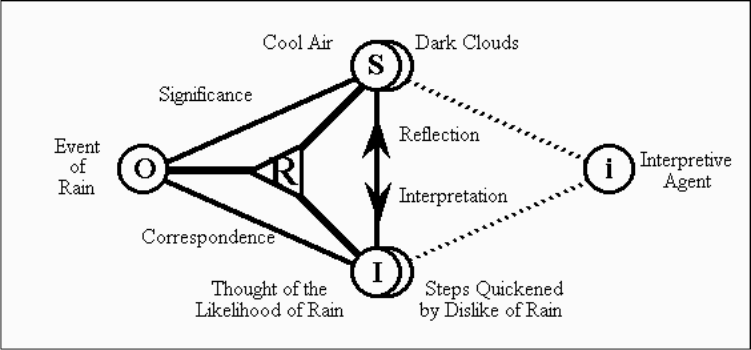
What makes the likelihood of rain a semiotic object in Dewey’s story is simply the fact that the ambulator interprets the cooling air as a sign of it.  We know the interpreter interprets the sign as a sign of that object by virtue of the fact that he forms an interpretent sign, the thought of the likelihood of rain, in his mind.

Reference

cc: Peirce List (1) (2) (3) (4) (5) (6) (7) (8)

Posted in Abduction, Analogy, Aristotle, Artificial Intelligence, C.S. Peirce, Deduction, Induction, Inquiry, Inquiry Driven Systems, Intelligent Systems Engineering, Logic, Mental Models, Peirce, Scientific Method, Semiotics, Systems | Tagged , , , , , , , , , , , , , , , | 6 Comments

Abduction, Deduction, Induction, Analogy, Inquiry • 18

Figure 2. Signs and Inquiry in Dewey

Re: Peirce List • Tom Gollier

Let me dispel any notion that “the interpretant introduces the person as part of the object-sign-interpretant structure”.  We may have left it implicit or unclear in the text but the lower case “i” and the dashed lines in the figure were meant to suggest the agency of the interpreter and the circumstance that signs and interpretants reside nearer the personal sphere than the objects, generally speaking.  As a rule, for all sorts of reasons, primers in semiotics tend to start out talking about interpreters and only gradually abstract away to interpretants.  But I see now that it was faulty notation, as it’s more usual to read a lower case “i” as indicating a member of a local set I.  Next time I will use a Greek iota for the interpretive agent.

Reference

cc: Peirce List (1) (2) (3) (4) (5) (6) (7)

Posted in Abduction, Analogy, Aristotle, Artificial Intelligence, C.S. Peirce, Deduction, Induction, Inquiry, Inquiry Driven Systems, Intelligent Systems Engineering, Logic, Mental Models, Peirce, Scientific Method, Semiotics, Systems | Tagged , , , , , , , , , , , , , , , | 6 Comments

Abduction, Deduction, Induction, Analogy, Inquiry • 17

Figure 2. Signs and Inquiry in Dewey

Re: Peirce List • Tom Gollier

I know we’ve discussed the various meanings of the word object which make sense in Peirce’s semiotics and pragmatism generally, so let me just link to a recent comment I found in my search for previous mentions.

Objects, Objectives, Objectivity

I am constantly reminded of this favorite line from Peirce:

“No longer wondered what I would do in life but defined my object.”

🙞  C.S. Peirce (1861), “My Life, written for the Class-Book”, (CE 1, 3)

The question of Objects, Objectives, and Objectivity is a persistent one.

The Latin-rooted English object springs from deeper roots in the Greek pragma.  It was a personal revelation to me on first looking into Liddell and Scott and reading all the meanings and ramifications of that vast pragmatic semantic complex.

It is especially the senses of the word object referring to aims and purposes, in other words, intentional objects and objects of intention, that we are likely to miss if we don’t remind ourselves of their pertinence to pragmatic thinking.

Keeping that variety of meanings in mind, a few more words may help to clarify the reading from last time.

  • There are of course the usual run of behaviorist, causal, stimulus-response theories of “signal processing” and “verbal behavior” that have enjoyed their popularity and never-say-die revivals from the days of Charles Morris to B.F. Skinner, but Peirce’s semiotics includes them as degenerate species of the more solid genre he had in mind.
  • Peirce’s definition of a triadic sign relation is cast at such a level of generality that nothing in it prevents a sign relation L \subseteq O \times S \times I from having intentional objects in its object domain O.
  • To say that coolness is a sign of rain is a perfectly natural statement in English, and I think it would be a more troubling narrowness to exclude it from sense.
  • Semiotic objects are any objects of discussion or thought.  It should be obvious that we talk and think about future, imaginary, intentional, or “virtual” objects all the time.
  • The fact that coolness might be a sign of many other things is exactly what calls for our peripatetic hero to abduce a hypothesis (rain?), to deduce a prediction (dark clouds?), and to test the prediction against further observations (look up!).  All of those features are why we chose Dewey’s story as an illustration of a full-blown inquiry.

Reference

cc: Peirce List (1) (2) (3) (4) (5) (6) (7)

Posted in Abduction, Analogy, Aristotle, Artificial Intelligence, C.S. Peirce, Deduction, Induction, Inquiry, Inquiry Driven Systems, Intelligent Systems Engineering, Logic, Mental Models, Peirce, Scientific Method, Semiotics, Systems | Tagged , , , , , , , , , , , , , , , | 10 Comments

Abduction, Deduction, Induction, Analogy, Inquiry • 16

Re: Peirce List • Jerry Chandler

The simple question arises:  If an abductive step is taken by the inquirer, then what?

A very good question.  Susan Awbrey and I tried our hands at answering the What Next? question in the medium of analyzing Dewey’s “Sign of Rain” example.  Here is the relevant excerpt from “Interpretation as Action : The Risk of Inquiry”.

The Pattern and Stages of Inquiry

To illustrate the place of the sign relation in inquiry we begin with Dewey’s elegant and simple example of reflective thinking in everyday life:

A man is walking on a warm day.  The sky was clear the last time he observed it;  but presently he notes, while occupied primarily with other things, that the air is cooler.  It occurs to him that it is probably going to rain;  looking up, he sees a dark cloud between him and the sun, and he then quickens his steps.  What, if anything, in such a situation can be called thought?  Neither the act of walking nor the noting of the cold is a thought.  Walking is one direction of activity;  looking and noting are other modes of activity.  The likelihood that it will rain is, however, something suggested.  The pedestrian feels the cold;  he thinks of clouds and a coming shower.  (Dewey 1991, 6–7).

In this narrative we can identify the characters of the sign relation as follows:  coolness is a Sign of the Object rain, and the Interpretant is the thought of the rain’s likelihood.  In his 1910 description of reflective thinking Dewey distinguishes two phases, “a state of perplexity, hesitation, doubt” and “an act of search or investigation” (Dewey 1991, 9), comprehensive stages which are further refined in his later model of inquiry.  In this example reflection is the act of the interpreter which establishes a fund of connections between the sensory shock of coolness and the objective danger of rain, by way of his impression that rain is likely.  But reflection is more than irresponsible speculation.  In reflection the interpreter acts to charge or defuse the thought of rain (the probability of rain in thought) by seeking other signs which this thought implies and evaluating the thought according to the results of this search.

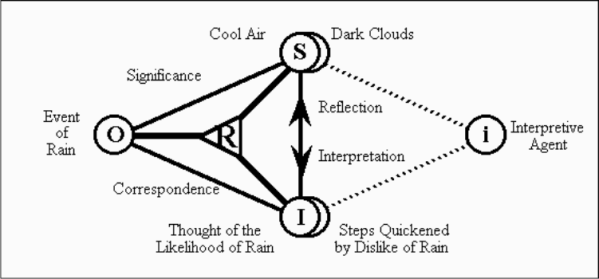
Figure 2 illustrates Dewey’s “Rain” example, tracing the structure and function of the sign relation as it informs the activity of inquiry, including both the movements of surprise explanation and intentional action.  The dyadic faces of the sign relation are labeled with just a few of the loosest terms that apply, indicating the “significance” of signs for eventual occurrences and the “correspondence” of ideas with external orientations.  Nothing essential is meant by these dyadic role distinctions, since it is only in special or degenerate cases that their shadowy projections can maintain enough information to determine the original sign relation.

Figure 2. Signs and Inquiry in Dewey

\text{Figure 2.} ~~ \text{Signs and Inquiry in Dewey}

If we follow this example far enough to consider the import of thought for action, we realize that the subsequent conduct of the interpreter, progressing up through the natural conclusion of the episode — the quickening steps, seeking shelter in time to escape the rain — all of these acts form a series of further interpretants, contingent on the active causes of the individual, for the originally recognized signs of rain and for the first impressions of the actual case.  Just as critical reflection develops the associated and alternative signs which gather about an idea, pragmatic interpretation explores the consequential and contrasting actions which give effective and testable meaning to a person’s belief in it.

cc: Peirce List (1) (2) (3) (4) (5) (6)

Posted in Abduction, Analogy, Aristotle, Artificial Intelligence, C.S. Peirce, Deduction, Induction, Inquiry, Inquiry Driven Systems, Intelligent Systems Engineering, Logic, Mental Models, Peirce, Scientific Method, Semiotics, Systems | Tagged , , , , , , , , , , , , , , , | 8 Comments

Theory and Therapy of Representations • 1

Again, in a ship, if a man were at liberty to do what he chose, but were devoid of mind and excellence in navigation (αρετης κυβερνητικης), do you perceive what must happen to him and his fellow sailors?

Plato • Alcibiades • 135 A

Re: Michael Harris • Mathematical Literacy and the Good Society

Statistics were originally the data a ship of state needed for stationkeeping and staying on course.  The Founders of the United States, like the Cybernauts of the Enlightenment they were, engineered a ship of state with checks and ballasts and error-controlled feedbacks for the sake of representing both reality and the will of the people.  In that connection Max Weber saw how a state’s accounting systems were intended as representations of realities its crew and passengers must observe or perish.

The question for today is —

  • What are the forces distorting our representations of what’s observed, what’s expected, and what’s intended?

Repercussions

cc: Conceptual Graphs • Cybernetics • Laws of Form • Ontolog Forum
cc: FB | Cybernetics • Structural Modeling • Systems Science

Posted in Cybernetics, Democracy, Economics, Education, Expectation, Governance, Information, Inquiry, Intention, Justice, Law, Logic, Observation, Plato, Representation, Science, Semiosis, Semiotics, Society, Statistics, Virtue | Tagged , , , , , , , , , , , , , , , , , , , , | 6 Comments

Abduction, Deduction, Induction, Analogy, Inquiry • 15

A couple of phrases have stuck in my mind from my earliest days of reading about abductive inference and hypothesis formation.  One has to do with the puzzle of “giving a rule to abduction” and the other alludes to “the reticular formation that marshals our abductions”.  The first derives from Peirce, of course, but I’ve been trying to remember the details of when and where I first encountered it, as I think it was another writer who first impressed its significance on me.  The second is clearly Warren S. McCulloch but again there was something about the context that kept eluding me.

After a few days rummaging through link and library I was lucky enough to happen on several old volumes with my original notes on the texts, so I think I’ve got the passages in question pinned down to the following places.  To my way of thinking, no one writing in the last century understood Peirce’s treatment of hypothesis and its applications to cognitive and cybernetic systems better than Chomsky and McCulloch.

Charles S. Peirce

  • “The Logic of Abduction”, Chapter 13 in Essays in the Philosophy of Science, Vincent Tomas (ed.), Bobbs–Merrill, 1957.  Selections originally published in Collected Papers, “Hume on Miracles” (CP 6.522–536), “Eighth Lowell Lecture of 1903” (CP 5.590–604), “Seventh Harvard Lecture of 1903” (CP 5.195–200).

Warren S. McCulloch

  • “What Is a Number, that a Man May Know It, and a Man, that He May Know a Number?”, Ninth Alfred Korzybski Memorial Lecture, General Semantics Bulletin, Numbers 26 and 27, Institute of General Semantics, Lakeville, CT, 1961, pp. 7–18.  Reprinted in Embodiments of Mind, pp. 1–18.  Online.
  • “What’s in the Brain That Ink May Character?”, International Congress for Logic, Methodology, and Philosophy of Science, Israel, August 28, 1964.  Reprinted in Embodiments of Mind, pp. 387–397.  Online.
  • Embodiments of Mind, MIT Press, Cambridge, MA, 1965.

Noam Chomsky

  • “Linguistic Contributions to the Study of Mind : Future”, in Language and Mind, Harcourt Brace Jovanovich, San Diego, CA.  First edition 1968.  Enlarged edition 1972.  Online.

cc: Peirce List (1) (2) (3) (4) (5) (6)

Posted in Abduction, Analogy, Aristotle, Artificial Intelligence, C.S. Peirce, Deduction, Induction, Inquiry, Inquiry Driven Systems, Intelligent Systems Engineering, Logic, Mental Models, Peirce, Scientific Method, Semiotics, Systems | Tagged , , , , , , , , , , , , , , , | 8 Comments

Abduction, Deduction, Induction, Analogy, Inquiry • 14

Re: Peirce List • Clark Goble • John Collier

As far as what gives a rule to abduction, as Peirce styled a question I found echoed in minds of inquiry from W.S. McCulloch to Noam Chomsky, Peirce had already given the answer in the form of his maxim of pragmatism, which sets the bar that any concept or thesis must pass in order to serve the purpose of inquiry.

That’s the short answer for anyone who’s heard this story before and needs but the slightest jog of memory.  But the circumstance stirring me to pipe up this time around arose in a dispute between folks who probably haven’t heard that line before and who seemed to be laboring under all sorts of misconceptions about Peirce’s perspective on the logic of science as it applies to the nature of physical theory.

So there I merely tried to make the following points:

  1. The abductive step is by no means the whole of inquiry.  Its end lies at the end of the steps that come after.
  2. The abductive step is sui generis and does not reduce to any mix of deductive or inductive reasoning, for example, Bayes’ theorem or its application to probabilities.

There are other points having to do with (3) the creative role of abductive reasoning in concept formation, (4) its inaugural role in breaking ground for the initial formation of conceptual frameworks and theories, (5) its catalytic action at times when paradigms get mature or unstable or otherwise ripe for shifting.  But sufficient unto the day, as they say.

cc: Peirce List (1) (2) (3) (4) (5) (6)

Posted in Abduction, Analogy, Aristotle, Artificial Intelligence, C.S. Peirce, Deduction, Induction, Inquiry, Inquiry Driven Systems, Intelligent Systems Engineering, Logic, Mental Models, Peirce, Scientific Method, Semiotics, Systems | Tagged , , , , , , , , , , , , , , , | 6 Comments

Abduction, Deduction, Induction, Analogy, Inquiry • 13

Re: C.S. Peirce • Doctrine Of Individuals
Re: Peirce List • Martin Kettelhut

I’ve been calling attention to what Peirce wrote about the “Doctrine of Individuals” (what we’d probably call a theory of individuals) for quite some time.  Just for starters, here’s a few entry points I was able to find right off.

  • Conceptual Graphs List • (27 Nov 2000)
  • Peirce List (Feb–Mar 2015) • (1) • (2) • (3) • (4)
  • Mathematical Demonstration and the Doctrine of Individuals • (1) • (2)

To my mind this constitutes one of the most far-reaching insights in all of the thought Peirce passed on to us, making as it does a turn from the dead hand of absolute ontology to the rather more handy and pragmatic tack of discourse-relative ontology and interpretive information theory.

cc: Peirce List (1) (2) (3) (4) (5) (6)

Posted in Abduction, Analogy, Aristotle, Artificial Intelligence, C.S. Peirce, Deduction, Induction, Inquiry, Inquiry Driven Systems, Intelligent Systems Engineering, Logic, Mental Models, Peirce, Scientific Method, Semiotics, Systems | Tagged , , , , , , , , , , , , , , , | 6 Comments