Animated Logical Graphs • 59

Re: Richard J. Lipton • The Art Of Math
Re: Animated Logical Graphs • (57) • (58)

Returning to the theme of duality and more general group-theoretic symmetries in logical graphs, here’s an improved version of the introduction I gave two years ago.

Cf: Animated Logical Graphs • 30

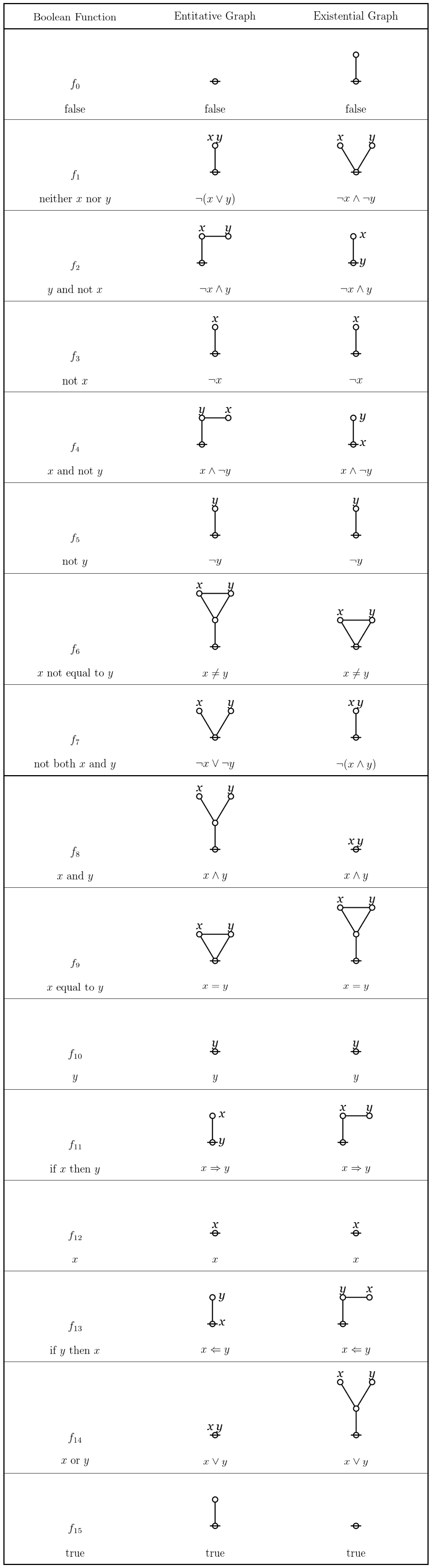
The duality between Entitative and Existential interpretations of logical graphs is a good example of a mathematical symmetry, in this case a symmetry of order two.  Symmetries of this and higher orders give us conceptual handles on excess complexity in the manifold of sensuous impressions, making it well worth the effort to seek them out and grasp them where we find them.

In that vein, here’s a Rosetta Stone to give us a grounding in the relationship between boolean functions and our two readings of logical graphs.

\text{Boolean Functions on Two Variables}

Boolean Functions on Two Variables

Resources

cc: Cybernetics (1) (2) • Laws of Form • FB | Logical Graphs • Ontolog Forum (1) (2)
• Peirce List (1) (2) (3) (4) (5) (6) (7) (8) (9) (10) (11) (12) • Structural Modeling (1) (2)
• Systems Science (1) (2)

Posted in Amphecks, Animata, Boolean Algebra, Boolean Functions, C.S. Peirce, Cactus Graphs, Constraint Satisfaction Problems, Deduction, Diagrammatic Reasoning, Duality, Equational Inference, Graph Theory, Laws of Form, Logic, Logical Graphs, Mathematics, Minimal Negation Operators, Model Theory, Painted Cacti, Peirce, Proof Theory, Propositional Calculus, Propositional Equation Reasoning Systems, Spencer Brown, Theorem Proving, Visualization | Tagged , , , , , , , , , , , , , , , , , , , , , , , , , | 21 Comments

Double Negation • 3

Re: Double Negation • (1) • (2)

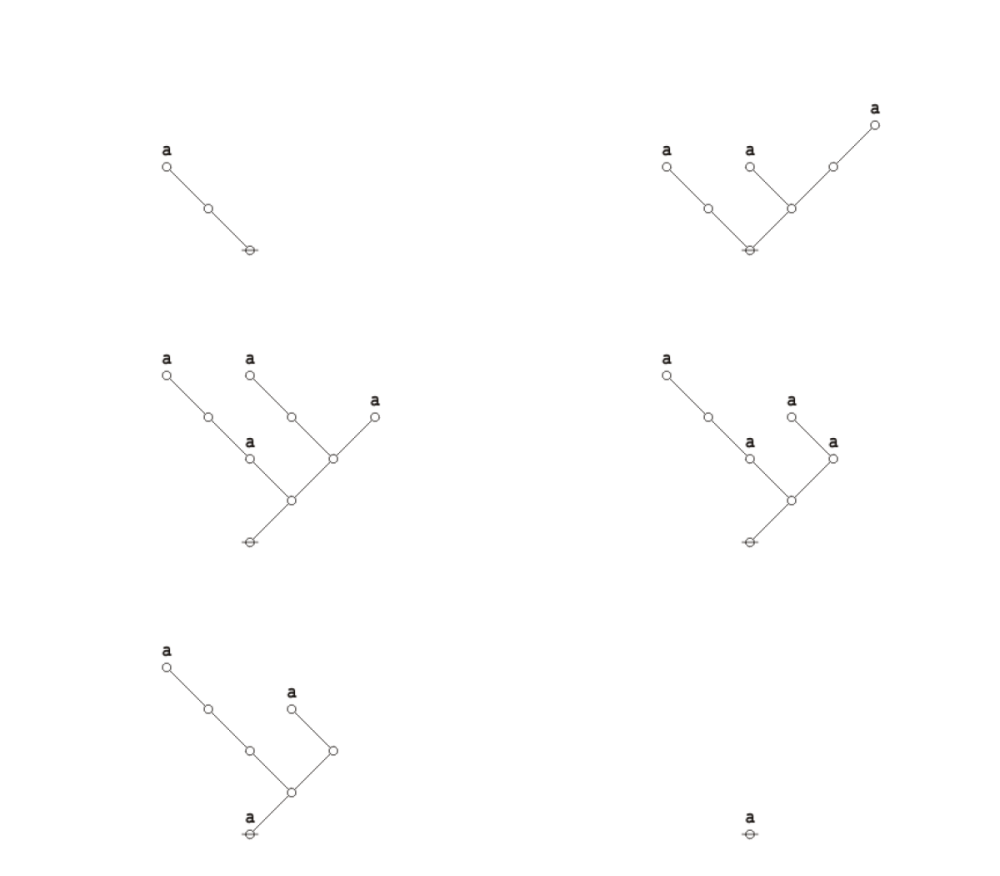
The steps of the proof of double negation are replayed in the following animation.

Double Negation Theorem • Animation

Resources

Reference

  • Spencer Brown, G. (1969), Laws of Form, George Allen and Unwin, London, UK.

cc: Cybernetics • Laws of Form • FB | Logical Graphs • Ontolog Forum • Peirce List
• Structural Modeling • Systems Science

Posted in Amphecks, Animata, Boolean Algebra, Boolean Functions, C.S. Peirce, Cactus Graphs, Constraint Satisfaction Problems, Deduction, Diagrammatic Reasoning, Duality, Equational Inference, Graph Theory, Laws of Form, Logic, Logical Graphs, Mathematics, Minimal Negation Operators, Model Theory, Painted Cacti, Peirce, Proof Theory, Propositional Calculus, Propositional Equation Reasoning Systems, Spencer Brown, Theorem Proving, Visualization | Tagged , , , , , , , , , , , , , , , , , , , , , , , , , | 3 Comments

Double Negation • 2

If we stand back for a moment to regard the structure of an implicational logic, such as Whitehead and Russell’s, we see that it is fully contained in that of an equivalence logic.  The difference is in the kind of step used.  In one case expressions are detached at the point of implication, in the other they are detached at the point of equivalence.

G. Spencer Brown • Laws of Form

We have been exploring the properties of a simple but elegant formal system exhibiting useful applications to logic.  This very simplicity helps us focus on core features of formal systems and logical reasoning in a far less cluttered environment than the general run of logical systems.  Earlier we touched on the theme of duality sourcing the radiation of mathematical form into logical subject matter, a theme we’ll touch on again. 

But while we have the simple but critical example of Double Negation in our sights let’s use it to illustrate another central feature of logical graphs bearing on the mathematical infrastructure of logic.  This is the power of using equational inference over and above implicational inference in proofs.

Here again is the formal equation corresponding to the principle of double negation, shown below in graph-theoretic and traversal-string forms.

Double Negation Theorem

Whether any principle is taken for an axiom or has to be proven as a theorem depends on the formal system at hand.  In the present system double negation is a consequence of the following set of axioms.

Axioms

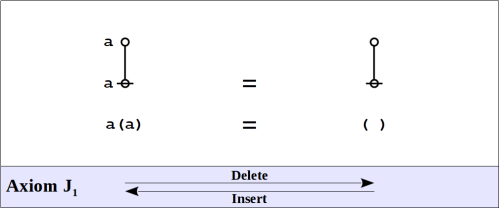
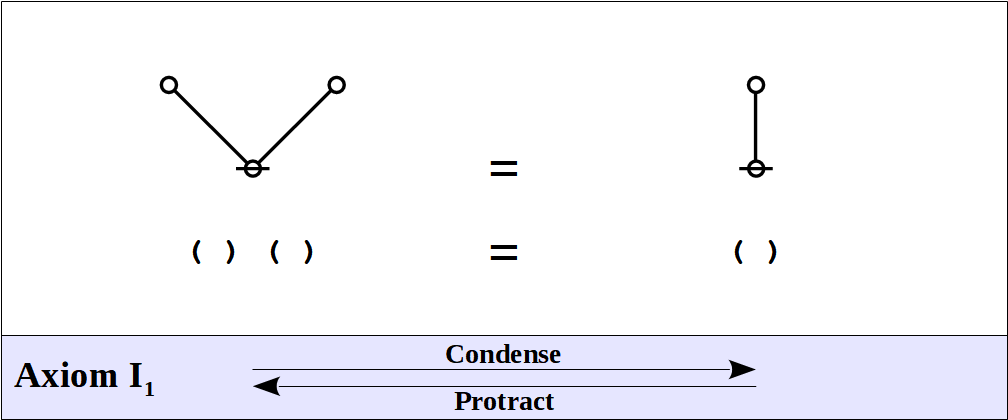
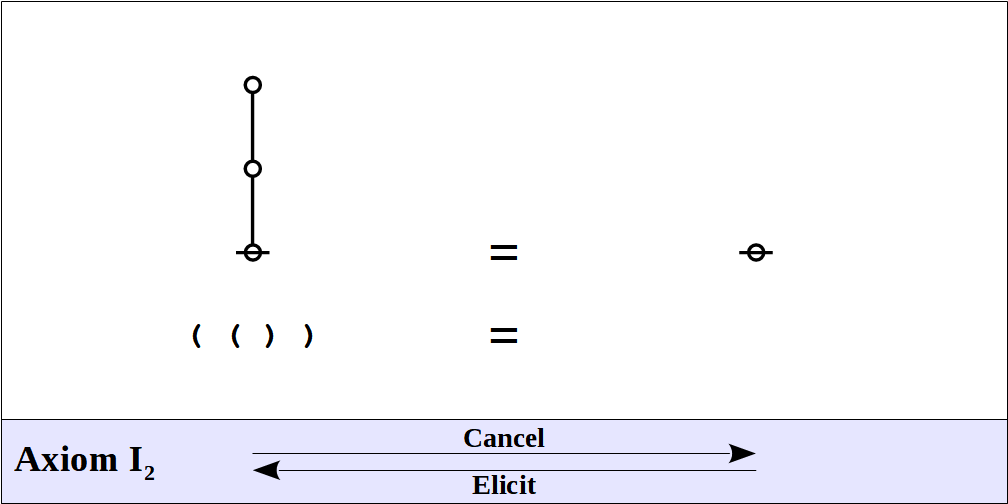
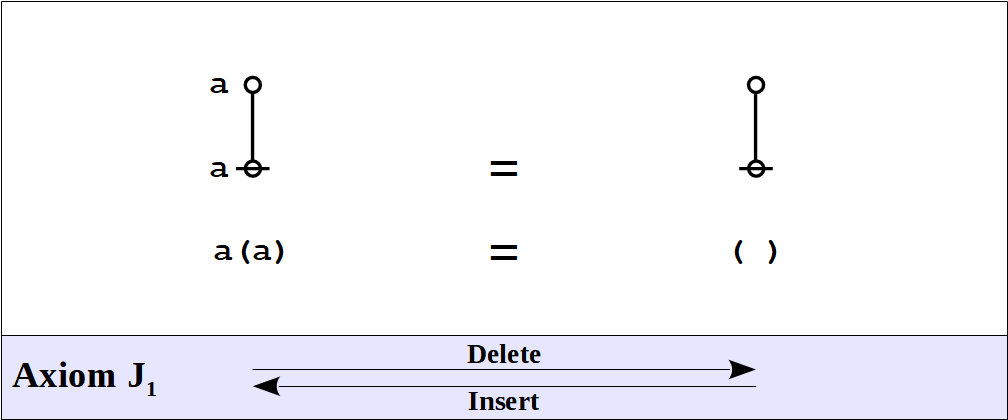
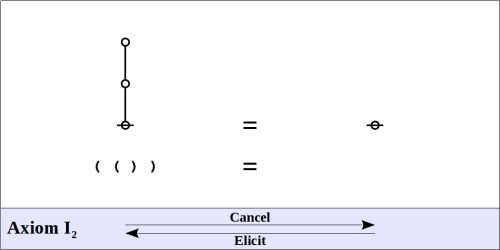
The formal system of logical graphs is defined by a foursome of formal equations, called initials when regarded purely formally, in abstraction from potential interpretations, and called axioms when interpreted as logical equivalences.  There are two arithmetic initials and two algebraic initials, as shown below.

Arithmetic Initials

I₁

I₂

Algebraic Initials

J₁

J₂

Logical Interpretation

One way of assigning logical meaning to the initial equations is known as the entitative interpretation (En).  Under En, the axioms read as follows.

\begin{array}{ccccc}  \mathrm{I_1}  & : & \text{true} ~ \text{or} ~ \text{true}  & = & \text{true}  \\[4pt]  \mathrm{I_2}  & : & \text{not} ~ \text{true}  & = & \text{false}  \\[4pt]  \mathrm{J_1}  & : & a ~ \text{or} ~ \text{not} ~ a  & = & \text{true}  \\[4pt]  \mathrm{J_2}  & : & (a ~ \text{or} ~ b) ~ \text{and} ~ (a ~ \text{or} ~ c)  & = & a ~ \text{or} ~ (b ~ \text{and} ~ c)  \end{array}

Another way of assigning logical meaning to the initial equations is known as the existential interpretation (Ex).  Under Ex, the axioms read as follows.

\begin{array}{ccccc}  \mathrm{I_1}  & : & \text{false} ~ \text{and} ~ \text{false}  & = & \text{false}  \\[4pt]  \mathrm{I_2}  & : & \text{not} ~ \text{false}  & = & \text{true}  \\[4pt]  \mathrm{J_1}  & : & a ~ \text{and} ~ \text{not} ~ a   & = & \text{false}  \\[4pt]  \mathrm{J_2}  & : & (a ~ \text{and} ~ b) ~ \text{or} ~ (a\ \text{and}\ c)  & = & a ~ \text{and} ~ (b ~ \text{or} ~ c)  \end{array}

Equational Inference

Formal proofs in what follows employ a variation on Spencer Brown’s annotation scheme to mark each step of proof according to which axiom is called to license the corresponding step of syntactic transformation, whether it applies to graphs or to strings.  All the axioms in the above set have the form of equations.  This means the inference steps they license are all reversible.  The proof annotation scheme employs a double bar =\!=\!=\!=\!=\!= to mark this fact, though it will often be left to the reader to decide which of the two possible directions is the one required for applying the indicated axiom.

Here is the proof of Double Negation.

Double Negation Theorem • Proof

The actual business of proof is a far more strategic affair than the simple cranking of inference rules might suggest.  Part of the reason for this lies in the circumstance that implicational inference rules combine the moving forward of a state of inquiry with the losing of whatever information along the way one did not think immediately relevant, at least, not as viewed in the local focus and short hauls of moment to moment progress of the proof in question.  Over the long haul, this has the pernicious side-effect of one being strategically forced to reconstruct much of the information one had strategically thought to forget in earlier stages of the proof, where before the proof started may be counted as an earlier stage of the proof in view.

This is one of the reasons it is instructive to study equational inference rules.  Equational forms of reasoning are paramount in mathematics but they are less familiar to the student of conventional logic textbooks, who may find a few surprises here.

Resources

Reference

  • Spencer Brown, G. (1969), Laws of Form, George Allen and Unwin, London, UK, p. 118.

cc: Cybernetics • Laws of Form • FB | Logical Graphs • Ontolog Forum • Peirce List
• Structural Modeling • Systems Science

Posted in Amphecks, Animata, Boolean Algebra, Boolean Functions, C.S. Peirce, Cactus Graphs, Constraint Satisfaction Problems, Deduction, Diagrammatic Reasoning, Duality, Equational Inference, Graph Theory, Laws of Form, Logic, Logical Graphs, Mathematics, Minimal Negation Operators, Model Theory, Painted Cacti, Peirce, Proof Theory, Propositional Calculus, Propositional Equation Reasoning Systems, Spencer Brown, Theorem Proving, Visualization | Tagged , , , , , , , , , , , , , , , , , , , , , , , , , | 4 Comments

Double Negation • 1

The article and section linked below introduce the Double Negation Theorem (DNT) in the manner described as Consequence 1 (C_1) or Reflection by Spencer Brown.

Converting the planar figures used by Peirce and Spencer Brown to the graph-theoretic structures commonly used in mathematics and computer science, the double negation theorem takes the following form.

Double Negation Theorem

The formal system of logical graphs is defined by a foursome of formal equations, called initials when regarded purely formally, in abstraction from potential interpretations, and called axioms when interpreted as logical equivalences.  There are two arithmetic initials and two algebraic initials, as shown below.

Arithmetic Initials
I₁

I₂

Algebraic Initials

J₁

J₂

Using these equations as transformation rules permits the development of formal consequences which may be interpreted as logical theorems.  The double negation theorem is one such consequence.  The proof of the double negation theorem I give next time is adapted from the one Spencer Brown presents in his Laws of Form and credits to two of his students, John Dawes and D.A. Utting.

Resources

cc: Cybernetics • Laws of Form • FB | Logical Graphs • Ontolog Forum • Peirce List
• Structural Modeling • Systems Science

Posted in Amphecks, Animata, Boolean Algebra, Boolean Functions, C.S. Peirce, Cactus Graphs, Constraint Satisfaction Problems, Deduction, Diagrammatic Reasoning, Duality, Equational Inference, Graph Theory, Laws of Form, Logic, Logical Graphs, Mathematics, Minimal Negation Operators, Model Theory, Painted Cacti, Peirce, Proof Theory, Propositional Calculus, Propositional Equation Reasoning Systems, Spencer Brown, Theorem Proving, Visualization | Tagged , , , , , , , , , , , , , , , , , , , , , , , , , | 4 Comments

Animated Logical Graphs • 58

Re: Laws of Form • Lyle Anderson
Re: Brading, K., Castellani, E., and Teh, N., (2017), “Symmetry and Symmetry Breaking”, The Stanford Encyclopedia of Philosophy (Winter 2017), Edward N. Zalta (ed.).  Online.

Dear Lyle,

Thanks for the link to the article on symmetry and symmetry breaking.  I did once take a Master’s in Mathematics, specializing in combinatorics, graph theory, and group theory.  When it comes to the bearing of symmetry groups on logical graphs and the calculus of indications, it will take careful attention to the details of the relationship between the two interpretations singled out by Peirce and Spencer Brown.

Both Peirce and Spencer Brown recognized the relevant duality, if they differed in what they found most convenient to use in their development and exposition, and most of us will emphasize one interpretation or the other as a matter of taste or facility in a chosen application, so it requires a bit of effort to keep the underlying unity in focus.  I recently made another try at taking a more balanced view, drawing up a series of tables in parallel columns the way one commonly does with dual theorems in projective geometry, so I will shortly share more of that work.

Resources

cc: Cybernetics (1) (2) • Laws of Form • FB | Logical Graphs • Ontolog Forum (1) (2)
• Peirce List (1) (2) (3) (4) (5) (6) (7) (8) (9) (10) (11) (12) • Structural Modeling (1) (2)
• Systems Science (1) (2)

Posted in Amphecks, Animata, Boolean Algebra, Boolean Functions, C.S. Peirce, Cactus Graphs, Constraint Satisfaction Problems, Deduction, Diagrammatic Reasoning, Duality, Equational Inference, Graph Theory, Laws of Form, Logic, Logical Graphs, Mathematics, Minimal Negation Operators, Model Theory, Painted Cacti, Peirce, Proof Theory, Propositional Calculus, Propositional Equation Reasoning Systems, Spencer Brown, Theorem Proving, Visualization | Tagged , , , , , , , , , , , , , , , , , , , , , , , , , | 21 Comments

Animated Logical Graphs • 57

All other sciences without exception depend upon the principles of mathematics;  and mathematics borrows nothing from them but hints.

C.S. Peirce • “Logic of Number”

A principal intention of this essay is to separate what are known as algebras of logic from the subject of logic, and to re-align them with mathematics.

G. Spencer Brown • Laws of Form

The duality between entitative and existential interpretations of logical graphs tells us something important about the relation between logic and mathematics.  It tells us the mathematical forms giving structure to reasoning are deeper and more abstract at once than their logical interpretations.

A formal duality points to a more encompassing unity, founding a calculus of forms whose expressions can be read in alternate ways by switching the meanings assigned to a pair of primitive terms.  Spencer Brown’s mathematical approach to Laws of Form and the whole of Peirce’s work on the mathematics of logic shows both thinkers were deeply aware of this principle.

Peirce explored a variety of dualities in logic which he treated on analogy with the dualities in projective geometry.  This gave rise to formal systems where the initial constants, and thus their geometric and graph-theoretic representations, had no uniquely fixed meanings but could be given dual interpretations in logic.

It was in this context that Peirce’s systems of logical graphs developed, issuing in dual interpretations of the same formal axioms which Peirce referred to as entitative graphs and existential graphs, respectively.  He developed only the existential interpretation to any great extent, since the extension from propositional to relational calculus appeared more natural in that case, but whether there is any logical or mathematical reason for the symmetry to break at that point is a good question for further research.

Resources

References

  • Peirce, C.S., [Logic of Number — Le Fevre] (MS 229), in Carolyn Eisele (ed., 1976),
    The New Elements of Mathematics by Charles S. Peirce, vol. 2, 592–595.  Excerpt.
  • Spencer Brown, G. (1969), Laws of Form, George Allen and Unwin, London, UK.

cc: Cybernetics (1) (2) • Laws of Form • FB | Logical Graphs • Ontolog Forum (1) (2)
• Peirce List (1) (2) (3) (4) (5) (6) (7) (8) (9) (10) (11) (12) • Structural Modeling (1) (2)
• Systems Science (1) (2)

Posted in Amphecks, Animata, Boolean Algebra, Boolean Functions, C.S. Peirce, Cactus Graphs, Constraint Satisfaction Problems, Deduction, Diagrammatic Reasoning, Duality, Equational Inference, Graph Theory, Laws of Form, Logic, Logical Graphs, Mathematics, Minimal Negation Operators, Model Theory, Painted Cacti, Peirce, Proof Theory, Propositional Calculus, Propositional Equation Reasoning Systems, Spencer Brown, Theorem Proving, Visualization | Tagged , , , , , , , , , , , , , , , , , , , , , , , , , | 23 Comments

Pragmatic Semiotic Information • Discussion 21

Re: FB | Medieval Logic • Kollbjorn Oldtheyn • Edward Buckner

On the question of which later developments in logic Peirce anticipated, I’ve been more focused on the points where he saw through to features we would not see again until the theories of categories, computation, and information began to make their impact on our conceptions of logic.  I’ll dig up some links along those lines …

Resources

cc: Cybernetics • Laws of Form • Ontolog Forum • Structural Modeling • Systems Science
Posted in Abduction, Aristotle, C.S. Peirce, Comprehension, Deduction, Definition, Determination, Extension, Hypothesis, Induction, Inference, Information, Information = Comprehension × Extension, Inquiry, Intension, Intention, Logic, Logic of Science, Mathematics, Measurement, Observation, Peirce, Perception, Phenomenology, Physics, Pragmatic Semiotic Information, Pragmatism, Probability, Quantum Mechanics, Scientific Method, Semiotics, Sign Relations | Tagged , , , , , , , , , , , , , , , , , , , , , , , , , , , , , , , | 5 Comments

Animated Logical Graphs • 56

Re: Animated Logical Graphs • 55
Re: Laws of Form • William Bricken

WB:

Weird how we’ve been doing this for so many years!  I look forward to what you have to say.  Dunno if you’ve seen this, may be of interest.

We built some stuff similar to logic graphs, we called distinction networks (d-nets), in the deep past.  Here’s some implementation details (1995) for asynchronous d-net computation.  Ran it first on an Intel Hypercube with 16 nodes (ugh, course-grain parallelism — a technical abstract (1987) at “The Losp Parallel Deduction Engine” (PDF)) and eventually migrated to a distributed network architecture in which each node was an independent operating system, more for the convenience of doing VR than for the elegance of fine-grain logic parallelism.

Distinction Networks

Abstract.  Intelligent systems can be modeled by organizationally closed networks of interacting agents.  An interesting step in the evolution from agents to systems of agents is to approach logic itself as a system of autonomous elementary processes called distinctions.  Distinction networks are directed acyclic graphs in which links represent logical implication and nodes are autonomous agents which act in response to changes in their local environment of connectivity.  Asynchronous communication of local decisions produces global computational results without global coordination.  Biological/environmental programming uses environmental semantics, spatial syntax, and boundary transformation to produce strongly parallel logical deduction.

Reference

  • Bricken, W. (July 1995), “Distinction Networks” (PDF).

Dear William,

Thanks for the readings.  Maybe I’ve just got McCulloch on the brain right now but the things I’m reading in several groups lately keep flashing me back to themes from his work.  What you wrote on distinction networks took me back to the beginnings of my interest in AI, especially as approached from logical directions.  There’s a couple of posts on my blog where I made an effort to point up what I regard as critical issues.  I’ll reshare those next and see if I can throw more light on what’s at stake.

cc: Cybernetics (1) (2) • Laws of Form • FB | Logical Graphs • Ontolog Forum (1) (2)
• Structural Modeling (1) (2) • Systems Science (1) (2)

Posted in Amphecks, Animata, Boolean Algebra, Boolean Functions, C.S. Peirce, Cactus Graphs, Constraint Satisfaction Problems, Deduction, Diagrammatic Reasoning, Duality, Equational Inference, Graph Theory, Laws of Form, Logic, Logical Graphs, Mathematics, Minimal Negation Operators, Model Theory, Painted Cacti, Peirce, Proof Theory, Propositional Calculus, Propositional Equation Reasoning Systems, Spencer Brown, Theorem Proving, Visualization | Tagged , , , , , , , , , , , , , , , , , , , , , , , , , | 7 Comments

Charles Sanders Peirce, George Spencer Brown, and Me • 15

Re: C.S. Peirce, Spencer Brown, and Me • 11
Re: Ontolog Forum • Michael DeBellis

MDB:
I’ve just started taking Peirce seriously in the last year or so and some of his more complex ideas still aren’t completely clear to me but here goes:  Has anyone come up with an OWL upper model (i.e., something like the upper models in Cyc and BFO) based on Peirce’s work?  I’ve come to appreciate Peirce as a major figure in the history of logic, information theory, semiotics, etc. but I’ve never quite been able to map his ideas into a logical model in OWL.  I’m not sure if this is because trying to do so isn’t consistent with what Peirce is trying to do or just that I still haven’t grasped his ideas completely.  Or perhaps the subset of FOL that OWL supports isn’t powerful enough to map to Peirce.  At an initial reading it seems like there should be a good fit because (at least as I understand it) one of Peirce’s core ideas of symbols (as opposed to icons or indexes) seems like a perfect fit to the triple model (Subject Predicate Object) that is the foundation (RDF/RDFS) for OWL.  Would like to know your opinions on this.

Dear Michael,

Google still reminds me I spent some time on the RDF-Logic List back around the turn of the millennium (January 2001).  I was especially intrigued by the prospect of using triples as a fundamental data structure.  Now the (subject, verb, object) triples of RDF and the (object, sign, interpretant) triples of Peirce’s semiotics are ostensibly different data types in their concrete descriptions but that may not obstruct integration too much if the triples are defined abstractly enough and implemented polymorphically enough.  As far as I can remember, though, the concrete connotations tended to get in the way of cross-cultural or trans-silo communication at that time.

That is not, however, the largest obstacle to harmonizing the logic of Peirce with the ways of FOL as she is spoke today.  I’ll take that up when I next get a chance …

Regards,

Jon

cc: Cybernetics • Laws of Form • Ontolog Forum • Structural Modeling • Systems Science
Posted in Abstraction, Amphecks, Analogy, Animata, Boolean Algebra, Boolean Functions, C.S. Peirce, Cactus Graphs, Cybernetics, Deduction, Differential Logic, Duality, Form, Graph Theory, Inquiry, Inquiry Driven Systems, Laws of Form, Logic, Logical Graphs, Mathematics, Minimal Negation Operators, Model Theory, Peirce, Proof Theory, Propositional Calculus, Semiotics, Sign Relational Manifolds, Sign Relations, Spencer Brown, Theorem Proving, Time, Topology | Tagged , , , , , , , , , , , , , , , , , , , , , , , , , , , , , , , | 6 Comments

Charles Sanders Peirce, George Spencer Brown, and Me • 14

Re: C.S. Peirce, Spencer Brown, and Me • 11
Re: Laws of Form • Dirk Baecker

DB:
Watzlawick’s request for a pragmatic calculus of communication up to now was never appropriately answered.  W. Barnett Pearce and Vernon E. Cronen (Communication, Action, and Meaning : The Creation of Social Realities, 1980) did important studies on this as did Anthony Wilden (System and Structure : Essays in Communication and Exchange, 1972), but we still lack it.

Dear Dirk,

Watzlawick’s request for a pragmatic calculus of communication recalls McCulloch’s earlier question whether the human capacity for insightful learning and reasoning demands a grasp of trans-dyadic relations, or not.

But the problem of insight, or intuition, or invention — call it what you will — we do not understand, although many of us are having a go at it.  […]  Tarski thinks that what we lack is a fertile calculus of relations of more than two relata.  I am inclined to agree with him, and if I were now the age I was in 1917, that is the problem I would tackle.

⁂

That process of insight by which a child learns at least one logical particle, neither or not both, when it is given only ostensively — and one must be so learned — is still a little beyond us.  It may perhaps have to wait for a potent logic of triadic relations, but I now doubt it.  (McCulloch, p. 15).

The way I see things today, my motto would be Context Precedes Calculus if I had to sum it up as briefly as possible.  In other words, the first order of business is finding the right context for understanding the phenomena and problems at hand.  As far as the human capacity for conversing with nature and our fellows goes, pragmatic thinkers informed by Peirce would no doubt point to the context of triadic sign relations and declare, “Eureka!  This Must Be The Place.” 

References

  • McCulloch, Warren S. (1961), “What Is a Number that a Man May Know It, and a Man, that He May Know a Number?”, Ninth Alfred Korzybski Memorial Lecture, General Semantics Bulletin, Numbers 26 and 27, pp. 7–18, Institute of General Semantics, Lakeville, CT.  Reprinted in Embodiments of Mind, pp. 1–18.  Online (1) (2).
  • McCulloch, Warren S. (1965), Embodiments of Mind, MIT Press, Cambridge, MA.

cc: Cybernetics • Laws of Form • Ontolog Forum • Structural Modeling • Systems Science

Posted in Abstraction, Amphecks, Analogy, Animata, Boolean Algebra, Boolean Functions, C.S. Peirce, Cactus Graphs, Cybernetics, Deduction, Differential Logic, Duality, Form, Graph Theory, Inquiry, Inquiry Driven Systems, Laws of Form, Logic, Logical Graphs, Mathematics, Minimal Negation Operators, Model Theory, Peirce, Proof Theory, Propositional Calculus, Semiotics, Sign Relational Manifolds, Sign Relations, Spencer Brown, Theorem Proving, Time, Topology | Tagged , , , , , , , , , , , , , , , , , , , , , , , , , , , , , , , | 6 Comments