Soon after I made my third foray into grad school, this time in Systems Engineering, I was trying to explain sign relations to my advisor and he — being the very model of a modern systems engineer — asked me to give a concrete example of a sign relation, as simple as possible without being trivial. After much cudgeling of the grey matter I came up with a pair of examples which had the added benefit of bearing instructive relationships to each other. Despite their simplicity, the examples to follow have subtleties of their own and their careful treatment serves to illustrate important issues in the general theory of signs.
Imagine a discussion between two people, Ann and Bob, and attend only to the aspects of their interpretive practice involving the use of the following nouns and pronouns.
“Ann”, “Bob”, “I”, “you”.
- The object domain of their discussion is the set of two people

- The sign domain of their discussion is the set of four signs

Ann and Bob are not only the passive objects of linguistic references but also the active interpreters of the language they use. The system of interpretation (SOI) associated with each language user can be represented in the form of an individual three-place relation known as the sign relation of that interpreter.
In terms of its set-theoretic extension, a sign relation  is a subset of a cartesian product
  The three sets
  are known as the object domain, the sign domain, and the interpretant domain, respectively, of the sign relation
Broadly speaking, the three domains of a sign relation may be any sets at all but the types of sign relations contemplated in formal settings are usually constrained to having  In those situations it becomes convenient to lump signs and interpretants together in a single class called the sign system or the syntactic domain. In the forthcoming examples
  and
and  are identical as sets, so the same elements manifest themselves in two different roles of the sign relations in question.
When it becomes necessary to refer to the whole set of objects and signs in the union of the domains for a given sign relation  we will call this set the World of and write
To facilitate an interest in the formal structures of sign relations and to keep notations as simple as possible as the examples become more complicated, it serves to introduce the following general notations.
![\begin{array}{ccl} O & = & \text{Object Domain} \\[6pt] S & = & \text{Sign Domain} \\[6pt] I & = & \text{Interpretant Domain} \end{array}](https://s0.wp.com/latex.php?latex=%5Cbegin%7Barray%7D%7Bccl%7D++O+%26+%3D+%26+%5Ctext%7BObject+Domain%7D++%5C%5C%5B6pt%5D++S+%26+%3D+%26+%5Ctext%7BSign+Domain%7D++%5C%5C%5B6pt%5D++I+%26+%3D+%26+%5Ctext%7BInterpretant+Domain%7D++%5Cend%7Barray%7D&bg=ffffff&fg=000000&s=0&c=20201002)
Introducing a few abbreviations for use in this Example, we have the following data.
![\begin{array}{cclcl} O & = & \{ \text{Ann}, \text{Bob} \} & = & \{ \mathrm{A}, \mathrm{B} \} \\[6pt] S & = & \{ {}^{\backprime\backprime} \text{Ann} {}^{\prime\prime}, {}^{\backprime\backprime} \text{Bob} {}^{\prime\prime}, {}^{\backprime\backprime} \text{I} {}^{\prime\prime}, {}^{\backprime\backprime} \text{you} {}^{\prime\prime} \} & = & \{ {}^{\backprime\backprime} \mathrm{A} {}^{\prime\prime}, {}^{\backprime\backprime} \mathrm{B} {}^{\prime\prime}, {}^{\backprime\backprime} \mathrm{i} {}^{\prime\prime}, {}^{\backprime\backprime} \mathrm{u} {}^{\prime\prime} \} \\[6pt] I & = & \{ {}^{\backprime\backprime} \text{Ann} {}^{\prime\prime}, {}^{\backprime\backprime} \text{Bob} {}^{\prime\prime}, {}^{\backprime\backprime} \text{I} {}^{\prime\prime}, {}^{\backprime\backprime} \text{you} {}^{\prime\prime} \} & = & \{ {}^{\backprime\backprime} \mathrm{A} {}^{\prime\prime}, {}^{\backprime\backprime} \mathrm{B} {}^{\prime\prime}, {}^{\backprime\backprime} \mathrm{i} {}^{\prime\prime}, {}^{\backprime\backprime} \mathrm{u} {}^{\prime\prime} \} \end{array}](https://s0.wp.com/latex.php?latex=%5Cbegin%7Barray%7D%7Bcclcl%7D++O++%26+%3D+%26++%5C%7B+%5Ctext%7BAnn%7D%2C+%5Ctext%7BBob%7D+%5C%7D+%26+%3D+%26+%5C%7B+%5Cmathrm%7BA%7D%2C+%5Cmathrm%7BB%7D+%5C%7D++%5C%5C%5B6pt%5D++S++%26+%3D+%26++%5C%7B+%7B%7D%5E%7B%5Cbackprime%5Cbackprime%7D+%5Ctext%7BAnn%7D+%7B%7D%5E%7B%5Cprime%5Cprime%7D%2C+%7B%7D%5E%7B%5Cbackprime%5Cbackprime%7D+%5Ctext%7BBob%7D+%7B%7D%5E%7B%5Cprime%5Cprime%7D%2C+%7B%7D%5E%7B%5Cbackprime%5Cbackprime%7D+%5Ctext%7BI%7D+%7B%7D%5E%7B%5Cprime%5Cprime%7D%2C+%7B%7D%5E%7B%5Cbackprime%5Cbackprime%7D+%5Ctext%7Byou%7D+%7B%7D%5E%7B%5Cprime%5Cprime%7D+%5C%7D++%26+%3D+%26++%5C%7B+%7B%7D%5E%7B%5Cbackprime%5Cbackprime%7D+%5Cmathrm%7BA%7D+%7B%7D%5E%7B%5Cprime%5Cprime%7D%2C+%7B%7D%5E%7B%5Cbackprime%5Cbackprime%7D+%5Cmathrm%7BB%7D+%7B%7D%5E%7B%5Cprime%5Cprime%7D%2C+%7B%7D%5E%7B%5Cbackprime%5Cbackprime%7D+%5Cmathrm%7Bi%7D+%7B%7D%5E%7B%5Cprime%5Cprime%7D%2C+%7B%7D%5E%7B%5Cbackprime%5Cbackprime%7D+%5Cmathrm%7Bu%7D+%7B%7D%5E%7B%5Cprime%5Cprime%7D+%5C%7D++%5C%5C%5B6pt%5D++I++%26+%3D+%26++%5C%7B+%7B%7D%5E%7B%5Cbackprime%5Cbackprime%7D+%5Ctext%7BAnn%7D+%7B%7D%5E%7B%5Cprime%5Cprime%7D%2C+%7B%7D%5E%7B%5Cbackprime%5Cbackprime%7D+%5Ctext%7BBob%7D+%7B%7D%5E%7B%5Cprime%5Cprime%7D%2C+%7B%7D%5E%7B%5Cbackprime%5Cbackprime%7D+%5Ctext%7BI%7D+%7B%7D%5E%7B%5Cprime%5Cprime%7D%2C+%7B%7D%5E%7B%5Cbackprime%5Cbackprime%7D+%5Ctext%7Byou%7D+%7B%7D%5E%7B%5Cprime%5Cprime%7D+%5C%7D++%26+%3D+%26++%5C%7B+%7B%7D%5E%7B%5Cbackprime%5Cbackprime%7D+%5Cmathrm%7BA%7D+%7B%7D%5E%7B%5Cprime%5Cprime%7D%2C+%7B%7D%5E%7B%5Cbackprime%5Cbackprime%7D+%5Cmathrm%7BB%7D+%7B%7D%5E%7B%5Cprime%5Cprime%7D%2C+%7B%7D%5E%7B%5Cbackprime%5Cbackprime%7D+%5Cmathrm%7Bi%7D+%7B%7D%5E%7B%5Cprime%5Cprime%7D%2C+%7B%7D%5E%7B%5Cbackprime%5Cbackprime%7D+%5Cmathrm%7Bu%7D+%7B%7D%5E%7B%5Cprime%5Cprime%7D+%5C%7D++%5Cend%7Barray%7D&bg=ffffff&fg=000000&s=0&c=20201002)
In the present example, 
Tables 1a and 1b show the sign relations associated with the interpreters  and
and  respectively. In this arrangement the rows of each Table list the ordered triples of the form
  belonging to the corresponding sign relations,
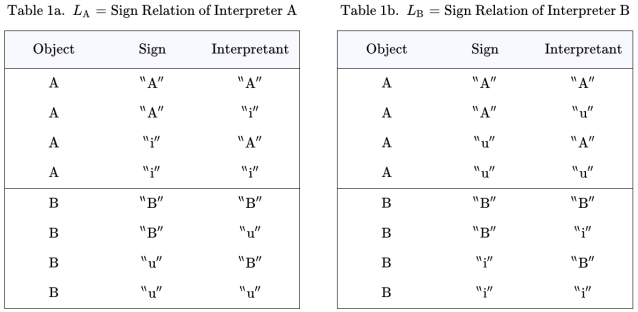
The Tables codify a rudimentary level of interpretive practice for the agents and  and provide a basis for formalizing the initial semantics appropriate to their common syntactic domain. Each row of a Table lists an object and two co-referent signs, together forming an ordered triple called an elementary sign relation, in other words, one element of the relation’s set-theoretic extension.
Already in this elementary context, there are several meanings that might attach to the project of a formal semiotics, or a formal theory of meaning for signs. In the process of discussing the alternatives, it is useful to introduce a few terms occasionally used in the philosophy of language to point out the needed distinctions. That is the task we’ll turn to next.
References
- Peirce, C.S. (1902), “Parts of Carnegie Application” (L 75), in Carolyn Eisele (ed., 1976), The New Elements of Mathematics by Charles S. Peirce, vol. 4, 13–73. Online.
- Awbrey, J.L., and Awbrey, S.M. (1995), “Interpretation as Action : The Risk of Inquiry”, Inquiry : Critical Thinking Across the Disciplines 15(1), pp. 40–52. Archive. Journal. Online (doc) (pdf).
Resources
Document History
See OEIS Wiki • Sign Relation • Document History.
cc: FB | Semeiotics • Cybernetics • Laws of Form • Ontolog Forum
cc: Conceptual Graphs • Structural Modeling • Systems Science



![[x]_E](https://s0.wp.com/latex.php?latex=%5Bx%5D_E&bg=ffffff&fg=000000&s=0&c=20201002)
![[x]](https://s0.wp.com/latex.php?latex=%5Bx%5D&bg=ffffff&fg=000000&s=0&c=20201002)

![\begin{array}{clc} (x, y) & \in & E \\[4pt] x & \in & [y]_E \\[4pt] y & \in & [x]_E \\[4pt] [x]_E & = & [y]_E \\[4pt] x & =_E & y \end{array}](https://s0.wp.com/latex.php?latex=%5Cbegin%7Barray%7D%7Bclc%7D++%28x%2C+y%29+%26+%5Cin+%26+E++%5C%5C%5B4pt%5D++x+%26+%5Cin+%26+%5By%5D_E++%5C%5C%5B4pt%5D++y+%26+%5Cin+%26+%5Bx%5D_E++%5C%5C%5B4pt%5D++%5Bx%5D_E+%26+%3D+%26+%5By%5D_E++%5C%5C%5B4pt%5D++x+%26+%3D_E+%26+y++%5Cend%7Barray%7D&bg=ffffff&fg=000000&s=0&c=20201002)
![\begin{array}{ccc} [x]_E & = & \{ y \in X : (x, y) \in E \} \\[6pt] x =_E y & \Leftrightarrow & (x, y) \in E \end{array}](https://s0.wp.com/latex.php?latex=%5Cbegin%7Barray%7D%7Bccc%7D++%5Bx%5D_E+%26+%3D+%26+%5C%7B+y+%5Cin+X+%3A+%28x%2C+y%29+%5Cin+E+%5C%7D++%5C%5C%5B6pt%5D++x+%3D_E+y+%26+%5CLeftrightarrow+%26+%28x%2C+y%29+%5Cin+E++%5Cend%7Barray%7D&bg=ffffff&fg=000000&s=0&c=20201002)


![[s]_L](https://s0.wp.com/latex.php?latex=%5Bs%5D_L&bg=ffffff&fg=000000&s=0&c=20201002)


![[s]_L = [s]_{L_{SI}}.](https://s0.wp.com/latex.php?latex=%5Bs%5D_L+%3D+%5Bs%5D_%7BL_%7BSI%7D%7D.&bg=ffffff&fg=000000&s=0&c=20201002)
![\begin{array}{clc} [x]_L & = & [y]_L \\[6pt] x & =_L & y \end{array}](https://s0.wp.com/latex.php?latex=%5Cbegin%7Barray%7D%7Bclc%7D++%5Bx%5D_L+%26+%3D+%26+%5By%5D_L++%5C%5C%5B6pt%5D++x+%26+%3D_L+%26+y++%5Cend%7Barray%7D&bg=ffffff&fg=000000&s=0&c=20201002)
![[o]_L](https://s0.wp.com/latex.php?latex=%5Bo%5D_L&bg=ffffff&fg=000000&s=0&c=20201002)
![[s]_L.](https://s0.wp.com/latex.php?latex=%5Bs%5D_L.&bg=ffffff&fg=000000&s=0&c=20201002)


![\begin{matrix} [ {}^{\backprime\backprime} \mathrm{A} {}^{\prime\prime} ]_{L_\mathrm{A}} & = & [ {}^{\backprime\backprime} \mathrm{i} {}^{\prime\prime} ]_{L_\mathrm{A}} \\[6pt] [ {}^{\backprime\backprime} \mathrm{B} {}^{\prime\prime} ]_{L_\mathrm{A}} & = & [ {}^{\backprime\backprime} \mathrm{u} {}^{\prime\prime} ]_{L_\mathrm{A}} \end{matrix}](https://s0.wp.com/latex.php?latex=%5Cbegin%7Bmatrix%7D++%5B+%7B%7D%5E%7B%5Cbackprime%5Cbackprime%7D+%5Cmathrm%7BA%7D+%7B%7D%5E%7B%5Cprime%5Cprime%7D+%5D_%7BL_%5Cmathrm%7BA%7D%7D++%26+%3D+%26++%5B+%7B%7D%5E%7B%5Cbackprime%5Cbackprime%7D+%5Cmathrm%7Bi%7D+%7B%7D%5E%7B%5Cprime%5Cprime%7D+%5D_%7BL_%5Cmathrm%7BA%7D%7D++%5C%5C%5B6pt%5D++%5B+%7B%7D%5E%7B%5Cbackprime%5Cbackprime%7D+%5Cmathrm%7BB%7D+%7B%7D%5E%7B%5Cprime%5Cprime%7D+%5D_%7BL_%5Cmathrm%7BA%7D%7D++%26+%3D+%26++%5B+%7B%7D%5E%7B%5Cbackprime%5Cbackprime%7D+%5Cmathrm%7Bu%7D+%7B%7D%5E%7B%5Cprime%5Cprime%7D+%5D_%7BL_%5Cmathrm%7BA%7D%7D++%5Cend%7Bmatrix%7D&bg=ffffff&fg=000000&s=0&c=20201002)
![\begin{matrix} {}^{\backprime\backprime} \mathrm{A} {}^{\prime\prime} & =_{L_\mathrm{A}} & {}^{\backprime\backprime} \mathrm{i} {}^{\prime\prime} \\[6pt] {}^{\backprime\backprime} \mathrm{B} {}^{\prime\prime} & =_{L_\mathrm{A}} & {}^{\backprime\backprime} \mathrm{u} {}^{\prime\prime} \end{matrix}](https://s0.wp.com/latex.php?latex=%5Cbegin%7Bmatrix%7D++%7B%7D%5E%7B%5Cbackprime%5Cbackprime%7D+%5Cmathrm%7BA%7D+%7B%7D%5E%7B%5Cprime%5Cprime%7D++%26+%3D_%7BL_%5Cmathrm%7BA%7D%7D+%26++%7B%7D%5E%7B%5Cbackprime%5Cbackprime%7D+%5Cmathrm%7Bi%7D+%7B%7D%5E%7B%5Cprime%5Cprime%7D++%5C%5C%5B6pt%5D++%7B%7D%5E%7B%5Cbackprime%5Cbackprime%7D+%5Cmathrm%7BB%7D+%7B%7D%5E%7B%5Cprime%5Cprime%7D++%26+%3D_%7BL_%5Cmathrm%7BA%7D%7D+%26++%7B%7D%5E%7B%5Cbackprime%5Cbackprime%7D+%5Cmathrm%7Bu%7D+%7B%7D%5E%7B%5Cprime%5Cprime%7D++%5Cend%7Bmatrix%7D&bg=ffffff&fg=000000&s=0&c=20201002)

![\begin{matrix} [ {}^{\backprime\backprime} \mathrm{A} {}^{\prime\prime} ]_{L_\mathrm{B}} & = & [ {}^{\backprime\backprime} \mathrm{u} {}^{\prime\prime} ]_{L_\mathrm{B}} \\[6pt] [ {}^{\backprime\backprime} \mathrm{B} {}^{\prime\prime} ]_{L_\mathrm{B}} & = & [ {}^{\backprime\backprime} \mathrm{i} {}^{\prime\prime} ]_{L_\mathrm{B}} \end{matrix}](https://s0.wp.com/latex.php?latex=%5Cbegin%7Bmatrix%7D++%5B+%7B%7D%5E%7B%5Cbackprime%5Cbackprime%7D+%5Cmathrm%7BA%7D+%7B%7D%5E%7B%5Cprime%5Cprime%7D+%5D_%7BL_%5Cmathrm%7BB%7D%7D++%26+%3D+%26++%5B+%7B%7D%5E%7B%5Cbackprime%5Cbackprime%7D+%5Cmathrm%7Bu%7D+%7B%7D%5E%7B%5Cprime%5Cprime%7D+%5D_%7BL_%5Cmathrm%7BB%7D%7D++%5C%5C%5B6pt%5D++%5B+%7B%7D%5E%7B%5Cbackprime%5Cbackprime%7D+%5Cmathrm%7BB%7D+%7B%7D%5E%7B%5Cprime%5Cprime%7D+%5D_%7BL_%5Cmathrm%7BB%7D%7D++%26+%3D+%26++%5B+%7B%7D%5E%7B%5Cbackprime%5Cbackprime%7D+%5Cmathrm%7Bi%7D+%7B%7D%5E%7B%5Cprime%5Cprime%7D+%5D_%7BL_%5Cmathrm%7BB%7D%7D++%5Cend%7Bmatrix%7D&bg=ffffff&fg=000000&s=0&c=20201002)
![\begin{matrix} {}^{\backprime\backprime} \mathrm{A} {}^{\prime\prime} & =_{L_\mathrm{B}} & {}^{\backprime\backprime} \mathrm{u} {}^{\prime\prime} \\[6pt] {}^{\backprime\backprime} \mathrm{B} {}^{\prime\prime} & =_{L_\mathrm{B}} & {}^{\backprime\backprime} \mathrm{i} {}^{\prime\prime} \end{matrix}](https://s0.wp.com/latex.php?latex=%5Cbegin%7Bmatrix%7D++%7B%7D%5E%7B%5Cbackprime%5Cbackprime%7D+%5Cmathrm%7BA%7D+%7B%7D%5E%7B%5Cprime%5Cprime%7D++%26+%3D_%7BL_%5Cmathrm%7BB%7D%7D+%26++%7B%7D%5E%7B%5Cbackprime%5Cbackprime%7D+%5Cmathrm%7Bu%7D+%7B%7D%5E%7B%5Cprime%5Cprime%7D++%5C%5C%5B6pt%5D++%7B%7D%5E%7B%5Cbackprime%5Cbackprime%7D+%5Cmathrm%7BB%7D+%7B%7D%5E%7B%5Cprime%5Cprime%7D++%26+%3D_%7BL_%5Cmathrm%7BB%7D%7D+%26++%7B%7D%5E%7B%5Cbackprime%5Cbackprime%7D+%5Cmathrm%7Bi%7D+%7B%7D%5E%7B%5Cprime%5Cprime%7D++%5Cend%7Bmatrix%7D&bg=ffffff&fg=000000&s=0&c=20201002)

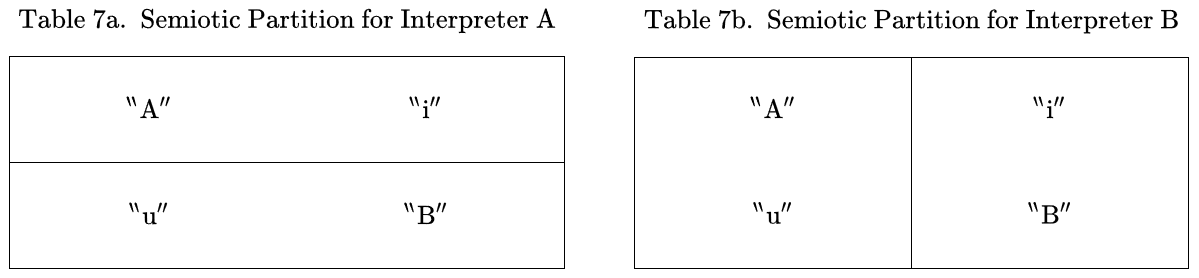
 and
and  have many interesting properties over and above those possessed by sign relations in general. Some of those properties have to do with the relation between signs and their interpretant signs, as reflected in the projections of
  ‑plane, notated as
  and
and  respectively. The dyadic relations on
  induced by those projections are also referred to as the connotative components of the corresponding sign relations, notated as
  and
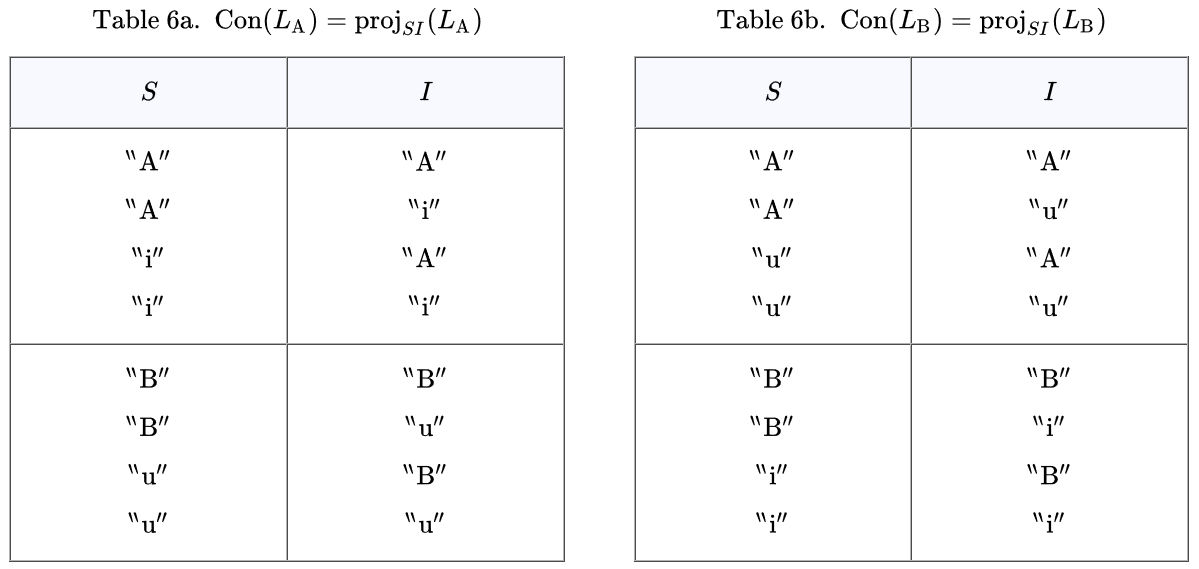
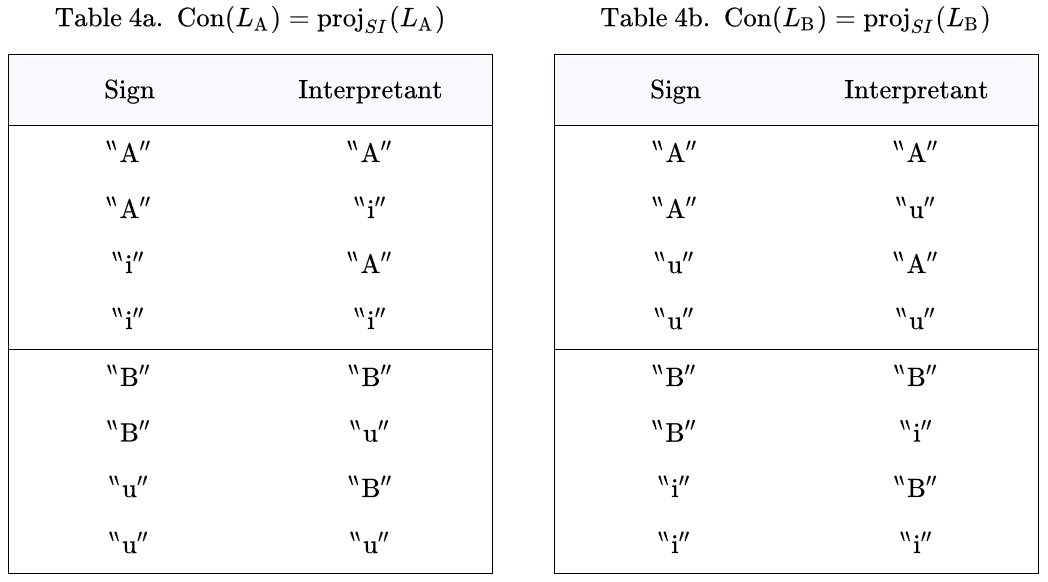
and  respectively. Tables 6a and 6b show the corresponding connotative components.
 form a pair of equivalence relations on their common syntactic domain
  This type of equivalence relation is called a semiotic equivalence relation (SER) because it equates signs having the same meaning to some interpreter.
 partitions the collection of signs into semiotic equivalence classes. This constitutes a strong form of representation in that the structure of the interpreters’ common object domain
  is reflected or reconstructed, part for part, in the structure of each one’s semiotic partition of the syntactic domain
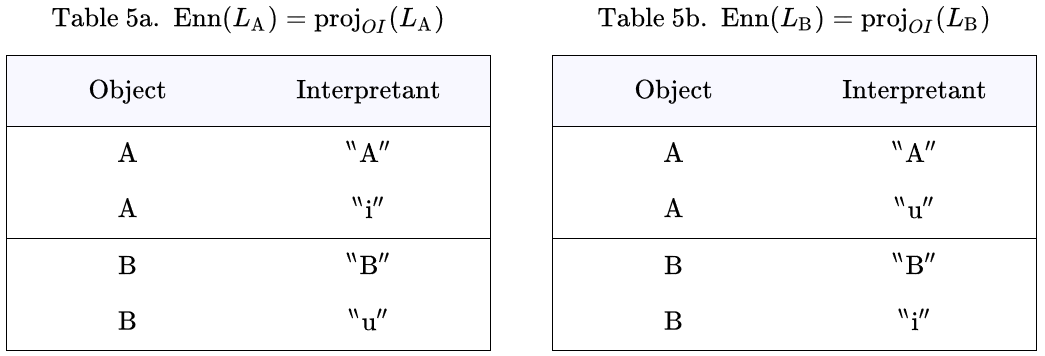
 Information about the ennotative aspect of meaning is obtained from
  and the interpretant domain
  The ennotative component of a sign relation

 and
and  is defined as follows.
 is echoed unchanged in
  and all the data of
  is echoed unchanged in
 in the corresponding projections,
 Information about the connotative aspect of meaning is obtained from

 and
and  is defined as follows.
 in the corresponding projections,
 Information about the denotative aspect of meaning is obtained from
  The denotative component of a sign relation

 and
and  is defined as follows.
 in the corresponding projections,
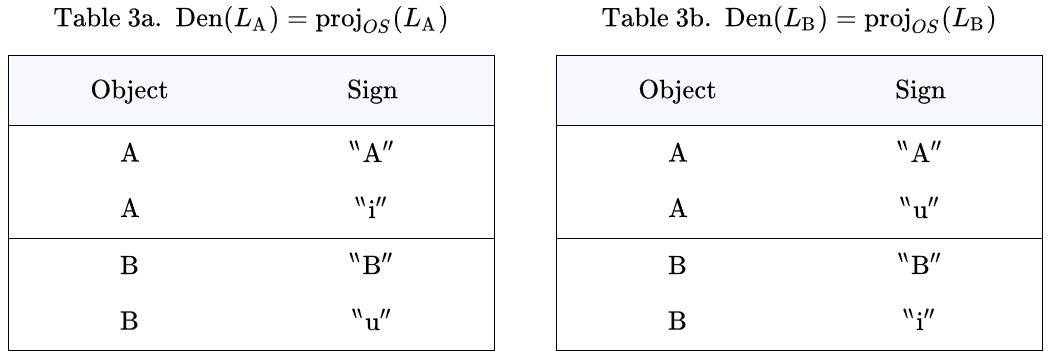
 various rows of the Tables specify, for example, that
  to denote
  to denote
 whether it happens to be a sign relation or not, there are six dyadic relations obtained by projecting
  -space
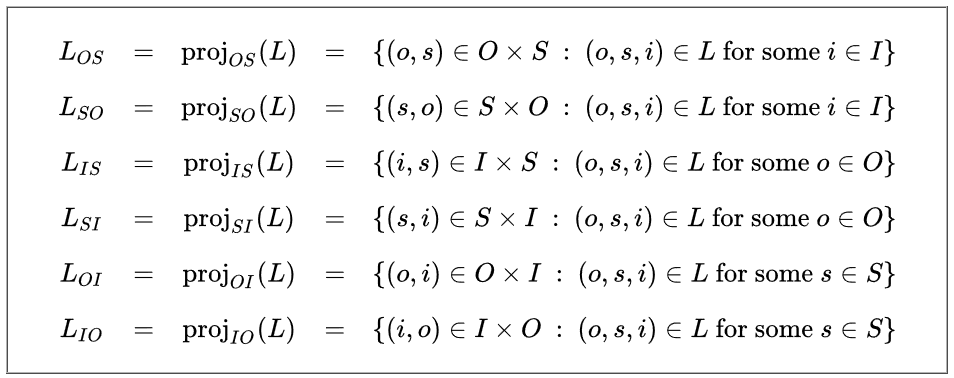
 -plane
  is written briefly as
  or written more fully as
  and is defined as the set of all ordered pairs
  in the set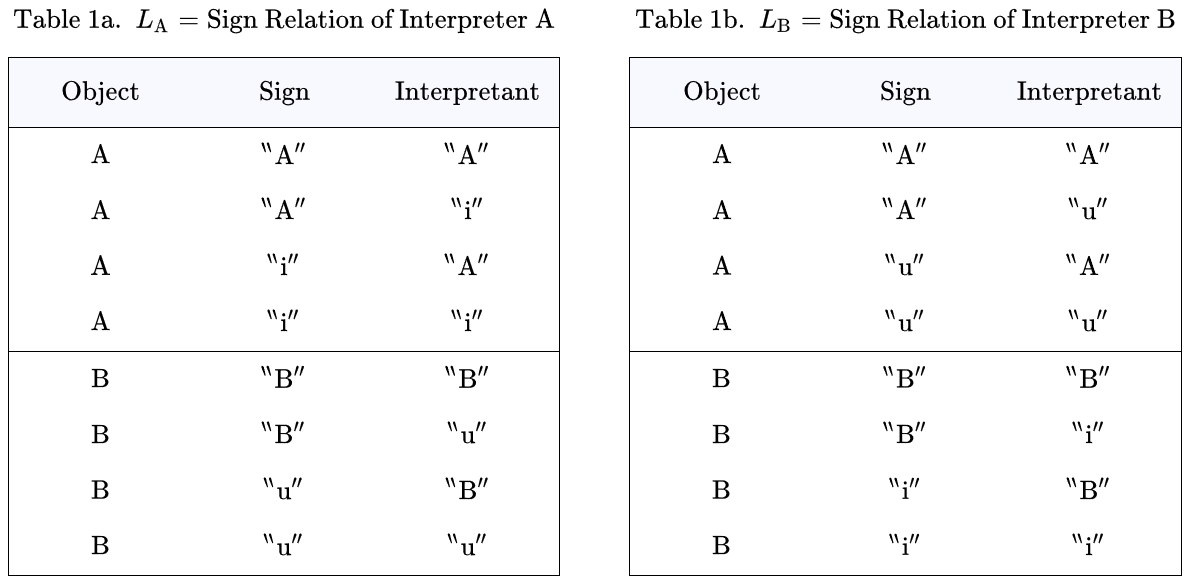


 Inquiry Into Inquiry