Abduction, Deduction, Induction, Analogy, Inquiry • 31

Re: Scott AaronsonExplanation-Gödel and Plausibility-Gödel

Scott Aaronson asks a question arising from Gödel’s First Incompleteness Theorem, namely, what are its consequences for the differential values of explanation, plausibility, and proof?  I add the following thoughts.

A general heuristic in problem solving suggests priming the pump with a stronger hypothesis.  Applying that strategy here would have us broaden the grounds of validity, our notion of validation, from purely deductive proofs to more general forms of inference.  Along that line, and following a lead from Aristotle, C.S. Peirce recognized three distinct modes of inference, called abductive, deductive, and inductive reasoning, and that way of thinking has even had some traction in AI from the days of Warren S. McCulloch on.  At any rate I think it helps to view our questions in that ballpark.  There’s a budget of resources and running thoughts on the matter I keep on the following page.

cc: Conceptual GraphsCyberneticsLaws of FormOntolog Forum
cc: FB | Inquiry Driven SystemsStructural ModelingSystems Science

Posted in Abduction, Analogy, Animata, Aristotle, Artificial Intelligence, C.S. Peirce, Deduction, Induction, Inquiry, Inquiry Driven Systems, Intelligent Systems Engineering, Logic, Mathematics, Scientific Method, Semiotics, Visualization | Tagged , , , , , , , , , , , , , , , | 5 Comments

Theme One Program • Exposition 8

Transformation Rules and Equivalence Classes

The abstract character of the cactus language relative to its logical interpretations makes it possible to give abstract rules of equivalence for transforming cacti among themselves and partitioning the space of cacti into formal equivalence classes.  The transformation rules and equivalence classes are “purely formal” in the sense of being indifferent to the logical interpretation, entitative or existential, one happens to choose.

Two definitions are useful here:

  • A reduction is an equivalence transformation which applies in the direction of decreasing graphical complexity.
  • A basic reduction is a reduction which applies to a basic connective, either a node connective or a lobe connective.

The two kinds of basic reductions are described as follows.

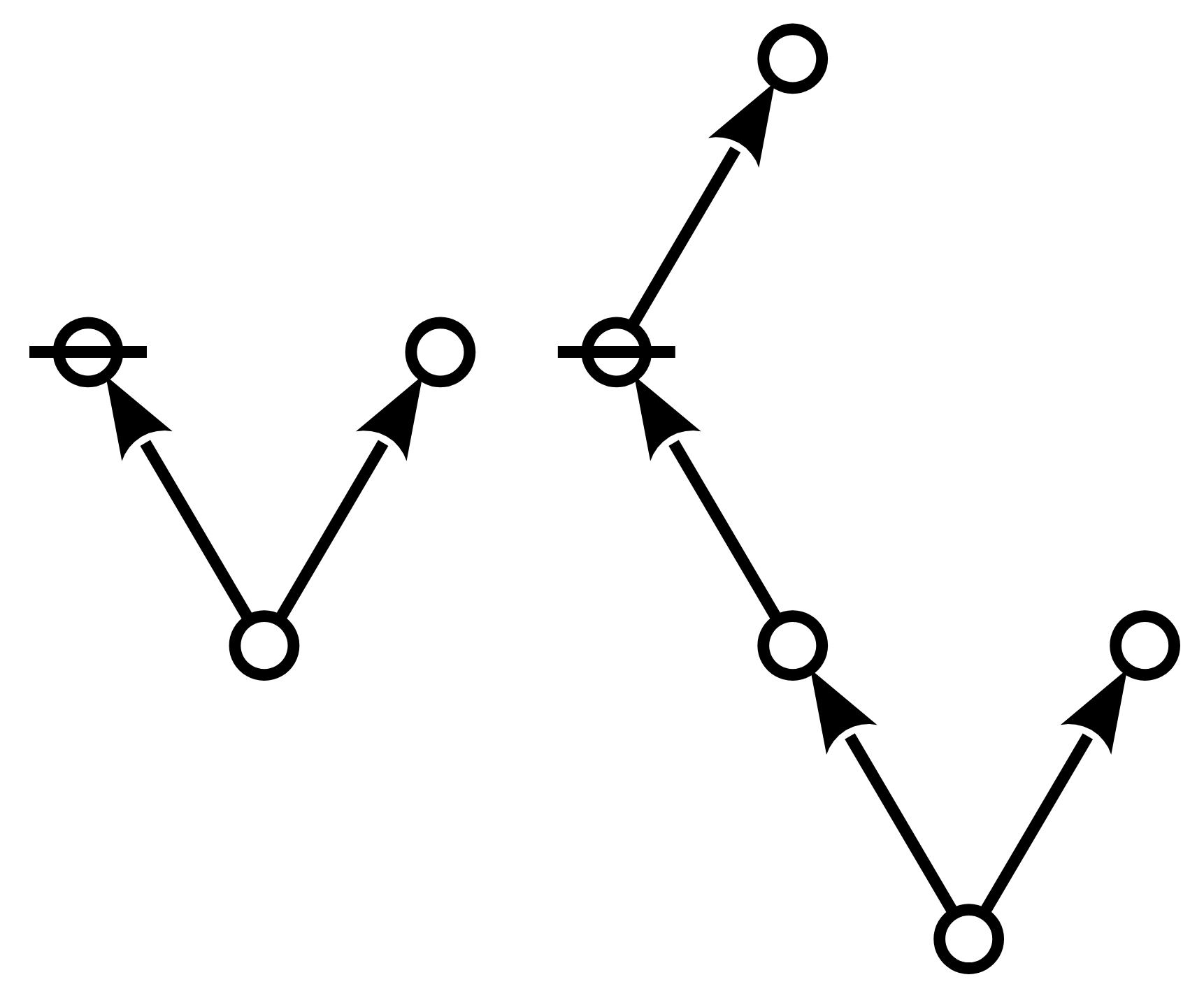
  • A node reduction is permitted if and only if every component cactus joined to a node itself reduces to a node.

Node Reduction

  • A lobe reduction is permitted if and only if exactly one component cactus listed in a lobe reduces to an edge.

Lobe Reduction

That is roughly the gist of the rules.  More formal definitions can wait for the day when we need to explain their use to a computer.

Resources

cc: Conceptual GraphsCyberneticsLaws of FormOntolog Forum
cc: FB | Theme One ProgramStructural ModelingSystems Science

Posted in Algorithms, Animata, Artificial Intelligence, Boolean Functions, C.S. Peirce, Cactus Graphs, Cognition, Computation, Constraint Satisfaction Problems, Data Structures, Differential Logic, Equational Inference, Formal Languages, Graph Theory, Inquiry Driven Systems, Laws of Form, Learning Theory, Logic, Logical Graphs, Mathematics, Minimal Negation Operators, Painted Cacti, Peirce, Propositional Calculus, Semiotics, Spencer Brown, Visualization | Tagged , , , , , , , , , , , , , , , , , , , , , , , , , , | 3 Comments

Theme One Program • Exposition 7

Mathematical Structure and Logical Interpretation

The main things to take away from the previous post are the following two ideas, one syntactic and one semantic.

  • Syntax.  The compositional structures of cactus graphs and cactus expressions are constructed from two kinds of connective operations.
  • Semantics.  There are two ways of mapping the compositional structures of syntax into the compositional structures of propositional sentences.

The two kinds of connective operations are described as follows.

  • The node connective joins a number of component cacti C_1, \ldots, C_k to a node, as shown below.

Node Connective

  • The lobe connective joins a number of component cacti C_1, \ldots, C_k to a lobe, as shown below.

Lobe Connective

The two ways of mapping cactus structures to logical meanings are summarized in Table 3, which compares the entitative and existential interpretations of the basic cactus structures, in effect, the graphical constants and connectives.

\text{Table 3. Logical Interpretations of Cactus Structures}
Logical Interpretations of Cactus Structures

Resources

cc: Conceptual GraphsCyberneticsLaws of FormOntolog Forum
cc: FB | Theme One ProgramStructural ModelingSystems Science

Posted in Algorithms, Animata, Artificial Intelligence, Boolean Functions, C.S. Peirce, Cactus Graphs, Cognition, Computation, Constraint Satisfaction Problems, Data Structures, Differential Logic, Equational Inference, Formal Languages, Graph Theory, Inquiry Driven Systems, Laws of Form, Learning Theory, Logic, Logical Graphs, Mathematics, Minimal Negation Operators, Painted Cacti, Peirce, Propositional Calculus, Semiotics, Spencer Brown, Visualization | Tagged , , , , , , , , , , , , , , , , , , , , , , , , , , | 3 Comments

Theme One Program • Exposition 6

Quickly recapping the discussion so far, we started with a data structure called an idea‑form flag and adopted it as a building block for constructing a species of graph-theoretic data structures called painted and rooted cacti.  We showed how to code the abstract forms of cacti into character strings called cactus expressions and how to parse the character strings into pointer structures in computer memory.

At this point we had to choose between two expository strategies.

A full account of Theme One’s operation would describe its use of cactus graphs in three distinct ways, called lexical, literal, and logical applications.  The more logical order would approach the lexical and literal tasks first.  That is because the program’s formal language learner must first acquire the vocabulary its propositional calculator interprets as logical variables.  The sequential learner operates at two levels, taking in sequences of characters it treats as strings or words plus sequences of words it treats as strands or sentences.

Finding ourselves more strongly attracted to the logical substance, however, we leave the matter of grammar to another time and turn to Theme One’s use of cactus graphs in its reasoning module to represent logical propositions on the order of Peirce’s alpha graphs and Spencer Brown’s calculus of indications.

Logical Cacti

Up till now we’ve been working to hammer out a two-edged sword of syntax, honing the syntax of cactus graphs and cactus expressions and turning it to use in taming the syntax of two-level formal languages.

But the purpose of a logical syntax is to support a logical semantics, which means, for starters, to bear interpretation as sentential signs capable of denoting objective propositions about a universe of objects.

One of the difficulties we face is that the words interpretation, meaning, semantics, and their ilk take on so many different meanings from one moment to the next of their use.  A dedicated neologician might be able to think up distinctive names for all the aspects of meaning and all the approaches to them that concern us, but I will do the best I can with the common lot of ambiguous terms, leaving it to context and intelligent interpreters to sort it out as much as possible.

The formal language of cacti is formed at such a high level of abstraction that its graphs bear at least two distinct interpretations as logical propositions.  The two interpretations concerning us here are descended from the ones C.S. Peirce called the entitative and the existential interpretations of his systems of graphical logics.

Existential Interpretation

Table 1 illustrates the existential interpretation of cactus graphs and cactus expressions by providing English translations for a few of the most basic and commonly occurring forms.

\text{Table 1. Existential Interpretation}
Existential Interpretation

Entitative Interpretation

Table 2 illustrates the entitative interpretation of cactus graphs and cactus expressions by providing English translations for a few of the most basic and commonly occurring forms.

\text{Table 2. Entitative Interpretation}
Entitative Interpretation

Resources

cc: Conceptual GraphsCyberneticsLaws of FormOntolog Forum
cc: FB | Theme One ProgramStructural ModelingSystems Science

Posted in Algorithms, Animata, Artificial Intelligence, Boolean Functions, C.S. Peirce, Cactus Graphs, Cognition, Computation, Constraint Satisfaction Problems, Data Structures, Differential Logic, Equational Inference, Formal Languages, Graph Theory, Inquiry Driven Systems, Laws of Form, Learning Theory, Logic, Logical Graphs, Mathematics, Minimal Negation Operators, Painted Cacti, Peirce, Propositional Calculus, Semiotics, Spencer Brown, Visualization | Tagged , , , , , , , , , , , , , , , , , , , , , , , , , , | 5 Comments

IAIASATSIMBIN

I’m Always In A State Adjacent To States I May Be In Next

cc: FB | Occupy Chance

Posted in Acronym, Mantra, Modality, Time | Tagged , , , | Leave a comment

Theory and Therapy of Representations • 4

Re: Theory and Therapy of Representations • 3
Re: Ontolog ForumPaola Di Maio

JA:
What are the forces distorting our representations of what’s observed, what’s expected, and what’s intended?
PDM:
The short answer is …. the force behind all distortions is our own unenlightened mind, and all the shortfalls this comes with.

I think that’s true, we have to keep reflecting on the state of our personal enlightenments.  If we can do that without losing our heads and our systems thinking caps, there will be much we can do to promote the general Enlightenment of the State.

On both personal and general grounds we have a stake in the projects of self‑governing systems — whether it is possible for them to exist and what it takes for them to thrive in given environments.  Systems on that order have of course been studied from many points of view and at many levels of organization.  Whether we address them under the names of adaptive, cybernetic, error-correcting, intelligent, or optimal control systems they all must be capable to some degree of learning, reasoning, and self‑guidance.

Resources

cc: Conceptual GraphsCyberneticsLaws of FormOntolog Forum
cc: FB | CyberneticsStructural ModelingSystems Science

Posted in Accountability, Adaptive Systems, C.S. Peirce, Cybernetics, Democracy, Economics, Education, Expectation, Governance, Information, Inquiry, Intention, Justice, Law, Logic, Max Weber, Observation, Plato, Pragmata, Representation, Science, Semiotics, Society, Statistics, Systems Theory | Tagged , , , , , , , , , , , , , , , , , , , , , , , , | 5 Comments

Theory and Therapy of Representations • 3

Representation is a concept we find at the intersection of cybernetics, epistemology, logic, mathematics, psychology, and sociology.  In my studies it led me from math to psych and back again, with sidelong glances at the history of democratic governance.  Its time come round again, I find myself returning to the scenes of two recurring questions.

Scene 1.  Pragmatic Truth • Discussion 18

We do not live in axiom systems.  We do not live encased in languages, formal or natural.  There is no reason to think we will ever have exact and exhaustive theories of what’s out there, and the truth, as we know, is “out there”.  Peirce understood there are more truths in mathematics than are dreamt of in logic — and Gödel’s realism should have put the last nail in the coffin of logicism — but some ways of thinking just never get a clue.

That brings us to Question 1 —

  • What are formalisms and all their embodiments in brains and computers good for?

Scene 2.  Theory and Therapy of Representations • 1

Statistics were originally the data a ship of state needed for stationkeeping and staying on course.  The Founders of the United States, like the Cybernauts of the Enlightenment they were, engineered a ship of state with checks and balances and error-controlled feedbacks for the sake of representing both reality and the will of the people.  In that connection Max Weber saw how a state’s accounting systems are intended as representations of realities its crew and passengers must observe or perish.

That brings us to Question 2 —

  • What are the forces distorting our representations of what’s observed, what’s expected, and what’s intended?

Resources

cc: Conceptual GraphsCyberneticsLaws of FormOntolog Forum
cc: FB | CyberneticsStructural ModelingSystems Science

Posted in Accountability, Adaptive Systems, C.S. Peirce, Cybernetics, Democracy, Economics, Education, Expectation, Governance, Information, Inquiry, Intention, Justice, Law, Logic, Max Weber, Observation, Plato, Pragmata, Representation, Science, Semiotics, Society, Statistics, Systems Theory | Tagged , , , , , , , , , , , , , , , , , , , , , , , , | 9 Comments

Theory and Therapy of Representations • 2

December 19, 2011

In a complex society, people making decisions and taking actions at places remote from you have the power to affect your life in significant ways.  Those people govern your life, they are your government, no matter what spheres of influence they inhabit, private or public.  The only way you get a choice in that governance is if there are paths of feedback permitting you to affect the life of those decision makers and action takers in significant ways.  That is what accountability, response-ability, and representative government are all about.

Naturally, some people are against that.

In the United States there has been a concerted campaign for as long as I can remember — but even more concerted since the Reagan Regime — to get the People to abdicate their hold on The Powers That Be and just let some anonymous corporate entity send us the bill after the fact.  They keep trying to con the People into thinking they can starve the beast, to limit government, when what they are really doing is feeding the beast of corporate control, weakening their own power over the forces that govern their lives.

That is the road to perdition as far as responsible government goes.  There is not much of anything one leader or one administration can do unsupported if the People do not constantly demand a government of, by, and for the People.

cc: Conceptual GraphsCyberneticsLaws of FormOntolog Forum
cc: FB | CyberneticsStructural ModelingSystems Science

Posted in Accountability, Adaptive Systems, C.S. Peirce, Cybernetics, Democracy, Economics, Education, Expectation, Governance, Information, Inquiry, Intention, Justice, Law, Logic, Max Weber, Observation, Plato, Pragmata, Representation, Science, Semiotics, Society, Statistics, Systems Theory | Tagged , , , , , , , , , , , , , , , , , , , , , , , , | 4 Comments

Theory and Therapy of Representations • 1

Again, in a ship, if a man were at liberty to do what he chose, but were devoid of mind and excellence in navigation (αρετης κυβερνητικης), do you perceive what must happen to him and his fellow sailors?

Plato • Alcibiades • 135 A

Re: Michael HarrisMathematical Literacy and the Good Society

Statistics were originally the data a ship of state needed for stationkeeping and staying on course.  The Founders of the United States, like the Cybernauts of the Enlightenment they were, engineered a ship of state with checks and balances and error‑controlled feedbacks for the sake of representing both reality and the will of the people.  In that connection Max Weber saw how a state’s accounting systems are intended as representations of realities its crew and passengers must observe or perish.

The question for our time is —

  • What are the forces distorting our representations of what’s observed, what’s expected, and what’s intended?

Repercussions

cc: Conceptual GraphsCyberneticsLaws of FormOntolog Forum
cc: FB | CyberneticsStructural ModelingSystems Science

Posted in Accountability, Adaptive Systems, C.S. Peirce, Cybernetics, Democracy, Economics, Education, Expectation, Governance, Information, Inquiry, Intention, Justice, Law, Logic, Max Weber, Observation, Plato, Pragmata, Representation, Science, Semiotics, Society, Statistics, Systems Theory | Tagged , , , , , , , , , , , , , , , , , , , , , , , , | 7 Comments

Survey of Cybernetics • 2

Again, in a ship, if a man were at liberty to do what he chose, but were devoid of mind and excellence in navigation (αρετης κυβερνητικης), do you perceive what must happen to him and his fellow sailors?

Plato • Alcibiades • 135 A

This is a Survey of blog posts relating to Cybernetics.  It includes the selections from Ashby’s Introduction and the comment on them I’ve posted so far, plus two series of reflections on the governance of social systems in light of cybernetic and semiotic principles.

Ashby’s Introduction to Cybernetics

  • Chapter 11 • Requisite Variety

Blog Series

  • Theory and Therapy of Representations • (1)(2)(3)(4)(5)

cc: Conceptual GraphsCyberneticsStructural ModelingSystems Science
cc: FB | CyberneticsMathstodonLaws of FormOntolog Forum

Posted in Abduction, C.S. Peirce, Communication, Control, Cybernetics, Deduction, Determination, Discovery, Doubt, Epistemology, Fixation of Belief, Induction, Information, Information = Comprehension × Extension, Information Theory, Inquiry, Inquiry Driven Systems, Inquiry Into Inquiry, Interpretation, Invention, Knowledge, Learning Theory, Logic, Logic of Relatives, Logic of Science, Mathematics, Peirce, Philosophy, Philosophy of Science, Pragmatic Information, Probable Reasoning, Process Thinking, Relation Theory, Scientific Inquiry, Scientific Method, Semeiosis, Semiosis, Semiotic Information, Semiotics, Sign Relational Manifolds, Sign Relations, Surveys, Triadic Relations, Uncertainty | Tagged , , , , , , , , , , , , , , , , , , , , , , , , , , , , , , , , , , , , , , , , , , , | 3 Comments