Definition and Determination • 9

Re: Cathy O’NeilThe Art of Definition

In classical logical traditions the concepts of definition and determination are closely related and their bond acquires all the more force if you view the overarching concept of constraint from an information-theoretic point of view, as C.S. Peirce did beginning in the 1860s.  That makes an understanding of these intertwined concepts critical to the application of Peirce’s theories of information and inquiry.

Here’s a running thread with links to a collection of notes I’ve been gathering.

cc: Inquiry List • Peirce List (1) (2) (3)

Posted in C.S. Peirce, Definition, Determination, Inquiry, Logic, Mathematics, Peirce, Phenomenology, Semiotics | Tagged , , , , , , , , | 7 Comments

Objects, Models, Theories • 1

Happy Birthday, Charles Sanders Peirce❢ — September 10, 1839

Re: Artem KaznatcheevThree Types of Mathematical Models

Comment 1

In speaking of models one tends to find denizens of different disciplines talking at cross purposes to one another.  Logicians use the word to describe what may be distinguished as logical models, saying a model is whatever satisfies a theory, anything a theory holds true of, and this is the sense used in the logical subject of model theory.  Almost everyone else uses the word to describe what may be called analogical models, analogues being things holding enough properties in common with other things that learning about Thing 2 (the analogue system) can teach us about Thing 1 (the object system).  It is actually quite easy to integrate these senses of the word model into a coherent picture of the whole situation, namely, the triadic relationship among objects, analogues, and theories.

Comment 2

I’m presently in the middle of some very tedious work and will have to keep my nose to the grindstone for fear of never working up the fortitude to face it again, so for now I’ll just link to some very rough notes and hope for a chance to give them a proper set-up later.  (Full disclosure — I view almost everything from a Peircean perspective.)

Posted in Adaptive Systems, Analogy, Biological Systems, C.S. Peirce, Information, Inquiry, Inquiry Driven Systems, Learning Theory, Logic, Logic of Science, Mathematical Models, Mathematics, Mental Models, Model Theory, Pragmata, Semiotics, Sign Relations, Triadic Relations, Visualization | Tagged , , , , , , , , , , , , , , , , , , | 8 Comments

What To Do?

Re: What To Do?

You are headed toward a grabitational singularity, and someone offers you a ton of gold.  What good is that?  Feathers and cannonballs all fall the same, I’m told.  If you have a way to convert the mass to energy and fire it in the right direction — Does feeding the beast make it worse for you?  Then maybe a bit tangentially, I dunno — you might have a ghost of a chance of saving your ectoplasm for another day.  Meanwhile aliens — they might as well be aliens for all they understand of humanity — are terraforming your planet into something only an alien could love.  What to do?  What to do?  Indeed …

Posted in Grabitational Singularity, Singularity | Tagged , | Leave a comment

Where Is Fancy Bred?

Re: Artem KaznatcheevFitness Landscapes as Mental & Mathematical Models of Evolution

The question of “mental models” has occupied my thoughts for quite a while.

As intelligent agents with a capacity for inquiry, we have ways of forming and transforming independent representations of reality — “reality” being one of many names we give the imagined source of impressions that persist in impressing themselves on us and that we sort on a trial basis to the bins of our external and internal worlds.

As social agents with a capacity for communication, we have ways of impressing our personal representations on external media and sharing them with other sign-using agents, with all the contingencies and difficulties that bedevil our partly phylogenetic and partly ontogenetic capacity for sharing signs.

I tend to come at these questions from a system-theoretic direction, asking “Where is the threshold of system-theoretic complexity that must be crossed in order to achieve the first signs of these capacities?”

Posted in Adaptive Systems, Analogy, Artem Kaznatcheev, Artificial Intelligence, Biological Systems, Communication, Computational Complexity, Control, Evolution, Fitness Landscapes, Imagination, Information, Inquiry, Inquiry Driven Systems, Learning Theory, Mathematical Models, Mental Models, Natural Intelligence, Semiotics, Sign Relations | Tagged , , , , , , , , , , , , , , , , , , , | 1 Comment

Ideas Demand Expression Always

Re: Quomodocumque

What came of my morning meditation today —

There is something about an idea that demands to be communicated.

But what of bad ideas, fixed ideas, ideology?

And again, is there really any such thing as a bad idea in Plato’s Heaven?

Or is it only the bad expression of a good idea that leads Humanity astray?

I will have to think on it more, anon.

Posted in Meditation | Tagged | Leave a comment

Anamnesis, Maieusis, Monadology, Semeiosis

Anamnesis
Learning = Recollection
Maieusis
Teaching = Midwifery
Monadology
Communication = Pre-Established Harmony
Semeiosis
Meaning = Interpretation
Posted in Anamnesis, Maieusis, Monadology, Semeiosis, Semiosis, Symbolism | Tagged , , , , , | Leave a comment

The Lambda Point • 1

A note on the title.  From long ago discussions with Harvey Davis, one of my math professors at Michigan State.  I remember telling him of my interest in the place where algebra, geometry, and logic meet, and he quipped, “Ah yes, the lambda point”, punning on the triple point of phase transitions among gaseous, liquid, and solid states.

Re: Cathy O’Neil

One of the insights coming out of C.S. Peirce’s work on logic, informing the development of his logical graphs, is that negative logical relations are more fundamental than positive logical relations, since the right set of negative relations can generate all possible logical relations, but no set of purely positive relations can do all that.  That is the gist of it, put very roughly, modulo the right definitions of positive and negative relations, of course.

We see this theme exhibited in the generative power of the \textsc{nand} and \textsc{nnor} operators for propositional calculus which Peirce discovered early on and dubbed the amphecks.

Posted in Algebra, Amphecks, Boolean Algebra, C.S. Peirce, Cactus Graphs, Geometry, Graph Theory, Lambda Point, Logic, Logical Graphs, Mathematics, Minimal Negation Operators, Peirce, Propositional Calculus, Topology | Tagged , , , , , , , , , , , , , , | Leave a comment

How To Succeed In Proof Business Without Really Trying

Re: R.J. LiptonSurely You Are Joking?

Comment 1

Even at the mailroom entry point of propositional calculus, there is a qualitative difference between insight proofs and routine proofs.  Human beings can do either sort, as a rule, but routinizing insight is notoriously difficult, so the clerical routines have always been the ones that lend themselves to the canonical brands of canned mechanical proofs.

Just by way of a very choice example, consider the Praeclarum Theorema (Splendid Theorem) noted by Leibniz, as presented in cactus syntax here:

I’ll discuss different ways of proving this in the comments that follow.

Comment 2

The proof given via the link above is the sort that a human, all too human was able to find without much trouble.  You can see that it exhibits a capacity for global pattern recognition and analogical pattern matching — manifestly aided by the use of graphical syntax — that marks the human knack for finding proofs.  When I first set to work developing a Simple Propositional Logic Engine (SPLE) those were the aptitudes I naturally sought to emulate.  Alas, I lacked the metaptitude for that.

Comment 3

For my next proof of the Praeclarum Theorema I give an example of a routine proof, the sort of proof that a machine with all its blinkers on can be trained to derive simply by following its nose, demanding as little insight as possible and exploiting the barest modicum of tightly reigned-in look-ahead.

Posted in Algorithms, Animata, Artificial Intelligence, Automatic Theorem Proving, Boolean Algebra, Boolean Functions, C.S. Peirce, Cactus Graphs, Computational Complexity, Graph Theory, Logic, Logical Graphs, Minimal Negation Operators, Model Theory, Peirce, Praeclarum Theorema, Proof Theory, Propositional Calculus, Visualization | Tagged , , , , , , , , , , , , , , , , , , | 7 Comments

What Is A Theorem That A Human May Prove It?

Re: Gil KalaiWhy Is Mathematics Possible?Tim Gowers’ Take On The Matter

Comment 1

To the extent that mathematics has to do with reasoning about possible existence, or inference from pure hypothesis, a line of thinking going back to Aristotle and developed greatly by C.S. Peirce may have some bearing on the question of “Why Mathematics Is Possible”.  In that line of thought, hypothesis formation is treated as a case of “abductive” inference, whose job in science generally is to supply suitable raw materials for deduction and induction to develop and test.  In that light, a large part of our original question becomes, as Peirce once expressed it —

Is there cause to believe “we can trust to the human mind’s having such a power of guessing right that before very many hypotheses shall have been tried, intelligent guessing may be expected to lead us to the one which will support all tests, leaving the vast majority of possible hypotheses unexamined”?  (Peirce, Collected Papers, CP 6.530).

The question may fit the situation in mathematics slightly better if we modify the word “hypothesis” to say “proof“.

Comment 2

I copied out a more substantial excerpt from Peirce’s paper here:

The question of naturalness arises in many areas, from AI and cognitive science to logic and the philosophy of science, most often under the heading of “Natural Kinds”.  Given a universe of discourse X, the lattice of “All Kinds” would be its power set, and we want to know what portion of that ordering makes up the Natural Kinds, the concepts or hypotheses that are worth considering in practice.

To the same purpose, Peirce employs the criterion of “admissible hypotheses that seem the simplest to the human mind”.

Comment 3

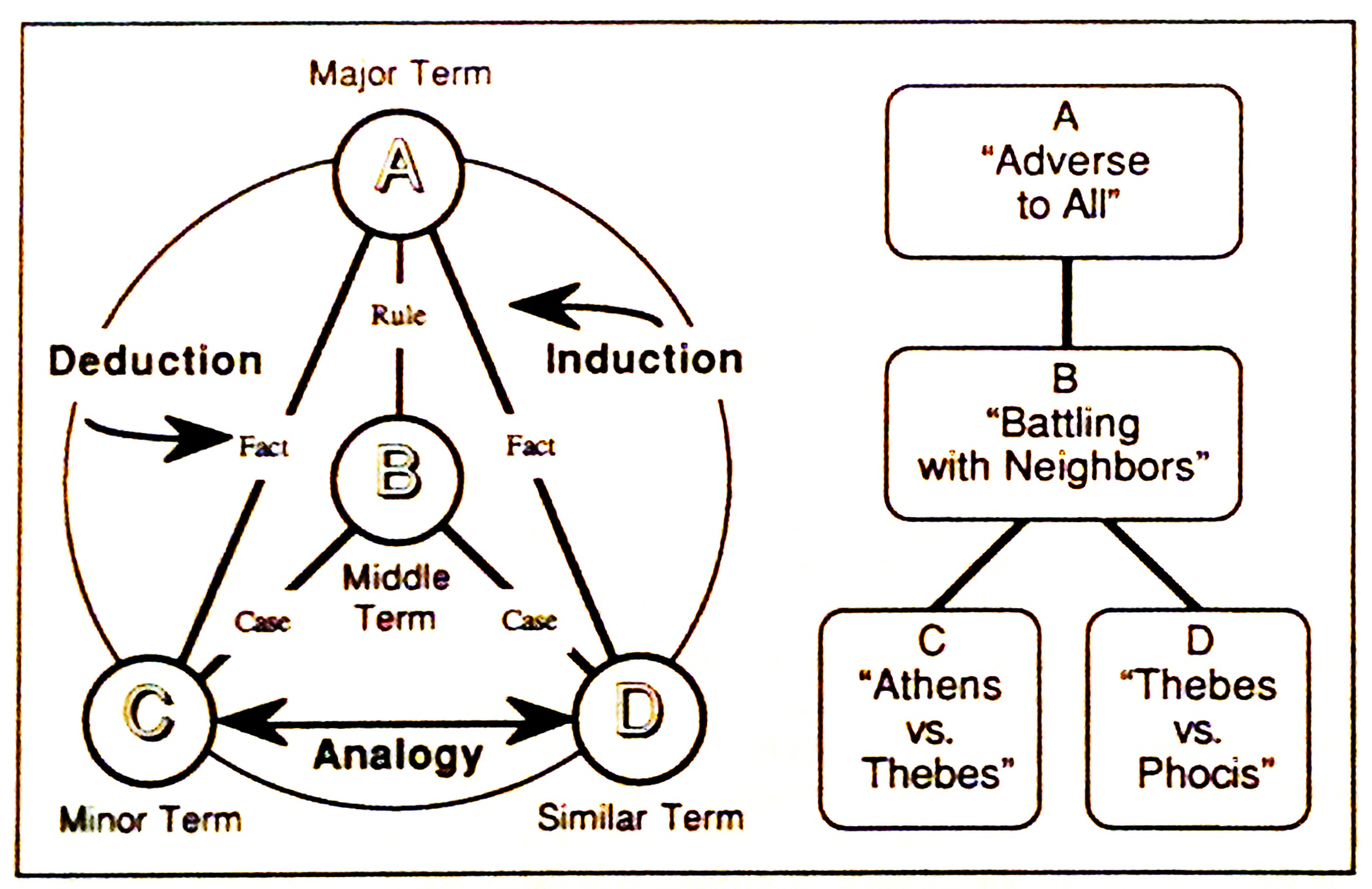
The following project report outlines the three types of inference — Abductive, Deductive, and Inductive — as treated by Aristotle and Peirce, at least insofar as these patterns of reasoning can be analyzed in syllogistic forms.  I did this work by way of exploring how a propositional logic engine might be used to assist in scientific inquiry.

It looks a bit cobbled together to my eyes today and probably could use a rewrite, but I did put a lot of work into the diagrams and remain rather pleased with those.

References

Well, more like allusions, really …

  • McCulloch, Warren S. (1961), “What Is a Number that a Man May Know It, and a Man, that He May Know a Number?”, Ninth Alfred Korzybski Memorial Lecture, General Semantics Bulletin, Numbers 26 and 27, pp. 7–18, Institute of General Semantics, Lakeville, CT.  Reprinted in Embodiments of Mind, pp. 1–18.  Online (1) (2).
  • McCulloch, Warren S. (1965), Embodiments of Mind, MIT Press, Cambridge, MA.
Posted in Abduction, Analogy, Aristotle, C.S. Peirce, Conjecture, Deduction, Epistemology, Hypothesis, Induction, Inquiry, Logic, Logic of Science, Mathematics, Peirce, Proof Theory, Retroduction, Theorem Proving, Warren S. McCulloch | Tagged , , , , , , , , , , , , , , , , , | 2 Comments

C.S. Peirce • The Proper Treatment of Hypotheses

Selection from C.S. Peirce, “Hume On Miracles” (1901), CP 6.522–547

530.   Now the testing of a hypothesis is usually more or less costly. Not infrequently the whole life’s labor of a number of able men is required to disprove a single hypothesis and get rid of it. Meantime the number of possible hypotheses concerning the truth or falsity of which we really know nothing, or next to nothing, may be very great. In questions of physics there is sometimes an infinite multitude of such possible hypotheses. The question of economy is clearly a very grave one.

In very many questions, the situation before us is this: We shall do better to abandon the whole attempt to learn the truth, however urgent may be our need of ascertaining it, unless we can trust to the human mind’s having such a power of guessing right that before very many hypotheses shall have been tried, intelligent guessing may be expected to lead us to the one which will support all tests, leaving the vast majority of possible hypotheses unexamined. Of course, it will be understood that in the testing process itself there need be no such assumption of mysterious guessing-powers. It is only in selecting the hypothesis to be tested that we are to be guided by that assumption.

531.   If we subject the hypothesis, that the human mind has such a power in some degree, to inductive tests, we find that there are two classes of subjects in regard to which such an instinctive scent for the truth seems to be proved. One of these is in regard to the general modes of action of mechanical forces, including the doctrine of geometry; the other is in regard to the ways in which human beings and some quadrupeds think and feel. In fact, the two great branches of human science, physics and psychics, are but developments of that guessing-instinct under the corrective action of induction.

532.   In those subjects, we may, with great confidence, follow the rule that that one of all admissible hypotheses which seems the simplest to the human mind ought to be taken up for examination first. Perhaps we cannot do better than to extend this rule to all subjects where a very simple hypothesis is at all admissible.

This rule has another advantage, which is that the simplest hypotheses are those of which the consequences are most readily deduced and compared with observation; so that, if they are wrong, they can be eliminated at less expense than any others.

Notes

Wiener, Selected Writings

  • Chapter 18. Letters to Samuel P. Langley, and “Hume on Miracles and Laws of Nature” (pp. 275–321).

Essential Peirce 2(a)(b)

  • MS 869, untitled, marked “H[ume] on M[iracles]”. Probably composed toward the end of April 1901 as a working document toward the next one. Published in CP 6.522–547.
  • MS 692, “The Proper Treatment of Hypotheses : a Preliminary Chapter, toward an Examination of Hume’s Argument against Miracles, in its Logic and in its History”. This was the second paper Peirce sent to Langley, who received it on May 13, 1901. Peirce wanted it to be the first of three chapters. Langley rejected the paper and the plan on May 18. Published in Carolyn Eisele’s Historical Perspectives 2:890–904.

References

  • Peirce, C.S., Collected Papers of Charles Sanders Peirce, vols. 1–6, Charles Hartshorne and Paul Weiss (eds.), vols. 7–8, Arthur W. Burks (ed.), Harvard University Press, Cambridge, MA, 1931–1935, 1958. Volume 6 : Scientific Metaphysics, 1935.
  • Wiener, Philip P. (ed.), Charles S. Peirce : Selected Writings, Dover Publications, New York, NY, 1966. Originally published as Values in a Universe of Chance, Doubleday, 1958.
Posted in Abduction, Hypothesis, Inquiry, Logic of Science, Peirce, References, Retroduction, Sources | Tagged , , , , , , , | 1 Comment