Differential Logic, Dynamic Systems, Tangent Functors • Discussion 2

Re: Cybernetic CommunicationsSU

One thing that interests me here is the relation between narratives and navigation.  Navigation has to do with how we move through actual state spaces while narratives are the tales we tell about past adventures and what we may have learned from them by way of guiding future ventures.

Navigation has its local (individual, immediate) and global (general, ultimate) aspects but it tends to lose its point if it does not keep at least one eye to present business.  Purloining a paradigm from physics it keeps watch over the bearings of local and global purposes on each other with instruments analogous to differential and integral calculus.

Narratives, in contrast, inhabiting as they do the semiotic plane of signs and symbols, have a tendency to detach themselves from the matter at hand, to become autonomous, to create worlds of fantasy all their own, and even to spin altogether out of control.

So we have to watch out for that …

Resources

cc: Systems ScienceStructural ModelingOntolog ForumLaws of FormCybernetics

Posted in Amphecks, Boolean Functions, C.S. Peirce, Cactus Graphs, Category Theory, Cybernetics, Differential Analytic Turing Automata, Differential Calculus, Differential Logic, Discrete Dynamical Systems, Dynamical Systems, Graph Theory, Hill Climbing, Hologrammautomaton, Information Theory, Inquiry Driven Systems, Intelligent Systems, Knowledge Representation, Laws of Form, Logic, Logical Graphs, Mathematics, Minimal Negation Operators, Painted Cacti, Peirce, Propositional Calculus, Propositional Equation Reasoning Systems, Spencer Brown, Systems, Visualization | Tagged , , , , , , , , , , , , , , , , , , , , , , , , , , , , , | 11 Comments

Pragmatic Semiotic Information • Discussion 9

Re: Ontolog ForumJS

I’ll be experiencing intermittent interruptions from now until the moving vans come and probably a while after but I’m hoping things will settle down by Thanksgiving.

For the moment I’ll simply post a few links to matters I’ve been trying to get back to and hope to develop further as time goes on.

The topic named in the title is the same as what I used to call Semiotic Information but I added Pragmatic to emphasize the continuity with Aristotle’s pragmata and to point up the object dimension of sign relations, encompassing objects both actual and intentional.  Various excursions along those lines are linked on the following Survey page:

Reference

  • Awbrey and Awbrey (1995), “Interpretation as Action : The Risk of Inquiry” (1) (2)

cc: Systems ScienceStructural Modeling

Posted in Abduction, Aristotle, C.S. Peirce, Comprehension, Deduction, Definition, Determination, Extension, Hypothesis, Induction, Inference, Information, Information = Comprehension × Extension, Inquiry, Intension, Intention, Logic, Logic of Science, Mathematics, Measurement, Observation, Peirce, Perception, Phenomenology, Physics, Pragmatic Semiotic Information, Pragmatism, Probability, Quantum Mechanics, Scientific Method, Semiotics, Sign Relations | Tagged , , , , , , , , , , , , , , , , , , , , , , , , , , , , , , , | 8 Comments

{ Information = Comprehension × Extension } • Comment 7

One of the most tantalizing puzzles in Peirce’s work is the relation between his theory of inquiry and his theory of signs.  From the outset I found it useful to return to his early ventures where the two theories work most closely in tandem, indeed as offshoots of a single conception, namely, information.

Peirce’s inquiry into “the laws of information”, going back to his lectures of 1865 and 1866, marks one of those occasions when he leapt far ahead of his time, anticipating ideas we’d not see again until much later in the Twentieth Century.

So I’ve long found it well worth the effort to tease out the hints of information theory Peirce sketched in those early days.  In that spirit I’m going to make another try at returning to a line of inquiry I started two years ago.  Here is where I left off —

Reference

  • Peirce, C.S. (1866), “The Logic of Science, or, Induction and Hypothesis”, Lowell Lectures of 1866, pp. 357–504 in Writings of Charles S. Peirce : A Chronological Edition, Volume 1, 1857–1866, Peirce Edition Project, Indiana University Press, Bloomington, IN, 1982.

Resources

cc: Ontolog ForumStructural ModelingSystems Science

Posted in Abduction, Belief Fixation, C.S. Peirce, Comprehension, Deduction, Extension, Hypothesis, Icon Index Symbol, Induction, Inference, Information, Information = Comprehension × Extension, Inquiry, Intension, Logic, Logic of Science, Peirce, Peirce's Categories, Pragmatism, Scientific Method, Semiotic Information, Semiotics, Sign Relations | Tagged , , , , , , , , , , , , , , , , , , , , , , | 9 Comments

Differential Logic, Dynamic Systems, Tangent Functors • Discussion 1

Re: CyberneticsStuart Umpleby

Susan and I just returned from our annual dramatic immersion in Stratford Ontario and the last play we saw was a playfully dramatic rendition of Milton’s Paradise Lost.

That and the spectacular immorality play currently embroiling Washington DC moved me to meditate on the differences that narratives bear in relation to their objects — their objectives, intentions, goals, and aims — especially the difference between narratives aiming at the truth which sets us free and narratives propagating the lies which enslave humanity.

Resources

cc: CyberneticsOntolog ForumStructural ModelingSystems Science

Posted in Amphecks, Boolean Functions, C.S. Peirce, Cactus Graphs, Category Theory, Cybernetics, Differential Analytic Turing Automata, Differential Calculus, Differential Logic, Discrete Dynamical Systems, Dynamical Systems, Graph Theory, Hill Climbing, Hologrammautomaton, Information Theory, Inquiry Driven Systems, Intelligent Systems, Knowledge Representation, Laws of Form, Logic, Logical Graphs, Mathematics, Minimal Negation Operators, Painted Cacti, Peirce, Propositional Calculus, Propositional Equation Reasoning Systems, Spencer Brown, Systems, Visualization | Tagged , , , , , , , , , , , , , , , , , , , , , , , , , , , , , | 8 Comments

Pragmatic Semiotic Information • Discussion 8

Re: Ontolog ForumJS

The concept of a triadic sign relation, in typical form L \subseteq O \times S \times I, where O is the object domain (think universe of discourse) and S and I are domains of signs (think channels or languages) being used to talk and think about O, is most often applied in one of two ways.

  1. S and I are really the same channel, language, medium, set of signs, or state space of a system we are using to convey information about O.  In cases where S = I we are often concerned with transformations taking place within a single set of signals and we may write I = S^\prime to signify our focus on sign relational triples of the form (o, s, s^\prime) where s^\prime is a sign that follows s in a logical or temporal sequence, in short, where s^\prime is contemplated as a next state of s.
  2. S and I are two different channels, languages, media, sets of signs, or state spaces of systems being used to convey information about O.  In this case the issue is one of translation or interoperability.

Reference

  • Awbrey and Awbrey (1995), “Interpretation as Action : The Risk of Inquiry” (1) (2)

cc: Systems ScienceStructural Modeling

Posted in Abduction, Aristotle, C.S. Peirce, Comprehension, Deduction, Definition, Determination, Extension, Hypothesis, Induction, Inference, Information, Information = Comprehension × Extension, Inquiry, Intension, Intention, Logic, Logic of Science, Mathematics, Measurement, Observation, Peirce, Perception, Phenomenology, Physics, Pragmatic Semiotic Information, Pragmatism, Probability, Quantum Mechanics, Scientific Method, Semiotics, Sign Relations | Tagged , , , , , , , , , , , , , , , , , , , , , , , , , , , , , , , | 8 Comments

Pragmatic Semiotic Information • Discussion 7

Re: Ontolog ForumJS

JS:
It appears to me that it is very difficult to fully grasp the fundamental issues associated with pragmatic semiotic information when the natural language of the individual conducting the inquiry is the main object of study.

That one took me a double take but if I take the when clause as a hypothetical condition and not the assertion of a fixed intention then I’d naturally agree:

IF
The natural language of the individual conducting the inquiry is the main object of study
THEN
It is very difficult to fully grasp the fundamental issues associated with pragmatic semiotic information.

It is well worth the candle to reflect on the properties of our embedding languages but we normally meet with limited, partial, and well-circumscribed success on any given trial.  That is why we study formalized object languages as microcosms of our yet unformalized semiotic contexts.

Reference

  • Awbrey and Awbrey (1995), “Interpretation as Action : The Risk of Inquiry” (1) (2)

cc: Systems ScienceStructural Modeling

Posted in Abduction, Aristotle, C.S. Peirce, Comprehension, Deduction, Definition, Determination, Extension, Hypothesis, Induction, Inference, Information, Information = Comprehension × Extension, Inquiry, Intension, Intention, Logic, Logic of Science, Mathematics, Measurement, Observation, Peirce, Perception, Phenomenology, Physics, Pragmatic Semiotic Information, Pragmatism, Probability, Quantum Mechanics, Scientific Method, Semiotics, Sign Relations | Tagged , , , , , , , , , , , , , , , , , , , , , , , , , , , , , , , | 8 Comments

Where Is Fancy Bred? • Comment 1

Re: Artem KaznatcheevLabyrinth : Fitness Landscapes As Mazes, Not Mountains

A species in progress, with its naturally evolved organs of sensitivity, effectivity, and discernment, in its trials to learn the properties of its environment, cannot be expected to know in advance the full dimensionality of the space it inhabits on a mundane basis and through which it charts its eventual evolution.

An adaptive mutation in one of those capacities will expand its grasp of its environment into a larger space of states.

Related Ruminations

Posted in Adaptive Systems, Analogy, Artem Kaznatcheev, Artificial Intelligence, Biological Systems, Communication, Computational Complexity, Control, Evolution, Fitness Landscapes, Imagination, Information, Inquiry, Inquiry Driven Systems, Learning Theory, Mathematical Models, Mental Models, Natural Intelligence, Semiotics, Sign Relations | Tagged , , , , , , , , , , , , , , , , , , , | Leave a comment

Pragmatic Semiotic Information • Discussion 6

Re: Ontolog ForumJS

The subject of natural languages and their relation to formal languages, for example, logical calculi, logical graphs, mathematical formalisms, and programming languages, has come up periodically in our discussions and I’ve been struggling to arrive at something both cogent and coherent to say about it.  But what the heck, here’s a few thoughts off the cuff.

We naturally use our mother tongues as metalanguages to talk among ourselves in fora like these, not only about well-formalized object languages but also about the object domains that supply them with semantic substance, in a word, “meaning”.  Nothing about that makes “the natural language of the individual conducting the inquiry … the main object of study”.  At least, that is not how I’d personally understand the task at hand.

I began using the run-on formula “pragmatic-semiotic point of view” during a few exchanges with Bruce Schuman and John Sowa as a way of alluding to the line of thinking about signs stretching from Aristotle to Peirce, Dewey, and pragmatists of that stripe.  Here’s a link to my blog rehash of that episode:

To be continued …

Reference

  • Awbrey and Awbrey (1995), “Interpretation as Action : The Risk of Inquiry” (1) (2)

cc: Systems ScienceStructural Modeling

Posted in Abduction, Aristotle, C.S. Peirce, Comprehension, Deduction, Definition, Determination, Extension, Hypothesis, Induction, Inference, Information, Information = Comprehension × Extension, Inquiry, Intension, Intention, Logic, Logic of Science, Mathematics, Measurement, Observation, Peirce, Perception, Phenomenology, Physics, Pragmatic Semiotic Information, Pragmatism, Probability, Quantum Mechanics, Scientific Method, Semiotics, Sign Relations | Tagged , , , , , , , , , , , , , , , , , , , , , , , , , , , , , , , | 8 Comments

Pragmatic Semiotic Information • Discussion 5

Re: Ontolog ForumAA

Of course it’s not that simple.  I called it a cornerstone not a whole building but it gives us a starting point and a first approach to a pragmatic semiotic architecture still being built as we speak.

There is more detail and a trace of semiotic’s later development in this paper:

  • Awbrey and Awbrey (1995), “Interpretation as Action : The Risk of Inquiry” (1) (2)

We began by quoting the founding paragraph from Aristotle:

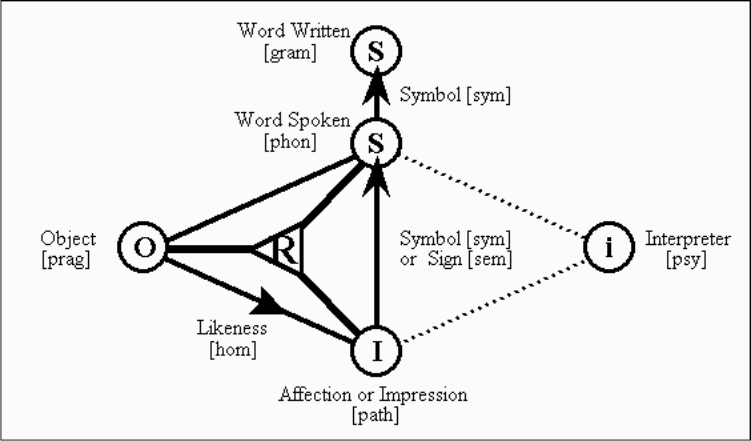
Words spoken are symbols or signs (symbola) of affections or impressions (pathemata) of the soul (psyche);  written words are the signs of words spoken.  As writing, so also is speech not the same for all races of men.  But the mental affections themselves, of which these words are primarily signs (semeia), are the same for the whole of mankind, as are also the objects (pragmata) of which those affections are representations or likenesses, images, copies (homoiomata).  (Aristotle, De Interp. i. 16a4).

We used the following Figure to highlight the structure of the triadic relation among objects (pragmata), affections or impressions (pathemata), and symbols or signs (symbola, semeia) as given in Aristotle’s account:

Figure 1. The Sign Relation in Aristotle

Figure 1.  The Sign Relation in Aristotle

The triadic nexus marked “R” in the Figure is what graph theorists call a node or point of degree 3 and it provides a graphical picture of a relational triple that may be taken in any convenient order so long as we keep it constant throughout a given discussion.  For example, we could take Aristotle’s object, sign or symbol, and impression in the order (o, s, i), mostly just because I find that convenient in later developments.

Diagrams of that sort, whether triangular or tri-radial in form, have long been in common use for conveying the properties of triadic sign relations.  But I have discovered to my dismay over the intervening years that people tend to be led astray by pictures like that, often getting stuck on square one, or rather triangle one.  That is, they get stuck on single triples of sign relations rather than grasping them as they should, as prototypical examples of a whole class of ordered triples.

cc: Systems ScienceStructural Modeling

Posted in Abduction, Aristotle, C.S. Peirce, Comprehension, Deduction, Definition, Determination, Extension, Hypothesis, Induction, Inference, Information, Information = Comprehension × Extension, Inquiry, Intension, Logic, Logic of Science, Mathematics, Measurement, Observation, Peirce, Perception, Peter Woit, Phenomenology, Physics, Pragmatic Semiotic Information, Pragmatism, Probability, Quantum Mechanics, Scientific Method, Semiotics, Sign Relations | Tagged , , , , , , , , , , , , , , , , , , , , , , , , , , , , , , , | 8 Comments

Pragmatic Semiotic Information • Discussion 4

Re: Is Quantum Mechanics A Probabilistic Theory?What Is Measurement?

Measurement is an extension of perception.  Measurement gives us data about an object system the way perception gives us percepts, which we may consider just a species of data.

If we ask when we first became self-conscious about this whole process of perception and measurement, I don’t know, but Aristotle broke ground in a very articulate way with his treatise On Interpretation.  Sense data are impressions on the mind and they have their consensual, communicable derivatives in spoken and written signs.  This triple interaction among objects, ideas, and signs is the cornerstone of our contemporary theories of signs, collectively known as semiotics.

cc: Ontolog ForumSystems ScienceStructural Modeling

Posted in Abduction, Aristotle, C.S. Peirce, Comprehension, Deduction, Definition, Determination, Extension, Hypothesis, Induction, Inference, Information, Information = Comprehension × Extension, Inquiry, Intension, Logic, Logic of Science, Mathematics, Measurement, Observation, Peirce, Perception, Peter Woit, Phenomenology, Physics, Pragmatic Semiotic Information, Pragmatism, Probability, Quantum Mechanics, Scientific Method, Semiotics, Sign Relations | Tagged , , , , , , , , , , , , , , , , , , , , , , , , , , , , , , , | 8 Comments