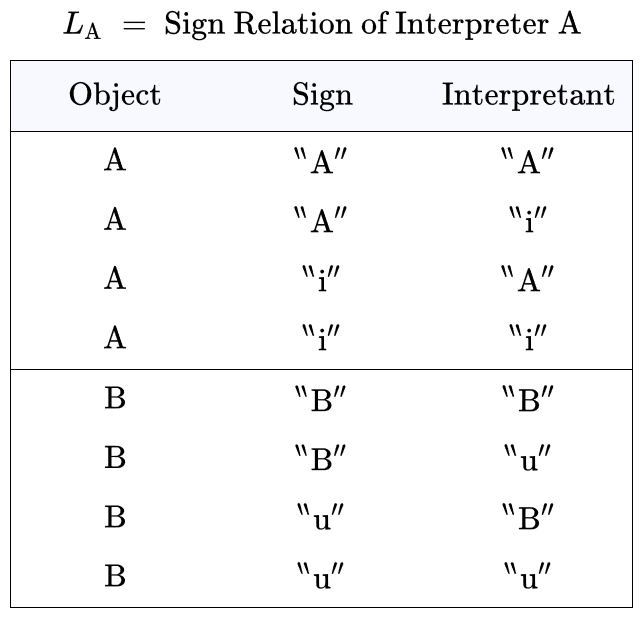
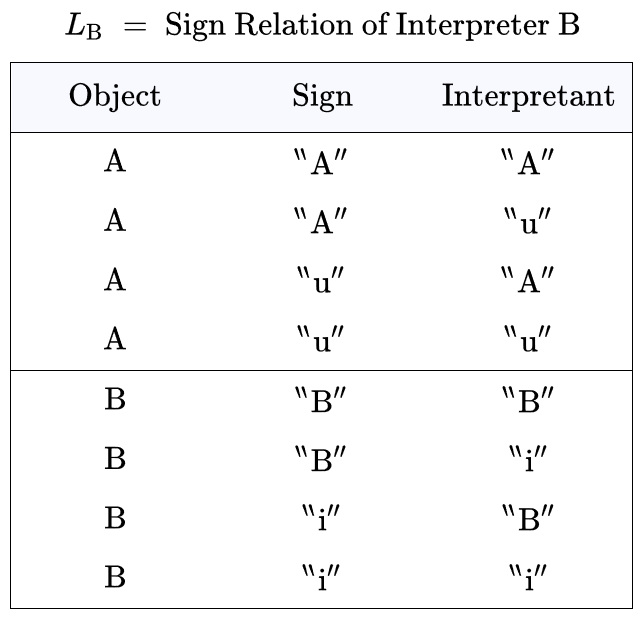
Semiotics, Semiosis, Sign Relations • Discussion 6

Re: Peirce ListJon Alan Schmidt

Just a note to record this citation by Jon Alan Schmidt of an important theme in Peirce.  It touches on one of those recurring questions which has come up time and again on the Peirce List over the last twenty years, more acutely in recent Facebook discussions about universes of discourse, and more obliquely in the Ontolog Forum in connection with the AI/CogSci/DataBase issue of open vs. closed worlds.  In another life, under another hat, I might have mentioned the Central Limit Theorem at this point as that would have brought us nearer Peirce’s core insight into the matter, but maybe another time …

JAS:
Every proposition is collective and copulative;  as I stated in a recent post, its dynamical object is “the entire universe” (CP 5.448n, EP 2:394, 1906), which is “the totality of all real objects” (CP 5.152, EP 2:209, 1903), while its immediate object is “the logical universe of discourse” (CP 2.323, EP 2:283, 1903).

Thanks are due to JAS for calling attention to a critical point.  I’m occupied with another train of thought at the moment so I’ll just stop to flag it for a later discussion.  Incidentally, or synchronistically, lack of care in distinguishing different objects of the same signs, in particular, immediate and ultimate objects and their corresponding universes or object domains, has been the source of many misunderstandings in scattered discussions on Facebook of late.

Another issue arising here has to do with the difference between the “dimensionality of a relation” and the “number of correlates”.  Signs may have any number of correlates in the object domain without requiring the dimensionality of the relevant sign relation to be greater than three.  This is one of the consequences of “triadic relation irreducibility”.

Resources

Logic Syllabus Sign Relation
Semeiotic Triadic Relation
Universe of Discourse Relation Theory
Peirce’s 1870 Logic Of Relatives Relation Reduction

cc: CyberneticsOntolog ForumPeirce ListStructural ModelingSystems Science

Posted in C.S. Peirce, Category Theory, Logic, Relation Theory, Semiosis, Semiotics, Sign Relations, Triadic Relations | Tagged , , , , , , , | 12 Comments

Differential Logic • 9

Propositional Forms on Two Variables

Table A2 arranges the propositional forms on two variables according to another plan, sorting propositions with similar shapes into seven subclasses.  Thereby hangs many a tale, to be told in time.

Table A2.  Propositional Forms on Two Variables

Table A2. Propositional Forms on Two Variables

cc: Category TheoryCyberneticsOntologStructural ModelingSystems Science
cc: FB | Differential LogicLaws of Form • Peirce (1) (2) (3) (4)

Posted in Amphecks, Animata, Boolean Algebra, Boolean Functions, C.S. Peirce, Cactus Graphs, Category Theory, Change, Cybernetics, Differential Analytic Turing Automata, Differential Calculus, Differential Logic, Discrete Dynamics, Equational Inference, Frankl Conjecture, Functional Logic, Gradient Descent, Graph Theory, Hologrammautomaton, Indicator Functions, Inquiry Driven Systems, Leibniz, Logic, Logical Graphs, Mathematics, Minimal Negation Operators, Painted Cacti, Peirce, Propositional Calculus, Surveys, Time, Topology, Visualization, Zeroth Order Logic | Tagged , , , , , , , , , , , , , , , , , , , , , , , , , , , , , , , , , | 6 Comments

Differential Logic • Discussion 1

Re: Structural ModelingJoseph Simpson

Thanks, Joe, glad you liked the table, I’ve got a million of ’em!  I’ll be setting another mess of tables directly as we continue studying the effects of differential operators on families of propositional forms.

For anyone wondering, Where’s the Peirce? — the efficiency of Peirce’s logical graphs, augmented by Spencer Brown and generalized to cactus graphs, made it possible for the first time to take on the extra complexities of differential propositional calculus.  This makes Peircean themes a constant throughout the development of differential logic.

Hope you and yours are safe and sound,

Jon

cc: Category TheoryCyberneticsOntologStructural ModelingSystems Science
cc: FB | Differential LogicLaws of Form • Peirce (1) (2) (3) (4)

Posted in Amphecks, Animata, Boolean Algebra, Boolean Functions, C.S. Peirce, Cactus Graphs, Category Theory, Change, Cybernetics, Differential Analytic Turing Automata, Differential Calculus, Differential Logic, Discrete Dynamics, Equational Inference, Frankl Conjecture, Functional Logic, Gradient Descent, Graph Theory, Hologrammautomaton, Indicator Functions, Inquiry Driven Systems, Leibniz, Logic, Logical Graphs, Mathematics, Minimal Negation Operators, Painted Cacti, Peirce, Propositional Calculus, Surveys, Time, Topology, Visualization, Zeroth Order Logic | Tagged , , , , , , , , , , , , , , , , , , , , , , , , , , , , , , , , , | 8 Comments

Differential Logic • 8

Propositional Forms on Two Variables

To broaden our experience with simple examples, let’s examine the sixteen functions of concrete type P \times Q \to \mathbb{B} and abstract type \mathbb{B} \times \mathbb{B} \to \mathbb{B}.  Our inquiry into the differential aspects of logical conjunction will pay dividends as we study the actions of \mathrm{E} and \mathrm{D} on this family of forms.

Table A1 arranges the propositional forms on two variables in a convenient order, giving equivalent expressions for each boolean function in several systems of notation.

Table A1.  Propositional Forms on Two Variables

Table A1. Propositional Forms on Two Variables

cc: Category TheoryCyberneticsOntologStructural ModelingSystems Science
cc: FB | Differential LogicLaws of Form • Peirce (1) (2) (3) (4)

Posted in Amphecks, Animata, Boolean Algebra, Boolean Functions, C.S. Peirce, Cactus Graphs, Category Theory, Change, Cybernetics, Differential Analytic Turing Automata, Differential Calculus, Differential Logic, Discrete Dynamics, Equational Inference, Frankl Conjecture, Functional Logic, Gradient Descent, Graph Theory, Hologrammautomaton, Indicator Functions, Inquiry Driven Systems, Leibniz, Logic, Logical Graphs, Mathematics, Minimal Negation Operators, Painted Cacti, Peirce, Propositional Calculus, Surveys, Time, Topology, Visualization, Zeroth Order Logic | Tagged , , , , , , , , , , , , , , , , , , , , , , , , , , , , , , , , , | 6 Comments

Differential Logic • 7

Differential Expansions of Propositions

Panoptic View • Enlargement Maps

The enlargement or shift operator \mathrm{E} exhibits a wealth of interesting and useful properties in its own right, so it pays to examine a few of the more salient features playing out on the surface of our initial example, f(p, q) = pq.

A suitably generic definition of the extended universe of discourse is afforded by the following set‑up.

\begin{array}{cccl}  \text{Let} & X & = & X_1 \times \ldots \times X_k.  \\[6pt]  \text{Let} & \mathrm{d}X & = & \mathrm{d}X_1 \times \ldots \times \mathrm{d}X_k.  \\[6pt]  \text{Then} & \mathrm{E}X & = & X \times \mathrm{d}X  \\[6pt]  & & = & X_1 \times \ldots \times X_k ~\times~ \mathrm{d}X_1 \times \ldots \times \mathrm{d}X_k  \end{array}

For a proposition of the form f : X_1 \times \ldots \times X_k \to \mathbb{B}, the (first order) enlargement of f is the proposition \mathrm{E}f : \mathrm{E}X \to \mathbb{B} defined by the following equation.

\mathrm{E}f(x_1, \ldots, x_k, \mathrm{d}x_1, \ldots, \mathrm{d}x_k) ~=~ f(x_1 + \mathrm{d}x_1, \ldots, x_k + \mathrm{d}x_k) ~=~ f(\texttt{(} x_1 \texttt{,} \mathrm{d}x_1 \texttt{)}, \ldots, \texttt{(} x_k \texttt{,} \mathrm{d}x_k \texttt{)})

The differential variables \mathrm{d}x_j are boolean variables of the same type as the ordinary variables x_j.  Although it is conventional to distinguish the (first order) differential variables with the operational prefix {}^{\backprime\backprime} \mathrm{d} {}^{\prime\prime} this way of notating differential variables is entirely optional.  It is their existence in particular relations to the initial variables, not their names, which defines them as differential variables.

In the example of logical conjunction, f(p, q) = pq, the enlargement \mathrm{E}f is formulated as follows.

\begin{matrix}  \mathrm{E}f(p, q, \mathrm{d}p, \mathrm{d}q)  & = &  (p + \mathrm{d}p)(q + \mathrm{d}q)  & = &  \texttt{(} p \texttt{,} \mathrm{d}p \texttt{)(} q \texttt{,} \mathrm{d}q \texttt{)}  \end{matrix}

Given that this expression uses nothing more than the boolean ring operations of addition and multiplication, it is permissible to “multiply things out” in the usual manner to arrive at the following result.

\begin{matrix}  \mathrm{E}f(p, q, \mathrm{d}p, \mathrm{d}q)  & = &  p~q  & + &  p~\mathrm{d}q  & + &  q~\mathrm{d}p  & + &  \mathrm{d}p~\mathrm{d}q  \end{matrix}

To understand what the enlarged or shifted proposition means in logical terms, it serves to go back and analyze the above expression for \mathrm{E}f in the same way we did for \mathrm{D}f.  To that end, the value of \mathrm{E}f_x at each x \in X may be computed in graphical fashion as shown below.

Cactus Graph Ef = (p,dp)(q,dq)

Cactus Graph Enlargement pq @ pq = (dp)(dq)

Cactus Graph Enlargement pq @ p(q) = (dp)dq

Cactus Graph Enlargement pq @ (p)q = dp(dq)

Cactus Graph Enlargement pq @ (p)(q) = dp dq

Collating the data of this analysis yields a boolean expansion or disjunctive normal form (DNF) equivalent to the enlarged proposition \mathrm{E}f.

\begin{matrix}  \mathrm{E}f  & = &  pq \cdot \mathrm{E}f_{pq}  & + &  p(q) \cdot \mathrm{E}f_{p(q)}  & + &  (p)q \cdot \mathrm{E}f_{(p)q}  & + &  (p)(q) \cdot \mathrm{E}f_{(p)(q)}  \end{matrix}

Here is a summary of the result, illustrated by means of a digraph picture, where the “no change” element \texttt{(} \mathrm{d}p \texttt{)(} \mathrm{d}q \texttt{)} is drawn as a loop at the point p~q.

Directed Graph Enlargement pq

\begin{array}{rcccccc}  f & = & p  & \cdot & q  \\[4pt]  \mathrm{E}f & = & p  & \cdot &  q  & \cdot &  \texttt{(} \mathrm{d}p \texttt{)(} \mathrm{d}q \texttt{)}  \\[4pt]  & + &  p  & \cdot & \texttt{(} q \texttt{)}  & \cdot &  \texttt{(} \mathrm{d}p \texttt{)} \texttt{~} \mathrm{d}q \texttt{~}  \\[4pt]  & + &  \texttt{(} p \texttt{)} & \cdot &  q  & \cdot &  \texttt{~} \mathrm{d}p \texttt{~} \texttt{(} \mathrm{d}q \texttt{)}  \\[4pt]  & + &  \texttt{(} p \texttt{)} & \cdot & \texttt{(} q \texttt{)}  & \cdot & \mathrm{d}p \texttt{~~} \mathrm{d}q  \end{array}

We may understand the enlarged proposition \mathrm{E}f as telling us all the ways of reaching a model of the proposition f from the points of the universe X.

cc: Category TheoryCyberneticsOntologStructural ModelingSystems Science
cc: FB | Differential LogicLaws of Form • Peirce (1) (2) (3) (4)

Posted in Amphecks, Animata, Boolean Algebra, Boolean Functions, C.S. Peirce, Cactus Graphs, Category Theory, Change, Cybernetics, Differential Analytic Turing Automata, Differential Calculus, Differential Logic, Discrete Dynamics, Equational Inference, Frankl Conjecture, Functional Logic, Gradient Descent, Graph Theory, Hologrammautomaton, Indicator Functions, Inquiry Driven Systems, Leibniz, Logic, Logical Graphs, Mathematics, Minimal Negation Operators, Painted Cacti, Peirce, Propositional Calculus, Surveys, Time, Topology, Visualization, Zeroth Order Logic | Tagged , , , , , , , , , , , , , , , , , , , , , , , , , , , , , , , , , | 5 Comments

Differential Logic • 6

Differential Expansions of Propositions

Panoptic View • Difference Maps

In the previous section we computed what is variously described as the difference map, the difference proposition, or the local proposition \mathrm{D}f_x of the proposition f(p, q) = pq at the point x where p = 1 and q = 1.

In the universe of discourse X = P \times Q, the four propositions pq, \, p \texttt{(} q \texttt{)}, \, \texttt{(} p \texttt{)} q, \, \texttt{(} p \texttt{)(} q \texttt{)} indicating the “cells”, or the smallest distinguished regions of the universe, are called singular propositions.  These serve as an alternative notation for naming the points (1, 1), ~ (1, 0), ~ (0, 1), ~ (0, 0), respectively.

Thus we can write \mathrm{D}f_x = \mathrm{D}f|_x = \mathrm{D}f|_{(1, 1)} = \mathrm{D}f|_{pq}, so long as we know the frame of reference in force.

In the example f(p, q) = pq, the value of the difference proposition \mathrm{D}f_x at each of the four points x \in X may be computed in graphical fashion as shown below.

Cactus Graph Df = ((p,dp)(q,dq),pq)

Cactus Graph Difference pq @ pq = ((dp)(dq))

Cactus Graph Difference pq @ p(q) = (dp)dq

Cactus Graph Difference pq @ (p)q = dp(dq)

Cactus Graph Difference pq @ (p)(q) = dp dq

The easy way to visualize the values of these graphical expressions is just to notice the following equivalents.

Cactus Graph Lobe Rule

Cactus Graph Spike Rule

Laying out the arrows on the augmented venn diagram, one gets a picture of a differential vector field.

Venn Diagram Difference pq

The Figure shows the points of the extended universe \mathrm{E}X = P \times Q \times \mathrm{d}P \times \mathrm{d}Q indicated by the difference map \mathrm{D}f : \mathrm{E}X \to \mathbb{B}, namely, the following six points or singular propositions.

\begin{array}{rcccc}  1. & p & q & \mathrm{d}p & \mathrm{d}q  \\  2. & p & q & \mathrm{d}p & \texttt{(} \mathrm{d}q \texttt{)}  \\  3. & p & q & \texttt{(} \mathrm{d}p \texttt{)} & \mathrm{d}q  \\  4. & p & \texttt{(} q \texttt{)} & \texttt{(} \mathrm{d}p \texttt{)} & \mathrm{d}q  \\  5. & \texttt{(} p \texttt{)} & q & \mathrm{d}p & \texttt{(} \mathrm{d}q \texttt{)}   \\  6. & \texttt{(} p \texttt{)} & \texttt{(} q \texttt{)} & \mathrm{d}p & \mathrm{d}q  \end{array}

The information borne by \mathrm{D}f should be clear enough from a survey of these six points — they tell you what you have to do from each point of X in order to change the value borne by f(p, q), that is, the move you have to make in order to reach a point where the value of the proposition f(p, q) is different from what it is where you started.

We have been studying the action of the difference operator \mathrm{D} on propositions of the form f : P \times Q \to \mathbb{B}, as illustrated by the example f(p, q) = pq which is known in logic as the conjunction of p and q.  The resulting difference map \mathrm{D}f is a (first order) differential proposition, that is, a proposition of the form \mathrm{D}f : P \times Q \times \mathrm{d}P \times \mathrm{d}Q \to \mathbb{B}.

The augmented venn diagram shows how the models or satisfying interpretations of \mathrm{D}f distribute over the extended universe of discourse \mathrm{E}X = P \times Q \times \mathrm{d}P \times \mathrm{d}Q.  Abstracting from that picture, the difference map \mathrm{D}f can be represented in the form of a digraph or directed graph, one whose points are labeled with the elements of X =  P \times Q and whose arrows are labeled with the elements of \mathrm{d}X = \mathrm{d}P \times \mathrm{d}Q, as shown in the following Figure.

Directed Graph Difference pq

\begin{array}{rcccccc}  f & = & p & \cdot & q  \\[4pt]  \mathrm{D}f & = &  p & \cdot & q & \cdot &  \texttt{((} \mathrm{d}p \texttt{)(} \mathrm{d}q \texttt{))}  \\[4pt]  & + &  p & \cdot & \texttt{(} q \texttt{)} & \cdot &  \texttt{~(} \mathrm{d}p \texttt{)~} \mathrm{d}q \texttt{~~}  \\[4pt]  & + &  \texttt{(} p \texttt{)} & \cdot & q & \cdot &  \texttt{~~} \mathrm{d}p \texttt{~(} \mathrm{d}q \texttt{)~}  \\[4pt]  & + &  \texttt{(} p \texttt{)} & \cdot & \texttt{(} q \texttt{)} & \cdot &  \texttt{~~} \mathrm{d}p \texttt{~~} \mathrm{d}q \texttt{~~}  \end{array}

Any proposition worth its salt can be analyzed from many different points of view, any one of which has the potential to reveal previously unsuspected aspects of the proposition’s meaning.  We will encounter more and more of these alternative readings as we go.

cc: Category TheoryCyberneticsOntologStructural ModelingSystems Science
cc: FB | Differential LogicLaws of Form • Peirce (1) (2) (3) (4)

Posted in Amphecks, Animata, Boolean Algebra, Boolean Functions, C.S. Peirce, Cactus Graphs, Category Theory, Change, Cybernetics, Differential Analytic Turing Automata, Differential Calculus, Differential Logic, Discrete Dynamics, Equational Inference, Frankl Conjecture, Functional Logic, Gradient Descent, Graph Theory, Hologrammautomaton, Indicator Functions, Inquiry Driven Systems, Leibniz, Logic, Logical Graphs, Mathematics, Minimal Negation Operators, Painted Cacti, Peirce, Propositional Calculus, Surveys, Time, Topology, Visualization, Zeroth Order Logic | Tagged , , , , , , , , , , , , , , , , , , , , , , , , , , , , , , , , , | 5 Comments

Differential Logic • 5

Differential Expansions of Propositions

Worm’s Eye View

Let’s run through the initial example again, keeping an eye on the meanings of the formulas which develop along the way.  We begin with a proposition or a boolean function f(p, q) = pq whose venn diagram and cactus graph are shown below.

Venn Diagram f = pq

Cactus Graph f = pq

A function like this has an abstract type and a concrete type.  The abstract type is what we invoke when we write things like f : \mathbb{B} \times \mathbb{B} \to \mathbb{B} or f : \mathbb{B}^2 \to \mathbb{B}.  The concrete type takes into account the qualitative dimensions or “units” of the case, which can be explained as follows.

Let P be the set of values \{ \texttt{(} p \texttt{)},~ p \} ~=~ \{ \mathrm{not}~ p,~ p \} ~\cong~ \mathbb{B}.
Let Q be the set of values \{ \texttt{(} q \texttt{)},~ q \} ~=~ \{ \mathrm{not}~ q,~ q \} ~\cong~ \mathbb{B}.

Then interpret the usual propositions about p, q as functions of the concrete type f : P \times Q \to \mathbb{B}.

We are going to consider various operators on these functions.  An operator \mathrm{F} is a function which takes one function f into another function \mathrm{F}f.

The first couple of operators we need to consider are logical analogues of two which play a founding role in the classical finite difference calculus, namely:

The difference operator \Delta, written here as \mathrm{D}.
The enlargement operator, written here as \mathrm{E}.

These days, \mathrm{E} is more often called the shift operator.

In order to describe the universe in which these operators operate, it is necessary to enlarge the original universe of discourse.  Starting from the initial space X = P \times Q, its (first order) differential extension \mathrm{E}X is constructed according to the following specifications.

\begin{array}{rcc}  \mathrm{E}X & = & X \times \mathrm{d}X  \end{array}

where:

\begin{array}{rcc}  X & = & P \times Q  \\[4pt]  \mathrm{d}X & = & \mathrm{d}P \times \mathrm{d}Q  \\[4pt]  \mathrm{d}P & = & \{ \texttt{(} \mathrm{d}p \texttt{)}, ~ \mathrm{d}p \}  \\[4pt]  \mathrm{d}Q & = & \{ \texttt{(} \mathrm{d}q \texttt{)}, ~ \mathrm{d}q \}  \end{array}

The interpretations of these new symbols can be diverse, but the easiest option for now is just to say \mathrm{d}p means “change p” and \mathrm{d}q means “change q”.

Drawing a venn diagram for the differential extension \mathrm{E}X = X \times \mathrm{d}X requires four logical dimensions, P, Q, \mathrm{d}P, \mathrm{d}Q, but it is possible to project a suggestion of what the differential features \mathrm{d}p and \mathrm{d}q are about on the 2-dimensional base space X = P \times Q by drawing arrows crossing the boundaries of the basic circles in the venn diagram for X, reading an arrow as \mathrm{d}p if it crosses the boundary between p and \texttt{(} p \texttt{)} in either direction and reading an arrow as \mathrm{d}q if it crosses the boundary between q and \texttt{(} q \texttt{)} in either direction, as indicated in the following figure.

Venn Diagram p q dp dq

Propositions are formed on differential variables, or any combination of ordinary logical variables and differential logical variables, in the same ways propositions are formed on ordinary logical variables alone.  For example, the proposition \texttt{(} \mathrm{d}p \texttt{(} \mathrm{d}q \texttt{))} says the same thing as \mathrm{d}p \Rightarrow \mathrm{d}q, in other words, there is no change in p without a change in q.

Given the proposition f(p, q) over the space X = P \times Q, the (first order) enlargement of f is the proposition \mathrm{E}f over the differential extension \mathrm{E}X defined by the following formula.

\begin{matrix}  \mathrm{E}f(p, q, \mathrm{d}p, \mathrm{d}q)  & = &   f(p + \mathrm{d}p,~ q + \mathrm{d}q)  & = &  f( \texttt{(} p, \mathrm{d}p \texttt{)},~ \texttt{(} q, \mathrm{d}q \texttt{)} )  \end{matrix}

In the example f(p, q) = pq, the enlargement \mathrm{E}f is computed as follows.

\begin{matrix}  \mathrm{E}f(p, q, \mathrm{d}p, \mathrm{d}q)  & = &   (p + \mathrm{d}p)(q + \mathrm{d}q)  & = &  \texttt{(} p, \mathrm{d}p \texttt{)(} q, \mathrm{d}q \texttt{)}  \end{matrix}

Cactus Graph Ef = (p,dp)(q,dq)

Given the proposition f(p, q) over X = P \times Q, the (first order) difference of f is the proposition \mathrm{D}f over \mathrm{E}X defined by the formula \mathrm{D}f = \mathrm{E}f - f, or, written out in full:

\begin{matrix}  \mathrm{D}f(p, q, \mathrm{d}p, \mathrm{d}q)  & = &   f(p + \mathrm{d}p,~ q + \mathrm{d}q) - f(p, q)  & = &  \texttt{(} f( \texttt{(} p, \mathrm{d}p \texttt{)},~ \texttt{(} q, \mathrm{d}q \texttt{)} ),~ f(p, q) \texttt{)}  \end{matrix}

In the example f(p, q) = pq, the difference \mathrm{D}f is computed as follows.

\begin{matrix}  \mathrm{D}f(p, q, \mathrm{d}p, \mathrm{d}q)  & = &   (p + \mathrm{d}p)(q + \mathrm{d}q) - pq  & = &  \texttt{((} p, \mathrm{d}p \texttt{)(} q, \mathrm{d}q \texttt{)}, pq \texttt{)}  \end{matrix}

Cactus Graph Df = ((p,dp)(q,dq),pq)

At the end of the previous section we evaluated this first order difference of conjunction \mathrm{D}f at a single location in the universe of discourse, namely, at the point picked out by the singular proposition pq, in terms of coordinates, at the place where p = 1 and q = 1.  This evaluation is written in the form \mathrm{D}f|_{pq} or \mathrm{D}f|_{(1, 1)}, and we arrived at the locally applicable law which may be stated and illustrated as follows.

f(p, q) ~=~ pq ~=~ p ~\mathrm{and}~ q \quad \Rightarrow \quad \mathrm{D}f|_{pq} ~=~ \texttt{((} \mathrm{dp} \texttt{)(} \mathrm{d}q \texttt{))} ~=~ \mathrm{d}p ~\mathrm{or}~ \mathrm{d}q

Venn Diagram Difference pq @ pq

Cactus Graph Difference pq @ pq

The venn diagram shows the analysis of the inclusive disjunction \texttt{((} \mathrm{d}p \texttt{)(} \mathrm{d}q \texttt{))} into the following exclusive disjunction.

\begin{matrix}  \mathrm{d}p ~\texttt{(} \mathrm{d}q \texttt{)}  & + &  \texttt{(} \mathrm{d}p \texttt{)}~ \mathrm{d}q  & + &  \mathrm{d}p ~\mathrm{d}q  \end{matrix}

The differential proposition \texttt{((} \mathrm{d}p \texttt{)(} \mathrm{d}q \texttt{))} may be read as saying “change p or change q or both”.  And this can be recognized as just what you need to do if you happen to find yourself in the center cell and require a complete and detailed description of ways to escape it.

cc: Category TheoryCyberneticsOntologStructural ModelingSystems Science
cc: FB | Differential LogicLaws of Form • Peirce (1) (2) (3) (4)

Posted in Amphecks, Animata, Boolean Algebra, Boolean Functions, C.S. Peirce, Cactus Graphs, Category Theory, Change, Cybernetics, Differential Analytic Turing Automata, Differential Calculus, Differential Logic, Discrete Dynamics, Equational Inference, Frankl Conjecture, Functional Logic, Gradient Descent, Graph Theory, Hologrammautomaton, Indicator Functions, Inquiry Driven Systems, Leibniz, Logic, Logical Graphs, Mathematics, Minimal Negation Operators, Painted Cacti, Peirce, Propositional Calculus, Surveys, Time, Topology, Visualization, Zeroth Order Logic | Tagged , , , , , , , , , , , , , , , , , , , , , , , , , , , , , , , , , | 8 Comments

Differential Logic • 4

Differential Expansions of Propositions

Bird’s Eye View

An efficient calculus for the realm of logic represented by boolean functions and elementary propositions makes it feasible to compute the finite differences and the differentials of those functions and propositions.

For example, consider a proposition of the form {}^{\backprime\backprime} \, p ~\mathrm{and}~ q \, {}^{\prime\prime} graphed as two letters attached to a root node, as shown below.

Cactus Graph Existential p and q

Written as a string, this is just the concatenation p~q.

The proposition pq may be taken as a boolean function f(p, q) having the abstract type f : \mathbb{B} \times \mathbb{B} \to \mathbb{B}, where \mathbb{B} = \{ 0, 1 \} is read in such a way that 0 means \mathrm{false} and 1 means \mathrm{true}.

Imagine yourself standing in a fixed cell of the corresponding venn diagram, say, the cell where the proposition pq is true, as shown in the following Figure.

Venn Diagram p and q

Now ask yourself:  What is the value of the proposition pq at a distance of \mathrm{d}p and \mathrm{d}q from the cell pq where you are standing?

Don’t think about it — just compute:

Cactus Graph (p,dp)(q,dq)

The cactus formula \texttt{(} p \texttt{,} \mathrm{d}p \texttt{)(} q \texttt{,} \mathrm{d}q \texttt{)} and its corresponding graph arise by replacing p with p + \mathrm{d}p and q with q + \mathrm{d}q in the boolean product or logical conjunction pq and writing the result in the two dialects of cactus syntax.  This follows because the boolean sum p + \mathrm{d}p is equivalent to the logical operation of exclusive disjunction, which parses to a cactus graph of the following form.

Cactus Graph (p,dp)

Next question:  What is the difference between the value of the proposition pq over there, at a distance of \mathrm{d}p and \mathrm{d}q from where you are standing, and the value of the proposition pq where you are, all expressed in the form of a general formula, of course?  The answer takes the following form.

Cactus Graph ((p,dp)(q,dq),pq)

There is one thing I ought to mention at this point:  Computed over \mathbb{B}, plus and minus are identical operations.  This will make the relation between the differential and the integral parts of the appropriate calculus slightly stranger than usual, but we will get into that later.

Last question, for now:  What is the value of this expression from your current standpoint, that is, evaluated at the point where pq is true?  Well, replacing p with 1 and q with 1 in the cactus graph amounts to erasing the labels p and q, as shown below.

Cactus Graph (( ,dp)( ,dq), )

And this is equivalent to the following graph:

Cactus Graph ((dp)(dq))

We have just met with the fact that the differential of the and is the or of the differentials.

\begin{matrix}  p ~\mathrm{and}~ q  & \quad &  \xrightarrow{\quad\mathrm{Diff}\quad}  & \quad &  \mathrm{d}p ~\mathrm{or}~ \mathrm{d}q  \end{matrix}

Cactus Graph pq → Diff → ((dp)(dq))

It will be necessary to develop a more refined analysis of that statement directly, but that is roughly the nub of it.

If the form of the above statement reminds you of De Morgan’s rule, it is no accident, as differentiation and negation turn out to be closely related operations.  Indeed, one can find discussions of logical difference calculus in the Boole–De Morgan correspondence and Peirce also made use of differential operators in a logical context, but the exploration of these ideas has been hampered by a number of factors, not the least of which has been the lack of a syntax adequate to handle the complexity of expressions evolving in the process.

cc: Category TheoryCyberneticsOntologStructural ModelingSystems Science
cc: FB | Differential LogicLaws of Form • Peirce (1) (2) (3) (4)

Posted in Amphecks, Animata, Boolean Algebra, Boolean Functions, C.S. Peirce, Cactus Graphs, Category Theory, Change, Cybernetics, Differential Analytic Turing Automata, Differential Calculus, Differential Logic, Discrete Dynamics, Equational Inference, Frankl Conjecture, Functional Logic, Gradient Descent, Graph Theory, Hologrammautomaton, Indicator Functions, Inquiry Driven Systems, Leibniz, Logic, Logical Graphs, Mathematics, Minimal Negation Operators, Painted Cacti, Peirce, Propositional Calculus, Surveys, Time, Topology, Visualization, Zeroth Order Logic | Tagged , , , , , , , , , , , , , , , , , , , , , , , , , , , , , , , , , | 11 Comments

Differential Logic • 3

Cactus Language for Propositional Logic

Table 1 shows the cactus graphs, the corresponding cactus expressions, their logical meanings under the so-called existential interpretation, and their translations into conventional notations for a sample of basic propositional forms.

Table 1.  Syntax and Semantics of a Calculus for Propositional Logic

Table 1.  Syntax and Semantics of a Calculus for Propositional Logic

The simplest expression for logical truth is the empty word, typically denoted by \boldsymbol\varepsilon or \lambda in formal languages, where it is the identity element for concatenation.  To make it visible in context, it may be denoted by the equivalent expression {}^{\backprime\backprime} \texttt{((}~\texttt{))} {}^{\prime\prime}, or, especially if operating in an algebraic context, by a simple {}^{\backprime\backprime} 1 {}^{\prime\prime}.  Also when working in an algebraic mode, the plus sign {}^{\backprime\backprime} + {}^{\prime\prime} may be used for exclusive disjunction.  Thus we have the following translations of algebraic expressions into cactus expressions.

\begin{matrix}  a + b \quad = \quad \texttt{(} a \texttt{,} b \texttt{)}  \\[8pt]  a + b + c  \quad = \quad \texttt{(} a \texttt{,(} b \texttt{,} c \texttt{))}  \quad = \quad \texttt{((} a \texttt{,} b \texttt{),} c \texttt{)}  \end{matrix}

It is important to note the last expressions are not equivalent to the 3-place form \texttt{(} a \texttt{,} b \texttt{,} c \texttt{)}.

cc: Category TheoryCyberneticsOntologStructural ModelingSystems Science
cc: FB | Differential LogicLaws of Form • Peirce (1) (2) (3) (4)

Posted in Amphecks, Animata, Boolean Algebra, Boolean Functions, C.S. Peirce, Cactus Graphs, Category Theory, Change, Cybernetics, Differential Analytic Turing Automata, Differential Calculus, Differential Logic, Discrete Dynamics, Equational Inference, Frankl Conjecture, Functional Logic, Gradient Descent, Graph Theory, Hologrammautomaton, Indicator Functions, Inquiry Driven Systems, Leibniz, Logic, Logical Graphs, Mathematics, Minimal Negation Operators, Painted Cacti, Peirce, Propositional Calculus, Surveys, Time, Topology, Visualization, Zeroth Order Logic | Tagged , , , , , , , , , , , , , , , , , , , , , , , , , , , , , , , , , | 5 Comments

Differential Logic • 2

Cactus Language for Propositional Logic

The development of differential logic is facilitated by having a moderately efficient calculus in place at the level of boolean-valued functions and elementary logical propositions.  One very efficient calculus on both conceptual and computational grounds is based on just two types of logical connectives, both of variable k-ary scope.  The syntactic formulas of this calculus map into a family of graph-theoretic structures called “painted and rooted cacti” which lend visual representation to the functional structures of propositions and smooth the path to efficient computation.

The first kind of connective takes the form of a parenthesized sequence of propositional expressions, written \texttt{(} e_1 \texttt{,} e_2 \texttt{,} \ldots \texttt{,} e_{k-1} \texttt{,} e_k \texttt{)} and meaning exactly one of the propositions e_1, e_2, \ldots, e_{k-1}, e_k is false, in short, their minimal negation is true.  An expression of this form maps into a cactus structure called a lobe, in this case, “painted” with the colors e_1, e_2, \ldots, e_{k-1}, e_k as shown below.

Lobe Connective

The second kind of connective is a concatenated sequence of propositional expressions, written e_1 ~ e_2 ~ \ldots ~ e_{k-1} ~ e_k and meaning all the propositions e_1, e_2, \ldots, e_{k-1}, e_k are true, in short, their logical conjunction is true.  An expression of this form maps into a cactus structure called a node, in this case, “painted” with the colors e_1, e_2, \ldots, e_{k-1}, e_k as shown below.

Node Connective

All other propositional connectives can be obtained through combinations of these two forms.  As it happens, the parenthesized form is sufficient to define the concatenated form, making the latter formally dispensable, but it’s convenient to maintain it as a concise way of expressing more complicated combinations of parenthesized forms.  While working with expressions solely in propositional calculus, it’s easiest to use plain parentheses for logical connectives.  In contexts where ordinary parentheses are needed for other purposes an alternate typeface \texttt{(} \ldots \texttt{)} may be used for the logical operators.

cc: Category TheoryCyberneticsOntologStructural ModelingSystems Science
cc: FB | Differential LogicLaws of Form • Peirce (1) (2) (3) (4)

Posted in Amphecks, Animata, Boolean Algebra, Boolean Functions, C.S. Peirce, Cactus Graphs, Category Theory, Change, Cybernetics, Differential Analytic Turing Automata, Differential Calculus, Differential Logic, Discrete Dynamics, Equational Inference, Frankl Conjecture, Functional Logic, Gradient Descent, Graph Theory, Hologrammautomaton, Indicator Functions, Inquiry Driven Systems, Leibniz, Logic, Logical Graphs, Mathematics, Minimal Negation Operators, Painted Cacti, Peirce, Propositional Calculus, Surveys, Time, Topology, Visualization, Zeroth Order Logic | Tagged , , , , , , , , , , , , , , , , , , , , , , , , , , , , , , , , , | 6 Comments