Peirce’s 1870 “Logic of Relatives” • Selection 1

We pick up the text at §3. Application of the Algebraic Signs to Logic.

Peirce’s 1870 “Logic of Relatives”Selection 1

Use of the Letters

The letters of the alphabet will denote logical signs.

Now logical terms are of three grand classes.

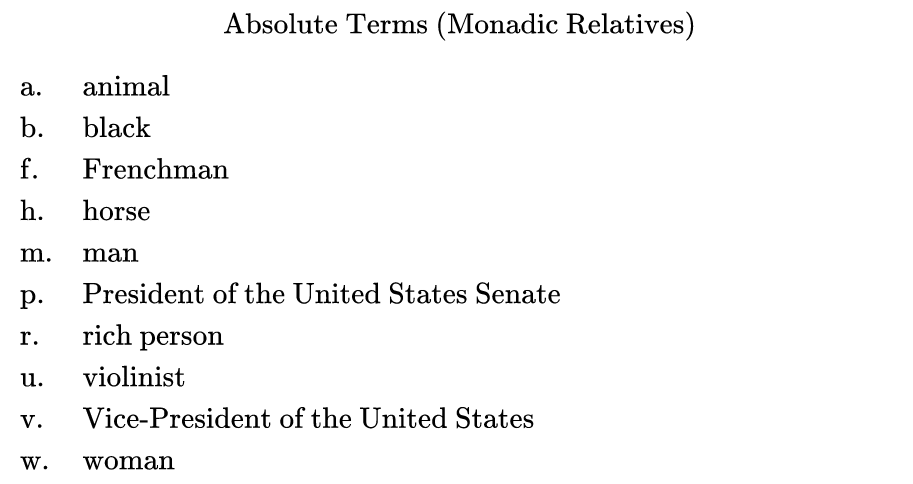
The first embraces those whose logical form involves only the conception of quality, and which therefore represent a thing simply as “a ──”.  These discriminate objects in the most rudimentary way, which does not involve any consciousness of discrimination.  They regard an object as it is in itself as such (quale);  for example, as horse, tree, or man.  These are absolute terms.

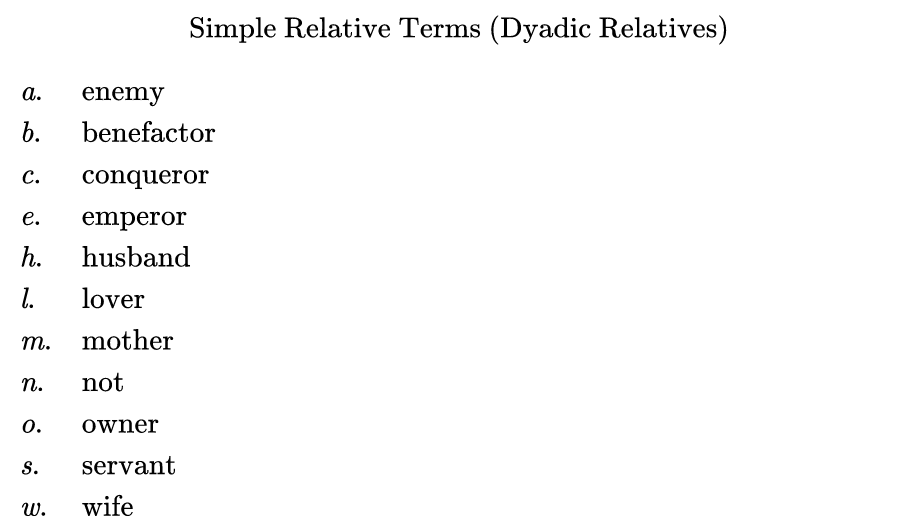
The second class embraces terms whose logical form involves the conception of relation, and which require the addition of another term to complete the denotation.  These discriminate objects with a distinct consciousness of discrimination.  They regard an object as over against another, that is as relative; as father of, lover of, or servant of.  These are simple relative terms.

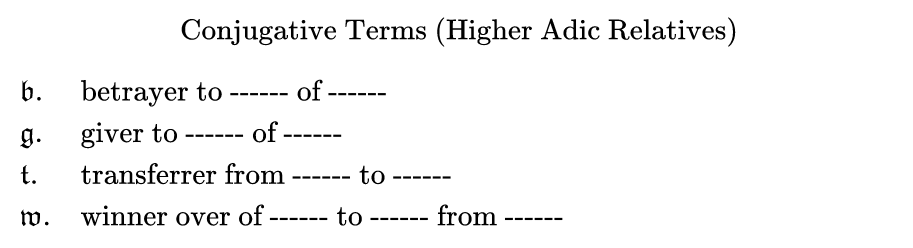
The third class embraces terms whose logical form involves the conception of bringing things into relation, and which require the addition of more than one term to complete the denotation.  They discriminate not only with consciousness of discrimination, but with consciousness of its origin.  They regard an object as medium or third between two others, that is as conjugative;  as giver of ── to ──, or buyer of ── for ── from ──.  These may be termed conjugative terms.

The conjugative term involves the conception of third, the relative that of second or other, the absolute term simply considers an object.  No fourth class of terms exists involving the conception of fourth, because when that of third is introduced, since it involves the conception of bringing objects into relation, all higher numbers are given at once, inasmuch as the conception of bringing objects into relation is independent of the number of members of the relationship.  Whether this reason for the fact that there is no fourth class of terms fundamentally different from the third is satisfactory of not, the fact itself is made perfectly evident by the study of the logic of relatives.

(Peirce, CP 3.63)

One thing that strikes me about the above passage is a pattern of argument I can recognize as invoking a closure principle.  This is a figure of reasoning Peirce uses in three other places:  his discussion of continuous predicates, his definition of a sign relation, and his formulation of the pragmatic maxim itself.

One might also call attention to the following two statements:

Now logical terms are of three grand classes.

No fourth class of terms exists involving the conception of fourth, because when that of third is introduced, since it involves the conception of bringing objects into relation, all higher numbers are given at once, inasmuch as the conception of bringing objects into relation is independent of the number of members of the relationship.

Resources

cc: CyberneticsOntolog ForumStructural ModelingSystems Science
cc: FB | Peirce MattersLaws of Form • Peirce List (1) (2) (3) (4) (5) (6) (7)
Posted in C.S. Peirce, Logic, Logic of Relatives, Mathematics, Relation Theory, Semiotics, Triadicity, Visualization | Tagged , , , , , , , | 11 Comments

Peirce’s 1870 “Logic of Relatives” • Preliminaries

In the beginning was the three-pointed star,
One smile of light across the empty face;
One bough of bone across the rooting air,
The substance forked that marrowed the first sun;
And, burning ciphers on the round of space,
Heaven and hell mixed as they spun.

Dylan Thomas • In The Beginning

I need to return to my study of Peirce’s 1870 Logic of Relatives, and I thought it might be more pleasant to do that on my blog than to hermit away on the wiki where I last left off.

Peirce’s 1870 “Logic of Relatives”Part 1

Peirce’s text employs lower case letters for logical terms of general reference and upper case letters for logical terms of individual reference.  General terms fall into types, namely, absolute terms, dyadic relative terms, and higher adic relative terms, and Peirce employs different typefaces to distinguish these.  The following Tables indicate the typefaces used in the text below for Peirce’s examples of general terms.

Absolute Terms (Monadic Relatives)

Simple Relative Terms (Dyadic Relatives)

Conjugative Terms (Higher Adic Relatives)

Individual terms are taken to denote individual entities falling under a general term.  Peirce uses upper case Roman letters for individual terms, for example, the individual horses \mathrm{H}, \mathrm{H}^{\prime}, \mathrm{H}^{\prime\prime} falling under the general term \mathrm{h} for horse.

The path to understanding Peirce’s system and its wider implications for logic can be smoothed by paraphrasing his notations in a variety of contemporary mathematical formalisms, while preserving the semantics as much as possible.  Remaining faithful to Peirce’s orthography while adding parallel sets of stylistic conventions will, however, demand close attention to typography-in-context.  Current style sheets for mathematical texts specify italics for mathematical variables, with upper case letters for sets and lower case letters for individuals.  So we need to keep an eye out for the difference between the individual \mathrm{X} of the genus \mathrm{x} and the element x of the set X as we pass between the two styles of text.

References

  • Peirce, C.S. (1870), “Description of a Notation for the Logic of Relatives, Resulting from an Amplification of the Conceptions of Boole’s Calculus of Logic”, Memoirs of the American Academy of Arts and Sciences 9, 317–378, 26 January 1870.  Reprinted, Collected Papers (CP 3.45–149), Chronological Edition (CE 2, 359–429).  Online (1) (2) (3).
  • Peirce, C.S., Collected Papers of Charles Sanders Peirce, vols. 1–6, Charles Hartshorne and Paul Weiss (eds.), vols. 7–8, Arthur W. Burks (ed.), Harvard University Press, Cambridge, MA, 1931–1935, 1958.  Cited as (CP volume.paragraph).
  • Peirce, C.S., Writings of Charles S. Peirce : A Chronological Edition, Peirce Edition Project (eds.), Indiana University Press, Bloomington and Indianapolis, IN, 1981–.  Cited as (CE volume, page).

Resources

cc: CyberneticsOntolog ForumStructural ModelingSystems Science
cc: FB | Peirce MattersLaws of Form • Peirce List (1) (2) (3) (4) (5) (6) (7)
Posted in C.S. Peirce, Logic, Logic of Relatives, Mathematics, Relation Theory, Semiotics, Triadicity, Visualization | Tagged , , , , , , , | 28 Comments

All Process, No Paradox • 6

Re: R.J. LiptonAnti-Social Networks
Re: Lou KauffmanIterants, Imaginaries, Matrices

Comments I made elsewhere about computer science and (anti-)social networks have a connection with the work in progress on this thread, so it may steal a march to append them here.

Comment 1

I have been interested for a long time now in using graphs to do logic.  For that you need more than positive links — negative relations are more generative than positive relations.  The logical situation is analogous to social networks where people can “unlike” or “¬like” other people, or website networks where the information at one node may contradict the information at another node.  In my pursuits it turns out that particular species of graph-theoretic “cacti” are much more useful than the garden variety trees and unsigned graphs.

Comment 2

For what it’s worth, here is my exposition of “painted cacti” and their application to propositional calculus.

A painted cactus is a rooted cactus with any number of symbols from a finite alphabet attached to each node.  In their ordinary logical interpretations these symbols (“paints”) stand for boolean variables.

Triangles are interesting in computational contexts because they arise in case-breakdown expressions.  In one of the common interpretations of cactus graphs, a rooted triangular lobe says the values of the two non-root nodes are logically inequivalent.

Resources

cc: CyberneticsLaws of FormOntolog ForumPeirce List
cc: FB | CyberneticsStructural ModelingSystems Science

Posted in Algorithms, Amphecks, Boolean Algebra, Boolean Functions, C.S. Peirce, Cactus Graphs, Cybernetics, Differential Logic, Graph Theory, Laws of Form, Logic, Logical Graphs, Lou Kauffman, Mathematics, Minimal Negation Operators, Painted Cacti, Paradox, Peirce, Process Thinking, Propositional Calculus, Spencer Brown, Systems, Time | Tagged , , , , , , , , , , , , , , , , , , , , , , | 10 Comments

All Process, No Paradox • 5

In the midst of this strife, whereat the halls of Ilúvatar shook and a tremor ran out into the silences yet unmoved, Ilúvatar arose a third time, and his face was terrible to behold.  Then he raised up both his hands, and in one chord, deeper than the Abyss, higher than the Firmament, piercing as the light of the eye of Ilúvatar, the Music ceased.

Tolkien • Ainulindalë

Re: Objects, Models, Theories • (1)(2)
Re: Peirce List (1) (2) • Helmut Raulien (1) (2)

For continuity’s sake — as I try to recover my train of thought from the spin-offs of the solstice roundhouse — I’m recycling my replies to a comment by Helmut Raulien on the Peirce List which raised a host of questions about Peirce’s categories, logic, and semiotics in the light of Spencer Brown’s Laws of Form.

Comment 1

George Spencer Brown’s Laws of Form tends to be loved XOR hated by most folks, with few coming down in between.  I ran across the book early in my undergrad years, shortly after encountering C.S. Peirce, so I recognized the way it revived Peirce’s logical graphs, emphasizing the entitative interpretation of the abstract formal calculus immanent in Peirce’s “Alpha” graphs.  It took me a decade to gain a modicum of clarity about all that “imaginary truth value” and “re-entry” folderol.  I’ll say some things about that later on.

Comment 2

I mulled the matter over for a fair spell of days and nights and decided it wouldn’t be good to jump into the middle of the muddle about re-entry and imaginary truth values right off the bat, that it would be better in the long run to get a solid grip on what is going on with the propositional level of Peirce’s logical graphs and how Spencer Brown’s elaborations can be seen to manifest the same spirit of reasoning, if they are read the right way.  Toward that end I’ll append a list of resources to break the ice on this approach.

Resources

cc: CyberneticsLaws of FormOntolog ForumPeirce List
cc: FB | CyberneticsStructural ModelingSystems Science

Posted in Animata, C.S. Peirce, Category Theory, Cybernetics, Differential Logic, Laws of Form, Logic, Logical Graphs, Mathematics, Paradox, Peirce, Process, Semiotics, Spencer Brown, Systems Theory, Tertium Quid, Time, Tolkien | Tagged , , , , , , , , , , , , , , , , , | 9 Comments

All Process, No Paradox • 4

Thus began the Days of the Bliss of Valinor;
and thus began also the Count of Time.

Tolkien • Quenta Silmarillion

While looking for something else on the web, I ran across an old note I had written in reply to an inquiry on the Conceptual Graphs List, and it seemed to express one of the points of the present thesis in a fairly clear fashion, so here’s the part I found fit to revive.

Time Representation

A point of view arising from fundamental physical considerations makes the concept of Process more fundamental than the concept of Time, since references to a time parameter are simply references to a process taken as standard, in other words, a clock.

We can always develop another “naive physics”, natural language “tense logic”, or implicit psychological theory of time, and maybe that’s all we need in particular settings, but if we push for a deeper logical analysis of timed processes themselves then we need a logical framework capable of dealing with relations between systems which undergo changes in their properties, as described by logical statements.

That is the impulse motivating Differential Logic.  As it turns out, Peirce’s way of doing logic, especially in graphical form, is naturally adapted to dealing with change and difference in logical form.

Resources

cc: CyberneticsLaws of FormOntolog ForumPeirce List
cc: FB | CyberneticsStructural ModelingSystems Science

Posted in Abstraction, C.S. Peirce, Conceptual Graphs, Cybernetics, Differential Logic, Laws of Form, Logic, Logical Graphs, Mathematics, Paradox, Peirce, Process, Process Thinking, Spencer Brown, Systems Theory, Time, Tolkien | Tagged , , , , , , , , , , , , , , , , | 9 Comments

All Process, No Paradox • 3

Consider what effects that might conceivably
have practical bearings you conceive the
objects of your conception to have.  Then,
your conception of those effects is the
whole of your conception of the object.

Charles S. Peirce • “Issues of Pragmaticism”

Re: Peirce ListPaul Eduardo

A riddle is a description of something, typically in metaphorical, oblique, and very partial terms, from which the respondent must abduce the identity of the thing described.  One of the interesting things about Gollum’s riddle is the pragmatic way he describes the object of his conception in terms of its effects on the contents of a whole universe of discourse.  If we weren’t at hazard for being devoured ourselves, we’d be at leisure to sit down and work out a logical analysis of those effects.  There are a few fine points we’d have to settle, like when he says this thing devours all things — Does it devour itself or other things only?

I meant to write more, but it’s later than I thought it would be by now …

cc: CyberneticsLaws of FormOntolog ForumPeirce List
cc: FB | CyberneticsStructural ModelingSystems Science

Posted in Animata, C.S. Peirce, Change, Cybernetics, Differential Logic, Graph Theory, Laws of Form, Logic, Logical Graphs, Mathematics, Paradox, Peirce, Pragmatic Maxim, Process Thinking, Spencer Brown, Systems, Time, Tolkien | Tagged , , , , , , , , , , , , , , , , , | 11 Comments

All Process, No Paradox • 2

These are the forms of time, which imitates eternity and revolves according to a law of number.

Plato • Timaeus

Re: Lou KauffmanIterants, Imaginaries, Matrices

As serendipity would have it, Lou Kauffman, who knows a lot about the lines of inquiry Charles Sanders Peirce and George Spencer Brown pursued into graphical syntaxes for logic, just last month opened a blog and his very first post touched on perennial questions of logic and time — Logos and Chronos — puzzling the wits of everyone who has thought about them for as long as anyone can remember.  Just locally and recently these questions have arisen in the following contexts:

Kauffman’s treatment of logic, paradox, time, and imaginary truth values led me to make the following comments I think are very close to what I’d been struggling to say before.

Let me get some notational matters out of the way before continuing.

I use \mathbb{B} for a generic 2-point set, usually \{ 0, 1 \} and typically but not always interpreted for logic so that 0 = \mathrm{false} and 1 = \mathrm{true}.  I use “teletype” parentheses \texttt{(} \ldots \texttt{)} for negation, so that \texttt{(} x \texttt{)} = \lnot x for x ~\text{in}~ \mathbb{B}.  Later on I’ll be using teletype format lists \texttt{(} x_1 \texttt{,} \ldots \texttt{,} x_k \texttt{)} for minimal negation operators.

As long as we’re reading x as a boolean variable (x \in \mathbb{B}) the equation x = \texttt{(} x \texttt{)} is not paradoxical but simply false.  As an algebraic structure \mathbb{B} can be extended in many ways but it remains a separate question what sort of application, if any, such extensions might have to the normative science of logic.

On the other hand, the assignment statement x := \texttt{(} x \texttt{)} makes perfect sense in computational contexts.  The effect of the assignment operation on the value of the variable x is commonly expressed in time series notation as x' = \texttt{(} x \texttt{)} and the same change is expressed even more succinctly by defining \mathrm{d}x = x' - x and writing \mathrm{d}x = 1.

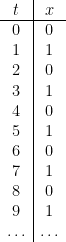
Now suppose we are observing the time evolution of a system X with a boolean state variable x : X \to \mathbb{B} and what we observe is the following time series.
\begin{array}{c|c}  t & x \\  \hline  0 & 0 \\  1 & 1 \\  2 & 0 \\  3 & 1 \\  4 & 0 \\  5 & 1 \\  6 & 0 \\  7 & 1 \\  8 & 0 \\  9 & 1 \\  \ldots & \ldots  \end{array}

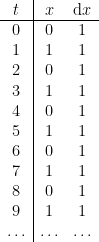
Computing the first differences we get:

\begin{array}{c|cc}  t & x & \mathrm{d}x \\  \hline  0 & 0 & 1 \\  1 & 1 & 1 \\  2 & 0 & 1 \\  3 & 1 & 1 \\  4 & 0 & 1 \\  5 & 1 & 1 \\  6 & 0 & 1 \\  7 & 1 & 1 \\  8 & 0 & 1 \\  9 & 1 & 1 \\  \ldots & \ldots & \ldots  \end{array}

Computing the second differences we get:

\begin{array}{c|cccc}  t & x & \mathrm{d}x & \mathrm{d}^2 x & \ldots \\  \hline  0 & 0 & 1 & 0 & \ldots \\  1 & 1 & 1 & 0 & \ldots \\  2 & 0 & 1 & 0 & \ldots \\  3 & 1 & 1 & 0 & \ldots \\  4 & 0 & 1 & 0 & \ldots \\  5 & 1 & 1 & 0 & \ldots \\  6 & 0 & 1 & 0 & \ldots \\  7 & 1 & 1 & 0 & \ldots \\  8 & 0 & 1 & 0 & \ldots \\  9 & 1 & 1 & 0 & \ldots \\  \ldots & \ldots & \ldots & \ldots & \ldots  \end{array}

This leads to thinking of the system X as having an extended state (x, \mathrm{d}x, \mathrm{d}^2 x, \ldots, \mathrm{d}^k x), and this additional language gives us the facility of describing state transitions in terms of the various orders of differences.  For example, the rule x' = \texttt{(} x \texttt{)} can now be expressed by the rule \mathrm{d}x = 1.

The following article has a few more examples along these lines.

Resources

cc: CyberneticsLaws of FormOntolog ForumPeirce List
cc: FB | CyberneticsStructural ModelingSystems Science

Posted in Animata, Boolean Functions, C.S. Peirce, Cybernetics, Differential Logic, Discrete Dynamics, Laws of Form, Logic, Logical Graphs, Lou Kauffman, Mathematics, Paradox, Peirce, Plato, Process, Spencer Brown, Timaeus, Time | Tagged , , , , , , , , , , , , , , , , , | 11 Comments

All Process, No Paradox • 1


This thing all things devours:
Birds, beasts, trees, flowers;
Gnaws iron, bites steel;
Grinds hard stones to meal;
Slays king, ruins town,
And beats high mountain down.

Tolkien • The Hobbit

Talking about time is a waste of time.  Time is merely an abstraction from process and what is needed are better languages and better pictures for describing process in all its variety.  In the sciences the big breakthrough in describing process came with the differential and integral calculus, that made it possible to shuttle between quantitative measures of state and quantitative measures of change.  But every inquiry into a new phenomenon begins with the slimmest grasp of its qualitative features and labors long and hard to reach as far as a tentative logical description.  What can avail us in the mean time, still tuning up before the first measure, to reason about change in qualitative terms?

Et sic deinceps … (So it begins …)

cc: FB | CyberneticsStructural ModelingSystems Science
cc: CyberneticsLaws of FormOntolog ForumPeirce List

Posted in Animata, C.S. Peirce, Change, Cybernetics, Differential Logic, Graph Theory, Laws of Form, Logic, Logical Graphs, Mathematics, Paradox, Peirce, Process, Process Thinking, Spencer Brown, Systems Theory, Time, Tolkien | Tagged , , , , , , , , , , , , , , , , , | 11 Comments

Precursors Of Category Theory • 3

Act only according to that maxim by which you can at the same time will that it should become a universal law.

Immanuel Kant (1785)

Precursors Of Category Theory

Peirce

Cued by Kant’s idea on the function of concepts in general, Peirce locates his categories on the highest level of abstraction affording a meaningful measure of traction in practice, reserving judgment on the absolute unity of perfect ambiguity and the numerous dualisms which taken together may well converge on the same conception as Peirce’s trinity.

Selection 1

§1.  This paper is based upon the theory already established, that the function of conceptions is to reduce the manifold of sensuous impressions to unity, and that the validity of a conception consists in the impossibility of reducing the content of consciousness to unity without the introduction of it.  (CP 1.545).

§2.  This theory gives rise to a conception of gradation among those conceptions which are universal.  For one such conception may unite the manifold of sense and yet another may be required to unite the conception and the manifold to which it is applied;  and so on.  (CP 1.546).

C.S. Peirce, “On a New List of Categories” (1867)

Selection 2

I will now say a few words about what you have called Categories, but for which I prefer the designation Predicaments, and which you have explained as predicates of predicates.

That wonderful operation of hypostatic abstraction by which we seem to create entia rationis that are, nevertheless, sometimes real, furnishes us the means of turning predicates from being signs that we think or think through, into being subjects thought of.  We thus think of the thought-sign itself, making it the object of another thought-sign.

Thereupon, we can repeat the operation of hypostatic abstraction, and from these second intentions derive third intentions.  Does this series proceed endlessly?  I think not.  What then are the characters of its different members?

My thoughts on this subject are not yet harvested.  I will only say that the subject concerns Logic, but that the divisions so obtained must not be confounded with the different Modes of Being:  Actuality, Possibility, Destiny (or Freedom from Destiny).

On the contrary, the succession of Predicates of Predicates is different in the different Modes of Being.  Meantime, it will be proper that in our system of diagrammatization we should provide for the division, whenever needed, of each of our three Universes of modes of reality into Realms for the different Predicaments.  (CP 4.549).

C.S. Peirce, “Prolegomena to an Apology for Pragmaticism”, The Monist 16, 492–546 (1906), CP 4.530–572.

The first thing to extract from this passage is that Peirce’s Categories, or “Predicaments”, are predicates of predicates.  Considerations like these tend to generate hierarchies of subject matters, extending through what is traditionally called the logic of second intentions, or what is handled very roughly by second order logic in contemporary parlance, and continuing onward through higher intentions, or higher order logic and type theory.

Peirce arrived at his own system of three categories after a thoroughgoing study of his predecessors, with special reference to the categories of Aristotle, Kant, and Hegel.  The names he used for his own categories varied with context and occasion, but ranged from moderately intuitive terms like quality, reaction, and symbolization to maximally abstract terms like firstness, secondness, and thirdness.  Taken in full generality, k-ness may be understood as referring to those properties all k-adic relations have in common.  Peirce’s distinctive claim is that a type hierarchy of three levels is generative of all we need in logic.

Part of the justification for Peirce’s claim that three categories are necessary and sufficient appears to arise from mathematical facts about the reducibility of k-adic relations.  With regard to necessity, triadic relations cannot be completely analyzed in terms or monadic and dyadic predicates.  With regard to sufficiency, all higher arity k-adic relations can be analyzed in terms of triadic and lower arity relations.

Posted in Abstraction, Ackermann, Aristotle, C.S. Peirce, Carnap, Category Theory, Hilbert, Kant, Logic, Logic of Relatives, Mathematics, Peirce, Peirce's Categories, Relation Theory, Saunders Mac Lane, Sign Relations, Type Theory | Tagged , , , , , , , , , , , , , , , , | 8 Comments

Precursors Of Category Theory • 2

Thanks to art, instead of seeing one world only, our own, we see that world multiply itself and we have at our disposal as many worlds as there are original artists …

☙ Marcel Proust

Precursors Of Category Theory

When it comes to looking for the continuities of the category concept across different systems and systematizers, we don’t expect to find their kinship in the names or numbers of categories, since those are legion and their divisions deployed on widely different planes of abstraction, but in their common function.

Aristotle

Things are equivocally named, when they have the name only in common, the definition (or statement of essence) corresponding with the name being different.  For instance, while a man and a portrait can properly both be called animals (ζωον), these are equivocally named.  For they have the name only in common, the definitions (or statements of essence) corresponding with the name being different.  For if you are asked to define what the being an animal means in the case of the man and the portrait, you give in either case a definition appropriate to that case alone.

Things are univocally named, when not only they bear the same name but the name means the same in each case — has the same definition corresponding.  Thus a man and an ox are called animals.  The name is the same in both cases;  so also the statement of essence.  For if you are asked what is meant by their both of them being called animals, you give that particular name in both cases the same definition.

— Aristotle, Categories, 1.1a1–12.

Translator’s Note.  “Ζωον in Greek had two meanings, that is to say, living creature, and, secondly, a figure or image in painting, embroidery, sculpture.  We have no ambiguous noun.  However, we use the word ‘living’ of portraits to mean ‘true to life’.”

In the logic of Aristotle categories are adjuncts to reasoning designed to resolve ambiguities and thus to prepare equivocal signs, otherwise recalcitrant to being ruled by logic, for the application of logical laws.  The example of ζωον illustrates the fact that we don’t need categories to make generalizations so much as we need them to control generalizations, to reign in abstractions and analogies that are stretched too far.

References

  • Aristotle, “The Categories”, Harold P. Cooke (trans.), pp. 1–109 in Aristotle, Volume 1, Loeb Classical Library, William Heinemann, London, UK, 1938.
  • Karpeles, Eric (2008), Paintings in Proust, Thames and Hudson, London, UK.
Posted in Abstraction, Ackermann, Aristotle, C.S. Peirce, Carnap, Category Theory, Hilbert, Kant, Logic, Logic of Relatives, Mathematics, Peirce, Peirce's Categories, Relation Theory, Saunders Mac Lane, Sign Relations, Type Theory | Tagged , , , , , , , , , , , , , , , , | 6 Comments