Pragmatic Traction • 6

Re: Peirce List DiscussionGFJFS

When it comes to the relative contributions of phenomenology and mathematics to logic, I always find myself returning to the picture I drew once before from Peirce’s Syllabus, on the relationship of phenomenology and mathematics to the normative sciences and metaphysics.


Peirce Syllabus

Normative science rests largely on phenomenology and on mathematics;
metaphysics on phenomenology and on normative science.

— Charles Sanders Peirce, Collected Papers, CP 1.186 (1903)
Syllabus : Classification of Sciences (CP 1.180–202, G-1903-2b)

I find this “two-footed, thrice-braced” stance has many advantages over the “dufflepud” attempt to stand logic on phenomenology alone.

Posted in C.S. Peirce, Control, Cybernetics, Definition, Determination, Fixation of Belief, Information, Inquiry, Inquiry Driven Systems, Logic, Logic of Science, Mathematics, Metaphysics, Normative Science, Peirce, Peirce's Categories, Phenomenology, Philosophy, Pragmatic Maxim, Pragmatism, Scientific Method, Semiotics, Volition | Tagged , , , , , , , , , , , , , , , , , , , , , , | 2 Comments

Sign Relational Manifolds • Discussion 1

Semiotic Orbits, Manifolds, Arcs

The arc of the semiotic universe is long but it bends towards universal harmony.

Re: FB | Semiotics, Books, Links, NewsWhat’s at the End of a Chain of Interpretants?

Semiotic manifolds, like physical and mathematical manifolds, may be finite and bounded or infinite and unbounded but they may also be finite and unbounded, having no boundary in the topological sense.  Thus unbounded semiosis does not imply infinite semiosis.

Here are two points in previous discussions where the question of infinite semiosis came up.

Resource

Posted in C.S. Peirce, Cybernetics, Differential Geometry, Differential Logic, Geometry, Interoperability, Logic, Manifolds, Mathematics, Riemann, Semiotics, Sign Relational Manifolds, Sign Relations, Triadic Relations, Visualization | Tagged , , , , , , , , , , , , , , | Leave a comment

Pragmatic Traction • 5

☯   TAO   ☯

Trials And Outcomes

Expression | Impression

Effectors | Receptors

Exertion | Reaction

Conduct | Bearing

Control | Observe

Effect | Detect

Poke | Peek

Note | Note

Pat | Apt | Tap

Pragmatism makes thinking to consist in the living inferential metaboly of symbols whose purport lies in conditional general resolutions to act.  (Peirce, CP 5.402 n. 3).

Such reasonings and all reasonings turn upon the idea that if one exerts certain kinds of volition, one will undergo in return certain compulsory perceptions.  Now this sort of consideration, namely, that certain lines of conduct will entail certain kinds of inevitable experiences is what is called a “practical consideration”.  Hence is justified the maxim, belief in which constitutes pragmatism;  namely:

In order to ascertain the meaning of an intellectual conception one should consider what practical consequences might conceivably result by necessity from the truth of that conception;  and the sum of these consequences will constitute the entire meaning of the conception.  (Peirce, CP 5.9, 1905).

Reference

Posted in Abduction, C.S. Peirce, Control, Cybernetics, Deduction, Error, Error-Controlled Regulation, Feedback, Fixation of Belief, Hypothesis, Induction, Inference, Information, Information Theory, Inquiry, Inquiry Driven Systems, Knowledge, Knowledge Representation, Learning, Learning Theory, Likelihood, Logic, Logic of Science, Logical Graphs, Peirce, Philosophy, Philosophy of Science, Pragmatic Information, Pragmatic Maxim, Pragmatism, Probability, Probable Reasoning, Scientific Inquiry, Scientific Method, Semiotics, Statistical Inference, Statistics, Uncertainty, Volition | Tagged , , , , , , , , , , , , , , , , , , , , , , , , , , , , , , , , , , , , , , | Leave a comment

Pragmatic Traction • 4

Re: Oliver MaclarenStatistics Without True Models Or Hypothesis Testing

I once wrote a “pure empiricist” sequential learning program that took this sort of approach to the data in its input stream.

Here is the manual, that will give some idea —

The program integrated a sequential learning module and a propositional reasoning module that I thought of as The Empiricist and The Rationalist, respectively.

The learning module was influenced by ideas from the psychologists Thorndike and Guthrie and the statisticians Fisher and Tukey.  The reasoning module made use of ideas about logical graphs from C.S. Peirce.  There is a kind of phase transition as we pass from finite state adaptation covered by the learning module to context-free hypothesis generation covered by the reasoning module, but it happens that some aspects of the latter are already anticipated in the former.

Posted in Abduction, C.S. Peirce, Control, Cybernetics, Deduction, Error, Error-Controlled Regulation, Feedback, Fixation of Belief, Hypothesis, Induction, Inference, Information, Information Theory, Inquiry, Inquiry Driven Systems, Knowledge, Knowledge Representation, Learning, Learning Theory, Likelihood, Logic, Logic of Science, Logical Graphs, Peirce, Philosophy, Philosophy of Science, Pragmatic Information, Pragmatic Maxim, Pragmatism, Probability, Probable Reasoning, Scientific Inquiry, Scientific Method, Semiotics, Statistical Inference, Statistics, Uncertainty | Tagged , , , , , , , , , , , , , , , , , , , , , , , , , , , , , , , , , , , , , | Leave a comment

Pragmatic Traction • 3

Re: Deborah G. MayoRevisiting Popper’s Demarcation of Science

I think Peirce would say that any struggle to pass from the irritation of doubt toward the settlement of belief is a form of inquiry — it’s just that some forms work better than others over the long haul.  Instead of a demarcation Peirce describes a spectrum of methods, graded according to their measure of success in achieving the aim of inquiry.

Posted in Abduction, C.S. Peirce, Control, Cybernetics, Deborah G. Mayo, Deduction, Error, Error-Controlled Regulation, Feedback, Fixation of Belief, Hypothesis, Induction, Inference, Information, Information Theory, Inquiry, Inquiry Driven Systems, Knowledge, Knowledge Representation, Learning, Learning Theory, Likelihood, Logic, Logic of Science, Peirce, Philosophy, Philosophy of Science, Pragmatic Information, Pragmatic Maxim, Pragmatism, Probability, Probable Reasoning, Scientific Inquiry, Scientific Method, Semiotics, Statistical Inference, Statistics, Uncertainty | Tagged , , , , , , , , , , , , , , , , , , , , , , , , , , , , , , , , , , , , , | Leave a comment

Pragmatic Traction • 2

Re: FB | Ecology of Systems ThinkingRichard Saunders

I’m about to be diverted for a couple of weeks but this is an ever-ongoing question so I know I’ll be coming back to it again.  The short shrift goes a bit like this —

The gist of the idea that Peirce dubbed the pragmatic maxim is really a mathematical principle that has always been hard to render in ordinary language, largely due to the Procrustean subject-predicate embeddings most of the languages we know and love impose on its core structure.  The primal form is more like one of those bi‑stable gestalts — duck‑rabbit, Necker cube, old‑young woman, etc.  One way to get a mental handle on the matter is to mull over the many variations on its underlying theme, such as the ones I quoted and discussed in my blog post —

Posted in Abduction, C.S. Peirce, Control, Cybernetics, Deborah G. Mayo, Deduction, Error, Error-Controlled Regulation, Feedback, Fixation of Belief, Hypothesis, Induction, Inference, Information, Information Theory, Inquiry, Inquiry Driven Systems, Knowledge, Knowledge Representation, Learning, Learning Theory, Likelihood, Logic, Logic of Science, Peirce, Philosophy, Philosophy of Science, Pragmatic Information, Pragmatic Maxim, Pragmatism, Probability, Probable Reasoning, Scientific Inquiry, Scientific Method, Semiotics, Statistical Inference, Statistics, Uncertainty | Tagged , , , , , , , , , , , , , , , , , , , , , , , , , , , , , , , , , , , , , | Leave a comment

Pragmatic Traction • 1

Re: Deborah G. MayoPeircean Induction and the Error-Correcting Thesis

C.S. Peirce’s pragmatic maxim marks the place where the tire of theory meets the test track of experience — it tells us how general ideas are impacted by practical consequences.  If our concept of an object is the sum of its conceivable practical effects then the truth of a concept can be defeated by single outcome outside the sum.

Posted in Abduction, C.S. Peirce, Control, Cybernetics, Deborah G. Mayo, Deduction, Error, Error-Controlled Regulation, Feedback, Fixation of Belief, Hypothesis, Induction, Inference, Information, Information Theory, Inquiry, Inquiry Driven Systems, Knowledge, Knowledge Representation, Learning, Learning Theory, Likelihood, Logic, Logic of Science, Peirce, Philosophy, Philosophy of Science, Pragmatic Information, Pragmatic Maxim, Pragmatism, Probability, Probable Reasoning, Scientific Inquiry, Scientific Method, Semiotics, Statistical Inference, Statistics, Uncertainty | Tagged , , , , , , , , , , , , , , , , , , , , , , , , , , , , , , , , , , , , , | Leave a comment

Minimal Negation Operators • 4

Note.  I’m including a more detailed definition of minimal negation operators in terms of conventional logical operations largely because readers of particular tastes have asked for it in the past.  But it can easily be skipped until one has a felt need for it.  Skimmed lightly, though, it can serve to illustrate a major theme in logic and mathematics, namely, the Relativity of Complexity or the Relativity of Primitivity to the basis we have chosen for constructing our conceptual superstructures.

⁂ ⁂ ⁂

Defining minimal negation operators over a more conventional basis is next in order of exposition, if not necessarily in order of every reader’s reading.  For what it’s worth and against the day when it may be needed, here is a definition of minimal negations in terms of \land, \lor, and \lnot.

Formal Definition

To express the general form of \nu_k in terms of familiar operations, it helps to introduce an intermediary concept.

Definition.  Let the function \lnot_j : \mathbb{B}^k \to \mathbb{B} be defined for each integer j in the interval [1, k] by the following equation.

\begin{matrix}  \lnot_j (x_1, \ldots, x_j, \ldots, x_k)  & = &  x_1 \land \ldots \land x_{j-1} \land \lnot x_j \land x_{j+1} \land \ldots \land x_k.  \end{matrix}

Then {\nu_k : \mathbb{B}^k \to \mathbb{B}} is defined by the following equation.

\begin{matrix}  \nu_k (x_1, \ldots, x_k)  & = &  \lnot_1 (x_1, \ldots, x_k) \lor \ldots \lor \lnot_j (x_1, \ldots, x_k) \lor \ldots \lor \lnot_k (x_1, \ldots, x_k).  \end{matrix}

We may take the boolean product x_1 \cdot \ldots \cdot x_k or the logical conjunction x_1 \land \ldots \land x_k to indicate the point x = (x_1, \ldots, x_k) in the space \mathbb{B}^k, in which case the minimal negation \texttt{(} x_1 \texttt{,} \ldots \texttt{,} x_k \texttt{)} indicates the set of points in \mathbb{B}^k which differ from x in exactly one coordinate.  This makes \texttt{(} x_1 \texttt{,} \ldots \texttt{,} x_k \texttt{)} a discrete functional analogue of a point-omitted neighborhood in ordinary real analysis, more precisely, a point-omitted distance-one neighborhood.  Viewed in that light the minimal negation operator can be recognized as a differential construction, an observation opening a very wide field.

The remainder of this discussion proceeds on the algebraic convention making the plus sign (+) and the summation symbol (\textstyle\sum) both refer to addition mod 2.  Unless otherwise noted, the boolean domain \mathbb{B} = \{ 0, 1 \} is interpreted for logic in such a way that 0 = \mathrm{false} and 1 = \mathrm{true}.  This has the following consequences.

  • The operation x + y is a function equivalent to the exclusive disjunction of x and y, while its fiber of 1 is the relation of inequality between x and y.
  • The operation \textstyle\sum_{j=1}^k x_j maps the bit sequence (x_1, \ldots, x_k) to its parity.

The following properties of the minimal negation operators {\nu_k : \mathbb{B}^k \to \mathbb{B}} may be noted.

  • The function \texttt{(} x \texttt{,} y \texttt{)} is the same as that associated with the operation x + y and the relation x \ne y.
  • In contrast, \texttt{(} x \texttt{,} y \texttt{,} z \texttt{)} is not identical to x + y + z.
  • More generally, the function \nu_k (x_1, \dots, x_k) for k > 2 is not identical to the boolean sum \textstyle\sum_{j=1}^k x_j.
  • The inclusive disjunctions indicated for the \nu_k of more than one argument may be replaced with exclusive disjunctions without affecting the meaning since the terms in disjunction are already disjoint.

Resources

cc: CyberneticsOntolog ForumPeirce ListStructural ModelingSystems Science
cc: FB | Minimal Negation OperatorsLaws of Form

Posted in Amphecks, Animata, Boolean Functions, C.S. Peirce, Cactus Graphs, Differential Logic, Functional Logic, Graph Theory, Laws of Form, Logic, Logical Graphs, Mathematics, Minimal Negation Operators, Painted Cacti, Peirce, Propositional Calculus, Propositional Equation Reasoning Systems, Semiotics, Venn Diagrams, Visualization | Tagged , , , , , , , , , , , , , , , , , , , | 10 Comments

Minimal Negation Operators • 3

It will take a few more rounds of stage-setting before we are able to entertain concrete examples of applications but the following may indicate the direction of generalization embodied in minimal negation operators.

To begin, let’s observe two ways of generalizing the logical operation commonly known as exclusive disjunction (\textsc{xor}) or symmetric difference (\Delta).

Let \mathbb{B} = the boolean domain \{ 0, 1 \}.

Exclusive disjunction is a boolean function \Delta : \mathbb{B} \times \mathbb{B} \to \mathbb{B} isomorphic to the algebraic field addition + : \mathbb{B} \times \mathbb{B} \to \mathbb{B}, also known as addition mod 2.  Adding the language of minimal negation operators to the mix we have the following equivalent expressions.

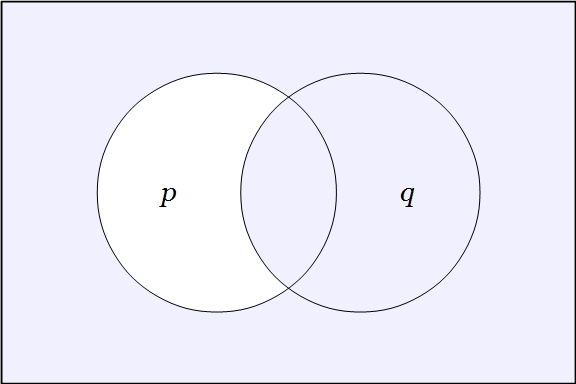
\begin{matrix}  \textsc{xor}(p, q)  & = &  \Delta (p, q)  & = &  p + q  & = &  \nu (p, q)  & = &  \texttt{(} p \texttt{,} q \texttt{)}  \end{matrix}

Minimal Negation \texttt{(} p \texttt{,} q \texttt{)} as Parity Indicator

Generalizing the function p + q of two variables to more variables extends the sequence of functions in the fashion p\!+\!q\!+\!r,  p\!+\!q\!+\!r\!+\!s,  p\!+\!q\!+\!r\!+\!s\!+\!t,  and so on.  These are known as parity sums, returning a value of 0 when there are an even number of 1’s in the sum and returning a value of 1 when there are an odd number of 1’s in the sum.

Minimal Negation \texttt{(} p \texttt{,} q \texttt{)} as Border Indicator

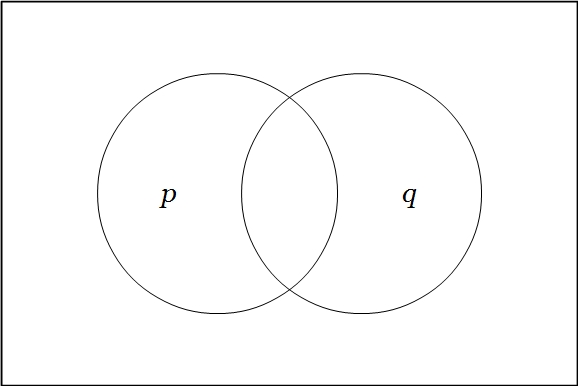
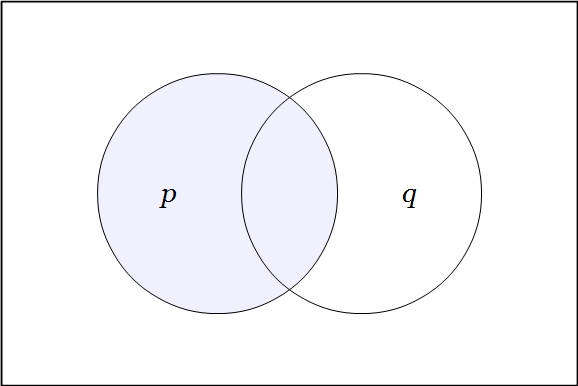
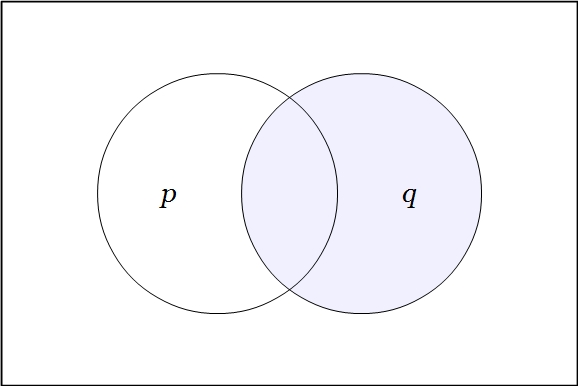
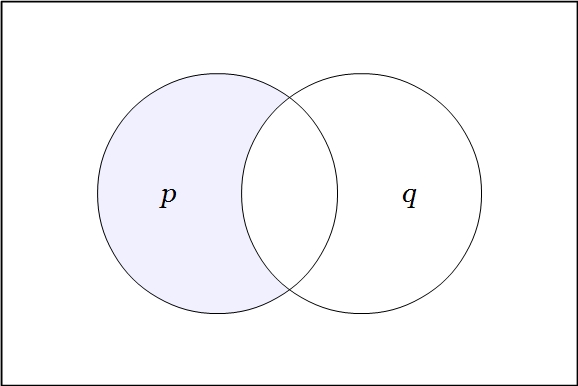
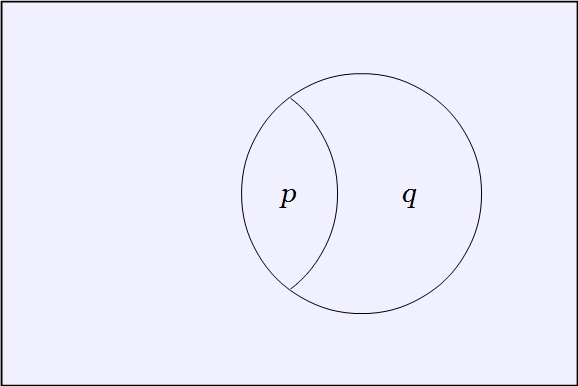
The equivalent expressions \texttt{(} p \texttt{,} q \texttt{)} = \nu(p, q) = p + q = p \,\Delta\, q = p ~\textsc{xor}~ q may be read with a different connotation, indicating the venn diagram cells adjacent to the conjunction p \land q.  Generalizing the function \texttt{(} p \texttt{,} q \texttt{)} of two variables to more variables extends the sequence of functions in the fashion \texttt{(} p \texttt{,} q \texttt{,} r \texttt{)},  \texttt{(} p \texttt{,} q \texttt{,} r \texttt{,} s \texttt{)},  \texttt{(} p \texttt{,} q \texttt{,} r \texttt{,} s \texttt{,} t \texttt{)},  and so on.  That sequence of operators differs from the sequence of parity sums once it passes the 2-variable case.

The triple sum may be written in terms of 2-place minimal negations as follows.

\begin{matrix}  p + q + r  & = &  \texttt{((} p \texttt{,} q \texttt{)}\!\texttt{,} r \texttt{)}  & = &  \texttt{(} p \texttt{,} \texttt{(} q \texttt{,} r \texttt{))}  \end{matrix}

It is important to recognize the triple sum expressions and the 3-place minimal negation \texttt{(} p \texttt{,} q \texttt{,} r \texttt{)} have very different meanings.

Resources

cc: CyberneticsOntolog ForumPeirce ListStructural ModelingSystems Science
cc: FB | Minimal Negation OperatorsLaws of Form

Posted in Amphecks, Animata, Boolean Functions, C.S. Peirce, Cactus Graphs, Differential Logic, Functional Logic, Graph Theory, Laws of Form, Logic, Logical Graphs, Mathematics, Minimal Negation Operators, Painted Cacti, Peirce, Propositional Calculus, Propositional Equation Reasoning Systems, Semiotics, Venn Diagrams, Visualization | Tagged , , , , , , , , , , , , , , , , , , , | 11 Comments

Minimal Negation Operators • 2

Re: Minimal Negation Operators • 1

The brief description of minimal negation operators given in the previous post is enough to convey the rule of their construction.  For future reference, a more formal definition is given below.

Initial Definition

The minimal negation operator \nu is a multigrade operator (\nu_k)_{k \in \mathbb{N}} where each \nu_k is a k-ary boolean function defined by the rule that \nu_k (x_1, \ldots, x_k) = 1 if and only if exactly one of the arguments x_j is 0.

In contexts where the initial letter \nu is understood, minimal negation operators may be indicated by argument lists in parentheses.  In the discussion that follows a distinctive typeface will be used for logical expressions based on minimal negation operators, for example, \texttt{(} x \texttt{,} y \texttt{,} z \texttt{)} = \nu (x, y, z).

The first four members of this family of operators are shown below.  The third and fourth columns give paraphrases in two other notations, where tildes and primes, respectively, indicate logical negation.

Minimal Negation Operators

Resources

cc: CyberneticsOntolog ForumPeirce ListStructural ModelingSystems Science
cc: FB | Minimal Negation OperatorsLaws of Form

Posted in Amphecks, Animata, Boolean Functions, C.S. Peirce, Cactus Graphs, Differential Logic, Functional Logic, Graph Theory, Laws of Form, Logic, Logical Graphs, Mathematics, Minimal Negation Operators, Painted Cacti, Peirce, Propositional Calculus, Propositional Equation Reasoning Systems, Semiotics, Venn Diagrams, Visualization | Tagged , , , , , , , , , , , , , , , , , , , | 11 Comments