Signspiel • 1

Re: Ontolog ForumJohn Sowa

All sorts of players have given us all sorts of spiel about speech acts over the years but Peirce stands out from the chorus in giving us models of semiotic processes whose generation by triadic sign relations allows them to maintain a constant relation among signs, their active interpretants in conduct, and their ultimate pragmata, the objects and objectives of the whole action.  Shy of that, the spielerei of Austin and Wittgenstein simply never gets off the ground.

cc: FB | Semeiotics • Laws of Form • OntologMathstodonAcademia.edu
cc: Conceptual GraphsCyberneticsStructural ModelingSystems Science

Posted in C.S. Peirce, Cybernetics, Logic, Peirce, Pragmatism, Relation Theory, Semiosis, Semiotics, Sign Relations | Tagged , , , , , , , , | 4 Comments

Individuality, Identity, Teridentity • 1

Some problems cannot be solved in the paradigms where they first appear, which is why we keep recurring to them without quite freeing ourselves from the loops in which they ensnare us.  Questions about the supposed uniqueness of supposed individuals and the dyadic relation of identity are as old as the ship of Theseus and the morning and evening star(s) we steer by.

Peirce, of course, took another course …

As fortune has it, I find myself waylaid between bouts of travel, with promises to keep when it comes to Peirce’s information formula, so let me leave this for now with a link to one of the most critical passages in all of Peirce’s explorations:

Selection from C.S. Peirce, “Logic Of Relatives” (1870), CP 3.45–149

93.   In reference to the doctrine of individuals, two distinctions should be borne in mind.  The logical atom, or term not capable of logical division, must be one of which every predicate may be universally affirmed or denied.  For, let \mathrm{A} be such a term.  Then, if it is neither true that all \mathrm{A} is \mathrm{X} nor that no \mathrm{A} is \mathrm{X}, it must be true that some \mathrm{A} is \mathrm{X} and some \mathrm{A} is not \mathrm{X};  and therefore \mathrm{A} may be divided into \mathrm{A} that is \mathrm{X} and \mathrm{A} that is not \mathrm{X}, which is contrary to its nature as a logical atom.

Such a term can be realized neither in thought nor in sense.

Not in sense, because our organs of sense are special — the eye, for example, not immediately informing us of taste, so that an image on the retina is indeterminate in respect to sweetness and non-sweetness.  When I see a thing, I do not see that it is not sweet, nor do I see that it is sweet;  and therefore what I see is capable of logical division into the sweet and the not sweet.  It is customary to assume that visual images are absolutely determinate in respect to color, but even this may be doubted.  I know no facts which prove that there is never the least vagueness in the immediate sensation.

In thought, an absolutely determinate term cannot be realized, because, not being given by sense, such a concept would have to be formed by synthesis, and there would be no end to the synthesis because there is no limit to the number of possible predicates.

A logical atom, then, like a point in space, would involve for its precise determination an endless process.  We can only say, in a general way, that a term, however determinate, may be made more determinate still, but not that it can be made absolutely determinate.  Such a term as “the second Philip of Macedon” is still capable of logical division — into Philip drunk and Philip sober, for example;  but we call it individual because that which is denoted by it is in only one place at one time.  It is a term not absolutely indivisible, but indivisible as long as we neglect differences of time and the differences which accompany them.  Such differences we habitually disregard in the logical division of substances.  In the division of relations, etc., we do not, of course, disregard these differences, but we disregard some others.  There is nothing to prevent almost any sort of difference from being conventionally neglected in some discourse, and if I be a term which in consequence of such neglect becomes indivisible in that discourse, we have in that discourse,

[I] = 1.

This distinction between the absolutely indivisible and that which is one in number from a particular point of view is shadowed forth in the two words individual (τὸ ἄτομον) and singular (τὸ καθ᾿ ἕκαστον);  but as those who have used the word individual have not been aware that absolute individuality is merely ideal, it has come to be used in a more general sense.

Note

Peirce explains his use of the square bracket notation at CP 3.65.

I propose to denote the number of a logical term by enclosing the term in square brackets, thus, [t].

The number of an absolute term, as in the case of I, is defined as the number of individuals it denotes.

References

  • Peirce, C.S. (1870), “Description of a Notation for the Logic of Relatives, Resulting from an Amplification of the Conceptions of Boole’s Calculus of Logic”, Memoirs of the American Academy of Arts and Sciences 9, 317–378, 26 January 1870.  Reprinted, Collected Papers 3.45–149, Chronological Edition 2, 359–429.  Online (1) (2) (3).
  • Peirce, C.S., Collected Papers of Charles Sanders Peirce, vols. 1–6, Charles Hartshorne and Paul Weiss (eds.), vols. 7–8, Arthur W. Burks (ed.), Harvard University Press, Cambridge, MA, 1931–1935, 1958.
  • Peirce, C.S., Writings of Charles S. Peirce : A Chronological Edition, Peirce Edition Project (eds.), Indiana University Press, Bloomington and Indianapolis, IN, 1981–.

Resources

cc: Ontolog ForumStructural ModelingSystems Science

Posted in C.S. Peirce, Doctrine of Individuals, Icon Index Symbol, Identity, Individuality, Individuals, Logic, Logic of Relatives, Logical Atoms, Mathematics, Peirce, Relation Theory, Semiotics, Sign Relations, Teridentity, Triadic Relations | Tagged , , , , , , , , , , , , , , , | Leave a comment

{ Information = Comprehension × Extension } • Discussion 17

Re: Ontolog ForumJoseph Simpson

We are in the middle of trying to work out what Peirce has in mind with his concept of information.  He appears to have developed it from purely logical considerations — if logic can remain “pure” in applying itself to experience — and he thinks it solves “the puzzle of the validity of scientific inference”.

I am going, next, to show that inference is symbolization and that the puzzle of the validity of scientific inference lies merely in this superfluous comprehension and is therefore entirely removed by a consideration of the laws of information.

(Peirce 1866, p. 467)

We will eventually come to the task of seeing how a theory of information born in that environment relates to concepts of information in common use today, sprouted as they were from the needs of telegraph operators to detect and correct errors of transmission through noisy channels of communication.

As I see it, Peirce’s concept of information is potentially deeper and more general than concepts of information based on quantitative measures of probability and quantifiable statistics of messages.  That is possible because the qualitative properties of spaces studied in topology are deeper and more general than the quantitative properties of spaces bearing real‑valued measures.

All in good time, though.  We have a ways to go in understanding Peirce’s idea before we can say how the two paradigms compare.

References

  • Peirce, C.S. (1866), “The Logic of Science, or, Induction and Hypothesis”, Lowell Lectures of 1866, pp. 357–504 in Writings of Charles S. Peirce : A Chronological Edition, Volume 1, 1857–1866, Peirce Edition Project, Indiana University Press, Bloomington, IN, 1982.
  • Peirce, C.S. (1867), “Upon Logical Comprehension and Extension”, Proceedings of the American Academy of Arts and Sciences, Vol. 7, pp. 416–432.  ArchiveOnline.

Resources

cc: CyberneticsOntolog ForumStructural ModelingSystems Science

Posted in Abduction, C.S. Peirce, Comprehension, Deduction, Extension, Hypothesis, Icon Index Symbol, Induction, Inference, Information = Comprehension × Extension, Information Theory, Inquiry, Intension, Logic, Logic of Science, Peirce, Peirce's Categories, Pragmatic Semiotic Information, Pragmatism, Scientific Method, Semiotics, Sign Relations | Tagged , , , , , , , , , , , , , , , , , , , , , | 9 Comments

{ Information = Comprehension × Extension } • Discussion 16

Re: Ontolog ForumJoseph Simpson

To understand the purpose of Peirce’s lecture hall illustrations I think we need to consider how these sorts of expository examples come into being.  Having crafted a few myself the technique is much like the Art of the Story Problem I remember from my days teaching math.  We have a universe of discourse circumscribed by a particular subject matter, say linear algebra, plane geometry, the quadratic formula, or the like, and we have a set of methods that work well enough in that context to recommend their use to others.  The methods themselves have been abstracted and formalized over the years, if not millennia, to the point of being detached from everyday life and potential practice, so we flesh them out with names and local habitations and narrative figures designed to tutor nature — or at least the students thereof.

The main thing we want from our stock examples and story problems is to show how it’s possible to bring a body of abstract ideas to bear on ordinary practical affairs.  We are thus reversing to a degree the process by which a formalized subject matter is abstracted from a host of concrete situations, but only to a degree, as dredging up the mass of adventitious and conflicting details would be too distracting.  Instead we stipulate a hypothetical state of affairs whose concrete structure falls under the class of ideal structures studied in our formal subject matter.

Reference

  • Peirce, C.S. (1866), “The Logic of Science, or, Induction and Hypothesis”, Lowell Lectures of 1866, pp. 357–504 in Writings of Charles S. Peirce : A Chronological Edition, Volume 1, 1857–1866, Peirce Edition Project, Indiana University Press, Bloomington, IN, 1982.

Resources

cc: CyberneticsOntolog ForumStructural ModelingSystems Science

Posted in Abduction, C.S. Peirce, Comprehension, Deduction, Extension, Hypothesis, Icon Index Symbol, Induction, Inference, Information = Comprehension × Extension, Information Theory, Inquiry, Intension, Logic, Logic of Science, Peirce, Peirce's Categories, Pragmatic Semiotic Information, Pragmatism, Scientific Method, Semiotics, Sign Relations | Tagged , , , , , , , , , , , , , , , , , , , , , | 9 Comments

{ Information = Comprehension × Extension } • Discussion 15

I am roughly at the halfway point of my comments on Peirce’s information formula, having just finished up the link between abductive inference and iconic reference.  The discussion of induction and indexicals will follow pretty much the same pattern, though there are a few wrinkles having to do with a number of interesting differences between Peirce’s early and later accounts of indices.

The rest of this post is slightly tangent to the topic at hand, but I couldn’t resist saying a few more words about the duality of information and control once other discussions brought the issue to mind.

Viewing systems topics like change, control, dynamics, goals, objectives, optimization, process, purpose and so on in the light of the information dimension opens up a wide field of investigation.  It’s been my custom to cultivate that field layer by layer, working up from the most basic layer with a modicum of utility, namely, propositional calculus.  This is the layer of qualitative description underlying every layer of quantitative description.

Propositional calculus is the level of logic we’ve been using in our present discussion to describe various classes of entities populating a given universe of discourse.  Whether we call the corresponding descriptors predicates, propositions, or terms is of no importance for present purposes so long as we are using them solely as symbols in a symbolic calculus following a specific set of rules.

Extending the layer of propositional calculus from its coverage of static situations to the description of time-evolving states can be done fairly easily.  One follows the model of physics, where dealing with change made little progress until the development of differential calculus.  The analogous medium at the logical level is the differential extension of propositional calculus, or “differential propositional calculus”, for short.  See the following resource for a gentle introduction.

Reference

  • Peirce, C.S. (1866), “The Logic of Science, or, Induction and Hypothesis”, Lowell Lectures of 1866, pp. 357–504 in Writings of Charles S. Peirce : A Chronological Edition, Volume 1, 1857–1866, Peirce Edition Project, Indiana University Press, Bloomington, IN, 1982.

Resources

cc: CyberneticsOntolog ForumStructural ModelingSystems Science

Posted in Abduction, C.S. Peirce, Comprehension, Deduction, Extension, Hypothesis, Icon Index Symbol, Induction, Inference, Information = Comprehension × Extension, Information Theory, Inquiry, Intension, Logic, Logic of Science, Peirce, Peirce's Categories, Pragmatic Semiotic Information, Pragmatism, Scientific Method, Semiotics, Sign Relations | Tagged , , , , , , , , , , , , , , , , , , , , , | 9 Comments

{ Information = Comprehension × Extension } • Discussion 14

Re: Ontolog ForumBruce Schuman

Information and optimization go hand in hand — discovering the laws or constraints naturally governing the systems in which we live is a big part of moving toward our hearts’ desires within them.  I’m engaged in trying to clear up a few old puzzles about information at present but the dual relationship of information and control in cybernetic systems is never far from my mind.  At any rate, here’s a sampling of thoughts along those lines I thought I might add to the mix.

Resources

cc: CyberneticsOntolog ForumStructural ModelingSystems Science

Posted in Abduction, Analogy, C.S. Peirce, Comprehension, Cybernetics, Deduction, Extension, Icon Index Symbol, Induction, Inference, Information = Comprehension × Extension, Information Theory, Inquiry, Intension, Logic, Logic of Science, Optimal Control, Optimization, Pragmatic Semiotic Information, Representation, Scientific Method, Semiotics, Sign Relations, Triadicity | Tagged , , , , , , , , , , , , , , , , , , , , , , , | 9 Comments

{ Information = Comprehension × Extension } • Discussion 13

Re: Deborah G. MayoR.A. Fisher: “Statistical Methods and Scientific Induction”

As much as I incline toward Fisher’s views over those of Neyman and Pearson, I always find these controversies driving me back to Peirce.  It’s my personal sense there’s no chance (or hope) of resolving the issues until we get clear about the distinct roles of abductive, deductive, and inductive inference and quit confounding abduction and induction the way mainstream statistics has always done.

Resources

cc: CyberneticsOntolog ForumStructural ModelingSystems Science

Posted in Abduction, C.S. Peirce, Comprehension, Deduction, Extension, Hypothesis, Icon Index Symbol, Induction, Inference, Information = Comprehension × Extension, Information Theory, Inquiry, Intension, Logic, Logic of Science, Peirce, Peirce's Categories, Pragmatic Semiotic Information, Pragmatism, Scientific Method, Semiotics, Sign Relations | Tagged , , , , , , , , , , , , , , , , , , , , , | 9 Comments

{ Information = Comprehension × Extension } Revisited • Comment 5

Let’s stay with Peirce’s example of abductive inference a little longer and try to clear up the more troublesome confusions that tend to arise.

Figure 1 shows the implication ordering of logical terms in the form of a lattice diagram.

Figure 1. Conjunctive Term z, Taken as Predicate

Figure 1. Conjunctive Term z, Taken as Predicate

One thing needs to be stressed at this point.  It is important to recognize the conjunctive term itself — namely, the syntactic string “spherical bright fragrant juicy tropical fruit” — is not an icon but a symbol.  It has its place in a formal system of symbols, for example, a propositional calculus, where it would normally be interpreted as a logical conjunction of six elementary propositions, denoting anything in the universe of discourse with all six of the corresponding properties.  The symbol denotes objects which may be taken as icons of oranges by virtue of their bearing those six properties in common with oranges.  But there are no objects denoted by the symbol which aren’t already oranges themselves.  Thus we observe a natural reduction in the denotation of the symbol, consisting in the absence of cases outside of oranges which have all the properties indicated.

The above analysis provides another way to understand the abductive inference from the Fact x \Rightarrow z and the Rule y \Rightarrow z to the Case x \Rightarrow y.  The lack of any cases which are z and not y is expressed by the implication z \Rightarrow y.  Taking this together with the Rule y \Rightarrow z gives the logical equivalence y = z.  But this reduces the Case x \Rightarrow y to the Fact x \Rightarrow z and so the Case is justified.

Viewed in the light of the above analysis, Peirce’s example of abductive reasoning exhibits an especially strong form of inference, almost deductive in character.  Do all abductive arguments take this form, or may there be weaker styles of abductive reasoning which enjoy their own levels of plausibility?  That must remain an open question at this point.

Reference

  • Peirce, C.S. (1866), “The Logic of Science, or, Induction and Hypothesis”, Lowell Lectures of 1866, pp. 357–504 in Writings of Charles S. Peirce : A Chronological Edition, Volume 1, 1857–1866, Peirce Edition Project, Indiana University Press, Bloomington, IN, 1982.

Resources

cc: CyberneticsOntolog ForumStructural ModelingSystems Science

Posted in Abduction, C.S. Peirce, Comprehension, Deduction, Extension, Hypothesis, Icon Index Symbol, Induction, Inference, Information = Comprehension × Extension, Information Theory, Inquiry, Intension, Logic, Logic of Science, Peirce, Peirce's Categories, Pragmatic Semiotic Information, Pragmatism, Scientific Method, Semiotics, Sign Relations | Tagged , , , , , , , , , , , , , , , , , , , , , | 9 Comments

{ Information = Comprehension × Extension } Revisited • Comment 4

Many things still puzzle me about Peirce’s account at this point.  I indicated a few of them by means of question marks at several places in the last two Figures.  There is nothing for it but returning to the text and trying once more to follow the reasoning.

Let’s go back to Peirce’s example of abductive inference and try to get a clearer picture of why he connects it with conjunctive terms and iconic signs.

Figure 1 shows the implication ordering of logical terms in the form of a lattice diagram.

Figure 1. Conjunctive Term z, Taken as Predicate

Figure 1. Conjunctive Term z, Taken as Predicate

The relationship between conjunctive terms and iconic signs may be understood as follows.  If there is anything with all the properties described by the conjunctive term — spherical bright fragrant juicy tropical fruit — then sign users may use that thing as an icon of an orange, precisely by virtue of the fact it shares those properties with an orange.  But the only natural examples of things with all those properties are oranges themselves, so the only thing qualified to serve as a natural icon of an orange by virtue of those very properties is that orange itself or another orange.

Reference

  • Peirce, C.S. (1866), “The Logic of Science, or, Induction and Hypothesis”, Lowell Lectures of 1866, pp. 357–504 in Writings of Charles S. Peirce : A Chronological Edition, Volume 1, 1857–1866, Peirce Edition Project, Indiana University Press, Bloomington, IN, 1982.

Resources

cc: CyberneticsOntolog ForumStructural ModelingSystems Science

Posted in Abduction, C.S. Peirce, Comprehension, Deduction, Extension, Hypothesis, Icon Index Symbol, Induction, Inference, Information = Comprehension × Extension, Information Theory, Inquiry, Intension, Logic, Logic of Science, Peirce, Peirce's Categories, Pragmatic Semiotic Information, Pragmatism, Scientific Method, Semiotics, Sign Relations | Tagged , , , , , , , , , , , , , , , , , , , , , | 9 Comments

{ Information = Comprehension × Extension } Revisited • Comment 3

Peirce identifies inference with a process he describes as symbolization.  Let us consider what that might imply.

I am going, next, to show that inference is symbolization and that the puzzle of the validity of scientific inference lies merely in this superfluous comprehension and is therefore entirely removed by a consideration of the laws of information(467).

Even if it were only a rough analogy between inference and symbolization, a principle of logical continuity, what is known in physics as a correspondence principle, would suggest parallels between steps of reasoning in the neighborhood of exact inferences and signs in the vicinity of genuine symbols.  This would lead us to expect a correspondence between degrees of inference and degrees of symbolization extending from exact to approximate (non-demonstrative) inferences and from genuine to approximate (degenerate) symbols.

For this purpose, I must call your attention to the differences there are in the manner in which different representations stand for their objects.

In the first place there are likenesses or copies — such as statues, pictures, emblems, hieroglyphics, and the like.  Such representations stand for their objects only so far as they have an actual resemblance to them — that is agree with them in some characters.  The peculiarity of such representations is that they do not determine their objects — they stand for anything more or less;  for they stand for whatever they resemble and they resemble everything more or less.

The second kind of representations are such as are set up by a convention of men or a decree of God.  Such are tallies, proper names, &c.  The peculiarity of these conventional signs is that they represent no character of their objects.

Likenesses denote nothing in particular;  conventional signs connote nothing in particular.

The third and last kind of representations are symbols or general representations.  They connote attributes and so connote them as to determine what they denote.  To this class belong all words and all conceptions.  Most combinations of words are also symbols.  A proposition, an argument, even a whole book may be, and should be, a single symbol.  (467–468).

In addition to Aristotle, the influence of Kant on Peirce is very strongly marked in these earliest expositions.  The invocations of “conceptions of the understanding”, the “use of concepts” and thus of symbols in reducing the manifold of extension, and the not so subtle hint of the synthetic à priori in Peirce’s discussion, not only of natural kinds but also of the kinds of signs leading up to genuine symbols, can all be recognized as pervasive Kantian themes.

In order to draw out these themes and see how Peirce was led to develop their leading ideas, let us bring together our previous Figures, abstracting from their concrete details, and see if we can figure out what is going on.

Figure 3 shows an abductive step of inquiry, as taken on the cue of an iconic sign.
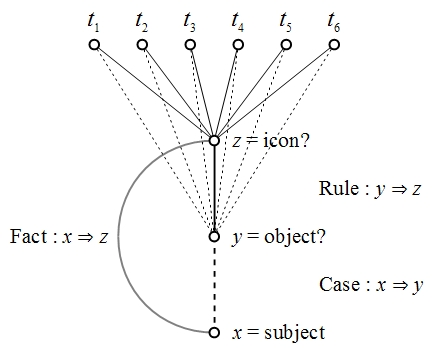
Figure 3. Conjunctive Predicate z, Abduction of Case x ⇒ y

Figure 3. Conjunctive Predicate z, Abduction of Case xy

Figure 4 shows an inductive step of inquiry, as taken on the cue of an indicial sign.
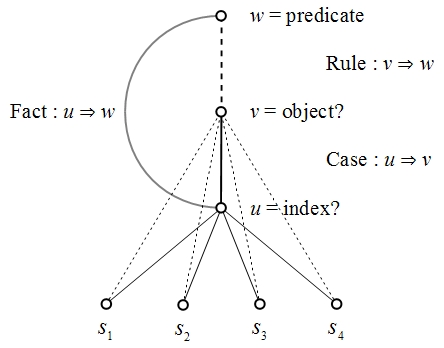
Figure 4. Disjunctive Subject u, Induction of Rule v ⇒ w

Figure 4. Disjunctive Subject u, Induction of Rule vw

To be continued …

Reference

  • Peirce, C.S. (1866), “The Logic of Science, or, Induction and Hypothesis”, Lowell Lectures of 1866, pp. 357–504 in Writings of Charles S. Peirce : A Chronological Edition, Volume 1, 1857–1866, Peirce Edition Project, Indiana University Press, Bloomington, IN, 1982.

Resources

cc: CyberneticsOntolog ForumStructural ModelingSystems Science

Posted in Abduction, C.S. Peirce, Comprehension, Deduction, Extension, Hypothesis, Icon Index Symbol, Induction, Inference, Information = Comprehension × Extension, Information Theory, Inquiry, Intension, Logic, Logic of Science, Peirce, Peirce's Categories, Pragmatic Semiotic Information, Pragmatism, Scientific Method, Semiotics, Sign Relations | Tagged , , , , , , , , , , , , , , , , , , , , , | 11 Comments
