
Cybernetics • Requisite Variety • Selection 11

Ashby now takes a few steps back from the picture of regulation in biological systems, setting out the framework he needs for a broader perspective on regulation in general.

Requisite Variety

11/1.   In the previous chapter we considered regulation from the biological point of view, taking it as something sufficiently well understood.  In this chapter we shall examine the process of regulation itself, with the aim of finding out exactly what is involved and implied.  In particular we shall develop ways of measuring the amount or degree of regulation achieved, and we shall show that this amount has an upper limit.

11/2.   The subject of regulation is very wide in its applications, covering as it does most of the activities in physiology, sociology, ecology, economics, and much of the activities in almost every branch of science and life.  Further, the types of regulator that exist are almost bewildering in their variety.  One way of treating the subject would be to deal seriatim with the various types;  and chapter 12 will, in fact, indicate them.  In this chapter, however, we shall be attempting to get at the core of the subject — to find what is common to all.

What is common to all regulators, however, is not, at first sight, much like any particular form.  We will therefore start anew in the next section, making no explicit reference to what has gone before.  Only after the new subject has been sufficiently developed will we begin to consider any relation it may have to regulation.

Reference

  • Ashby, W.R. (1956), An Introduction to Cybernetics, Chapman and Hall, London, UK.  Republished by Methuen and Company, London, UK, 1964.  Online.

cc: Cybernetics • Ontolog Forum • Structural Modeling • Systems Science
Posted in Adaptive Systems, Ashby, C.S. Peirce, Communication, Control, Cybernetics, Evolution, Information, Inquiry Driven Systems, Learning, Logic, Mathematics, Peirce, Purpose, Regulation, Survival, Truth Theory, W. Ross Ashby | Tagged , , , , , , , , , , , , , , , , , | 6 Comments

Cybernetics • Regulation In Biological Systems • Selection 10

Regulation In Biological Systems

Survival

Ashby Cybernetics Figure 10.5.2

10/7.[concl.]   When considering this second form [of defence] we should be careful to notice the part played by information and variety in the process.  The fencer must watch his opponent closely, and he must gain information in all ways possible if he is to survive.  For this purpose he is born with eyes, and for this purpose he learns how to use them.  Nevertheless, the end result of this skill, if successful, is shown by his essential variables, such as his blood-volume, remaining within normal limits, much as if the duel had not occurred.  Information flows freely to the non-essential variables, but the variety in the distinction “duel or no-duel” has been prevented from reaching the essential variables.

Through the remaining chapters we shall be considering this type of active defence, asking such questions as:  what principles must govern it?  What mechanisms can achieve it?  And, what is to be done when the regulation is very difficult?

Reference

  • Ashby, W.R. (1956), An Introduction to Cybernetics, Chapman and Hall, London, UK.  Republished by Methuen and Company, London, UK, 1964.  Online.

cc: Cybernetics • Ontolog (1) (2) • Structural Modeling (1) (2) • Systems Science (1) (2)

Posted in Adaptive Systems, Ashby, C.S. Peirce, Communication, Control, Cybernetics, Evolution, Information, Inquiry Driven Systems, Learning, Logic, Mathematics, Peirce, Purpose, Regulation, Survival, Truth Theory, W. Ross Ashby | Tagged , , , , , , , , , , , , , , , , , | 6 Comments

Cybernetics • Regulation In Biological Systems • Selection 9

Studies of intelligent systems, natural or artificial, tend to focus on dynamic models or symbolic models, rarely both, finding it difficult to integrate the two.  But here we are asking the synthetic question — How does a cybernetic system come to develop semiotic systems, mediated both internally and externally, capable of bearing the information it needs to survive and achieve its other objectives?

With that in mind, let’s return to Ashby’s text, picking up the argument where he underscores his thesis up to this point and continuing from there.

Regulation In Biological Systems

Survival

Ashby Cybernetics Figure 10.5.2

10/6.[concl.]   In general, then, an essential feature of the good regulator is that it blocks the flow of variety from disturbances to essential variables.

10/7.   The blocking may take place in a variety of ways, which prove, however, on closer examination to be fundamentally the same.  Two extreme forms will illustrate the range.

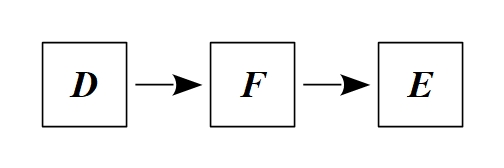
One way of blocking the flow (from the source of disturbance D to the essential variable E\,) is to interpose something that acts as a simple passive block to the disturbances.  Such is the tortoise’s shell, which reduces a variety of impacts, blows, bites, etc. to a negligible disturbance of the sensitive tissues within.  In the same class are the tree’s bark, the seal’s coat of blubber, and the human skull.

At the other extreme from this static defence is the defence by skilled counter-action — the defence that gets information about the disturbance to come, prepares for its arrival, and then meets the disturbance, which may be complex and mobile, with a defence that is equally complex and mobile.  This is the defence of the fencer, in some deadly duel, who wears no armour and who trusts to his skill in parrying.  This is the defence used mostly by the higher organisms, who have developed a nervous system precisely for the carrying out of this method.

Reference

  • Ashby, W.R. (1956), An Introduction to Cybernetics, Chapman and Hall, London, UK.  Republished by Methuen and Company, London, UK, 1964.  Online.

cc: Cybernetics • Ontolog (1) (2) • Structural Modeling (1) (2) • Systems Science (1) (2)

Posted in Adaptive Systems, Ashby, C.S. Peirce, Communication, Control, Cybernetics, Evolution, Information, Inquiry Driven Systems, Learning, Logic, Mathematics, Peirce, Purpose, Regulation, Survival, Truth Theory, W. Ross Ashby | Tagged , , , , , , , , , , , , , , , , , | 6 Comments

Cybernetics • Regulation In Biological Systems • Discussion 4

Re: Systems Science (1) (2) • Jack Ring

JR:
I share your appreciation of Ashby’s work.  However it seems to reflect the deductive approach typical of males as contrasted to the inductive approach typical of females.  Make sense?

A tutorial introduction to a scientific subject is necessarily bound by considerations both rhetorical and logical.

  • Rhetoric, classically speaking, concerns those forms of argument which consider the audience, that is, which take into account the receiver’s operating characteristics and prior state of information.
  • Logic, especially the “Logic of Science” conceived in a line of thinking from Aristotle through C.S. Peirce, requires abductive as well as deductive and inductive reasoning and divides their duties in a different way than dualist accounts of scientific inference.

The following project report contains more information about the triadic model of scientific inquiry.

Reference

  • Ashby, W.R. (1956), An Introduction to Cybernetics, Chapman and Hall, London, UK.  Republished by Methuen and Company, London, UK, 1964.  Online.

cc: Cybernetics • Ontolog (1) (2) • Structural Modeling (1) (2) • Systems Science (1) (2)

Posted in Adaptive Systems, Ashby, C.S. Peirce, Communication, Control, Cybernetics, Evolution, Information, Inquiry Driven Systems, Learning, Logic, Mathematics, Peirce, Purpose, Regulation, Survival, Truth Theory, W. Ross Ashby | Tagged , , , , , , , , , , , , , , , , , | 6 Comments

History, Its Arc, Its Tangents • 2

Re: Renaissance Mathematicus • Both Sides of History

Are there watersheds in the history of science?  A continental divide between basins of right and wrong ideas?  I was pondering these questions when one of my favorite passages from Leibniz came to mind.

The Present Is Big With The Future

Now that I have proved sufficiently that everything comes to pass according to determinate reasons, there cannot be any more difficulty over these principles of God’s foreknowledge.  Although these determinations do not compel, they cannot but be certain, and they foreshadow what shall happen.

It is true that God sees all at once the whole sequence of this universe, when he chooses it, and that thus he has no need of the connexion of effects and causes in order to foresee these effects.  But since his wisdom causes him to choose a sequence in perfect connexion, he cannot but see one part of the sequence in the other.

It is one of the rules of my system of general harmony, that the present is big with the future, and that he who sees all sees in that which is that which shall be.

What is more, I have proved conclusively that God sees in each portion of the universe the whole universe, owing to the perfect connexion of things.  He is infinitely more discerning than Pythagoras, who judged the height of Hercules by the size of his footprint.  There must therefore be no doubt that effects follow their causes determinately, in spite of contingency and even of freedom, which nevertheless exist together with certainty or determination.

Right or wrong side of history?

On the one hand it envisions a thoroughgoing determinism.  On the other hand it foreshadows latter-day ideas about a holographic universe.  And it does all this while laying out its own theory of history, whose core idea is the germ of the differential calculus.

Reference

Gottfried Wilhelm (Freiherr von) Leibniz, Theodicy : Essays on the Goodness of God, the Freedom of Man, and the Origin of Evil, edited with an introduction by Austin Farrer, translated by E.M. Huggard from C.J. Gerhardt’s edition of the Collected Philosophical Works, 1875–1890.  Routledge 1951.  Open Court 1985.  Paragraph 360, page 341.

cc: Cybernetics • Ontolog Forum • Structural Modeling • Systems Science

Posted in Differential Calculus, History of Science, Hologrammautomaton, Leibniz, Thony Christie | Tagged , , , , | Leave a comment

Higher Order Sign Relations • Discussion 2

Re: Ontolog Forum • Joseph Simpson
Re: Relations, Types, Functions

JA:
The subject matters of relations, types, and functions enjoy a form of recursive involvement with one another which makes it difficult to know where to get on and where to get off the circle of explanation.  As I currently understand their relationship, it can be approached in the following order.

  • Relations have types.
  • Types are functions.
  • Functions are relations.

In this setting, a type is a function from the places of a relation, that is, from the index set of its components, to a collection of sets known as the domains of the relation.

My 3-basket mantra recited above harks back to the mid 1980s when I took a course on Applications of Lambda Calculus from John Gray at Illinois.  It was all about categories, combinators, and computation, focusing especially on Cartesian Closed Categories, one of the hot topics of the day.  We had a packet of readings from the classic sources and used J. Lambek and P.J. Scott’s Introduction to Higher Order Categorical Logic as our main text.  I followed that up with a supervised independent study where I explored various themes of my own.

The directions I pursued and continue to explore all have to do with mutating category theory just far enough to encompass Peirce’s 3-eyed vision in a more natural fashion.

I’ll make that more explicit when I next get a chance.

cc: Conceptual Graphs • Cybernetics • Laws of Form • Ontolog Forum
cc: FB | Inquiry Driven Systems • Structural Modeling • Systems Science

Posted in C.S. Peirce, Gödel Numbers, Higher Order Sign Relations, Inquiry, Inquiry Driven Systems, Inquiry Into Inquiry, Logic, Peirce, Quotation, Reflection, Reflective Interpretive Frameworks, Semiotics, Sign Relations, Triadic Relations | Tagged , , , , , , , , , , , , , | 15 Comments

Theory and Therapy of Representations • 4

Re: Theory and Therapy of Representations • 3
Re: Ontolog Forum • Paola Di Maio

JA:
What are the forces distorting our representations of what’s observed, what’s expected, and what’s intended?
PDM:
The short answer is …. the force behind all distortions is our own unenlightened mind, and all the shortfalls this comes with.

I think that’s true, we have to keep reflecting on the state of our personal enlightenments.  If we can do that without losing our heads and our systems thinking caps, there will be much we can do to promote the general Enlightenment of the State.

On both personal and general grounds we have a stake in the projects of self‑governing systems — whether it is possible for them to exist and what it takes for them to thrive in given environments.  Systems on that order have of course been studied from many points of view and at many levels of organization.  Whether we address them under the names of adaptive, cybernetic, error-correcting, intelligent, or optimal control systems they all must be capable to some degree of learning, reasoning, and self‑guidance.

Resources

cc: Conceptual Graphs • Cybernetics • Laws of Form • Ontolog Forum
cc: FB | Cybernetics • Structural Modeling • Systems Science

Posted in Cybernetics, Democracy, Economics, Education, Expectation, Governance, Information, Inquiry, Intention, Justice, Law, Logic, Observation, Plato, Representation, Science, Semiosis, Semiotics, Society, Statistics, Virtue | Tagged , , , , , , , , , , , , , , , , , , , , | 1 Comment

Theory and Therapy of Representations • 3

Representation is a concept we find at the intersection of cybernetics, epistemology, logic, mathematics, psychology, and sociology.  In my studies it led me from math to psych and back again, with sidelong glances at the history of democratic governance.  Its time come round again, I find myself returning to the scenes of two recurring questions.

Scene 1.  Pragmatic Theory Of Truth • 18

We do not live in axiom systems.  We do not live encased in languages, formal or natural.  There is no reason to think we will ever have exact and exhaustive theories of what’s out there, and the truth, as we know, is “out there”.  Peirce understood there are more truths in mathematics than are dreamt of in logic — and Gödel’s realism should have put the last nail in the coffin of logicism — but some ways of thinking just never get a clue.

That brings us to Question 1 —

  • What are formalisms and all their embodiments in brains and computers good for?

Scene 2.  Theory and Therapy of Representations • 1

Statistics were originally the data a ship of state needed for stationkeeping and staying on course.  The Founders of the United States, like the Cybernauts of the Enlightenment they were, engineered a ship of state with checks and ballasts and error-controlled feedbacks for the sake of representing both reality and the will of the people.  In that connection Max Weber saw how a state’s accounting systems were intended as representations of realities its crew and passengers must observe or perish.

That brings us to Question 2 —

  • What are the forces distorting our representations of what’s observed, what’s expected, and what’s intended?

Resources

cc: Conceptual Graphs • Cybernetics • Laws of Form • Ontolog Forum
cc: FB | Cybernetics • Structural Modeling • Systems Science

Posted in Cybernetics, Democracy, Economics, Education, Expectation, Governance, Information, Inquiry, Intention, Justice, Law, Logic, Observation, Plato, Representation, Science, Semiosis, Semiotics, Society, Statistics, Virtue | Tagged , , , , , , , , , , , , , , , , , , , , | 2 Comments

History, Its Arc, Its Tangents • 1

Re: Renaissance Mathematicus • Both Sides of History

I do not pretend to understand the moral universe;
the arc is a long one, my eye reaches but little ways;
I cannot calculate the curve and complete the figure by
the experience of sight;  I can divine it by conscience.
And from what I see I am sure it bends towards justice.

🙞 Theodore Parker

I think we are dealing with the scientific analogue of the moral figure above.  To inquire is to act as if inquiry pursued far enough will end in truth.  It’s a regulative principle, not a dogma, but a regulative principle is akin to a leap of faith.  Here we have a parting of the ways between those who think the end is near what we think we already know and those who think it’s more likely further down the road.  The two camps sort past and present ideas according to each one’s guess what the future holds.

cc: Cybernetics • Ontolog Forum • Peirce List • Structural Modeling • Systems Science
cc: FB | Inquiry Driven Systems • Laws of Form

Posted in History of Science, Inquiry, Mathematics, Science, Theodore Parker, Thony Christie | Tagged , , , , , | 1 Comment

Pragmatic Truth • Discussion 19

Going over the last few month’s posts about signs, systems, and theories of truth I see many unanswered questions deserving of further attention.  Seasonal diversions being what they are my mind will be elsewhere the rest of the year so I’ve put together a list of topics for future work.

cc: Cybernetics • Ontolog Forum • Structural Modeling • Systems Science

Posted in Aristotle, C.S. Peirce, Coherence, Concordance, Congruence, Consensus, Convergence, Correspondence, Dewey, Fixation of Belief, Information, Inquiry, John Dewey, Kant, Logic, Logic of Science, Method, Peirce, Philosophy, Pragmatic Maxim, Pragmatism, Semiotics, Sign Relations, Triadic Relations, Truth, Truth Theory, William James | Tagged , , , , , , , , , , , , , , , , , , , , , , , , , , | 5 Comments