- Anthesis • Definition • Signs and Inquiry • Examples
- Dyadic Aspects • Denotation • Connotation • Ennotation
- Semiotic Equivalence Relations • (1) • (2)
Re: Cybernetics • Klaus Krippendorff • Bernard Scott
Re: Ontolog • Mihai Nadin • John Sowa • Alex Shkotin
Re: Peirce List • Helmut Raulien • Edwina Taborsky
While engaged in a number of real and imaginary dialogues with people I continue to owe full replies, I thought it might be a good time to stand back and take in the view from this vantage point. I summed up the desired outlook a few days ago in the following way.
The important thing now is to extend our perspective beyond one sign at a time and one object, sign, interpretant at a time to comprehending a sign relation as a specified set of object, sign, interpretant triples embedded in the set of all possible triples in a specified context.
If we now comprehend each sign relation 


Once we adopt a whole systems perspective on sign relations we begin to see many commonplace topics in a fresh light.
Agency
That Peirce remodels his theory of semiosis from speaking of interpretive agents to speaking of interpretant signs is a familiar theme by now. By way of reminder, we discussed this transformation recently in Discussion 4 and Discussion 5 of this series.
But we have to wonder: Why does Peirce make this shift, this change of basis from interpreters to interpretants? He does this because the idea of an interpreter stands in need of clarification and his method for clarifying ideas is to apply the pragmatic maxim. The result is an operational definition of an interpreter in terms of its effects on signs in relation to their objects.
It would seem we have replaced an interpreter with a sign relation. To be more precise, we are taking a sign relation as our effective model for the interpreter in question. But we must not take this the wrong way. There is no suggestion of reducing the hypostatic agent to a sign relation. It falls within our capacity merely to clarify our concept of the agent to a moderate degree, to construct a model or a representation capturing aspects of the agent’s activity bearing on a particular application.
With that I’ve run out of time for today. The topic for next time will be Context …
References
- Peirce, C.S. (1902), “Parts of Carnegie Application” (L 75), in Carolyn Eisele (ed., 1976), The New Elements of Mathematics by Charles S. Peirce, vol. 4, 13–73. Online.
- Awbrey, J.L., and Awbrey, S.M. (1995), “Interpretation as Action : The Risk of Inquiry”, Inquiry : Critical Thinking Across the Disciplines 15(1), pp. 40–52. Archive. Journal. Online.
Resources
cc: Cybernetics • Ontolog • Peirce List (1) (2) • Structural Modeling • Systems Science
 is an equivalence relation on a set
  then every element
  of
of ![[x]_E](https://s0.wp.com/latex.php?latex=%5Bx%5D_E&bg=ffffff&fg=000000&s=0&c=20201002) or the simpler form
or the simpler form ![[x]](https://s0.wp.com/latex.php?latex=%5Bx%5D&bg=ffffff&fg=000000&s=0&c=20201002) when the subscript
when the subscript  are equivalent under
 ![\begin{array}{clc} (x, y) & \in & E \\[4pt] x & \in & [y]_E \\[4pt] y & \in & [x]_E \\[4pt] [x]_E & = & [y]_E \\[4pt] x & =_E & y \end{array}](https://s0.wp.com/latex.php?latex=%5Cbegin%7Barray%7D%7Bclc%7D++%28x%2C+y%29+%26+%5Cin+%26+E++%5C%5C%5B4pt%5D++x+%26+%5Cin+%26+%5By%5D_E++%5C%5C%5B4pt%5D++y+%26+%5Cin+%26+%5Bx%5D_E++%5C%5C%5B4pt%5D++%5Bx%5D_E+%26+%3D+%26+%5By%5D_E++%5C%5C%5B4pt%5D++x+%26+%3D_E+%26+y++%5Cend%7Barray%7D&bg=ffffff&fg=000000&s=0&c=20201002)
![\begin{array}{ccc} [x]_E & = & \{ y \in X : (x, y) \in E \} \\[6pt] x =_E y & \Leftrightarrow & (x, y) \in E \end{array}](https://s0.wp.com/latex.php?latex=%5Cbegin%7Barray%7D%7Bccc%7D++%5Bx%5D_E+%26+%3D+%26+%5C%7B+y+%5Cin+X+%3A+%28x%2C+y%29+%5Cin+E+%5C%7D++%5C%5C%5B6pt%5D++x+%3D_E+y+%26+%5CLeftrightarrow+%26+%28x%2C+y%29+%5Cin+E++%5Cend%7Barray%7D&bg=ffffff&fg=000000&s=0&c=20201002)
 is an equivalence relation on
  let
let ![[s]_L](https://s0.wp.com/latex.php?latex=%5Bs%5D_L&bg=ffffff&fg=000000&s=0&c=20201002) be the equivalence class of
be the equivalence class of  That is, let
 ![[s]_L = [s]_{L_{SI}}.](https://s0.wp.com/latex.php?latex=%5Bs%5D_L+%3D+%5Bs%5D_%7BL_%7BSI%7D%7D.&bg=ffffff&fg=000000&s=0&c=20201002) A statement that the signs
A statement that the signs ![\begin{array}{clc} [x]_L & = & [y]_L \\[6pt] x & =_L & y \end{array}](https://s0.wp.com/latex.php?latex=%5Cbegin%7Barray%7D%7Bclc%7D++%5Bx%5D_L+%26+%3D+%26+%5By%5D_L++%5C%5C%5B6pt%5D++x+%26+%3D_L+%26+y++%5Cend%7Barray%7D&bg=ffffff&fg=000000&s=0&c=20201002)
 in a sign relation
  it is permissible to let
 ![[o]_L](https://s0.wp.com/latex.php?latex=%5Bo%5D_L&bg=ffffff&fg=000000&s=0&c=20201002) be defined as
be defined as ![[s]_L.](https://s0.wp.com/latex.php?latex=%5Bs%5D_L.&bg=ffffff&fg=000000&s=0&c=20201002) These modifications are designed to make the notation for semiotic equivalence classes harmonize as well as possible with the frequent use of similar devices for the denotations of signs and expressions.
These modifications are designed to make the notation for semiotic equivalence classes harmonize as well as possible with the frequent use of similar devices for the denotations of signs and expressions. and
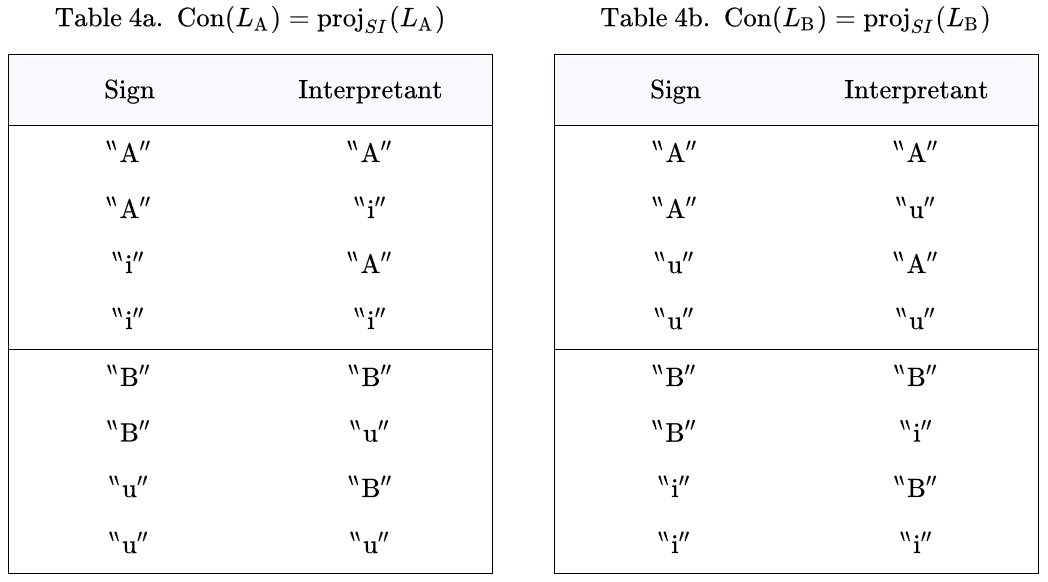
and  will serve to illustrate their use and utility.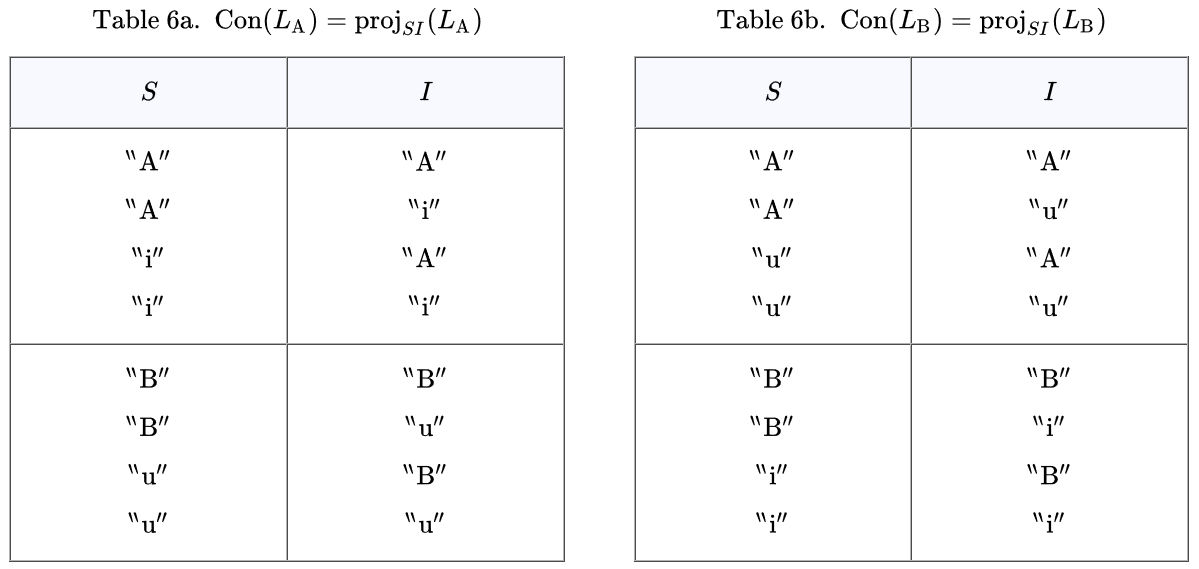
 yields the following semiotic equations.
![\begin{matrix} [ {}^{\backprime\backprime} \mathrm{A} {}^{\prime\prime} ]_{L_\mathrm{A}} & = & [ {}^{\backprime\backprime} \mathrm{i} {}^{\prime\prime} ]_{L_\mathrm{A}} \\[6pt] [ {}^{\backprime\backprime} \mathrm{B} {}^{\prime\prime} ]_{L_\mathrm{A}} & = & [ {}^{\backprime\backprime} \mathrm{u} {}^{\prime\prime} ]_{L_\mathrm{A}} \end{matrix}](https://s0.wp.com/latex.php?latex=%5Cbegin%7Bmatrix%7D++%5B+%7B%7D%5E%7B%5Cbackprime%5Cbackprime%7D+%5Cmathrm%7BA%7D+%7B%7D%5E%7B%5Cprime%5Cprime%7D+%5D_%7BL_%5Cmathrm%7BA%7D%7D++%26+%3D+%26++%5B+%7B%7D%5E%7B%5Cbackprime%5Cbackprime%7D+%5Cmathrm%7Bi%7D+%7B%7D%5E%7B%5Cprime%5Cprime%7D+%5D_%7BL_%5Cmathrm%7BA%7D%7D++%5C%5C%5B6pt%5D++%5B+%7B%7D%5E%7B%5Cbackprime%5Cbackprime%7D+%5Cmathrm%7BB%7D+%7B%7D%5E%7B%5Cprime%5Cprime%7D+%5D_%7BL_%5Cmathrm%7BA%7D%7D++%26+%3D+%26++%5B+%7B%7D%5E%7B%5Cbackprime%5Cbackprime%7D+%5Cmathrm%7Bu%7D+%7B%7D%5E%7B%5Cprime%5Cprime%7D+%5D_%7BL_%5Cmathrm%7BA%7D%7D++%5Cend%7Bmatrix%7D&bg=ffffff&fg=000000&s=0&c=20201002)
![\begin{matrix} {}^{\backprime\backprime} \mathrm{A} {}^{\prime\prime} & =_{L_\mathrm{A}} & {}^{\backprime\backprime} \mathrm{i} {}^{\prime\prime} \\[6pt] {}^{\backprime\backprime} \mathrm{B} {}^{\prime\prime} & =_{L_\mathrm{A}} & {}^{\backprime\backprime} \mathrm{u} {}^{\prime\prime} \end{matrix}](https://s0.wp.com/latex.php?latex=%5Cbegin%7Bmatrix%7D++%7B%7D%5E%7B%5Cbackprime%5Cbackprime%7D+%5Cmathrm%7BA%7D+%7B%7D%5E%7B%5Cprime%5Cprime%7D++%26+%3D_%7BL_%5Cmathrm%7BA%7D%7D+%26++%7B%7D%5E%7B%5Cbackprime%5Cbackprime%7D+%5Cmathrm%7Bi%7D+%7B%7D%5E%7B%5Cprime%5Cprime%7D++%5C%5C%5B6pt%5D++%7B%7D%5E%7B%5Cbackprime%5Cbackprime%7D+%5Cmathrm%7BB%7D+%7B%7D%5E%7B%5Cprime%5Cprime%7D++%26+%3D_%7BL_%5Cmathrm%7BA%7D%7D+%26++%7B%7D%5E%7B%5Cbackprime%5Cbackprime%7D+%5Cmathrm%7Bu%7D+%7B%7D%5E%7B%5Cprime%5Cprime%7D++%5Cend%7Bmatrix%7D&bg=ffffff&fg=000000&s=0&c=20201002)

 yields the following semiotic equations.
![\begin{matrix} [ {}^{\backprime\backprime} \mathrm{A} {}^{\prime\prime} ]_{L_\mathrm{B}} & = & [ {}^{\backprime\backprime} \mathrm{u} {}^{\prime\prime} ]_{L_\mathrm{B}} \\[6pt] [ {}^{\backprime\backprime} \mathrm{B} {}^{\prime\prime} ]_{L_\mathrm{B}} & = & [ {}^{\backprime\backprime} \mathrm{i} {}^{\prime\prime} ]_{L_\mathrm{B}} \end{matrix}](https://s0.wp.com/latex.php?latex=%5Cbegin%7Bmatrix%7D++%5B+%7B%7D%5E%7B%5Cbackprime%5Cbackprime%7D+%5Cmathrm%7BA%7D+%7B%7D%5E%7B%5Cprime%5Cprime%7D+%5D_%7BL_%5Cmathrm%7BB%7D%7D++%26+%3D+%26++%5B+%7B%7D%5E%7B%5Cbackprime%5Cbackprime%7D+%5Cmathrm%7Bu%7D+%7B%7D%5E%7B%5Cprime%5Cprime%7D+%5D_%7BL_%5Cmathrm%7BB%7D%7D++%5C%5C%5B6pt%5D++%5B+%7B%7D%5E%7B%5Cbackprime%5Cbackprime%7D+%5Cmathrm%7BB%7D+%7B%7D%5E%7B%5Cprime%5Cprime%7D+%5D_%7BL_%5Cmathrm%7BB%7D%7D++%26+%3D+%26++%5B+%7B%7D%5E%7B%5Cbackprime%5Cbackprime%7D+%5Cmathrm%7Bi%7D+%7B%7D%5E%7B%5Cprime%5Cprime%7D+%5D_%7BL_%5Cmathrm%7BB%7D%7D++%5Cend%7Bmatrix%7D&bg=ffffff&fg=000000&s=0&c=20201002)
![\begin{matrix} {}^{\backprime\backprime} \mathrm{A} {}^{\prime\prime} & =_{L_\mathrm{B}} & {}^{\backprime\backprime} \mathrm{u} {}^{\prime\prime} \\[6pt] {}^{\backprime\backprime} \mathrm{B} {}^{\prime\prime} & =_{L_\mathrm{B}} & {}^{\backprime\backprime} \mathrm{i} {}^{\prime\prime} \end{matrix}](https://s0.wp.com/latex.php?latex=%5Cbegin%7Bmatrix%7D++%7B%7D%5E%7B%5Cbackprime%5Cbackprime%7D+%5Cmathrm%7BA%7D+%7B%7D%5E%7B%5Cprime%5Cprime%7D++%26+%3D_%7BL_%5Cmathrm%7BB%7D%7D+%26++%7B%7D%5E%7B%5Cbackprime%5Cbackprime%7D+%5Cmathrm%7Bu%7D+%7B%7D%5E%7B%5Cprime%5Cprime%7D++%5C%5C%5B6pt%5D++%7B%7D%5E%7B%5Cbackprime%5Cbackprime%7D+%5Cmathrm%7BB%7D+%7B%7D%5E%7B%5Cprime%5Cprime%7D++%26+%3D_%7BL_%5Cmathrm%7BB%7D%7D+%26++%7B%7D%5E%7B%5Cbackprime%5Cbackprime%7D+%5Cmathrm%7Bi%7D+%7B%7D%5E%7B%5Cprime%5Cprime%7D++%5Cend%7Bmatrix%7D&bg=ffffff&fg=000000&s=0&c=20201002)



 and
and  have many interesting properties over and above those possessed by sign relations in general. Some of these properties have to do with the relation between signs and their interpretant signs, as reflected in the projections of
  -plane, notated as
  and
and  respectively. The dyadic relations on
  induced by these projections are also referred to as the connotative components of the corresponding sign relations, notated as
  and
and  respectively. Tables 6a and 6b show the corresponding connotative components.
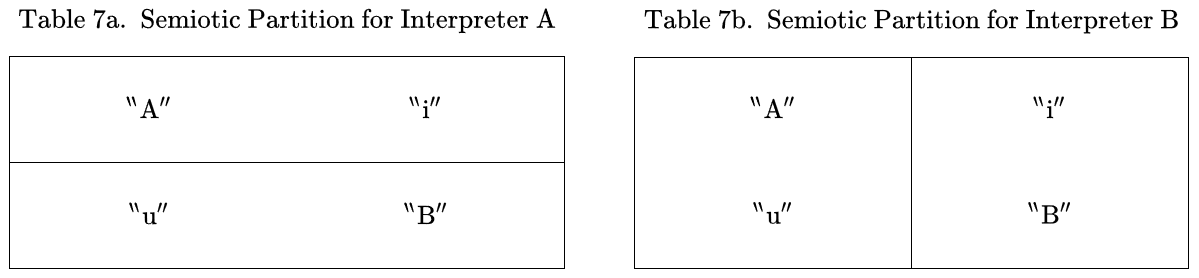
 form a pair of equivalence relations on their common syntactic domain
  This type of equivalence relation is called a semiotic equivalence relation (SER) because it equates signs having the same meaning to some interpreter.
 partitions the collection of signs into semiotic equivalence classes. This makes for a strong form of representation in that the structure of the interpreters’ common object domain
  is reflected or reconstructed, part for part, in the structure of each one’s semiotic partition of the syntactic domain
  But it needs to be observed that the semiotic partitions for interpreters
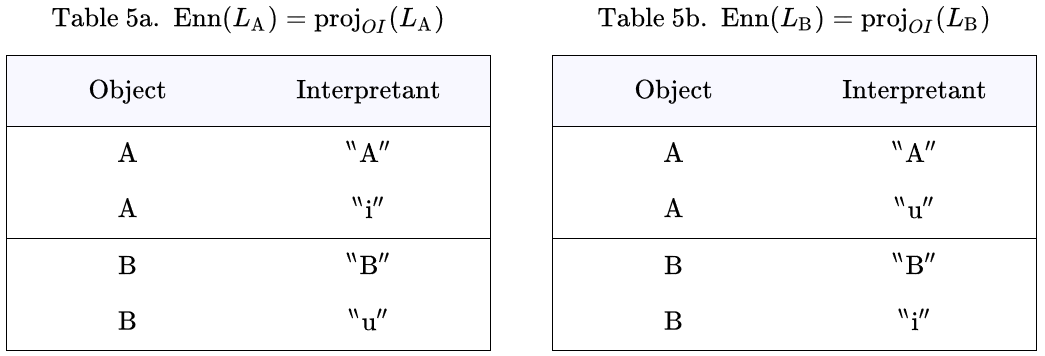
  Information about the ennotative aspect of meaning is obtained from
  The ennotative component of a sign relation

 and
and  is defined as follows.
 is echoed unchanged in
  and all the data of
  is echoed unchanged in
 respectively. The rows of each Table list the ordered pairs
  in the corresponding projections,
 is to say
  “maps” or “sends” an element of
  A concrete verb may quicken the intuition but the downside is its power to evoke excess meanings beyond the abstract intention. It is only as we become more familiar with the formal subject matter of sign relations that we can decide what kind of “bringing” and “creating” and “determining” is really going on in all that sign, object, interpretant relating, whether at the abstract level or in a given application.
 of sentences is called a theory. A theory is said to be closed iff every consequence of
  A set
A set  of sentences is said to be a set of axioms for a theory
  of all consequences of
  Information about the connotative aspect of meaning is obtained from

 and
and  is defined as follows.
 in the corresponding projections,